

A COA segment, or Chart of Accounts segment, is a discrete component within a multi-part account code structure that categorizes financial transactions according to specific organizational dimensions. In procurement, COA segments enable precise coding of purchases to track spending by cost center, department, project, location, or other business attributes. Each segment serves as a building block in the complete account string, allowing organizations to analyze procurement activity across multiple dimensions simultaneously while maintaining consistent financial reporting standards.
Why the Charts of Accounts (COA) Segment Matters in Procurement
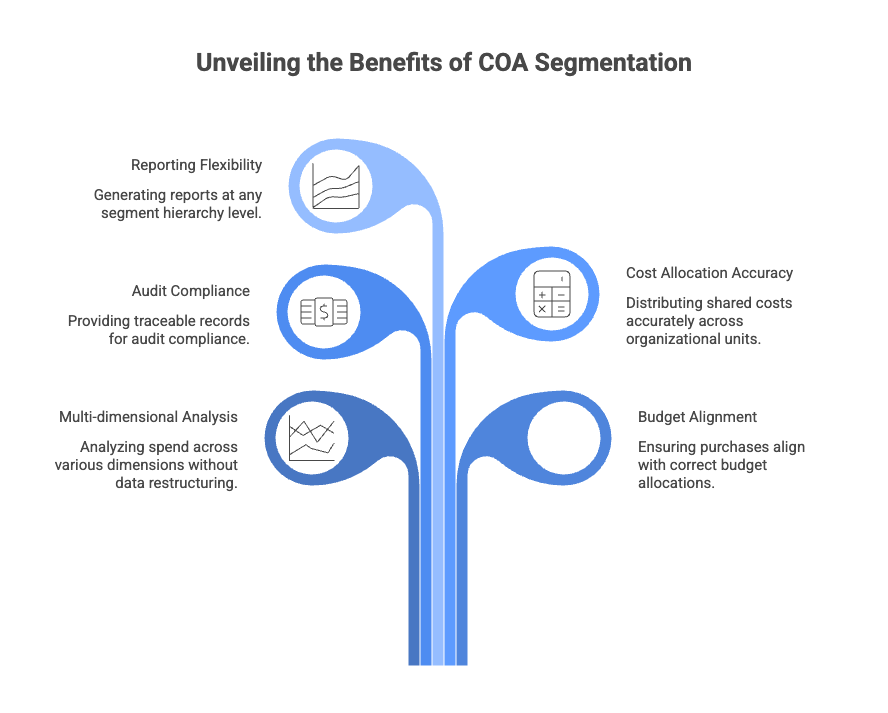
Accurate COA segment assignment directly impacts financial reporting, budget management, and spend analytics. When procurement transactions carry correct segment values, finance teams can generate reliable cost reports, monitor departmental budgets, and identify spending patterns across the organization. Incorrect or missing segment data creates reconciliation problems, obscures cost visibility, and complicates audit trails. Procurement organizations depend on proper segment coding to demonstrate budget compliance, allocate costs fairly across business units, and support strategic sourcing decisions with accurate spend data. Without effective segment management, organizations lose the ability to answer fundamental questions about where money is being spent.
The Core Process of the COA Segment
The COA segment lifecycle begins with structure definition, where finance and procurement collaborate to determine which dimensions require tracking and how segments should be organized within the account string. This foundational work establishes the analytical framework for all subsequent procurement reporting.
Once defined, segment values must be created and maintained in the master data. This includes establishing valid codes for each dimension, such as department numbers, project identifiers, or location codes. Value hierarchies may also be configured to support roll-up reporting at summary levels.
During transaction processing, requisitioners and buyers assign appropriate segment values to purchase requests and orders. System validations enforce that selected combinations are valid and that required segments contain values before transactions can proceed.
After transactions post, segment data feeds financial consolidation and reporting. Procurement analytics leverage segment dimensions to slice spend data and identify optimization opportunities across different organizational views and reporting hierarchies.
Core Components of COA) Segment
Segment definitions establish the purpose and structure of each account code component. Common segments include company, cost center, department, project, and natural account. Each segment has defined length, format, and validation requirements that must be consistently applied.
Segment values represent the valid codes within each dimension. A department segment might contain values like 1000 for Finance, 2000 for Operations, and 3000 for Marketing. These values require ongoing maintenance as organizational structures evolve and new requirements emerge.
Combination rules govern which segment values can be used together in valid account strings. Not all segments work with all values—certain projects may only be valid for specific departments, or certain cost centers may be restricted to particular locations based on business rules.
Default segment logic automates coding by pre-populating segment values based on user profiles, item categories, or supplier attributes, reducing manual entry burden and improving coding consistency across high transaction volumes.
Key Benefits of the Charts of Accounts (COA) Segment
Common Pitfalls of the Charts of Accounts (COA) Segment
- Over-segmentation: Too many segments or overly granular values create coding complexity that frustrates users and increases entry errors significantly.
- Inconsistent value maintenance: Failing to deactivate obsolete segment values allows continued use of invalid codes that corrupt reporting.
- Missing combination validation: Without proper rules, users can create invalid account strings that fail during financial processing or posting.
- No default logic: Requiring manual entry for every segment slows requisition processing and introduces inconsistent coding patterns.
How COA Segments Support Procurement Decisions
- Category spend by department: Segment data reveals which departments drive spending in specific categories, informing sourcing strategies and stakeholder engagement.
- Project cost tracking: Project segments enable accurate cost accumulation for capital projects, grants, or strategic initiatives requiring separate reporting.
- Location-based analysis: Geographic segments support regional spend comparisons, localized supplier strategy development, and distribution cost analysis.
- Variance investigation: When budgets show variances, segment drill-downs identify specific areas requiring attention and corrective action.
- Consolidation support: Company segments enable multi-entity organizations to consolidate procurement data while maintaining legal entity separation for statutory reporting.
KPIs of COA Segments
| Dimension | Sample KPIs |
| Coding Accuracy | Percentage of transactions with complete, valid segment values |
| Default Utilization | Proportion of segment values auto-populated versus manually entered |
| Error Rate | Segment validation failures per period, transactions requiring recoding |
| Maintenance | Time to add or modify segment values, obsolete values still active |
Technology Enablement
Modern procurement platforms integrate with ERP chart of accounts structures, providing real-time segment validation during requisition and order creation. Intelligent defaults based on user profiles and item attributes reduce manual coding effort while maintaining the financial accuracy required for enterprise reporting and compliance.
Key Terms in COA Segments
- Account String: The complete multi-segment code assigned to a financial transaction for classification and reporting.
- Natural Account: The segment identifying the type of expense or revenue, such as travel, supplies, or consulting services.
- Cost Center: A segment representing an organizational unit responsible for managing and controlling costs.
- Segment Hierarchy: The parent-child relationships enabling roll-up reporting within a segment dimension.
- Combination Rule: Logic defining which segment values can validly appear together in an account string.
- Flexfield: A configurable segment structure used in some ERP systems for chart of accounts design and maintenance.
FAQs
Q1. What is a COA segment?
A COA segment is one component of a multi-part account code that categorizes transactions by a specific dimension like department or project.
Q2. How many segments should we have?
Most organizations use four to eight segments. More creates complexity; fewer may limit analytical and reporting capability.
Q3. Who maintains segment values?
Finance typically owns the chart of accounts, though procurement may request new values for specific tracking and reporting needs.
Q4. Can segments change after posting?
Generally no—changing posted segment values requires journal entries or corrections that maintain complete audit trails.
Q5. What happens with invalid combinations?
Systems should reject invalid combinations during transaction entry, preventing downstream processing failures and data quality issues.
Q5. How do segments differ from tags?
Segments are structured, validated components of the account code. Tags are often informal labels without the same financial system integration.
References
Explore Zycus resources to learn more about the Charts of Accounts (COA) Segment: