



An Invitation to Tender (ITT) is a formal procurement document issued to pre-qualified or selected suppliers, inviting them to submit a binding competitive bid for a defined requirement. Unlike an RFP, which may invite proposals on how a requirement could be met, an ITT provides complete specifications and asks suppliers to bid on price and compliance against those fixed terms. The ITT process is designed to produce directly comparable, commercially binding responses that can be evaluated objectively to identify the winning bidder.
Why Invitation to Tender (ITT) Matters in Procurement
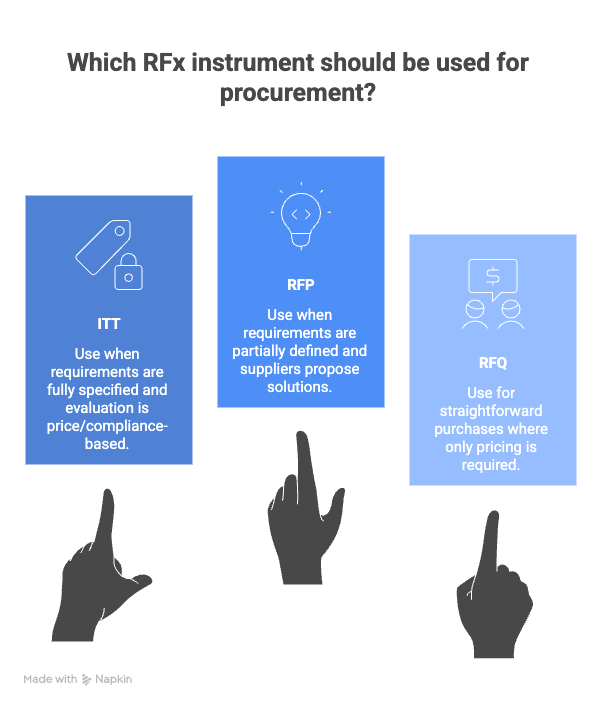
The ITT is the most rigorous of the competitive sourcing instruments. It is used when requirements are fully specified and the primary evaluation dimension is price and compliance rather than creative solution design. For procurement teams, the ITT process creates the strongest commercial outcomes when requirements are well-defined — it generates direct, binding bids from multiple suppliers, enables objective evaluation, and produces a defensible award decision with a clear audit trail. It is the standard approach for public sector procurement and is widely used in the private sector for high-value, clearly scoped categories.
The Core Process of Invitation to Tender (ITT)
- Specification Development: The process begins with a complete and precise specification of the requirement. All suppliers must be bidding on exactly the same scope — gaps or ambiguities produce non-comparable responses that undermine evaluation.
- Pre-Qualification and Supplier Selection: In many ITT processes, suppliers are pre-qualified through a Prior Information Notice or a separate Pre-Qualification Questionnaire before being invited to tender. Pre-qualification filters out suppliers that do not meet minimum capability, financial, or compliance thresholds, ensuring only qualified parties participate in the full tender.
- Tender Issuance and Response: The ITT document is issued to selected suppliers with a defined submission deadline. The document includes the full specification, pricing schedule, evaluation criteria and weightings, contract terms, and instructions for submission. Suppliers prepare and submit binding bids within the timeframe.
- Evaluation and Award: Submitted tenders are scored against the published criteria and methodology. The highest-scoring compliant tender is awarded the contract, with the evaluation documented to support challenge or audit.
Core Components of Invitation to Tender (ITT)
- Technical specification is the heart of the ITT. It defines exactly what is required — product standards, service levels, delivery requirements, and compliance obligations. A specification that is too vague produces non-comparable bids; one that is over-specified may restrict competition unnecessarily.
- The pricing schedule provides a structured format in which all suppliers price the same items or services in the same way, enabling direct comparison. Unstructured pricing requests make evaluation harder and create scope for suppliers to obscure true costs.
- Evaluation criteria and methodology are published in the ITT document and applied consistently across all submissions. Procurement must adhere to the stated methodology — changing evaluation criteria after tenders are received invalidates the process.
- Tender conditions and contract terms set out the obligations, warranties, and legal framework that will apply to the awarded contract. Suppliers accept these terms by submitting a compliant tender unless they formally raise exceptions.
Key Benefits of Invitation to Tender (ITT)
- Generates directly comparable, binding bids from multiple suppliers, enabling objective price and quality evaluation.
- Creates a documented, defensible award decision that can withstand challenge, audit, or regulatory scrutiny.
- Establishes clear contract terms from the outset, reducing the time and cost of post-award negotiation.
- Supports public sector compliance with regulations that mandate competitive tendering above defined value thresholds.
Common Pitfalls of Invitation to Tender (ITT)
- Issuing an ITT before the specification is complete: An incomplete specification forces suppliers to make assumptions, producing non-comparable bids and creating disputes about what was actually tendered.
- Changing evaluation criteria after tenders are received: Adjusting criteria or weightings post-submission is a fundamental process breach that exposes the organization to challenge and can invalidate the entire procurement.
- Setting an unrealistic submission timeline: Insufficient time for suppliers to prepare quality responses reduces competition quality and may deter capable bidders from participating.
- Failing to document the evaluation process: Undocumented scoring decisions are difficult to defend in challenges. Every evaluation judgment should be recorded with specific reference to the submitted tender content.
KPIs of Invitation to Tender (ITT)
| Dimension | Sample KPIs |
| Process Quality | Specification completeness score, number of clarification requests received |
| Competition | Average number of compliant bids per ITT, bid withdrawal rate |
| Timeline | ITT cycle time from issuance to award, % completed within planned schedule |
| Outcome | Price achieved vs. pre-tender estimate, savings vs. incumbent or benchmark |
Key Terms in Invitation to Tender (ITT)
- Pre-Qualification Questionnaire (PQQ): A document issued before the ITT to assess whether suppliers meet minimum capability and compliance thresholds to participate in the full tender.
- Binding Bid: A tender submission that constitutes a firm commercial offer, legally binding on the supplier for the validity period stated in the ITT.
- Evaluation Criteria: The dimensions and weightings published in the ITT against which all tender submissions are assessed.
- Most Economically Advantageous Tender (MEAT): An evaluation approach that considers both price and quality, as distinct from lowest-price-only evaluation.
- Tender Validity Period: The period during which a submitted tender remains binding on the supplier, allowing procurement time to complete evaluation and award.
Technology Enablement
Source-to-Pay platforms support the ITT process through electronic tendering modules that manage document issuance, supplier submission portals, automated evaluation scoring tools, and audit trail generation. These capabilities reduce administrative overhead, improve response quality, and create the documented evidence base needed to support award decisions and respond to challenges.
FAQs
Q1. What is an Invitation to Tender?
A formal document issued to selected suppliers inviting them to submit binding competitive bids for a fully specified requirement.
Q2. How is an ITT different from an RFP?
An ITT is used when requirements are fully specified and suppliers bid on price and compliance. An RFP is used when suppliers are asked to propose solutions to a partially defined requirement.
Q3. When should procurement use an ITT?
When the specification is complete, the evaluation is primarily price and compliance-based, and a binding, directly comparable bid is required.
Q4. What happens if a supplier submits a non-compliant tender?
Non-compliant tenders are typically disqualified or scored down on compliance criteria, depending on the severity of the non-compliance and the ITT’s stated rules.
Q5. Can evaluation criteria be changed after the ITT is issued?
No. Changing criteria after issuance — and particularly after receipt of bids — is a fundamental process breach that can invalidate the procurement.
Q6. How long should a tender validity period be?
Long enough for procurement to complete evaluation and award, typically four to twelve weeks. Complex evaluations may require longer validity periods.
References
For further insights into these processes, explore Zycus’ dedicated resources related to Invitation to Tender (ITT):
- [P2P Webinar] The P2P Payoff: Mining untapped returns from your Procure-to-Pay
- Procurement Automation – The Hidden Key to Competitive Growth for Mid-Size Organization Procurement
- Putting the Supplier at the Heart of Procurement Thinking – Part 2
- Realising Business Value from Spend Data
- In Talks with Zycus: Crown Resorts Procurement Transformation










