


WHAT IS CONTRACT OBLIGATION MANAGEMENT?
Contract obligation management is the practice of identifying the commitments in a signed contract, assigning each to an owner, tracking them to due dates and checking they are met. It covers duties on both sides, such as deliveries, payments, reports, service levels and renewal notices, and it ensures the contract delivers the value agreed at signing.
WHY IT MATTERS IN PROCUREMENT
A contract only creates value if its terms are carried out. Many contracts sit in a repository after signing, while their obligations are tracked by memory or spreadsheets. Missed notice dates, unclaimed service credits, late reports and unmet volume commitments then cost money, and nobody sees the loss until an audit or dispute.
Obligation management links the legal text to day-to-day work. It makes sure that someone owns each duty, that deadlines are visible and that performance is checked against the contract. It also helps the buyer meet its own duties, such as paying on time or giving notice, so that it does not breach the contract or lose rights.
THE CORE PROCESS / LIFECYCLE
- Identify Obligations. The team reads the contract and extracts each commitment, with its trigger, due date, responsible party and consequence of failure.
- Assign Owners. Each obligation is given a named owner in procurement, the business or legal, so no duty is left without a person responsible.
- Schedule and Alert. Due dates and recurring duties are entered into a tracker or contract system with reminders ahead of each deadline.
- Monitor Performance. Owners collect evidence, such as delivery records, service reports and invoices, and compare it with the contract terms.
- Act on Gaps. Missed obligations are escalated. The buyer claims credits or remedies, issues notices, and agrees corrective action with the supplier.
- Report and Close. Results feed performance reviews, renewal decisions and lessons for future contracts, and obligations are closed when they are met or the contract ends.
CORE COMPONENTS
- Obligation register is the list of all commitments with owner, date and status.
- Ownership assigns each duty to a person.
- Triggers and dates set when an obligation starts and when it is due.
- Evidence is the proof that a duty was met.
- Remedies are the credits, notices or penalties the contract provides if a duty is missed.
- Reporting shows overdue and at-risk items to management.
- System support is a contract or obligation tool that holds the register and sends alerts.
KEY BENEFITS
Tracking obligations protects value. Buyers claim the service credits, rebates and price adjustments they are owed, and avoid auto-renewals they did not intend. Deadlines for notices, audits and reviews are met on time, which preserves negotiating options.
It also lowers risk. The company can show that it met its own duties and that it checked supplier compliance, which matters in a dispute or an audit. Clear ownership and visible status improve working relationships, because both sides know what is due. Over time, the register shows which clauses cause problems, which informs better drafting.
COMMON PITFALLS
- Treating signature as the finish line. Without a handover to the people who run the contract, obligations are forgotten.
- Tracking only supplier duties. The buyer’s own obligations, such as payment terms and notice periods, also create risk if missed.
- Extracting obligations once and never updating. Amendments and changes alter the duties, so the register must follow them.
- No owner for each item. Shared responsibility means that nobody acts when a date passes.
COMMON TYPES OF OBLIGATION
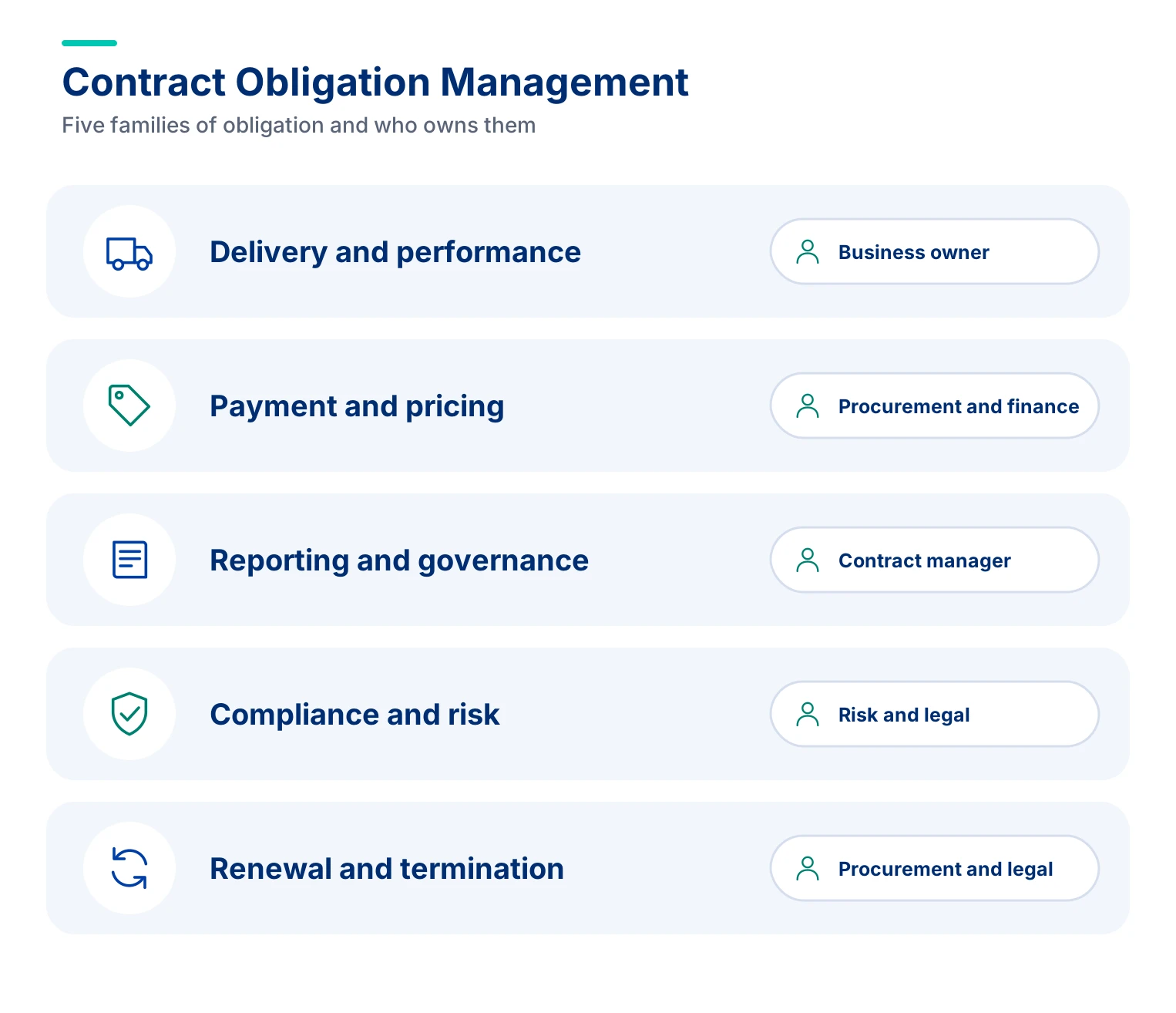
Most contracts hold the same families of obligation. The owner is usually the function closest to the work.
| Type | Examples | Typical owner |
| Delivery and performance | Delivery dates, acceptance, service levels | Business owner |
| Payment and pricing | Payment terms, price reviews, rebates, credits | Procurement and finance |
| Reporting and governance | Service reports, business reviews, audits | Contract manager |
| Compliance and risk | Insurance, certifications, data protection, security | Risk and legal |
| Renewal and termination | Notice windows, renewal dates, exit support | Procurement and legal |
KPIs
| Dimension | Sample KPIs |
| Coverage | Contracts with obligations extracted; obligations with a named owner |
| Timeliness | Obligations completed on time; overdue items |
| Value | Service credits and rebates claimed; value recovered |
| Risk | Missed notice dates; unintended auto-renewals |
KEY TERMS
- Obligation. A duty that a party to a contract must carry out.
- Obligation Register. A list of all contract commitments with owners, dates and status.
- Service Credit. A reduction in charges when a supplier misses a service level.
- Notice Period. The minimum time before a date, such as renewal or termination, by which notice must be given.
- Contract Abstraction. Extracting key data and terms from a contract into a structured form.
- Contract Lifecycle Management. The management of a contract from request to renewal or exit.
- Remedy. The action a party can take when the other side breaches the contract.
- Hand-Over. The transfer of a signed contract to the people who manage it.
FAQS
Q1. What is contract obligation management in procurement?
Contract obligation management is the process of identifying, assigning, tracking, and fulfilling commitments established in signed contracts. These obligations include supplier deliveries, payment terms, service levels, compliance requirements, and renewal notices. Procurement teams use obligation management to ensure both buyers and suppliers meet contractual commitments, prevent financial losses, reduce compliance risks, and maximize the value of negotiated agreements throughout the contract lifecycle.
Q2. What are the most common types of contractual obligations?
Common contractual obligations include delivery schedules, payment deadlines, service level agreements (SLAs), performance reporting, regulatory compliance, and contract renewal requirements. Suppliers may be responsible for meeting quality standards, maintaining certifications, and delivering services on time. Buyers must fulfill payment commitments, provide required notices, and meet agreed purchasing volumes. Tracking these obligations helps organizations avoid breaches, recover service credits, and maintain supplier accountability.
Q3. How does the contract obligation management process work?
The contract obligation management process begins by extracting commitments from signed agreements and assigning responsible owners. Each obligation is recorded with its deadline, triggering conditions, and compliance requirements. Teams then establish automated reminders, monitor performance, and collect supporting evidence. Missed obligations are escalated for corrective action or contractual remedies. Regular reviews help procurement teams track compliance, protect negotiated value, and improve supplier performance.
Q4. What is the difference between contract management and contract obligation management?
Contract management oversees the entire contract lifecycle, including drafting, negotiation, approval, execution, renewal, and termination. Contract obligation management focuses specifically on tracking and fulfilling commitments after a contract is signed. While contract lifecycle management (CLM) ensures agreements are properly administered, obligation management ensures contractual promises translate into measurable outcomes. Both processes work together to reduce risks, improve compliance, and protect contract value.
Q5. Who is responsible for managing contractual obligations?
Contractual obligations are typically managed collaboratively by procurement, legal, finance, contract managers, and business stakeholders. Each obligation should have a designated owner responsible for monitoring deadlines and verifying completion. Procurement oversees supplier commitments, finance manages payment obligations, and legal supports compliance and contractual remedies. Clear ownership and centralized obligation tracking prevent missed deadlines, strengthen accountability, and improve contract performance.
Q6. What happens when a supplier fails to meet contractual obligations?
When a supplier fails to meet contractual obligations, the buyer should document the breach, assess its impact, and review available remedies. Depending on contract terms, these may include service credits, financial penalties, corrective action plans, or termination rights. Procurement and contract management teams should escalate unresolved issues and monitor corrective actions. Early identification of missed commitments helps minimize operational disruption, recover contractual value, and protect business interests.
Q7. How does contract obligation management software improve compliance and performance?
Contract obligation management software centralizes contractual commitments, assigns ownership, tracks deadlines, and sends automated reminders. It helps procurement teams monitor supplier performance, maintain compliance evidence, and identify overdue obligations. Integration with contract lifecycle management systems can improve visibility into service levels, payment terms, and renewal dates. Automated tracking reduces manual errors, prevents missed contractual commitments, and supports better supplier accountability and contract value realization.