



Global treasury management is the organizational function responsible for managing an organization’s liquidity, foreign exchange exposure, financial risk, and cash flow across multiple currencies and geographies. It encompasses cash pooling, currency hedging, debt management, payment processing, and bank relationship management at a global scale. For procurement, treasury is a critical partner function — foreign currency exposure from international supplier contracts, payment term optimization for working capital, supply chain finance programmes, and cross-border payment execution are all areas where procurement strategy intersects directly with treasury operations.
Why Global Treasury Management Matters in Procurement
Procurement decisions that involve international suppliers, commodity-linked pricing, or extended payment terms create financial exposures that treasury must manage. A sourcing decision to consolidate spend with an offshore supplier in a volatile currency creates foreign exchange risk. A move to extend supplier payment terms improves buyer working capital but may harm supplier liquidity. Supply chain finance programmes can resolve this tension — but only when procurement and treasury design them together. Procurement that operates without treasury alignment creates financial risks it cannot see and misses working capital opportunities it cannot capture alone.
The Core Process of Global Treasury Management
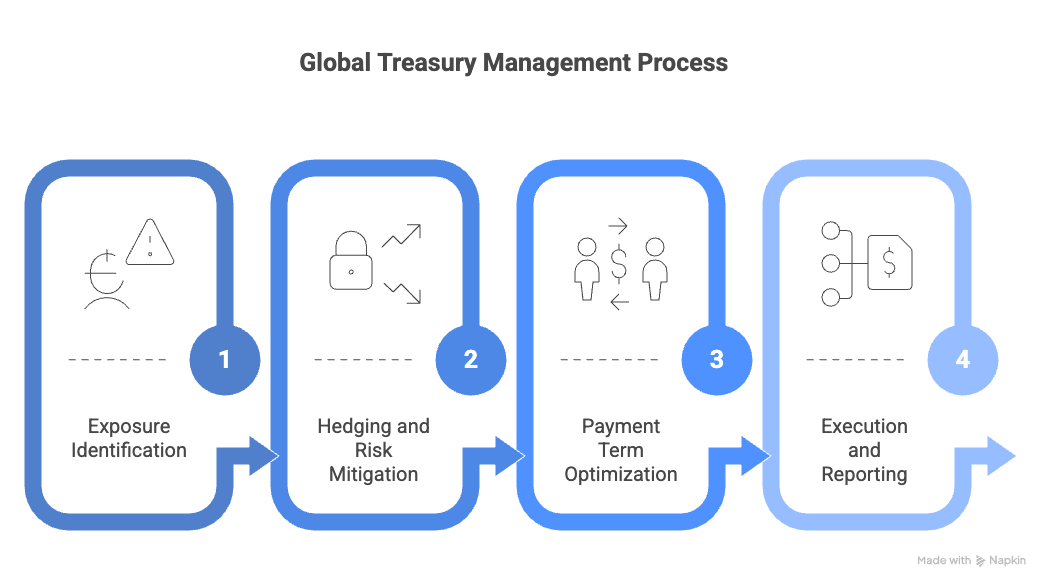
- Exposure Identification: Treasury and procurement jointly identify the foreign currency, commodity price, and payment term exposures created by the procurement portfolio. International supplier contracts denominated in foreign currencies, commodity-indexed pricing agreements, and extended payment terms all generate treasury-relevant exposures that must be assessed before hedging or financing strategies are designed.
- Hedging and Risk Mitigation: Treasury develops hedging strategies for the material currency and commodity exposures identified — using forward contracts, options, or natural hedging approaches to limit the financial impact of market movements. Procurement contributes the volume and timing data that makes hedging instruments effective.
- Payment Term and Working Capital Optimization: Procurement and treasury collaborate to optimize payment terms across the supply base — balancing the working capital benefit of extended terms against the cost to suppliers, and identifying where supply chain finance programmes can extend buyer payment terms without harming supplier cash flow.
- Execution and Reporting: Cross-border payments to international suppliers are executed through treasury-managed banking arrangements. Currency conversion, payment routing, and compliance with international payment regulations are treasury responsibilities that procurement must coordinate with to ensure supplier payment accuracy and timeliness.
Core Components of Global Treasury Management
- Foreign exchange management addresses the currency risk created by procurement contracts denominated in currencies other than the organization’s functional currency. Hedging instruments convert uncertain future exchange rates into known costs, protecting procurement budgets from adverse market movements.
- Supply chain finance provides financing mechanisms — dynamic discounting, reverse factoring, approved payables finance — that allow buyers to extend payment terms while ensuring suppliers receive early payment at a financing cost below their own borrowing rate.
- Cash flow forecasting requires procurement to provide accurate payment schedule data — when and in what currency invoices will be paid — so treasury can position liquidity and manage currency positions effectively.
Key Benefits of Global Treasury Management
- Protects procurement budgets from foreign exchange volatility by ensuring currency exposures are identified and hedged before market movements erode negotiated savings.
- Enables working capital optimization through payment term extension and supply chain finance programmes that benefit both buyer and supplier.
- Reduces the total cost of international supply by coordinating currency hedging, payment routing, and financing structures to minimize financial transaction costs.
- Strengthens supplier relationships by providing early payment options that reduce their financing costs without requiring the buyer to accelerate cash outflow.
Common Pitfalls of Global Treasury Management
- Procurement making currency commitments without treasury involvement. Contracts in foreign currencies create hedging requirements treasury must plan for. Late disclosure of currency exposure results in unhedged positions at unfavorable rates.
- Treating payment terms as a procurement-only decision. Payment term changes have working capital implications that finance and treasury must assess. Procurement should not change terms without cross-functional alignment.
- Failing to provide accurate payment forecasts. Treasury hedging and liquidity planning depends on reliable payment forecast data from procurement. Late or inaccurate forecasts create downstream financial exposure.
Where Procurement and Treasury Intersect
- Currency denomination in contracts: The choice of contract currency determines whether the buyer or supplier bears exchange rate risk — a procurement decision with direct treasury implications.
- Dynamic discounting: A treasury-funded programme in which buyers offer suppliers early payment in exchange for a discount — generating a return for the buyer while improving supplier cash flow.
- Payment term strategy: The organization-wide payment term policy balances AP working capital against supplier financial health and supply chain finance programme design.
KPIs of Global Treasury Management
| Dimension | Sample KPIs |
| FX Management | Currency hedge coverage ratio, FX gain/loss vs. hedged position |
| Working Capital | Days payable outstanding, supply chain finance programme utilisation |
| Payment Performance | % of international payments executed on time, payment error rate |
| Supply Chain Finance | Supplier early payment uptake rate, buyer financing cost vs. alternative |
Key Terms in Global Treasury Management
- Foreign Exchange Hedge: A financial instrument — forward contract, option, or swap — used to fix or limit the cost of a future foreign currency payment.
- Supply Chain Finance (SCF): A set of financing solutions that optimize cash flow by allowing buyers to extend payment terms while enabling suppliers to receive early payment.
- Dynamic Discounting: A buyer-funded early payment programme in which suppliers can request accelerated payment in exchange for an agreed discount.
- Days Payable Outstanding (DPO): The average number of days taken to pay supplier invoices — a key measure of accounts payable working capital management.
- Natural Hedge: A matching of currency inflows and outflows that reduces net foreign exchange exposure without using financial instruments.
Technology Enablement
Treasury management systems and procurement platforms increasingly integrate to share payment forecast data, manage supply chain finance programme enrolment, and provide visibility into currency exposure across the active supplier contract portfolio. These integrations ensure that treasury has the procurement data it needs to hedge effectively and that procurement has visibility into the working capital implications of its sourcing decisions.
FAQs
Q1.What is global treasury management?
The organizational function managing liquidity, foreign exchange exposure, financial risk, and cash flow across multiple currencies and geographies.
Q2. Why does treasury matter for procurement?
Because international sourcing decisions create currency and payment exposures that treasury manages. Procurement without treasury alignment generates financial risks and misses working capital opportunities.
Q3. What is supply chain finance and how does procurement benefit?
SCF allows buyers to extend payment terms while ensuring suppliers receive early payment through bank-funded financing. Procurement benefits through improved working capital without damaging supplier relationships.
Q4. What is dynamic discounting?
A buyer-funded early payment programme where suppliers request accelerated payment in exchange for a small discount, generating a return for the buyer funded from its own cash reserves.
Q5. How should procurement involve treasury in supplier contract negotiations?
By sharing currency denomination choices, payment term proposals, and commodity pricing structures early enough for treasury to assess the hedging and working capital implications before contracts are signed.
Q6. What is days payable outstanding?
The average number of days the organization takes to pay suppliers — a measure of AP working capital that procurement influences through payment term negotiations.
References
For further insights into these processes, explore Zycus’ dedicated resources related to Global Treasury Management:
- Sustainable Spend Strategies for a Resilient Future: A Procurement Leader’s Guide
- The Foolproof Guide to Implementing an AP Automation Solution for Maximum ROI
- 6 Key Procurement Organizational Structures You Can Consider To Optimize
- A Sneak Peek Into Basics Of Procure-To-Pay
- Emirates NBD Shares Strategic Procurement Insights from Jeddah with Zycus










