



Budget planning in procurement is the process of estimating, allocating, and managing financial resources required to fulfill organizational procurement needs within a defined period. It establishes how much the organization intends to spend across categories, departments, and projects, and creates the financial baseline against which actual procurement activity is measured. Effective budget planning aligns procurement strategy with organizational financial objectives.
Why Budget Planning Matters in Procurement
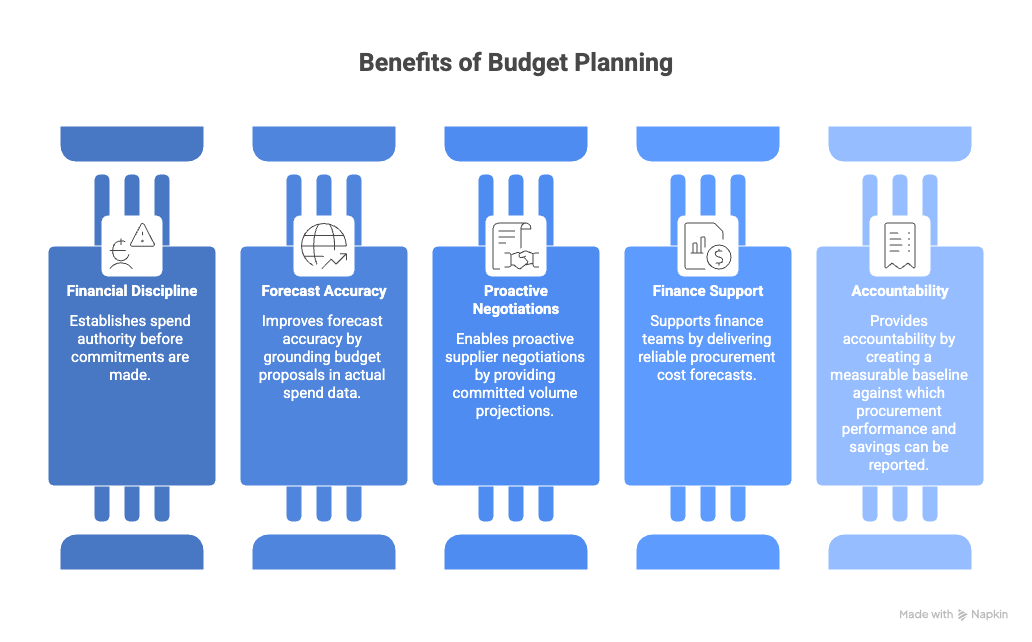
Procurement without a budget framework operates reactively. Buyers approve purchases without visibility into whether spending aligns with organizational priorities or financial constraints. Budget planning embeds procurement decisions within a financial structure that reflects what the organization can and should spend. It enables category managers to negotiate with suppliers based on committed volume, gives finance stakeholders confidence in cost forecasts, and creates the accountability mechanism that allows procurement performance to be measured accurately.
Read more: Procurement Budgeting Process: Save Your Bucks Effectively
The Core Process of Budget Planning
The process begins with a spend review. Procurement analyzes historical expenditure by category, department, and supplier to establish a baseline. This review identifies where spend occurred, whether it aligned with prior budgets, and where variances need to be explained before the next planning cycle.
With the baseline established, demand forecasting follows. Category managers work with internal stakeholders to project requirements for the upcoming period, including anticipated volumes, new projects, contract renewals, and known price movements. Budget proposals are developed incorporating demand forecasts, pricing assumptions, and inflation adjustments, then consolidated and submitted to finance for approval.
Once approved, budgets are entered into procurement and financial systems, creating the spend authority framework against which purchase orders are processed. Throughout the year, procurement monitors utilization against actuals, flags variances early, and manages reforecasting when material changes occur. At period-end, a budget-versus-actual analysis captures lessons learned and informs the next planning cycle.
Core Components of Budget Planning
Spend analytics provide the historical data foundation for budget planning. Without accurate, categorized spend data, proposals are built on estimates rather than evidence. Demand collaboration connects procurement to business units, capturing project-specific needs and avoiding budget surprises. Pricing assumptions translate volume forecasts into financial figures, factoring in contract pricing, market movements, and inflation indices. Variance management provides the in-year mechanism for maintaining budget integrity through timely escalation and reforecasting.
Common Pitfalls of Budget Planning
- Building budgets from prior-year spend without questioning assumptions: Historical spend includes inefficiencies and one-off events. Budgets that replicate the past without critical review perpetuate them.
- Underinvesting in demand collaboration: Budget proposals built without stakeholder input routinely miss project-specific requirements and generate in-year amendments.
- Failing to account for pricing volatility: Categories with commodity exposure or currency sensitivity require dynamic pricing assumptions, not static estimates.
- Treating the budget as a ceiling rather than a plan: Arbitrarily cutting procurement budgets without understanding demand implications creates operational and compliance risk.
How to Build a More Accurate Procurement Budget
- Start with clean spend data: Ensure historical spend is accurately categorized before using it as a planning baseline. Miscategorized spending leads to misallocated budgets.
- Engage stakeholders before the planning cycle closes: Business unit input must be captured early enough to influence the budget, not after approvals are finalized.
- Apply market intelligence to pricing assumptions: Use commodity indices, supplier feedback, and market research to ground pricing forecasts in current conditions.
- Build in a contingency reserve: For categories with high price volatility, a defined contingency allowance prevents budget exhaustion from expected-range fluctuations.
- Set variance thresholds and escalation triggers: Define what constitutes a material variance and establish escalation processes before issues become financial control problems.
KPIs of Budget Planning
| Dimension | Sample KPIs |
| Budget Accuracy | % variance between budgeted and actual spend by category |
| Forecast Quality | Reforecast frequency, forecast error rate |
| Compliance | % of spend within approved budget, unauthorized spend incidents |
| Savings Tracking | Procurement savings as % of budget, savings captured vs. committed |
Key Terms in Budget Planning
- Spend Baseline: The categorized historical expenditure used as the starting point for budget planning.
- Budget Variance: The difference between budgeted and actual spend, expressed in value or percentage terms.
- Reforecast: An in-year revision to the budget reflecting updated demand projections or changed pricing assumptions.
- Spend Authority: The financial limit within which a buyer or category manager can approve procurement commitments.
- Category Budget: The financial allocation assigned to a specific procurement category for a defined planning period.
- Contingency Reserve: A portion of the budget set aside to absorb unexpected costs within an acceptable range.
- Zero-Based Budgeting: A budgeting approach where all expenditure must be justified from scratch each cycle rather than from prior-year actuals.
Technology Enablement
Source-to-Pay platforms support budget planning through spend analytics that generate accurate baselines, budget management modules that track utilization in real time, and approval workflows that enforce spend authority limits. These capabilities reduce reliance on manual spreadsheet-based planning and improve visibility across the procurement organization.
FAQs
Q1. What is budget planning in procurement?
The process of estimating, allocating, and managing financial resources needed to fulfill procurement requirements within a defined period.
Q2. Who is responsible for procurement budget planning?
Typically a shared responsibility between category managers, who provide spend and demand inputs, and finance, who approves overall budgets.
Q3. How is a procurement budget different from a departmental budget?
A departmental budget covers all costs of running a function. A procurement budget focuses on goods and services purchased externally.
Q4. What data is needed to build a procurement budget?
Historical spend by category, demand forecasts from stakeholders, current contract pricing, and market intelligence on expected price movements.
Q5. How often should procurement budgets be reviewed?
Most organizations review quarterly and reforecast formally at mid-year. Volatile categories may require more frequent review.
Q6. What is zero-based budgeting?
An approach requiring each line of spend to be justified from scratch each cycle, challenging the baseline and eliminating embedded inefficiencies.
Q7. How does budget planning connect to savings reporting?
The approved budget creates the baseline against which savings are measured. Without a credible budget, savings claims cannot be reliably validated.
References
Explore Zycus resources to learn more about Budget Planning:










