



A procurement policy is a formal document that defines the rules, procedures, and standards governing how an organization purchases goods and services. It establishes procurement policy guidelines for supplier selection, approval authorities, competitive bidding thresholds, contract requirements, and ethical conduct. The policy provides a framework that ensures consistency, compliance, and accountability across all purchasing activities.
Why Procurement Policy Matters in Procurement?
Without clear procurement policy guidelines, purchasing decisions become inconsistent, compliance risks increase, and the organization loses control over how money is spent. A well-defined policy prevents maverick spending, ensures fair treatment of suppliers, supports regulatory compliance, and protects the organization from fraud and conflicts of interest. For procurement leaders, the policy is the foundation for operational discipline — it sets expectations for everyone involved in purchasing, from requisitioners to approvers to category managers.
Read more: The Procurement Policy Graveyard: Why Good Intentions End Up Gathering Dust (and How to Revive Them)
The Core Process of Procurement Policy
The process begins with policy development. Procurement, legal, finance, and compliance stakeholders collaborate to define the scope, objectives, and rules of the policy. This includes identifying applicable regulations, organizational risk tolerance, and operational requirements.
Once drafted, the policy is reviewed and approved by senior leadership or the board, depending on organizational governance. Approval signals official endorsement and establishes the policy as binding across the organization.
After approval, the policy is communicated and trained. All employees involved in purchasing must understand the rules, know where to find the policy, and be aware of consequences for non-compliance. Training may be delivered through onboarding, e-learning, or periodic refreshers.
Ongoing enforcement is managed through procurement systems and audit processes. Approval workflows, spending controls, and exception reporting ensure the policy is followed in practice. Periodic reviews — typically annual — assess whether the policy remains current with regulatory changes, business needs, and market conditions.
Core Components of Procurement Policy
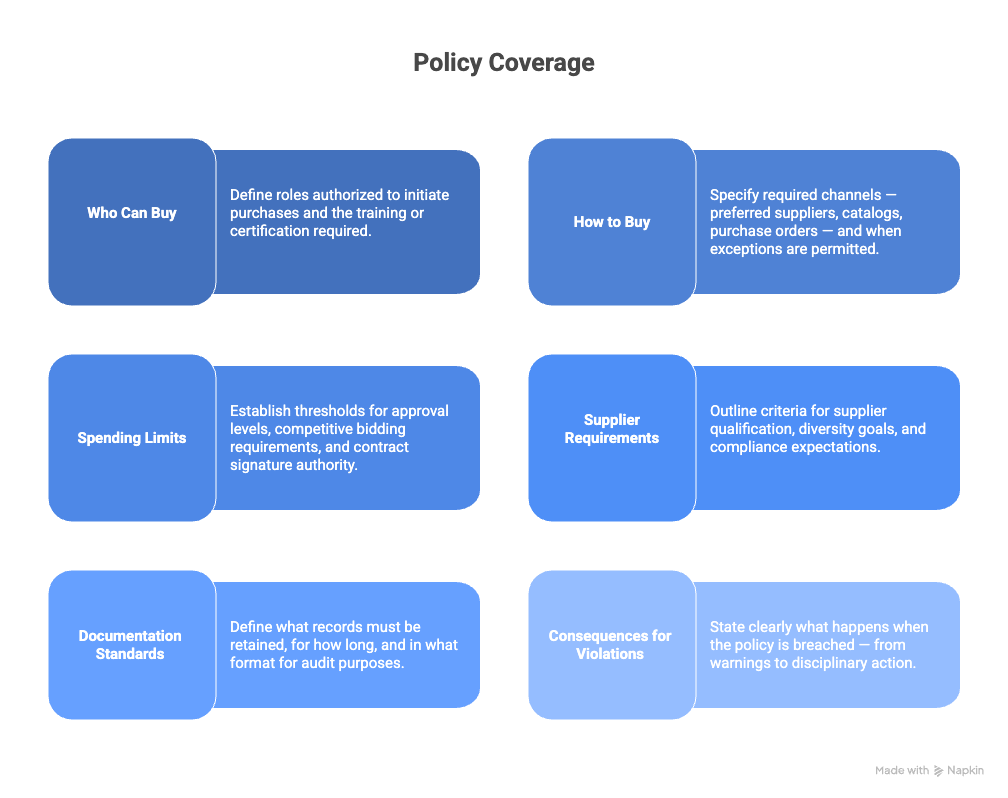
- Scope and Applicability: Defines which purchases, departments, geographies, and spend categories the policy covers — and any exclusions, special cases, or delegated authorities for specific situations.
- Approval Authorities: Specifies who can approve purchases at each spending threshold, ensuring appropriate oversight and segregation of duties for different levels of financial commitment.
- Competitive Bidding Requirements: Establishes when competitive sourcing is required, the number of bids needed, and any exceptions for sole-source or emergency purchases.
- Supplier Selection Criteria: Outlines the factors to consider when evaluating suppliers — price, quality, delivery, risk, sustainability, and diversity.
- Ethical Standards: Addresses conflicts of interest, gift policies, anti-bribery rules, and supplier treatment expectations.
- Contract and Documentation Requirements: Defines when formal contracts are required, record retention standards, and audit trail expectations.
Key Benefits of Procurement Policy
Ensures consistent purchasing practices across departments, locations, and business units.
Reduces compliance risk by embedding regulatory and ethical requirements into standard procedures.
Controls spending through defined approval authorities and competitive sourcing thresholds that prevent unauthorized commitments.
Protects the organization from fraud, conflicts of interest, and supplier disputes through documented ethical standards.
Provides a reference point for training, audits, and continuous improvement efforts across the procurement function.
Enables faster onboarding of new procurement staff by providing clear guidelines and expectations from day one.
Common Pitfalls of Procurement Policy
Overly complex policies: If the policy is too long or difficult to understand, employees will ignore it or find workarounds. Keep it clear and practical.
Lack of enforcement: A policy without teeth is just a document. Systems and audit processes must reinforce compliance.
Infrequent updates: Regulations, business needs, and markets change. Policies that are not reviewed regularly become outdated and ineffective.
Poor communication: Employees cannot follow a policy they do not know exists. Training and accessibility are essential.
KPIs of Policy Matters
| Dimension | Sample KPIs |
| Compliance | Policy adherence rate, maverick spend percentage, audit exception count |
| Efficiency | Average approval cycle time, policy exception request volume |
| Coverage | Percentage of spend under policy, training completion rate |
| Governance | Policy review frequency, time since last update |
Key Terms in Procurement Policy
- Maverick Spend: Purchases made outside of approved procurement channels or in violation of policy guidelines.
- Approval Authority: The designated level of management authorized to approve purchases up to a specified dollar threshold.
- Sole Source: A procurement where only one supplier is capable of meeting the requirement, exempting the purchase from competitive bidding.
- Conflict of Interest: A situation where personal interests could improperly influence procurement decisions.
- Preferred Supplier: A supplier pre-approved for use based on negotiated terms and policy compliance.
- Policy Exception: A documented deviation from standard policy, typically requiring additional approval and justification.
FAQs
Q1. What is a procurement policy?
A formal document that defines the rules, procedures, and standards for how an organization purchases goods and services.
Q2. Who is responsible for creating the procurement policy?
Typically procurement leadership, in collaboration with legal, finance, and compliance — with final approval from senior management or the board.
Q3. How often should the policy be reviewed?
At least annually, or whenever significant regulatory, organizational, or market changes occur.
Q4. What happens if someone violates the policy?
Consequences vary by organization but may include disciplinary action, revoked purchasing authority, or termination for serious breaches.
Q5. Does every purchase require competitive bidding?
No. Policies typically define thresholds below which competitive bidding is not required, and exceptions for emergencies or sole-source situations.
Q6. How is policy compliance enforced?
Through procurement systems that require approvals and block non-compliant transactions, audits that review purchasing activity, and training programs that reinforce expectations and consequences.
References
For further insights into these processes, explore Zycus’ dedicated resources related to Procurement Policy:
- Addressing Procurement Policy Compliance, Workflow Efficiency, and Strategic Value Creation with GenAI
- Suppliers, Time To Go Digital. Don’t You Think?
- Why does a one-size-fits-all policy not work for invoice compliance?
- Smart P2P – Next Generation Procure-to-pay Processes
- Measure Your Scope 3 Emissions with Zycus Carbon Analyzer










