

WHAT IS THE AGENT-TO-AGENT (A2A) PROTOCOL?
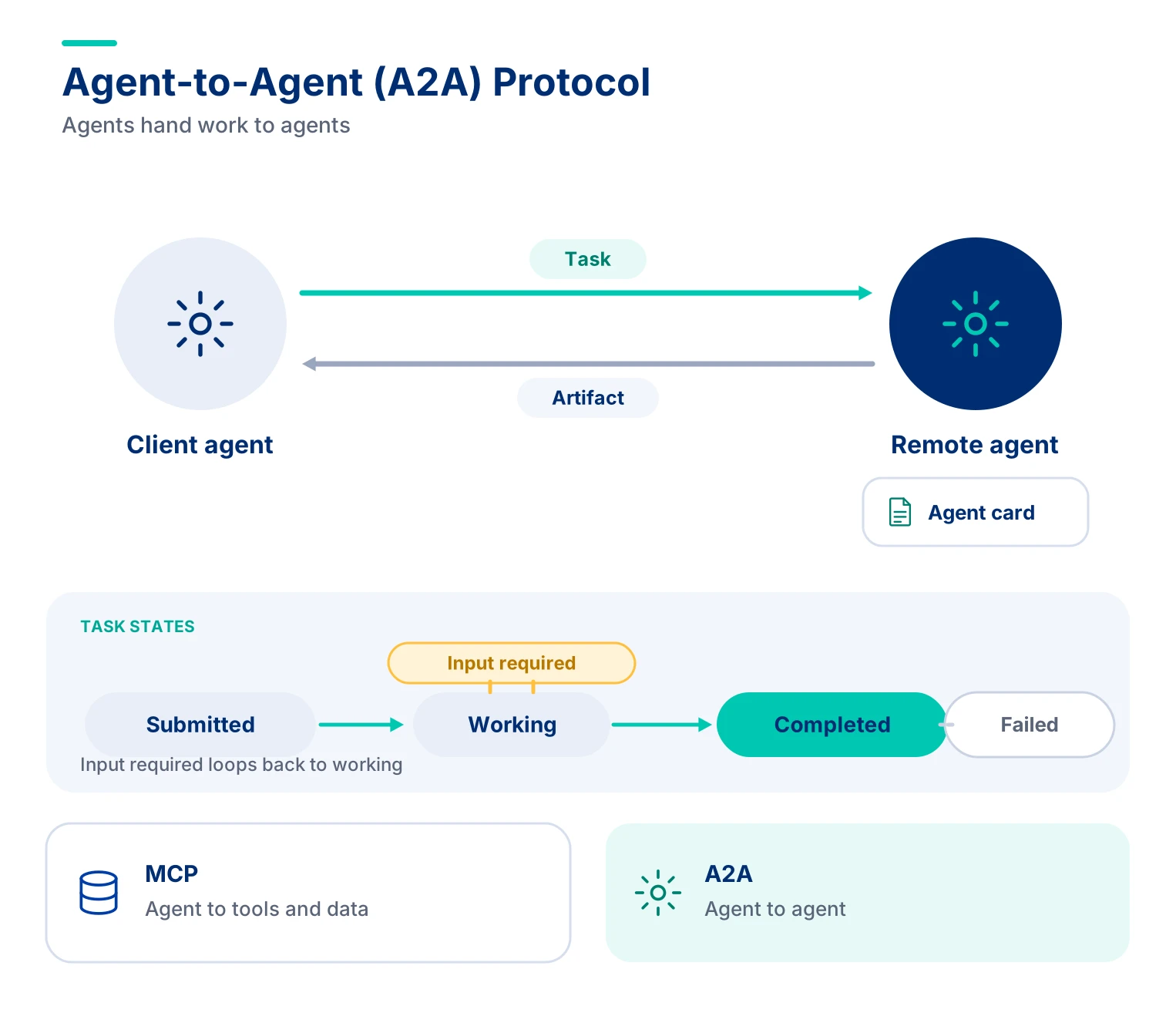
The Agent-to-Agent (A2A) protocol is an open standard that lets AI agents built by different teams or vendors find each other, exchange tasks and share results over a common format. It allows one agent to hand work to another without custom integration. Originally introduced by Google, it is now hosted by the Linux Foundation.
Status as of October 2026.
WHY IT MATTERS IN PROCUREMENT
Procurement is adopting AI agents for intake, sourcing, contracting and payables, often from different providers. If each agent speaks its own language, connecting them needs custom work every time, and the agents cannot hand tasks to each other. A shared protocol lets an intake agent pass a request to a sourcing agent, which can pass an award to a contract agent, as one flow.
A2A is different from the Model Context Protocol (MCP). MCP connects an agent to tools and data, such as a database or an API. A2A connects one agent to another agent. Many systems use both. A2A is young and still evolving, so teams should check the current specification and plan for governance, security and audit from the start.
THE CORE PROCESS / LIFECYCLE
- Discover the Agent. A client agent reads the other agent’s agent card, a public description of what it can do, how to reach it and how to authenticate.
- Authenticate. The client proves its identity using a method the card lists, such as OAuth 2.0, an API key or mutual TLS.
- Send a Task. The client sends a message that opens a task, for example a request to run a sourcing event, with the information the remote agent needs.
- Work and Report Status. The remote agent processes the task and reports its state, such as submitted, working, input required, completed, failed or canceled, and may stream updates.
- Exchange Information. If the agent needs more input, it asks the client or a person. Both sides exchange messages until the task can finish.
- Return Artifacts. The remote agent returns the result as one or more artifacts, such as a document, a data set or a recommendation, and the task closes.
CORE COMPONENTS
- Agent card is a public description of an agent, with its name, skills, endpoint and authentication needs.
- Task is a unit of work with a life cycle and state.
- Message carries a role and content parts such as text, data or files.
- Artifact is a deliverable produced by a task.
- Client and remote agent are the two roles in an exchange, and an agent can play either.
- Transport is the technical channel, with JSON-RPC over HTTPS as the common choice.
- Security covers authentication, authorization and encrypted connections.
KEY BENEFITS
A common protocol removes much of the custom integration work between agents. Companies can mix agents from different vendors and replace one without rebuilding every connection, which reduces lock-in.
It enables end-to-end flows that no single agent covers, such as intake to sourcing to contract to payment. Tasks have states, so long-running work can be tracked and audited. Agents from partners or suppliers can also be connected under agreed security rules, which supports collaboration across company boundaries.
COMMON PITFALLS
- Connecting agents without governance. Agents that can hand work to each other need clear rules on who may ask for what, or tasks spread without control.
- Skipping authentication and audit. An open channel between agents is a security risk unless identity, permissions and logs are in place.
- Confusing A2A with MCP. They solve different problems, so using one where the other is needed leaves gaps.
- Assuming the standard is settled. Versions and features are still developing, so teams should check the current specification.
A2A BUILDING BLOCKS AND THEIR ROLE
The table summarizes the main concepts. The procurement example in the last column shows how an intake agent might work with a sourcing agent.
| Concept | Role | Procurement example |
| Agent card | Describes an agent and how to call it | Sourcing agent lists its skills and endpoint |
| Task | Unit of work with a state | Run a sourcing event for a category |
| Message | Carries requests and replies | Intake agent sends the requirement and budget |
| Artifact | Result produced by the task | Ranked supplier shortlist |
| Status updates | Show progress on long work | Working, then input required, then completed |
KPIs
| Dimension | Sample KPIs |
| Connectivity | Agents exposing an agent card; agent-to-agent flows in production |
| Reliability | Tasks completed successfully; tasks failed or timed out |
| Security | Agents with verified identity; exchanges logged and reviewed |
| Value | End-to-end cycle time for multi-agent flows; manual hand-offs removed |
KEY TERMS
- AI Agent. A system that plans and takes actions toward a goal.
- Agent Card. A public description of an agent’s skills, endpoint and security needs.
- Task. A unit of work passed between agents, with a tracked state.
- Artifact. A result produced by a task, such as a document or data set.
- Model Context Protocol. A standard for connecting an AI agent to tools and data sources.
- Multi-Agent System. A set of agents that work together on a larger goal.
- Orchestration. Coordinating several agents or steps so they work as one process.
- Interoperability. The ability of different systems to work together.
FAQs
1. What is the Agent-to-Agent (A2A) Protocol in AI?
The Agent-to-Agent (A2A) Protocol is an open standard that enables AI agents developed by different vendors or platforms to communicate, exchange tasks, and share results. Originally introduced by Google and now hosted by the Linux Foundation, A2A supports interoperability between independent AI systems. In procurement, it allows specialized agents to collaborate across sourcing, contracting, supplier management, and payment workflows without requiring custom integrations for every connection.
2. How does the Agent-to-Agent (A2A) Protocol work?
The A2A Protocol enables AI agents to discover each other’s capabilities, authenticate connections, exchange messages, and complete tasks collaboratively. A client agent identifies a remote agent through its agent card, sends a task request, and receives status updates during execution. Once completed, the remote agent returns results as artifacts, such as documents or recommendations. This standardized communication supports coordinated workflows across different AI platforms.
3. What is the difference between A2A Protocol and Model Context Protocol (MCP)?
The A2A Protocol enables communication and task coordination between independent AI agents, while the Model Context Protocol (MCP) connects AI applications and agents to external tools and data sources. For example, MCP helps a procurement agent retrieve supplier information from a database, whereas A2A allows that agent to delegate sourcing activities to another specialized agent. Both protocols complement each other in building connected, multi-agent AI systems.
4. What is an agent card in the A2A Protocol?
An agent card is a standardized description of an AI agent’s identity, capabilities, communication endpoint, and authentication requirements. It helps other agents discover available services and understand how to interact with them. For example, a procurement sourcing agent might publish an agent card describing its ability to evaluate supplier bids or generate recommendations. Agent cards simplify agent discovery and support interoperability between AI systems.
5. How can the A2A Protocol improve procurement automation?
The A2A Protocol can improve procurement automation by enabling specialized AI agents to coordinate tasks across the procurement lifecycle. For example, an intake agent can transfer an approved purchasing request to a sourcing agent, which can pass the outcome to a contract management agent. This collaboration reduces manual handoffs, supports workflow continuity, and enables multi-agent orchestration across procurement systems while maintaining appropriate approval controls.
6. Is the Agent-to-Agent Protocol secure for enterprise procurement systems?
The A2A Protocol supports enterprise security through authentication mechanisms such as OAuth 2.0, API keys, and mutual TLS. However, secure implementation also requires authorization policies, encrypted communication, activity logging, and governance controls. Procurement organizations should define which agents can access sensitive supplier information, delegate tasks, and execute actions. Regular monitoring and audit trails help maintain accountability across interconnected AI workflows.
7. How can organizations implement the A2A Protocol in multi-agent AI systems?
Organizations can implement A2A by identifying workflows requiring collaboration between AI agents, defining agent capabilities, and configuring agent cards and secure communication endpoints. Teams should establish authentication, task permissions, status tracking, and audit procedures before deployment. Procurement organizations can begin with controlled workflows connecting intake, sourcing, and contracting agents. Since the A2A standard continues to evolve, compatibility testing and verification of vendor support are essential.