



WHAT IS PEPPOL?
Peppol is an international network and set of standards for exchanging electronic business documents, such as invoices, purchase orders and credit notes, between companies and governments. Documents travel through certified access points, so any buyer and supplier on the network can exchange them whatever software each uses.
WHY IT MATTERS IN PROCUREMENT
Without a shared network, every buyer and supplier pair needs its own connection and format, which does not scale. Peppol replaces those one-to-one links with one connection to the network, so a supplier can reach many buyers and a buyer can reach many suppliers.
It matters more as governments mandate structured e-invoicing. Peppol is a network, not a law: some countries require it, and others use it as one channel among several. For procurement and accounts payable, the practical question is whether suppliers and systems can send and receive the formats the network uses.
THE CORE PROCESS / LIFECYCLE
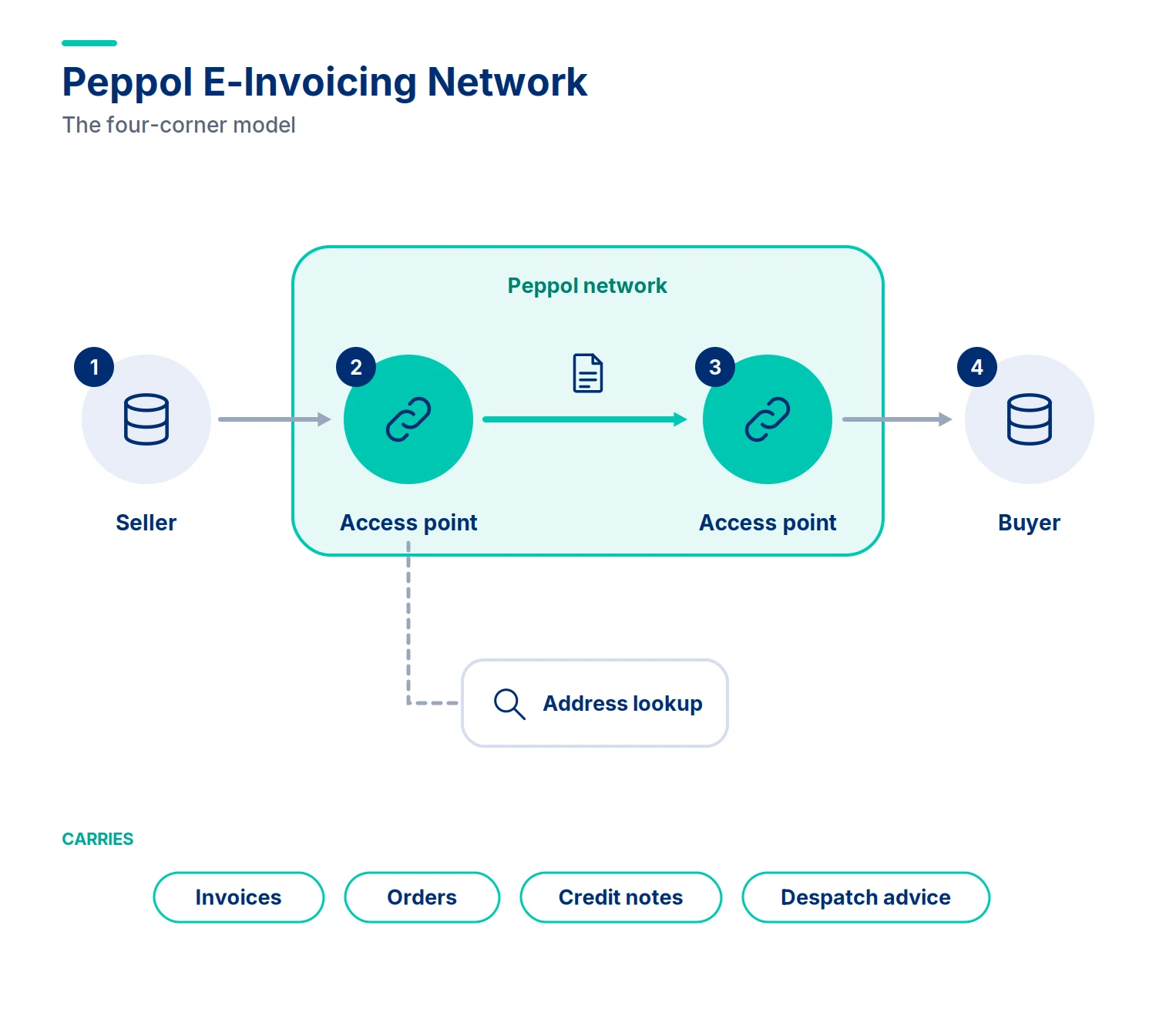
- Document Creation. The sender’s ERP or e-invoicing system creates a structured document in a Peppol format, such as Peppol BIS Billing 3.0, which is built on UBL.
- Sender Access Point. The sender’s access point checks the document against the format rules and prepares it for transmission.
- Address Lookup. The access point looks up the receiver’s Peppol ID in the network’s discovery registers. This shows where to deliver the document and what the receiver accepts.
- Secure Delivery. The document is sent between the two access points over the AS4 protocol, which provides security and delivery confirmation.
- Receiver Access Point. The receiver’s access point checks the document and passes it to the receiver’s ERP or accounts payable system.
- Processing and Response. The receiver processes the document, for example by matching an invoice to a PO. Status responses can travel back over the same network.
CORE COMPONENTS
Access points are certified providers that send and receive documents for their customers. A Peppol ID identifies each participant. Discovery registers show where to send a document and what it accepts. Document specifications, such as Peppol BIS Billing 3.0, define the formats. OpenPeppol, a non-profit association, governs the standards and the rules providers follow.
KEY BENEFITS
Peppol gives buyers and suppliers one connection to reach many partners. It standardizes formats, which cuts custom integration work. It supports compliance where e-invoicing is mandated. It reduces manual keying and errors, because documents arrive structured. And it covers more than invoices, so ordering and delivery documents can use the same route.
COMMON PITFALLS
- Assuming Peppol is a mandate everywhere. It is a network. Some countries require it for certain invoices, and others use different systems.
- Sending PDFs and calling it e-invoicing. A PDF is not a structured Peppol document, and it may not meet mandate rules.
- Not setting up the ability to receive. Buyers that cannot receive on the network push suppliers back to email.
- Ignoring specification updates. Formats are updated on a schedule, and providers and systems must follow each release.
PEPPOL DOCUMENTS PROCUREMENT TEAMS CAN EXCHANGE
Status as of October 2026. Document availability can differ by access point and country.
- Orders. Purchase orders can be sent to suppliers over the network, including changes and cancellations.
- Order responses. Suppliers can accept, change or reject an order, which supports purchase order acknowledgement.
- Despatch advice. Suppliers can tell the buyer what is being shipped, which is similar to an advance ship notice.
- Invoices and credit notes. Structured invoices and credit notes follow Peppol BIS Billing 3.0.
- Catalogues. Suppliers can send product and price catalogues to buyers.
- Responses. Invoice responses and message level responses report status back to the sender.
KPIs
| Dimension | Sample KPIs |
| Adoption | Suppliers able to send via Peppol; share of invoices received on the network |
| Quality | Documents rejected at validation; invoices matched without touch |
| Speed | Time from issue to receipt; invoice cycle time |
| Coverage | Document types in use; countries covered |
KEY TERMS
- Access Point. A certified service provider that sends and receives Peppol documents for its customers.
- Four-Corner Model. A delivery model where sender and receiver each use their own access point.
- Peppol ID. The identifier used to address a participant on the network.
- Peppol BIS Billing 3.0. The invoice and credit note specification used on the network.
- UBL. Universal Business Language, an XML format that Peppol documents are built on.
- OpenPeppol. The non-profit association that governs Peppol standards.
- PINT. The Peppol International Invoicing Model, a framework for extending Peppol invoicing beyond Europe.
FAQs
1. What is Peppol in electronic invoicing?
Peppol (Pan-European Public Procurement On-Line) is an international network and set of standards that enables businesses and governments to exchange structured electronic documents securely. It supports e-invoices, purchase orders, credit notes, and other procurement documents through certified access points. Peppol eliminates the need for separate connections between trading partners, improving interoperability, reducing manual invoice processing, and supporting compliance with applicable e-invoicing regulations.
2. How does the Peppol e-invoicing network work?
Peppol uses a four-corner model where buyers and suppliers connect through their respective certified access point providers. The sender creates a structured electronic invoice, which is validated and transmitted securely to the receiver’s access point. The receiving system processes the invoice using standardized formats such as Peppol BIS Billing 3.0. This approach enables businesses using different ERP or accounting systems to exchange invoices without custom integrations.
3. Is Peppol mandatory for businesses in 2026?
Peppol is not universally mandatory, but several countries require or support it for electronic invoicing. For example, Belgium introduced mandatory structured B2B e-invoicing from January 1, 2026, with Peppol as the standard exchange network. Other countries have different requirements for business-to-business and business-to-government transactions. Organizations should review country-specific regulations, invoice formats, and implementation deadlines to determine whether Peppol connectivity is required.
4. What is the difference between Peppol e-invoicing and traditional PDF invoicing?
Peppol e-invoicing uses structured, machine-readable formats that allow accounting and procurement systems to automatically validate, exchange, and process invoices. Traditional PDF invoices primarily present information visually and may require manual entry or data extraction tools. Peppol documents follow standardized specifications such as BIS Billing 3.0, improving interoperability and reducing processing errors. A regular PDF invoice alone does not qualify as a structured Peppol e-invoice.
5. How can a business connect to the Peppol network?
Businesses can connect to Peppol through a certified access point provider that integrates with their ERP, accounting, or accounts payable system. The organization registers a Peppol participant ID, configures supported document formats, and tests invoice transmission and receipt. Once connected, it can exchange compatible electronic documents with other Peppol participants. Choosing a provider with appropriate country coverage and system integration capabilities helps simplify implementation.
6. What documents can businesses exchange through Peppol besides invoices?
Peppol supports multiple electronic procurement documents, including purchase orders, order responses, credit notes, despatch advice, product catalogues, and invoice status responses. For example, suppliers can acknowledge purchase orders, communicate shipment details, and submit structured invoices through the same network. Supported document types may vary by country and access point provider. These capabilities help businesses automate procurement transactions and improve supplier communication across the procure-to-pay lifecycle.
7. What are the benefits of Peppol for procurement and accounts payable automation?
Peppol improves procurement and accounts payable efficiency by standardizing electronic document exchange between buyers and suppliers. It reduces manual invoice entry, minimizes formatting errors, and supports automated invoice validation and matching. A single network connection enables communication with multiple trading partners, reducing integration complexity. Peppol also supports compliance with applicable e-invoicing mandates and improves transaction visibility across procurement and finance operations.