



A change order is a formal document that modifies the terms of an existing contract or purchase order after it has been executed. Contract change orders authorize adjustments to scope, specifications, quantities, pricing, delivery schedules, or other contractual terms. They ensure that both buyer and supplier agree to modifications in writing, maintaining clarity about obligations and protecting both parties when circumstances require deviation from original agreements.
Read more: Transforming Engineering Change Order (ECO) Workflows with Conversational Intake
Why Change Order Matters in Procurement
Business requirements evolve after contracts are signed. Projects expand, specifications change, timelines shift, and market conditions fluctuate. Without a formal change order process, modifications happen informally — through emails, phone calls, or verbal agreements — creating ambiguity about what was agreed, who authorized it, and what the cost impact should be. Contract change orders provide governance, documentation, and control over modifications, protecting both the organization and its suppliers while maintaining contract integrity.
The Core Process of Change Order
The process begins when a change is identified. The requesting party — whether the buyer needing different specifications or the supplier encounters unforeseen conditions — documents the proposed modification and its rationale.
The change request is evaluated for impact. Procurement assesses how the change affects cost, schedule, risk, and other contract terms. For significant changes, finance, legal, or technical stakeholders may need to review.
Negotiation occurs if the parties disagree on terms. The supplier may propose pricing for additional work, or the buyer may negotiate credits for reduced scope. Both parties must reach agreement before proceeding.
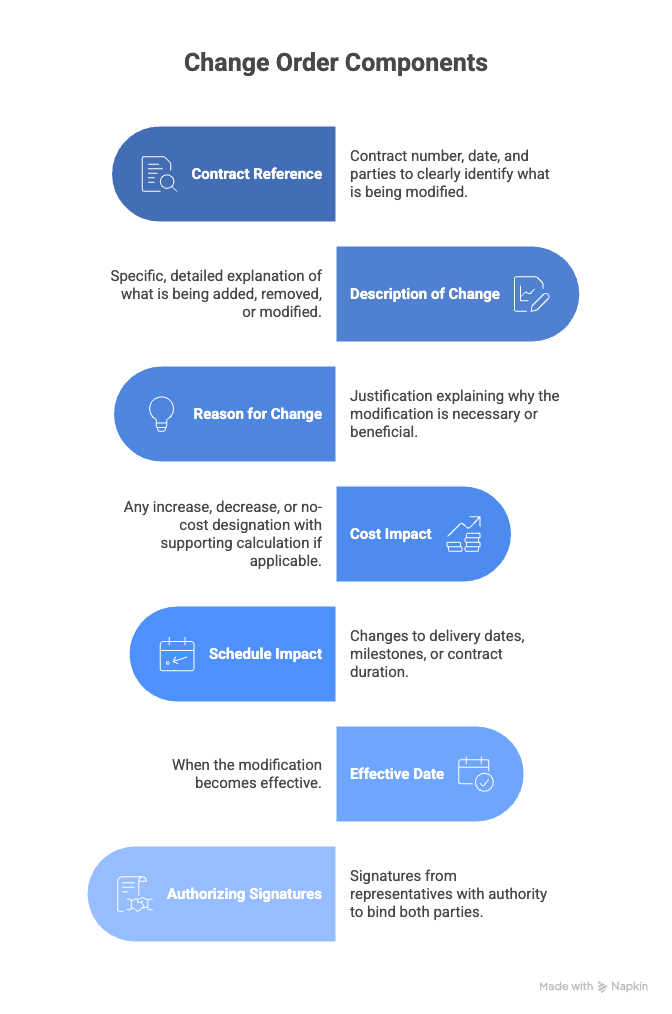
Once agreed, the change order is formalized. The document specifies exactly what is changing, the effective date, any cost or schedule adjustments, and signatures from authorized representatives of both parties. The original contract remains in effect except as modified.
Core Components of Change Order
- Change Request: The initial documentation of a proposed modification, including description, justification, and requester information.
- Impact Assessment: Analysis of how the proposed change affects cost, schedule, scope, quality, and risk.
- Authorization: Approval from individuals with authority to commit the organization to contract modifications.
- Change Order Document: The formal written agreement specifying the modification superseding relevant portions of the original contract.
- Contract Amendment: For major changes, a formal amendment that comprehensively restates affected contract sections.
Key Benefits of Change Order
- Documents modifications formally, eliminating ambiguity about what was agreed and when.
- Protects both parties by ensuring changes are mutually accepted before implementation.
- Maintains cost control by requiring approval and documentation before authorizing additional spend.
- Preserves contract integrity by clearly delineating what has changed versus the original terms.
- Creates audit trails demonstrating that changes followed proper governance processes.
- Supports dispute resolution by providing clear documentation if disagreements arise later.
Common Pitfalls of Change Order
- Informal changes. Verbal or email-only agreements create disputes later. Always document changes formally.
- Scope creep without documentation. Small changes accumulate into significant cost overruns. Capture all modifications, even minor ones.
- Delayed processing. Work proceeds while change orders languish. Process changes promptly to maintain alignment.
- Insufficient authorization. Changes approved by unauthorized personnel may not be binding. Verify approval authority.
KPIs of Change Order
| Dimension | Sample KPIs |
| Volume | Number of change orders per contract, change order rate by category |
| Cost | Total value of change orders, change order cost as a percentage of contract value |
| Efficiency | Change order processing time, approval cycle duration |
| Compliance | Percentage of changes with proper documentation, unauthorized change incidents |
Key Terms in Change Order
- Change Order: A formal document authorizing modification to an existing contract or purchase order.
- Contract Amendment: A comprehensive modification that restates or significantly revises contract terms.
- Scope Creep: Gradual, often undocumented expansion of project or contract scope beyond original boundaries.
- Variation: Another term for change order, commonly used in construction and engineering contracts.
- Authorization Threshold: The dollar limit up to which an individual can approve changes without escalation.
- Bilateral Change: A modification agreed to by both parties, as opposed to unilateral changes allowed by some contracts.
Technology Enablement
Modern Source-to-Pay platforms include contract change order workflows that automate routing for approval, maintain version history, track cumulative changes, and link modifications to the original contract. This ensures visibility into how contracts evolve over their lifecycle.
FAQs
Q1. What is a change order?
A formal document that modifies the terms of an existing contract or purchase order after execution.
Q2. When is a change order needed?
Whenever scope, pricing, quantities, schedules, or other material contract terms need to be modified after the contract is signed.
Q3. Who can authorize a change order?
Individuals with delegated authority to commit the organization to contract modifications, typically based on dollar thresholds.
Q4. What is the difference between a change order and an amendment?
A change order typically addresses specific modifications. An amendment may comprehensively restate or significantly revise contract sections.
Q5. Can a supplier refuse a change order?
Yes. Change orders require mutual agreement. A supplier can refuse or negotiate terms for requested changes.
Q6. How should change orders be tracked?
Maintain a log of all change orders per contract, including status, value, and cumulative impact on contract terms.
References
For further insights into these processes, explore the following Zycus resources related to Change Order:










