



MRO Procurement (Maintenance, Repair, and Operations procurement) refers to the sourcing and management of all goods and services required to keep an organization’s facilities, equipment, and daily operations running smoothly. Unlike direct materials that go into finished products, MRO covers operational essentials — from tools, safety gear, and lubricants to cleaning supplies, spare parts, and maintenance services.
Although often overlooked, MRO spend is critical. It ensures business continuity, minimizes downtime, maintains safety standards, and supports every operational function behind the scenes.
Read more: What is MRO Procurement and How It Optimizes Inventory and Supply Chain Efficiency
Why MRO Procurement Matters
MRO categories are high-volume and highly fragmented, making them prone to inefficiency, rogue buying, inflated costs, and emergency requests.
A strong MRO procurement strategy ensures:
- Reliable operational continuity and minimized equipment downtime
- Better cost control through consolidated suppliers and standardized catalogs
- Lower risk exposure from safety, compliance, and quality failures
- More accurate inventory planning and consumption visibility
- Improved supplier collaboration for faster repairs and support
In modern S2P ecosystems, MRO procurement evolves from a reactive, transactional function into a strategic driver of efficiency and resilience.
The Complete MRO Procurement Lifecycle
MRO procurement is not a linear event — it is a continuous operational cycle connecting maintenance teams, procurement teams, suppliers, and finance. Each stage builds the next, creating a closed loop of visibility and control.
1. Requirements Identification and Intake
The cycle begins when a maintenance team, facility manager, or operator identifies a need — a spare part for equipment, PPE refill, routine consumables, or emergency repair materials.
Guided intake frameworks (such as Merlin Intake) help translate user intent into accurate, category-aligned requests, reducing miscoding and ensuring the right sourcing path from the start.
2. MRO Sourcing and Supplier Selection
Sourcing focuses on identifying reliable suppliers who can deliver quality materials quickly and consistently.
This includes:
- Competitive RFQs for frequently sourced items
- Spot buys for urgent breakdown requirements
- Evaluating suppliers on price, lead time, warranty, and technical capability
- Establishing preferred supplier lists for standardized categories
AI-driven sourcing tools improve price benchmarking and optimize supplier selection across fragmented spend.
3. Contracting and Rate Agreements
Because MRO involves recurring demand, organizations develop long-term agreements that define pricing, service expectations, part availability, and response times.
This may include:
- Annual rate contracts
- Blanket POs
- Vendor-managed inventory (VMI) arrangements
- Service-level expectations for maintenance support
These agreements help reduce emergency purchasing and stabilize supply.
4. Purchase Order Creation and Approvals
Requisitions convert into purchase orders once budgets, specifications, and maintenance requirements are validated.
Modern P2P systems automate PO creation for catalog-based items and route approvals based on urgency, category, and policy thresholds — ensuring both control and speed.
5. Delivery, Goods Receipt, and Verification
Upon delivery, MRO items undergo verification:
- Correct quantity
- Correct specifications and part numbers
- Functional condition
- Compliance with safety or quality requirements
A Goods Receipt Note (GRN) is issued to update inventory and trigger financial matching.
This step ensures transparency and accountability across stores, maintenance, and finance.
6. Invoice Matching and Payment
AP teams validate invoices against PO and GRN data.
Automated 2-way or 3-way matching prevents:
- Overpayments
- Duplicate invoices
- Price discrepancies
- Unauthorized charges
Modern invoice automation reduces exception rates and accelerates payment cycles, strengthening supplier relationships.
7. Inventory and Spare-Part Optimization
MRO inventory is a significant cost center. Optimizing it ensures availability without excess holding costs.
This includes:
- Safety stock planning
- ABC classification
- Demand forecasting using maintenance schedules
- SKU standardization
- Lead time analysis
AI-enabled insights help predict usage patterns and recommend optimal stocking strategies.
8. Supplier Performance and Risk Management
Performance is continuously monitored through delivery accuracy, lead times, defect rates, response to urgent needs, and support for warranties or repairs.
Risk monitoring covers supplier safety compliance, financial stability, regulatory adherence, and data security.
Platforms like Merlin Risk Radar centralize internal and external risk signals, ensuring uninterrupted operational support.
Core Components of MRO Procurement
Below are the foundational pillars that define a strong MRO procurement function:
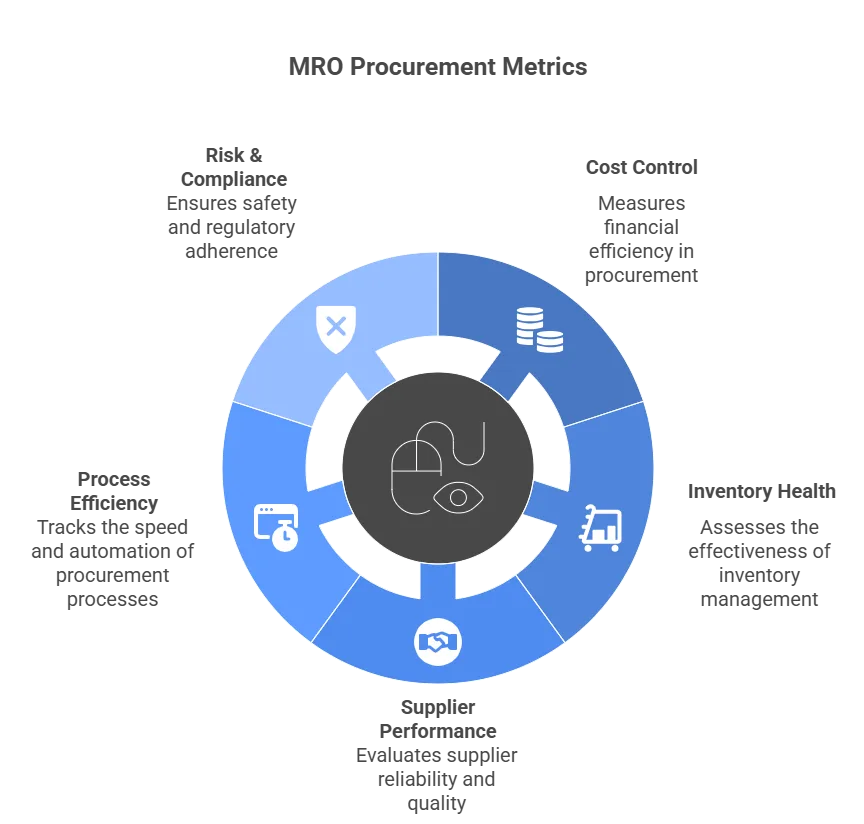
Category & Spend Management
Organizing MRO spend into structured categories (PPE, tools, spares, consumables, chemicals) to improve sourcing leverage and cost control.
Supplier Management & Compliance
Ensuring suppliers meet safety, environmental, and quality standards, with continuous tracking of certifications and audit results.
Contract & Catalog Management
Maintaining accurate e-catalogs, rate contracts, and approved items to reduce maverick buying and streamline requisitions.
Inventory & Logistics Coordination
Balancing stock levels across sites, managing replenishments, and ensuring real-time visibility into consumption.
Digital Workflow Automation
Using guided buying, automated POs, mobile approvals, and intelligent analytics to streamline MRO processes end-to-end.
(Subtle Zycus alignment: Zycus P2P solutions support catalog accuracy, intake orchestration, automated PO flows, and analytics-driven decision-making.)
Key Terms in MRO Procurement
| Term | Meaning |
| VMI | Vendor-managed inventory for critical or frequently used items |
| CMMS | Maintenance system used to schedule and track equipment upkeep |
| Critical Spares | Essential components with high impact on operational downtime |
| Catalogue Compliance | % of purchases made through approved SKUs and suppliers |
FAQs
Q1. What is MRO procurement?
The sourcing and management of supplies, tools, spare parts, and services required for maintenance, repairs, and routine operational needs.
Q2. What categories fall under MRO?
PPE, spare parts, hand tools, chemicals, cleaning supplies, lubricants, fasteners, facility maintenance items, and repair services.
Q3. How is MRO different from direct procurement?
Direct procurement feeds production; MRO supports operations. MRO is more fragmented, urgent, and heavily SKU-driven.
Q4. Why is MRO procurement challenging?
Unpredictable demand, thousands of low-value items, emergency purchases, multi-site operations, and supplier fragmentation increase complexity.
Q5. How does automation improve MRO procurement?
Automation streamlines intake, sourcing, approvals, catalog-based buying, inventory visibility, and risk monitoring — significantly reducing cost and downtime.
Q6. What is the role of AI in MRO procurement?
AI predicts consumption, identifies cost-saving opportunities, optimizes inventory, and recommends preferred suppliers based on performance and risk.
References
For further insights into these processes, explore Zycus’ dedicated resources related to MRO Procurement:
- Smart Intake Management for MRO Procurement: Hours, Not Weeks
- Beyond Breakdown: Transforming MRO Procurement for Operational Excellence
- Procurement Outlook in 2019: The Shape of Things to Come
- 4 Pillars to Accounts Payable Automation
- Optimizing Your Strategy: 6 Efficient Zycus Supplier Onboarding Steps










