



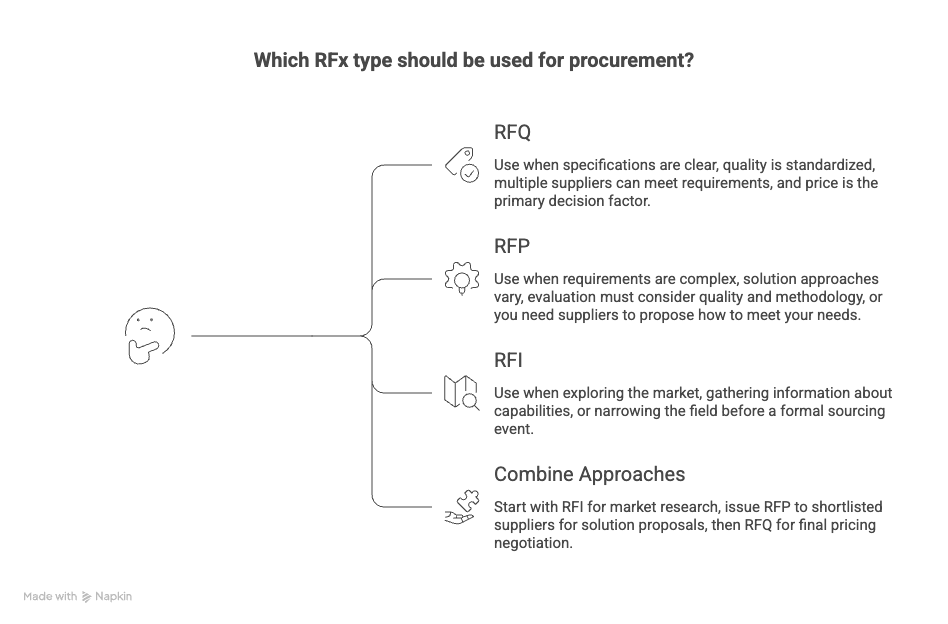
A Request for Quotation (RFQ) is a procurement document used to solicit pricing from suppliers for well-defined goods or services. Unlike a Request for Proposal, which invites comprehensive solutions for complex requirements, an RFQ in procurement focuses specifically on obtaining competitive prices when specifications are clear and the primary decision factor is cost. RFQs are efficient tools for commodity purchases where quality is standardized and multiple suppliers can meet requirements.
Read more: RFI, RFQ, and RFP Explained: A Practical Guide
Why Request For Quotation (RFQ) Matters in Procurement
RFQs drive cost savings through competition. When requirements are clear and multiple suppliers can deliver, obtaining competitive quotes ensures the organization pays market-appropriate prices. The RFQ process is faster and simpler than an RFP, making it suitable for routine purchases where extensive evaluation is unnecessary. For procurement teams managing high transaction volumes, efficient RFQ processes free resources for strategic activities while maintaining cost discipline on commodity spend.
Watch On-demand Webinar: Autonomous Sourcing: Speed, Savings & Strategic Edge in Procurement
The Core Process of Request For Quotation (RFQ)
The process begins with specification development. The requesting department defines exactly what is needed — product specifications, quantities, delivery location, and timing. Clear specifications are essential because RFQs assume the requirement is fixed.
Procurement identifies qualified suppliers to receive the RFQ. These may come from an approved vendor list, previous suppliers, or market research. The RFQ is distributed with a defined response deadline.
Suppliers submit quotations detailing their pricing, lead times, and any terms or conditions. Because specifications are standardized, quotes should be directly comparable.
Procurement evaluates quotes primarily on price, though delivery capability and supplier reliability may also factor in. The lowest acceptable quote typically wins, and a purchase order is issued to the selected supplier.
Core Components of Request For Quotation (RFQ)
- Specifications. Detailed description of what is being purchased — product requirements, technical standards, and quality parameters.
- Quantity and Timing. The volume required and delivery schedule, which affect pricing and supplier capacity.
- Pricing Template. A standardized format for suppliers to present their pricing, enabling direct comparison.
- Terms and Conditions. Commercial requirements including payment terms, warranty, and delivery terms.
- Response Deadline. The date by which suppliers must submit their quotations to be considered.
Key Benefits of Request For Quotation (RFQ)
- Generates competitive pricing through direct comparison of multiple supplier quotes on standardized specifications.
- Enables fast procurement cycles for straightforward requirements with minimal evaluation complexity or subjectivity.
- Provides pricing transparency and market benchmarks for commonly purchased items and standard commodities.
- Reduces procurement workload compared to complex RFP processes for routine, well-defined purchases.
- Creates documentation of competitive process supporting audit and compliance requirements.
- Allows easy rebidding and periodic price refreshes to maintain market-competitive pricing over contract terms.
Common Pitfalls of Request For Quotation (RFQ)
- Using RFQ for complex requirements: If solutions vary or evaluation requires judgment, use an RFP instead.
- Incomplete specifications: Ambiguous requirements produce non-comparable quotes. Be precise about what you need.
- Too few suppliers: Limited competition yields weak pricing. Include enough qualified suppliers to drive competition.
- Ignoring total cost: The lowest unit price may not be the best value if shipping, lead time, or quality differ.
KPIs of Request For Quotation (RFQ)
| Dimension | Sample KPIs |
| Cost | Savings vs. benchmark, price variance across quotes, and cost avoidance achieved |
| Competition | Number of quotes received, supplier response rate, price spread percentage |
| Efficiency | RFQ cycle time, days from issue to award, cost per RFQ processed |
| Quality | Quote compliance rate, supplier delivery performance post-award |
Key Terms in Request For Quotation (RFQ)
- RFQ: Request for Quotation — a solicitation for pricing on well-defined goods or services.
- Quotation: The supplier’s formal response to an RFQ containing pricing and terms.
- Bid: Another term for a supplier’s competitive pricing response to a solicitation.
- Specification: The detailed description of product or service requirements that suppliers must meet.
- Lead Time: The time between order placement and delivery, often a factor in RFQ evaluation.
- Award: The decision to select a supplier and issue a purchase order based on their quotation.
Technology Enablement
Modern Source-to-Pay platforms streamline RFQ processes through electronic distribution, online supplier response portals, automated quote comparison tools, and seamless integration with purchasing systems for order creation. These capabilities significantly reduce cycle time, improve supplier competition, and create complete audit trails of the entire sourcing process.
FAQs
Q1. What is an RFQ in procurement?
A Request for Quotation is a document soliciting competitive pricing from suppliers for well-defined requirements.
Q2. What is the difference between RFQ and RFP?
RFQs focus on price for clear specifications. RFPs solicit comprehensive proposals for complex requirements evaluated on multiple factors.
Q3. How many suppliers should receive an RFQ?
Typically 3–5 qualified suppliers to ensure meaningful competition without excessive administrative burden.
Q4. How long should suppliers have to respond?
Usually 1–2 weeks for standard RFQs, though complex or high-value requests may warrant more time.
Q5. Is the lowest quote always selected?
Usually, but total cost including delivery, quality risk, and reliability may also be considered.
Q6. Can RFQ responses be negotiated?
Yes. Procurement may negotiate with the lowest bidders to improve pricing or terms before final award.
References
For further insights into these processes, explore Zycus’ dedicated resources related to Request For Quotation Rfq:
- Unraveling the P2P benchmark survey findings – The visibility & compliance picture
- Procurement Advice – 5 practical steps to combat COVID-19!
- The Digital Archaeologist: How GenAI Integration Drives Efficiency Gains in Intake Management
- Fact based decision making in Procurement
- Exploring the Future of Digital Procurement with Jeetesh Vanmare










