



Supply chain disruption is any event that interrupts the normal flow of goods, services, or information between suppliers and the organizations that depend on them. Disruptions can originate at any point in the supply chain, from raw material extraction through logistics and last-mile delivery. They range in scale from isolated delivery delays to multi-tier failures affecting entire industries. For procurement, supply chain disruption represents one of the most consequential categories of operational risk.
Why Supply Chain Disruption Matters in Procurement
Procurement decisions directly shape an organization’s exposure to supply chain disruption. Sourcing strategies, supplier selection, contract structures, inventory policies, and geographic diversification all influence how resilient the supply chain is when disruptions occur. Procurement teams that treat disruption risk as a strategic consideration, rather than an operational fire to fight reactively, build supply bases that absorb shocks more effectively and recover more quickly. As global supply chains have become more interconnected and lean, the frequency and financial impact of disruptions have increased, making proactive risk management a core procurement competency.
Read more: Top 7 Supply Chain Challenges and Risks for 2026 and Beyond
The Core Process of Supply Chain Disruption
The process begins with risk identification. Procurement maps the supply chain to understand where dependencies exist, which suppliers are critical, and where single points of failure could halt operations. This mapping extends beyond Tier 1 suppliers to include Tier 2 and Tier 3 where the organization has meaningful exposure.
Risk assessment prioritizes identified exposures by combining the likelihood of disruption with the operational and financial impact if it occurs. High-likelihood, high-impact risks receive the most investment in mitigation. Lower-probability risks that carry catastrophic consequences also warrant contingency planning even if their frequency is low.
Mitigation strategies are designed and implemented at the category level. These may include dual sourcing, safety stock increases, geographic diversification, supplier financial monitoring, or demand-side adjustments that reduce dependency on constrained supply points.
When a disruption occurs, the response process activates. Procurement identifies the scope of impact, engages affected suppliers, activates contingency supply options, and communicates with internal stakeholders about revised delivery expectations. Post-disruption, a review captures lessons learned and updates risk assessments and mitigation plans accordingly.
Core Components of Supply Chain Disruption
Supply chain mapping provides visibility into where disruption risk exists, extending beyond Tier 1 to critical sub-tiers. Risk assessment frameworks translate mapping outputs into prioritized risk registers that guide mitigation investment. Mitigation planning defines specific actions, ownership, and success measures for each significant risk. Business continuity planning addresses how the organization will sustain operations during a disruption, including escalation protocols and stakeholder communication.
Key Benefits of Supply Chain Disruption
- Reduces the operational and financial impact of disruptions by enabling faster, better-prepared responses.
- Supports continuity of supply for critical categories through pre-planned mitigation strategies and contingency suppliers.
- Improves organizational resilience by embedding risk awareness into procurement strategy and supplier selection decisions.
- Reduces the cost of reactive emergency sourcing by addressing risk proactively before disruptions occur.
- Strengthens stakeholder confidence by demonstrating that procurement manages supply risk systematically rather than reactively.
Read more: Logistics vs. Supply Chain Management: What’s the Difference and Why It Matters
Common Pitfalls of Supply Chain Disruption
- Mapping only Tier 1 suppliers: Many disruptions originate further upstream. Organizations without visibility into Tier 2 and Tier 3 suppliers cannot anticipate or prepare for failures at those levels.
- Treating risk assessment as a compliance exercise rather than a management tool: Risk registers that are created, filed, and never reviewed provide no operational protection when disruptions occur.
- Over-relying on lean inventory as a cost reduction tool without understanding the risk trade-off: Minimal inventory buffers reduce holding costs but leave no margin when supply is interrupted. Procurement must balance efficiency with resilience.
- Failing to test business continuity plans: Untested contingency plans often contain gaps, outdated contacts, or assumptions that do not hold under real disruption conditions.
KPIs of Supply Chain Disruption
| Dimension | Sample KPIs |
| Risk Coverage | % of critical spend with documented risk assessment, Tier 2 visibility rate |
| Disruption Response | Mean time to recovery, % of disruptions with activated contingency plan |
| Resilience Investment | # of categories with dual or multi-source capability, safety stock coverage |
| Financial Impact | Cost of supply disruptions, emergency sourcing premium paid |
Key Terms in Supply Chain Disruption
- Supply Chain Resilience: The ability of a supply chain to anticipate, withstand, and recover from disruptions while maintaining continuity of supply.
- Single Point of Failure: A node in the supply chain where a disruption would directly halt operations with no immediate alternative.
- Business Continuity Plan (BCP): A documented plan defining how an organization will sustain critical operations during and after a significant disruption.
- Tier 2 Supplier: A supplier to the organization’s direct (Tier 1) supplier, whose failure can cascade up the supply chain.
- Force Majeure: A contract clause that excuses a party from performance obligations when extraordinary events outside their control make fulfillment impossible.
Technology Enablement
Modern Source-to-Pay platforms support supply chain disruption management through supplier risk monitoring tools, real-time alerts on supplier financial health and external risk events, and supply chain mapping capabilities that extend visibility beyond Tier 1. These tools help procurement identify emerging risks earlier and respond faster when disruptions occur.
FAQs
Q1. What is supply chain disruption?
Any event that interrupts the normal flow of goods, services, or information between suppliers and the organization that depends on them.
Q2. What are the most common causes of supply chain disruption?
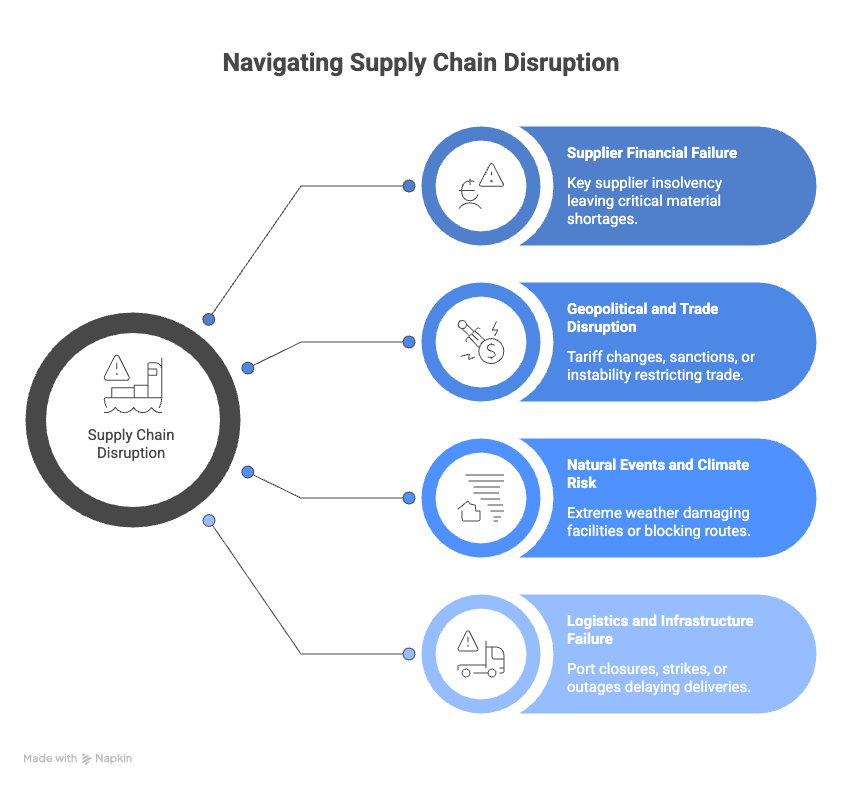
Supplier financial failure, geopolitical events, natural disasters, logistics failures, and unexpected demand surges are the most frequent causes.
Q3. How can procurement reduce supply chain disruption risk?
Through supply base diversification, safety stock management, supplier financial monitoring, multi-tier visibility, and documented contingency plans.
Q4. What is supply chain mapping, and why is it important?
It is the process of identifying all suppliers across multiple tiers. It is essential because many disruptions originate at Tier 2 or Tier 3, not at direct suppliers.
Q5. How does lean inventory contribute to disruption risk?
Lean inventory reduces holding costs but eliminates the buffer that absorbs supply delays. Organizations must balance efficiency with resilience based on category risk.
Q6. Is force majeure a reliable disruption protection?
Force majeure protects against liability but does not ensure supply continuity. Procurement should not rely on it as a substitute for operational contingency planning.
References
For further insights into these processes, explore Zycus’ dedicated resources related to Supply Chain Disruption:
- Coronavirus: How procurement teams can mitigate supply chain disruptions
- 7 Step Approach to Sustain Business During Supply Chain Disruptions
- GenAI in Procurement Orchestration: The New Conductor of Procurement’s Symphony
- Essential Source to Pay KPIs, Implementation & Benchmarking
- Be Prepared with SOX Compliance: Your Ultimate Guide by Zycus










