




Vendor Consolidation is a strategic procurement practice that involves reducing the number of active suppliers an organization works with, while deliberately increasing engagement with a smaller set of preferred or strategic vendors.
The objective is not simply to cut suppliers, but to optimize the supplier base—focusing spend, improving governance, and strengthening supplier partnerships.
Read more: A Complete Guide to Vendor Management – its Benefits, Challenges, Process & Best Practices
In mature procurement organizations, vendor consolidation is a value-driven initiative that balances cost efficiency, operational simplicity, risk management, and supplier performance across the procurement lifecycle.
Why Vendor Consolidation Matters in Procurement
Over time, many organizations accumulate fragmented supplier bases—multiple vendors supplying similar goods or services, often at different prices and under inconsistent terms. This fragmentation increases administrative effort, weakens negotiating power, and limits visibility.
Vendor consolidation helps procurement teams:
- Leverage higher spend volumes for better pricing and terms
- Simplify sourcing, ordering, and invoice management
- Improve supplier performance oversight and accountability
- Reduce compliance risk and contract leakage
- Build deeper, more strategic supplier relationships
When executed correctly, consolidation shifts procurement from supplier administration to supplier optimization.
The Vendor Consolidation Framework
Vendor consolidation is not a one-time clean-up exercise. It follows a structured, data-driven approach that aligns suppliers with business priorities and category strategies.
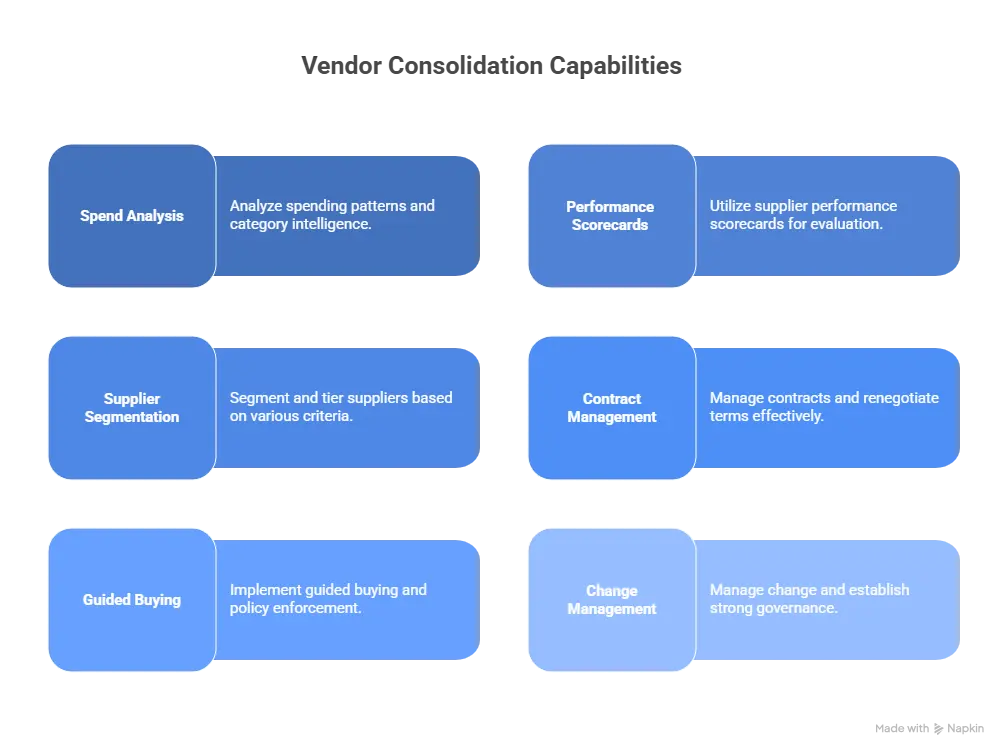
1. Spend and Supplier Landscape Analysis
The process begins with a clear understanding of the current supplier ecosystem.
Procurement analyzes spend data across categories, geographies, and business units to identify overlapping suppliers, low-volume vendors, and fragmented purchasing patterns.
This analysis highlights where consolidation opportunities exist without disrupting operations.
2. Supplier Segmentation and Criticality Assessment
Not all suppliers should be consolidated.
Suppliers are segmented based on criteria such as category importance, spend volume, performance history, risk exposure, and business dependency.
Strategic and high-risk suppliers are assessed carefully, while transactional and duplicative vendors are prime candidates for consolidation.
This ensures consolidation decisions are risk-aware and business-aligned.
3. Performance and Capability Evaluation
Before reducing the supplier base, procurement evaluates whether remaining suppliers can absorb increased volumes and meet future demand.
This includes reviewing delivery reliability, quality performance, financial stability, scalability, compliance posture, and innovation capability.
Vendor performance scorecards and historical KPIs often play a central role at this stage.
4. Rationalization and Supplier Selection
Based on analysis and evaluation, procurement defines a rationalized supplier list for each category.
This may involve selecting preferred suppliers, reducing tail vendors, or migrating spend from underperforming suppliers to higher-performing alternatives.
Clear transition plans ensure continuity of supply during supplier exits or migrations.
5. Contract Alignment and Volume Leverage
Consolidation is operationalized through updated contracts.
Increased spend concentration enables procurement to renegotiate pricing, service levels, rebates, and SLAs with selected suppliers.
Standardized contracts also improve compliance, reduce leakage, and simplify downstream procurement processes.
6. Change Management and Stakeholder Alignment
Vendor consolidation impacts business users, suppliers, and internal teams.
Successful programs include stakeholder communication, guided buying enablement, and clear governance to ensure users adopt consolidated suppliers rather than reverting to legacy vendors.
Adoption is as critical as supplier reduction.
7. Ongoing Monitoring and Optimization
Vendor consolidation is continuously monitored through spend analytics, supplier performance scorecards, and risk indicators.
Procurement regularly reviews whether consolidated suppliers continue to deliver expected value and adjusts strategies as categories, markets, or business needs evolve.
Key Benefits of Vendor Consolidation
Vendor consolidation delivers value across multiple dimensions:
- Cost Reduction: Higher spend volumes unlock better pricing, discounts, and commercial terms
- Operational Efficiency: Fewer suppliers reduce PO, invoice, and communication complexity
- Risk Management: Stronger oversight of a smaller supplier base improves continuity and compliance
- Supplier Relationships: Concentrated spend fosters collaboration, innovation, and accountability
- Data Clarity: Simplified supplier data improves analytics, forecasting, and decision-making
Key Terms
- Vendor Consolidation – Reducing and optimizing the supplier base to improve efficiency and value
- Supplier Rationalization – The process of evaluating and reducing overlapping or low-value suppliers
- Spend Concentration – Aggregating spend with fewer suppliers to increase leverage
- Preferred Supplier – A vendor selected to receive prioritized business due to performance and value
- Tail Suppliers – Low-spend, low-impact suppliers that often increase complexity
FAQs
Q1. What is vendor consolidation in procurement?
Vendor consolidation is the strategic reduction of suppliers to streamline operations, improve pricing leverage, and strengthen supplier management.
Q2. Is vendor consolidation the same as supplier reduction?
No. Consolidation focuses on optimizing value and performance, not simply cutting supplier numbers.
Q3. What categories benefit most from vendor consolidation?
Indirect spend, MRO, IT services, and professional services often see the highest impact.
Q4. What are the risks of over-consolidation?
Excessive consolidation can increase dependency risk if not balanced with performance and resilience checks.
Q5. How does vendor consolidation support cost savings?
By aggregating spend, organizations gain negotiating power, reduce price variance, and improve contract compliance.
Q6. How often should vendor consolidation be reviewed?
Most organizations review consolidation opportunities annually or alongside category strategy refresh cycles.
References
For further insights into these processes, explore Zycus’ dedicated resources related to Vendor Consolidation:
- The State of Strategic Sourcing 2014 – Part VI
- Why Implement ERP and Best of Breed Systems Together?
- 7 Step Approach to Sustain Business During Supply Chain Disruptions
- The Business Case for AI-Led AP Automation Actionable insights and a framework for driving AP transformation
- Zycus Quick Testimonials: Impactful Insights from Customers










