



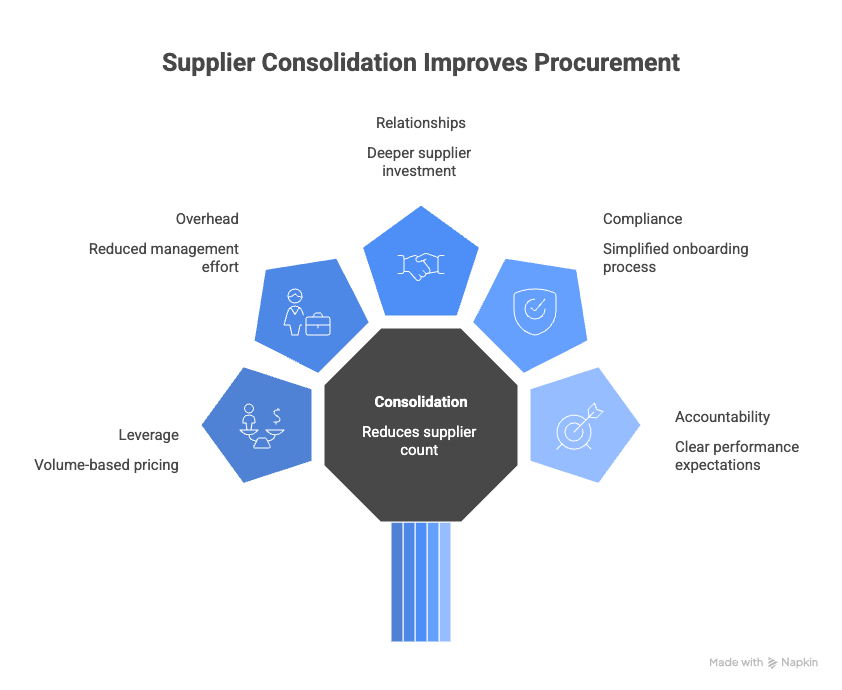
Supplier consolidation is the process of reducing the number of active suppliers in a category by concentrating spend with a smaller group of higher-performing, strategically aligned partners. Rather than distributing purchases across many vendors, consolidation redirects volume to fewer suppliers capable of meeting the full range of organizational requirements. The goal is to improve commercial leverage, reduce management complexity, and deepen supplier relationships — without creating excessive dependency on any single source.
Read more: 7 Supplier Relationship Management Strategies for Asia Pacific Organizations
Why Supplier Consolidation Matters in Procurement
Organizations that grow their supply base organically through fragmented buying accumulate supplier proliferation — too many vendors, too little spend with each, and insufficient leverage across any. Consolidation reverses this by concentrating volume where it generates the most value. For procurement leaders, the case for consolidation is not simply cost reduction: it is also about building a supply base structured for performance, accountability, and strategic alignment rather than one shaped by historical convenience.
The Core Process of Supplier Consolidation
The process begins with a spend and supplier analysis that maps current expenditure across the category, showing how many suppliers are active, what each is being paid, and what proportion of requirements each fulfills. This analysis typically reveals a concentration of spend in a small number of vendors alongside a long tail of low-value, low-volume suppliers who contribute little but generate disproportionate management overhead.
A rationalization target is then set, defining the desired supplier count and the criteria by which suppliers will be retained, developed, or exited. Retention criteria typically include performance history, pricing competitiveness, capacity, geographic coverage, and strategic alignment. Suppliers not meeting the threshold are identified as consolidation candidates.
Procurement engages retained suppliers to renegotiate terms that reflect the increased volume commitment. This is the commercial value delivery moment of consolidation — higher volumes justify improved pricing, service levels, and partnership investment from the supplier. Simultaneously, a structured offboarding process is initiated for exited suppliers.
Post-consolidation, the category is governed through a tighter supplier panel with defined review cycles. Procurement monitors whether the expected commercial and operational benefits have materialized and tracks whether the reduced supply base remains adequate to meet organizational requirements.
Core Components of Supplier Consolidation
- Spend analysis identifies where the current supply base is fragmented and quantifies the volume available for consolidation. Without accurate spend data, consolidation decisions rest on incomplete foundations.
- Supplier segmentation classifies active suppliers by performance, strategic value, and volume to determine which should be retained, developed, or transitioned out of the category.
- Volume commitment negotiation converts the consolidation decision into commercial value. Suppliers must understand what increased volume they will receive and what they are expected to deliver in return.
- Transition and offboarding management ensures that exited suppliers are handled professionally, spend is transferred without operational disruption, and relationships are preserved where future engagement is possible.
Common Pitfalls of Supplier Consolidation
- Consolidating without assessing concentration risk: Reducing supplier count creates dependency. Procurement must confirm that retained suppliers can absorb additional volume without introducing unacceptable supply continuity risk.
- Exiting suppliers without transition planning: Abrupt supplier exits can leave categories temporarily uncovered. A defined transition timeline and spend transfer plan prevent operational gaps.
- Over-consolidating in volatile categories: In categories with significant price volatility or supply disruption risk, maintaining competitive tension through multiple sources may outweigh the leverage benefits of consolidation.
- Failing to renegotiate after consolidation: Concentrating spend without renegotiating terms misses the primary commercial benefit. Volume commitment must be explicitly linked to improved pricing or service outcomes.
Indicators That a Category is Ready for Consolidation
- High supplier count relative to spend volume: A large number of suppliers receiving small, fragmented payments is the clearest signal that consolidation would reduce cost and complexity.
- Inconsistent pricing for equivalent goods or services: Wide price variation across suppliers for similar requirements indicates that spend is not being managed strategically.
- Low spend concentration in top-tier suppliers: If the top three suppliers account for less than 60 to 70 percent of category spend, there is likely room to consolidate further.
- High tail spend ratio: A large proportion of transactions below a materiality threshold signals fragmented buying that consolidation can address.
KPIs of Supplier Consolidation
| Dimension | Sample KPIs |
| Supply Base Scale | Active supplier count by category, year-on-year supplier count reduction |
| Commercial Outcomes | Price improvement achieved post-consolidation, volume rebate captured |
| Management Efficiency | Reduction in supplier onboarding and compliance overhead |
| Risk Balance | Spend concentration ratio, number of categories with single-source dependency |
Key Terms in Supplier Consolidation
- Supplier Rationalization: The broader process of reviewing and restructuring the supply base, of which consolidation is a key outcome.
- Tail Spend: Low-value, high-volume transactions spread across many suppliers, often the primary target of consolidation initiatives.
- Supply Base: The complete set of active suppliers an organization uses to fulfill procurement requirements.
- Volume Commitment: A contractual agreement to purchase a defined quantity from a supplier, used to justify and secure improved commercial terms.
- Preferred Supplier: A supplier designated as the primary or retained source in a category following a consolidation exercise.
- Spend Concentration: The proportion of category spend held by a defined number of top suppliers, a key measure of consolidation progress.
Technology Enablement
Spend analytics platforms support supplier consolidation by identifying fragmented spend patterns, quantifying the volume available for reallocation, and benchmarking pricing across active suppliers. Source-to-Pay platforms track supplier count trends over time and provide the performance data needed to make defensible retention and exit decisions.
FAQs
Q1. What is supplier consolidation?
The process of reducing the number of active suppliers in a category by concentrating spend with fewer, higher-performing partners.
Q2. How is consolidation different from rationalization?
Rationalization is the broader supply base management process; consolidation specifically refers to reducing supplier count and concentrating volume.
Q3. Does consolidation always reduce cost?
Not automatically. Cost benefit depends on renegotiating terms that reflect the increased volume commitment. Consolidation without renegotiation delivers little commercial value.
Q4. How many suppliers should remain after consolidation?
There is no universal answer. The target depends on category complexity, volume, risk tolerance, and the capacity of retained suppliers to absorb additional demand.
Q5. What happens to exited suppliers?
They are offboarded through a structured transition process. Relationships should be managed professionally as future re-engagement may be appropriate under changed circumstances.
Q6. Can consolidation increase supply risk?
Yes, if taken too far. Reducing to a single supplier creates concentration risk. Most categories benefit from retaining at least two qualified suppliers.
References
Explore Zycus resources to learn more about Supplier Consolidation:










