



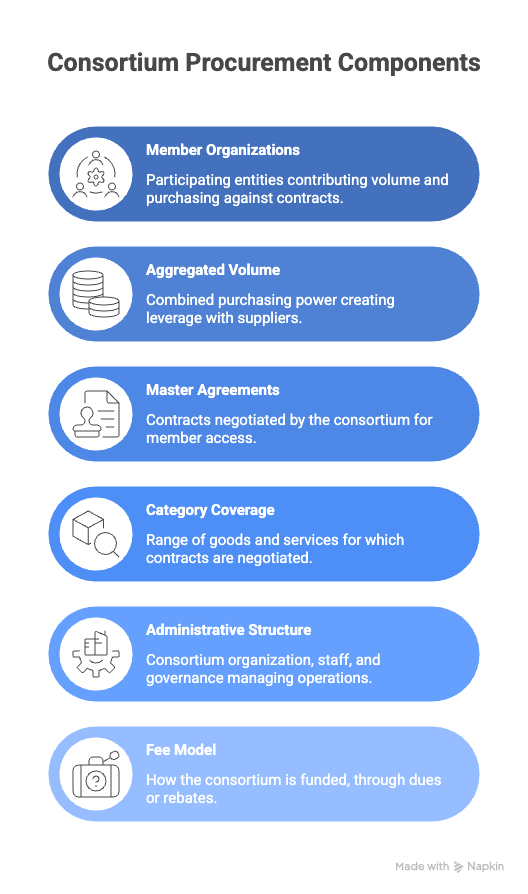
Consortia procurement is a collaborative purchasing approach where multiple organizations join together to aggregate their buying power and negotiate collectively with suppliers. Group purchasing consortia pool the demand of member organizations to achieve volume discounts, better contract terms, and reduced procurement costs that individual members could not obtain alone. Common in healthcare, higher education, and public sector, consortia enable smaller organizations to access pricing and supplier attention typically reserved for large buyers.
Why Consortia Procurement Matters in Procurement
Size matters in procurement negotiations. Suppliers consistently offer better pricing and favorable terms to customers who bring significant volume. Organizations too small to command supplier attention individually can gain leverage by combining their purchasing power through consortia arrangements. Beyond pricing advantages, consortia reduce procurement workload — members benefit from contracts already negotiated without conducting their own lengthy sourcing events. For procurement leaders at small and mid-sized organizations, consortia participation can deliver savings and efficiency that would be impossible to achieve independently.
The Core Process of Consortia Procurement
The process begins with consortia formation or membership. Organizations with similar purchasing needs join together, either creating a new consortium or joining an established group purchasing organization.
The consortia aggregates member requirements. Collective volume across all members is calculated for target categories, demonstrating combined purchasing power to potential suppliers.
Sourcing is conducted on behalf of members. The consortium negotiates master agreements with suppliers, leveraging aggregated volume to secure favorable pricing, terms, and service levels.
Members access negotiated contracts. Individual organizations purchase against consortium agreements, benefiting from pre-negotiated terms without conducting their own competitive processes. The consortium may collect administrative fees or rebates to fund operations.
Key Benefits of Consortia Procurement
- Achieves volume-based pricing discounts that individual members could not negotiate independently through their own sourcing efforts.
- Reduces procurement workload significantly by providing pre-negotiated contracts ready for immediate member use.
- Provides access to professionally negotiated terms and conditions that protect member interests and reduce legal risk.
- Enables benchmarking by sharing pricing data, contract terms, and procurement practice information across the member community.
- Offers smaller organizations the supplier access and dedicated attention typically reserved for large enterprise buyers.
- Shares best practices, category expertise, and procurement knowledge across the member community for continuous improvement.
Common Pitfalls of Consortia Procurement
- Assuming all contracts fit: Consortium contracts may not meet every organization’s specific requirements. Evaluate fit carefully.
- Ignoring local alternatives: Regional or local suppliers may offer better value for some categories. Compare options.
- Passive membership: Value requires active participation. Engage with the consortium to influence contracts that matter to you.
- Hidden costs: Membership fees and administrative charges reduce net savings. Calculate true value after all costs.
When Consortia Procurement Works Best
- Commodity categories. Standardized products where specifications align across members and volume aggregation drives value.
- Similar member needs. Organizations with comparable requirements that can be addressed by common contracts.
- Limited internal resources. When procurement capacity is constrained and ready-made contracts reduce workload.
- Market pricing power. Categories where supplier pricing is volume-sensitive and aggregation creates meaningful leverage.
- Compliance benefits. Public sector environments where consortium contracts satisfy competitive procurement requirements.
KPIs of Consortia Procurement
| Dimension | Sample KPIs |
| Savings | Price discount vs. market, total member savings, savings per membership dollar |
| Participation | Contract utilization rate, member adoption percentage, spend through consortium |
| Coverage | Categories under contract, spend addressable by contracts, contract renewal rate |
| Value | Net savings after fees, member satisfaction scores, contract compliance rate |
Key Terms in Consortia Procurement
- Consortium: An association of organizations that join together for a common purpose, in this case collaborative procurement.
- Group Purchasing Organization (GPO): An entity that aggregates buying power of members to negotiate contracts with suppliers.
- Aggregated Volume: Combined purchasing power of all consortium members used to negotiate better terms.
- Master Agreement: A contract negotiated by the consortium that individual members can access for purchases.
- Piggyback Contract: Using another entity’s competitively bid contract rather than conducting independent procurement.
- Administrative Fee: Charges collected by the consortium to fund operations, typically as a percentage of purchases.
Technology Enablement
Modern Source-to-Pay platforms support consortia participation by enabling seamless access to consortium catalogs and contracts, tracking purchases against consortium agreements, measuring contract utilization rates, and providing analytics that compare consortium pricing and savings realized versus independent procurement alternatives.
FAQs
Q1. What is consortia procurement?
Collaborative purchasing is where multiple organizations combine their collective buying power to negotiate better pricing and contract terms.
Q2. What types of organizations use consortia?
Common in healthcare, higher education, K-12 school districts, state and local government, and nonprofit sectors.
Q3. How do consortia make money?
Through membership fees, administrative fees assessed on purchases, and/or rebates collected from contracted suppliers.
Q4. Are consortium contracts mandatory for members?
Typically no. Members may choose to use available consortium contracts but usually retain freedom to procure independently.
Q5. Do consortium contracts satisfy competitive bidding requirements?
Often yes. Many public procurement regulations explicitly allow use of competitively-bid consortium or cooperative contracts.
Q6. Can for-profit companies join purchasing consortia?
Some consortia serve commercial members, though many focus primarily on nonprofit, education, or government sectors.
References
For further insights into these processes, explore the following Zycus resources related to Construction Procurement:










