

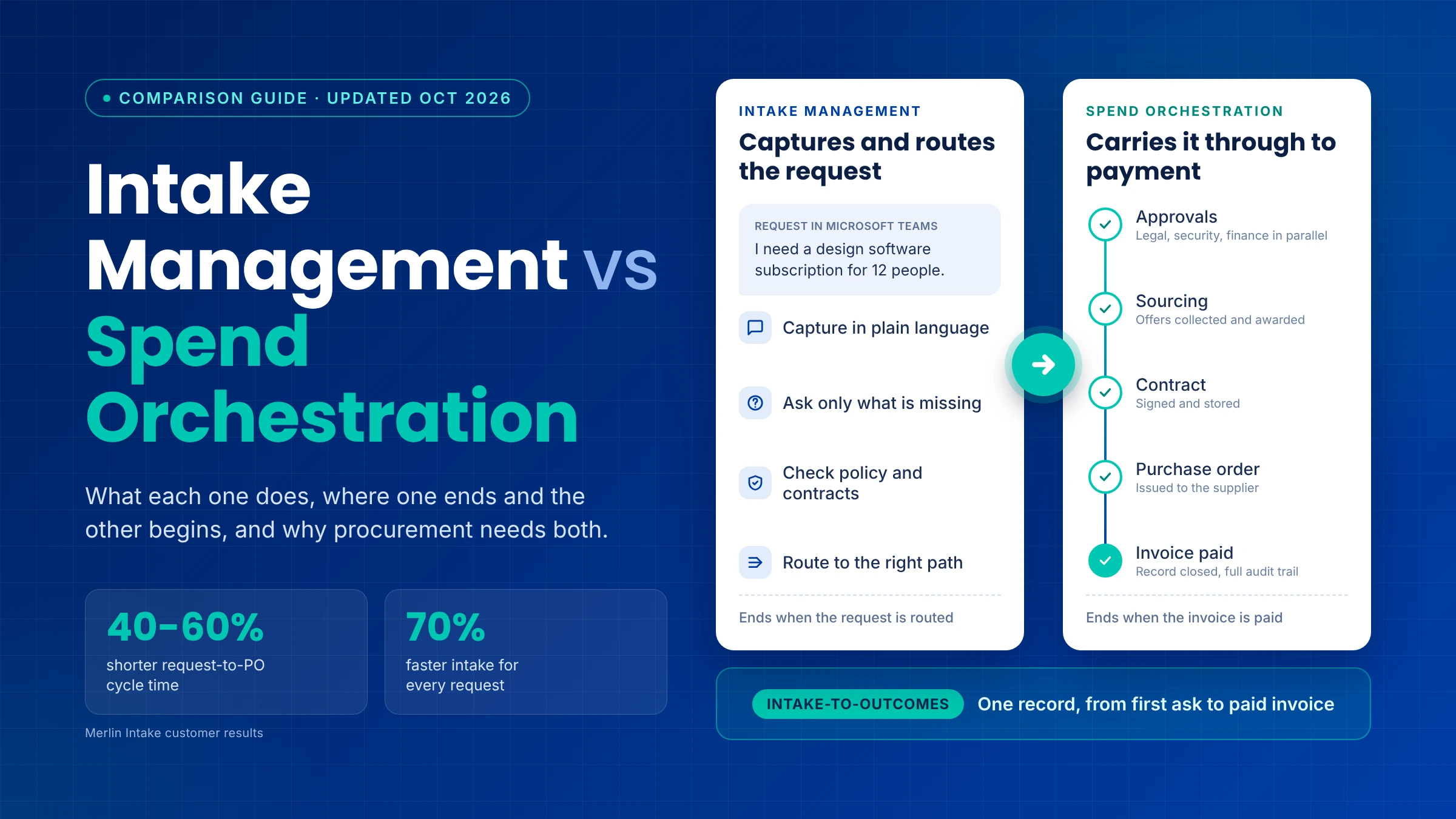

Intake management is the process of capturing, structuring and routing every purchase request through a single front door, so procurement knows what is needed, why, and which path it should take. Spend orchestration is the coordination of everything that happens after that, carrying the request through approvals, sourcing, contracting, purchasing and payment as one governed workflow across teams and systems.
Put simply, intake management decides what a request is and where it should go. Spend orchestration makes sure it gets there and finishes. This guide compares intake management vs spend orchestration side by side, explains where procurement orchestration and intake orchestration fit, and shows how to decide whether you need one, the other or both.
Key takeaways
- Intake management starts when an employee raises a need and ends when the request is routed. Spend orchestration starts there and ends when the invoice is paid.
- “Spend orchestration” and “procurement orchestration” describe the same layer. “Intake orchestration” is intake that also governs the next steps.
- Most enterprises need both. When they run as one flow on one record, nothing is re-entered at the handoff.
Intake management vs spend orchestration at a glance
| Intake management | Spend orchestration | |
| Main question it answers | What is being asked for, and which path should it take? | How does this request get finished, correctly and on time? |
| Where it starts | The moment an employee raises a need, in a chat, an email or a form | The moment a structured request is cleared to move forward |
| Where it ends | When the request is classified, checked against policy and routed: a purchase requisition, a sourcing event, a contract or supplier onboarding | When the outcome is delivered: supplier awarded, contract signed, PO issued, invoice paid and the record closed |
| Who uses it | Requesters across the business, plus procurement triage teams and first-line approvers | Procurement, finance, legal, IT security, risk and suppliers, each acting on their own step |
| What it produces | One complete request with category, budget, policy route and a named owner | Finished transactions (award, contract, PO, paid invoice) under one audit trail |
| Systems involved | Collaboration tools such as Microsoft Teams, Slack and email, plus catalog, contract and supplier records used for checks | Sourcing, contract management, supplier management, procure-to-pay and accounts payable, connected to the ERP (SAP, Oracle, NetSuite) |
| How success is measured | First-pass completeness, time to triage, on-contract buying, adoption | Request-to-PO cycle time, time-in-step by function, SLA compliance, exceptions resolved |
What is intake management in procurement?
Intake management is the front door of procurement. Without it, requests arrive through email threads, chat messages and spreadsheets, procurement sees them late, and policy is checked after the money is already committed. With it, every need enters the same way and carries the context procurement needs to act.
A modern intake layer does five jobs:
- Capture. Employees describe the need in plain language in the tools they already use, such as Microsoft Teams, Slack or email.
- Clarify. The system asks only for what is missing, such as quantity, budget, dates and specs, instead of presenting a long form.
- Check policy. Preferred suppliers, existing contracts, catalogs and budget thresholds are checked before anything is bought.
- Triage and route. The request is classified by category, value and risk, and sent to the right path.
- Show status. The requester can see where the request stands without chasing anyone.
For a fuller definition, see What is Intake Process in Procurement.
What is spend orchestration (or procurement orchestration)?
Spend orchestration, also called procurement orchestration, coordinates the work that turns an accepted request into a finished outcome. Its value sits in the handoffs: which team acts next, which system holds the data, and what happens when something does not fit the normal path.
A spend orchestration layer typically covers four things:
- Workflow across functions. Procurement, finance, legal, IT security and risk review in the right order, or in parallel where they can.
- Connection to systems of record. Sourcing, contracts, supplier records, purchasing and accounts payable stay in sync with the ERP.
- Exception handling. A non-operational supplier, a missing certification or an over-budget request goes to a named owner instead of stalling in an inbox.
- One audit trail. Every decision is logged against the original request, from first ask to payment.
See how Zycus approaches procurement orchestration.
How does a request move from intake to orchestration?
Take a common request: a marketing team needs a new design software subscription.
- Intake. The requester describes the need in Microsoft Teams. Intake asks only for what is missing, such as number of seats, budget and start date.
- Intake. The request is checked against policy. No existing contract covers it, so it is routed to a sourcing path, with a security review flagged because it is new software.
- Orchestration. Security and legal reviews run in parallel while offers are collected from suppliers.
- Orchestration. The award becomes a contract and then a PO, with the new supplier onboarded in between.
- Orchestration. The invoice is matched and paid, and the original request shows as complete, with every step in one audit trail.
Steps 1 and 2 are intake management. Steps 3 to 5 are orchestration. The handoff between step 2 and step 3 is where context gets lost if the two run in separate systems and the request has to be re-entered.
Intake management vs procurement orchestration: Is it a different comparison?
Not really. Comparing intake management vs procurement orchestration asks the same question as comparing intake management vs spend orchestration, with a different name for the second layer. “Spend orchestration” puts the focus on the money moving through the business, while “procurement orchestration” puts it on the process procurement owns. Both describe coordinating request, sourcing, contract, PO, invoice and payment as one governed flow.
The more useful question is scope. Orchestration can cover only the steps around a request, such as approvals and notifications, or it can carry the request into sourcing, negotiation, contracting and payment. Ask how far the orchestration reaches before comparing products. Analysts often group the market as “intake and orchestration” for the same reason: buyers rarely evaluate one without the other.
Intake management vs intake orchestration
Intake management captures and structures a request. Intake orchestration governs what happens next: classifying the request, applying policy, routing the work and tracking it through to payment. Intake orchestration is the bridge between the two layers. It begins at the front door but reaches into the downstream workflow.
| Term | What it covers | Where it stops |
| Intake management | Capturing and structuring the request | When the request is routed |
| Intake orchestration | Intake, plus classifying, applying policy, routing and tracking the next steps | When the downstream work is tracked to completion |
| Procurement orchestration (spend orchestration) | Coordinating every step and system from request to payment | When the invoice is paid and the record is closed |
Which KPIs show that intake and orchestration are working?
Measure the two layers separately, so you can see exactly where a request slows down.
| Layer | KPI | What it tells you |
| Intake | First-pass completeness | Share of requests that need no follow-up questions |
| Intake | Time to triage | How fast a request reaches the right path |
| Intake | On-contract purchase rate | Whether policy steers buying to existing contracts and preferred suppliers |
| Intake | Adoption | Share of requests coming through the front door instead of email |
| Orchestration | Request-to-PO cycle time | End-to-end speed from first ask to PO |
| Orchestration | Time-in-step by function | Which review (legal, security, finance) is the bottleneck |
| Orchestration | SLA compliance | Whether each step finishes on time |
| Orchestration | Exceptions resolved | How many issues reach a named owner and get fixed instead of stalling |
For early warning signs, see Which intake KPIs tell you something before it is too late?
Do you need both intake management and spend orchestration?
For most enterprises, yes. Intake without orchestration gives you clean requests that still stall at the handoff to sourcing, legal or finance. Orchestration without intake runs a governed process on incomplete requests, so approvers chase missing details and off-policy buying slips through.
Where to start depends on where requests break down today. If they arrive incomplete, off-policy or by email, start with intake. If clean requests stall between legal, security, finance and procurement, start with orchestration. Either way, choose a platform that covers both, so the handoff does not have to be rebuilt later.
That is why Zycus treats them as one flow, which we call Intake-to-Outcomes (I2O). Merlin Intake is the front door to the Merlin Agentic Platform. Employees ask in plain language in Microsoft Teams, Slack or email, and Merlin Intake applies policy and routes the request to the right path: a direct PO, Merlin Autonomous Negotiation Agents or Merlin Autonomous Sourcing. Because Merlin Intake is built into the Zycus Source-to-Pay suite, the request that enters is the same record that moves through sourcing, contracting and payment.
Teams on another suite or ERP can connect through 1,121 APIs and an MCP server, starting with intake on their current stack and extending orchestration at their own pace. The result is Autonomous Procurement, powered by Agentic AI, on the Merlin Agentic Platform.
What results do Zycus customers see?
Across deployments, Zycus customers using Merlin Intake report a 40-60% reduction in request-to-PO cycle time, 70% faster intake for every request and 2-3x higher platform adoption. Four customer examples:
- Delta Air Lines reduced procurement cycle time by 81% with the Zycus Source-to-Pay suite, across 10 procurement portfolios. Its procurement team is now, in the words of Managing Director Niteen Suresh, “clearly considered a ‘trusted advisor’ across the business.” Read the Delta story
- A fast-growing NetSuite customer moved purchase requests out of email and spreadsheets by adding Zycus as a procurement layer over NetSuite, without replacing its ERP, and cut PR-to-PO cycle times by up to 75%. – Read the entire NetSuite case study.
- Tate & Lyle combined request intake, workflow orchestration and execution into one guided process. Dave Everett, Global Head of Indirect Procurement, walks through the journey in From Intake Chaos to Business Outcomes.
- Nordea chose Zycus as a partner with “AI built into it, not bolted onto it.” – Read the entire procurement transformation journey
What to look for in an intake and orchestration platform?
Use these seven checks when you shortlist. Test each one with a real request from your own business, not a scripted demo.
- Requests come in where people already work. Microsoft Teams, Slack and email, with no new portal to learn.
- Policy is applied before the PO. Preferred suppliers, contracts and budget are checked at the point of request, not audited afterward.
- Routing starts the actual work. The request lands in a PO, a negotiation or a sourcing event, not only a notification.
- One record from request to payment. Nothing is re-keyed at the handoff between intake and orchestration.
- It works with your current systems. The ERP stays the system of record, connected through APIs.
- Procurement owns the rules. Routing and policy changes do not wait for developer tickets.
- Every decision is traceable. One audit trail covers approvals, exceptions and outcomes.
Merlin Intake meets all seven, as part of the Zycus Source-to-Pay suite or over the systems you already run. For a deeper evaluation guide, see How to Evaluate Procurement Intake Software: 7 Criteria That Matter.
Conclusion: one front door, one governed flow
Intake management and spend orchestration answer different questions. Intake decides what a request is and where it goes. Orchestration makes sure it finishes. Treat them as two separate projects and the handoff between them becomes the place where requests are re-keyed, approvals stall and policy slips.
Treat them as one flow and every request is captured once, checked once and carried on one record from first ask to paid invoice. That is the idea behind Intake-to-Outcomes. With Merlin Intake on the Merlin Agentic Platform, the front door and the downstream work run as one governed flow. The question stops being “intake or orchestration?” and becomes “how many handoffs stand between a request and its outcome?”
Bring a real request from your business. We will show you how Merlin Intake captures it in plain language, applies your policy and carries it through sourcing, contracting and payment on one record.
Request a demo or Try the interactive Merlin Intake demo
Related Reads
- Orchestration or choreography: which pattern does intake-to-ERP need?
- Procurement Intake vs eProcurement: Which Should You Implement First?
- Guide to Procurement Orchestration [2026]
- Benelux: Beyond S2P from Intake to Outcomes with Agentic AI
- From Intake Chaos to Business Outcomes: A Procurement Transformation Story
- Rethinking Intake Management: From Gatekeeping to Intelligent Orchestration
Frequently asked questions
1. What is the difference between intake management and spend orchestration?
Intake management captures, structures and routes a purchase request at a single front door. Spend orchestration coordinates everything after that: approvals, sourcing, contracting, purchasing and payment, across teams and systems. Intake ends when the request is routed. Orchestration ends when the invoice is paid.
2. Is spend orchestration the same as procurement orchestration?
In practice, yes. Both terms describe coordinating the people, systems and steps that take a purchase request through approval, sourcing, contracting, purchasing and payment. “Spend orchestration” emphasizes the money, and “procurement orchestration” emphasizes the process. When evaluating platforms, ask how far the workflow goes: from the first request all the way to a paid invoice, or only part of the way.
3. What is the difference between intake management and intake orchestration?
Intake management captures and structures a request. Intake orchestration governs what happens next, which means classifying the request, applying policy, routing the work and tracking it through to payment. Merlin Intake does both, so the request that enters is the same record that moves through sourcing, contracting and payment.
4. Can you run intake management without spend orchestration?
Yes, and many teams start there. Intake on its own improves request quality and policy compliance at the front door. The limit shows up at the handoff: if sourcing, contracting and payment run in separate systems, the request has to be re-entered or tracked by hand. Choosing intake that is part of an orchestration platform avoids that rework later.
5. Should you implement intake or orchestration first?
Start where requests break down. If requests arrive incomplete, off-policy or by email, start with intake. If clean requests stall between legal, security, finance and procurement, start with orchestration. Choose a platform that covers both, so the handoff does not need to be rebuilt later.
6. Do you need to replace your ERP to add intake and orchestration?
No. Your ERP stays the system of record, and intake and orchestration run around it. Zycus connects to SAP, Oracle and NetSuite through 1,121 APIs, native connectors and the Merlin MCP Server, covering master data, PO and invoice flow, and vendor records.
7. Who owns intake and orchestration inside an organization?
Procurement usually owns both: the front-door experience, the policy rules and the routing logic. Finance, legal, IT security and risk own their own review steps inside the orchestrated flow. Business users only see the front door. They ask, answer a few questions and track status.
8. How does AI change intake and orchestration?
AI reads the intent behind a plain-language request, asks only the missing questions and classifies it, which removes most form-filling. On the orchestration side, AI agents can act on the routed work, such as negotiating a tail-spend purchase or preparing a sourcing event, under the same policy and audit trail. Zycus delivers this as Autonomous Procurement, powered by Agentic AI, on the Merlin Agentic Platform.