


Parking procurement transformation behind a massive ERP program is often framed as risk management, but the true cost of waiting for ERP go-live rarely appears on IT budgets. While leaders delay, addressable spend stays unmanaged, deferring millions in contract savings while legacy supplier data ages. Ardent Partners notes that every dollar brought under procurement management yields 6% to 12% savings in the initial contract period.
This article outlines how to calculate the cost of waiting for ERP go-live, uncover hidden deferred savings, and use early source-to-pay transformation to help fund broader IT initiatives. The cost of parking procurement transformation behind an ERP program never appears on the ERP budget. Here is how to put a number on it, and why it can become a funding source instead.
TL;DR
- Waiting for ERP go-live looks free because nobody prices it. Its cost sits on procurement’s budget, not the ERP program’s.
- Ardent Partners reports that every additional dollar brought under procurement management yields savings of 6% to 12% during the initial contract period.
- On an illustrative $360M of unmanaged spend, that is $21.6M to $43.2M of savings deferred.
- The Hackett Group puts S2P payback at about one year after implementation, with ROI exceeding 5x.
- Savings banked early can help fund the ERP program instead of waiting behind it.
- Size the cost in your own numbers with the worksheet in the ebook: Procurement Doesn’t Have to Wait for the ERP
More than most business cases show. While procurement waits for ERP go-live, spend that could be brought under management stays outside it, and the savings it would earn are deferred. Ardent Partners reports that every additional dollar brought under procurement management yields savings of 6% to 12% during the initial contract period. None of it appears on the ERP program’s budget; it sits on procurement’s. This article is for CPOs and finance leaders deciding whether to hold procurement transformation until the ERP is live.
Why does waiting look free?
Because nobody prices it. An ERP program has a budget line, a steering committee and a business case. The decision to hold procurement until go-live has none of those. It is usually agreed in a single meeting, framed as prudence, and rarely revisited.
Delay itself is not a new problem, and the cost of delayed procurement transformation is well documented. The ERP version is harder to see, because the wait is attached to someone else’s program and its length is set by someone else’s timeline.
There is also an asymmetry in who sees the cost. If the ERP program slips, its overruns are visible and reported. If procurement’s start slips with it, the deferred savings stay invisible, because savings that were never captured do not appear in any report.
How do you put a number on the wait?
Start with the spend procurement does not manage yet. Ardent Partners reports that “every additional dollar of spend brought under procurement management yields savings of 6% to 12% during the initial contract period.”
That rate is what waiting defers. Take an illustrative enterprise with $800M of addressable spend, $440M of it under management. The $360M outside management, at 6% to 12%, represents $21.6M to $43.2M of savings in the initial contract period (Figure 1). This is not a forecast, and not an annual figure. It assumes the spend is actually brought under management, which is the work procurement transformation does.
Then add time. The longer the wait, the longer that spend stays unmanaged. A wait that stretches from one budget year into the next defers savings in both.
The exact number matters less than the fact that it exists, can be estimated, and belongs in the decision. The ebook includes a worksheet to do this with your own figures.
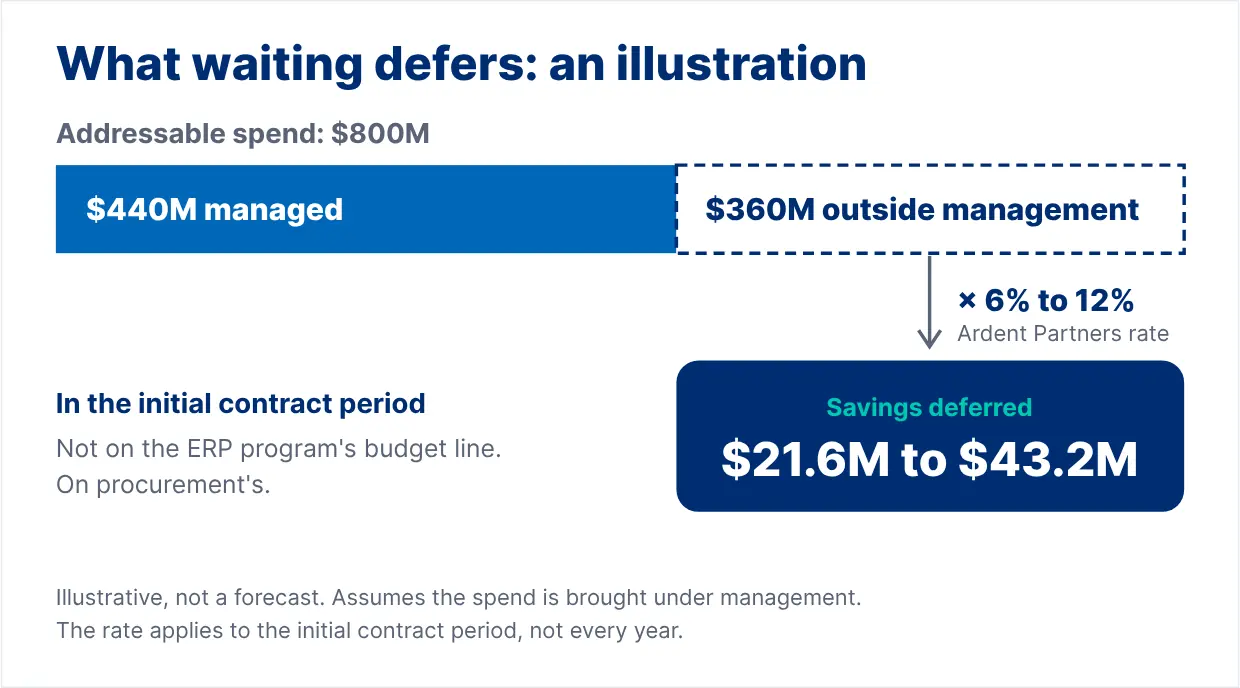
Figure 1: Illustrative savings deferred while procurement waits for ERP go-live.
What else does the bill include besides deferred savings?
Data. While procurement waits, the records the ERP migration will eventually inherit keep aging. Supplier records are the clearest example: duplicates multiply and documents expire, and every one becomes cleanup work for the migration team later, usually at the busiest point in the program. Contracts that renew without review and spend that stays unclassified follow the same pattern: each is cheaper to fix before the migration than during it.
This is the hidden half of the cost. It does not show up as lost savings. It shows up as migration effort, on a different budget again. The ebook shows where that work lands, and how procurement going first changes who does it and when.
How quickly does procurement technology pay back?
Faster than most ERP programs run. The Hackett Group estimates that “the payback period for an S2P technology implementations is approximately one-year post-implementation” with “an ROI exceeding 5x,” and argues that “the savings generated by your S2P technology can help fund your ERP implementation or future projects.”
Set that against an ERP wait measured in years. A procurement capability started now can pay for itself well before the final business unit goes live, while the same capability started after go-live begins its payback clock only then.
That changes the risk comparison too. The risk of starting early is some rework when the new ERP arrives. The risk of waiting is a payback clock that does not start at all.
Can procurement savings help fund the ERP program?
Yes, and that changes the conversation with the CFO. Waiting treats procurement as a cost the ERP program cannot absorb yet. Going first treats it as a source of savings the program can draw on.
The case that digital procurement adds savings is long-standing.
The reversal follows directly: savings banked during the ERP program are savings that can help pay for it.
It also changes the politics. A procurement team that arrives at the ERP steering committee with savings already banked negotiates from a different position than one asking for a slot after go-live.
How do you build a business case your CFO will sign?
Keep it to four lines: the spend outside management today, the savings rate you apply, how long the wait would last, and the payback period of the procurement investment. A CFO can test each line.
Each line should carry its own source. The spend figure comes from your spend data, the rate from published research, the duration from the ERP program’s own plan, and the payback from vendor evidence tested against independent benchmarks.
Then show operating evidence. In Zycus customer deployments, Merlin Intake has delivered a 20% improvement in spend under management (2025 customer benchmark), which feeds straight into the first line. Built-in beats bolt-on here: because intake, sourcing and contracting share one data model, the spend captured at the front door is spend procurement can actually manage. Intake runs on the Merlin Agentic Platform alongside the existing ERP, so the case does not depend on go-live. That is the practical meaning of Intake to Outcomes: savings start at the request.
What should you bring to the steering committee?
A number, a date and a choice. The number is the savings deferred. The date is the final business unit’s go-live, and how far it has moved. The choice is whether waiting is still worth what it costs.
Present them side by side. A steering committee can accept a wait it has priced. What it should not accept is a wait nobody has priced at all. If you are still deciding whether to wait at all, start with our companion article, Should procurement wait for the ERP go-live?
Waiting is also a decision. The ebook helps you write it down, with a cost worksheet, a readiness scorecard and a three-stage plan.
Procurement Doesn’t Have to Wait for the ERP. A three-stage plan to start now and connect as your ERP program moves. Published by Zycus. Download the ebook →
Conclusion
Ignoring the cost of waiting for ERP go-live results in silent losses from deferred savings and mounting data cleanup for future migrations. Because The Hackett Group estimates source-to-pay payback at roughly one year with an ROI over 5x, deploying solutions like Merlin Intake alongside legacy systems lets CPOs capture spend under management immediately.
Ready to calculate your deferred savings and accelerate time-to-value? Request a free demo today.
Frequently asked questions
1. Is it cheaper to wait for ERP go-live before transforming procurement?
Usually not. Waiting avoids some rework at go-live, but it defers savings on spend that could be brought under management in the meantime. Ardent Partners puts those savings at 6% to 12% for each additional dollar during the initial contract period. That deferred value rarely appears in the ERP business case, so the comparison is often made without it.
2. How do you calculate the cost of delaying procurement transformation?
Multiply the spend outside procurement management by a savings rate for newly managed spend, then consider how long the wait will last. Using Ardent’s 6% to 12% range, $360M of unmanaged spend represents $21.6M to $43.2M in the initial contract period. Treat the result as an estimate to test, not a forecast.
3. What is spend under management, and why does it matter here?
Spend under management is the share of an organization’s spend that procurement actively sources, contracts and governs. It matters because savings come from managed spend. Every month procurement transformation waits, spend that could move under management stays outside it, and the savings it would earn are deferred.
4. How fast does source-to-pay software pay back?
The Hackett Group estimates that source-to-pay technology pays back in approximately one year after implementation, with ROI exceeding 5x. Against ERP programs that often run for several years, that means a procurement capability started now can pay for itself before the ERP program finishes.
5. Can procurement savings fund an ERP migration?
They can help. The Hackett Group argues that savings from source-to-pay technology can help fund ERP implementation or future projects. Starting procurement transformation during the ERP program turns it from a cost the program cannot absorb into a source of savings it can draw on.
6. How does Merlin Intake increase spend under management?
Merlin Intake routes every request through one front door and codes it correctly from the start, so more spend flows through governed sourcing and contracting. In Zycus customer deployments it has delivered a 20% improvement in spend under management (Zycus 2025 customer benchmark). It runs alongside the existing ERP, so it does not depend on go-live.
7. Does the 6% to 12% savings rate apply every year?
No. Ardent Partners describes it as savings during the initial contract period for each additional dollar brought under management. It also assumes the spend is actually brought under management. Use it to size what waiting defers, not as a recurring annual return.
8. What data problems does waiting create for an ERP migration?
While procurement waits, the data the migration will inherit keeps aging. Supplier records duplicate and documents expire, and that cleanup lands on the migration team later. Procurement going first can hand the program cleaner data before conversion, though no study yet measures how much that reduces migration risk.