








As organizations struggle with fragmented purchasing workflows, choosing the right procurement intake software has become a critical priority for modern finance and operations teams. Knowing how to evaluate procurement intake software effectively can mean the difference between seamless adoption and employee frustration. Before making a commitment, establishing clear procurement intake software evaluation criteria ensures you select a platform that simplifies demand, enforces compliance, and drives real business value from day one.
TL;DR
- Evaluate procurement intake software across seven dimensions: request coverage, routing logic depth, policy enforcement, data captured at entry, integration surface, requester experience, and configuration ownership.
- Do not weight every criterion equally. The right weighting depends on whether your primary problem is leakage, adoption, downstream exceptions, or operational rigidity.
- Policy enforcement point, requester experience, and configuration ownership deserve special attention because they are difficult to redesign after implementation.
- Feature scorecards miss exception handling, administrative effort, integration failures, and real requester behavior. Test those through scripted demos using your own procurement requests.
- The strongest platform is not the one with the longest feature list. It is the one that handles your normal requests, exceptions, and downstream handoffs with the least operational friction.
Procurement intake software can look deceptively similar in a controlled demonstration. Most platforms can show a front door, dynamic forms, approval routing, dashboards, and integrations.
The differences usually emerge after go-live: when a request spans two categories, policy needs to act before a commitment is made, an ERP rejects a record, or procurement needs to change a routing rule without waiting for IT.
This guide provides a practical framework for evaluating procurement intake software: seven criteria to assess, how to weight them against your actual problem, which decisions are hardest to reverse, and the vendor-demo scenarios that expose weaknesses a conventional scorecard may miss.
Supplier Risk Management Framework: A Comprehensive Approach to Mitigating Supplier Risks
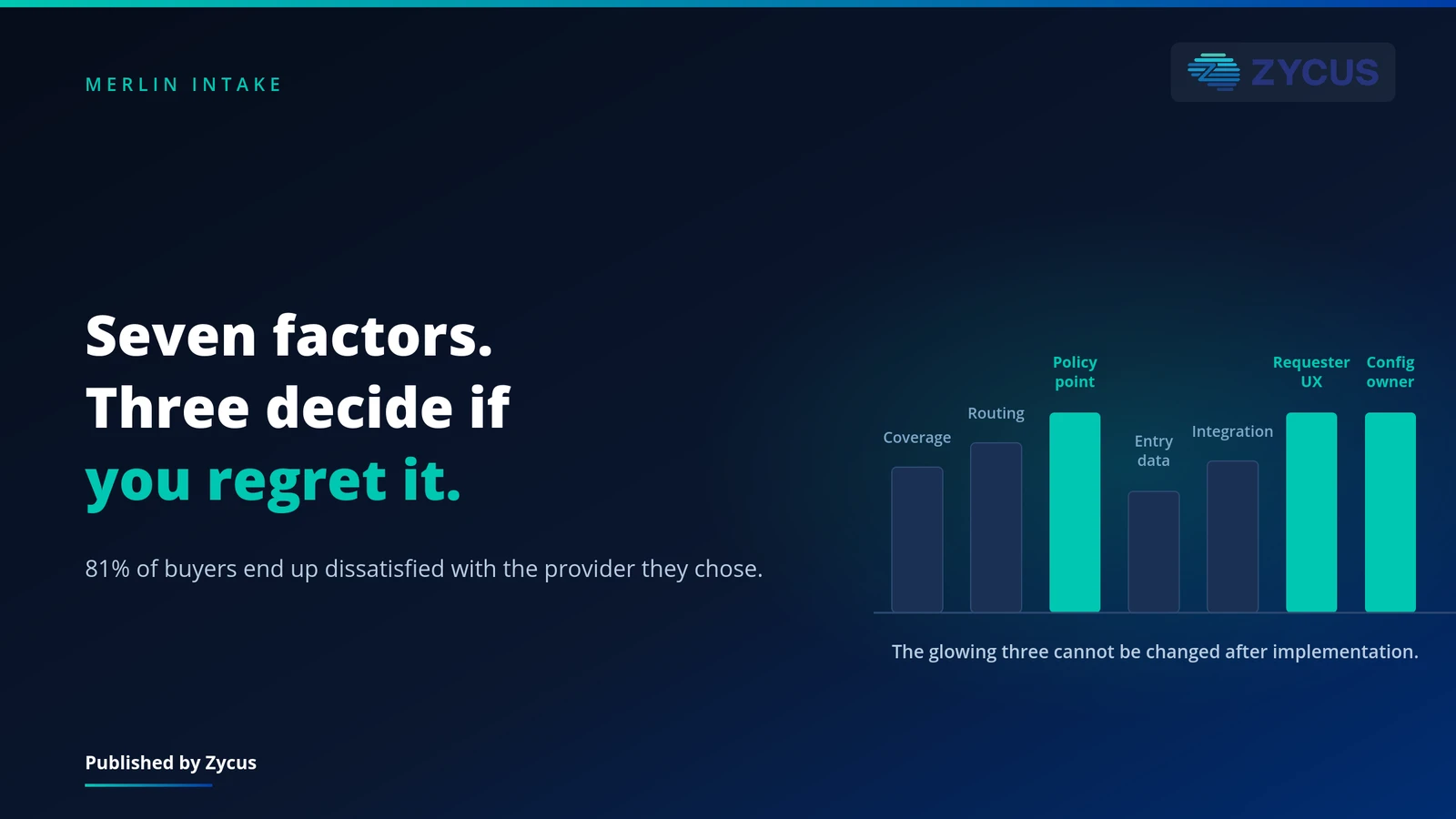
Forrester’s The State Of Business Buying, 2024 found that 81% of buyers expressed dissatisfaction with the provider they selected at the end of a purchase process.
That finding is broader than procurement intake software, but it makes the evaluation question worth taking seriously: what should you test before a polished demo becomes an operating system your organization has to live with?
What Criteria Should You Use to Evaluate Procurement Intake Software?
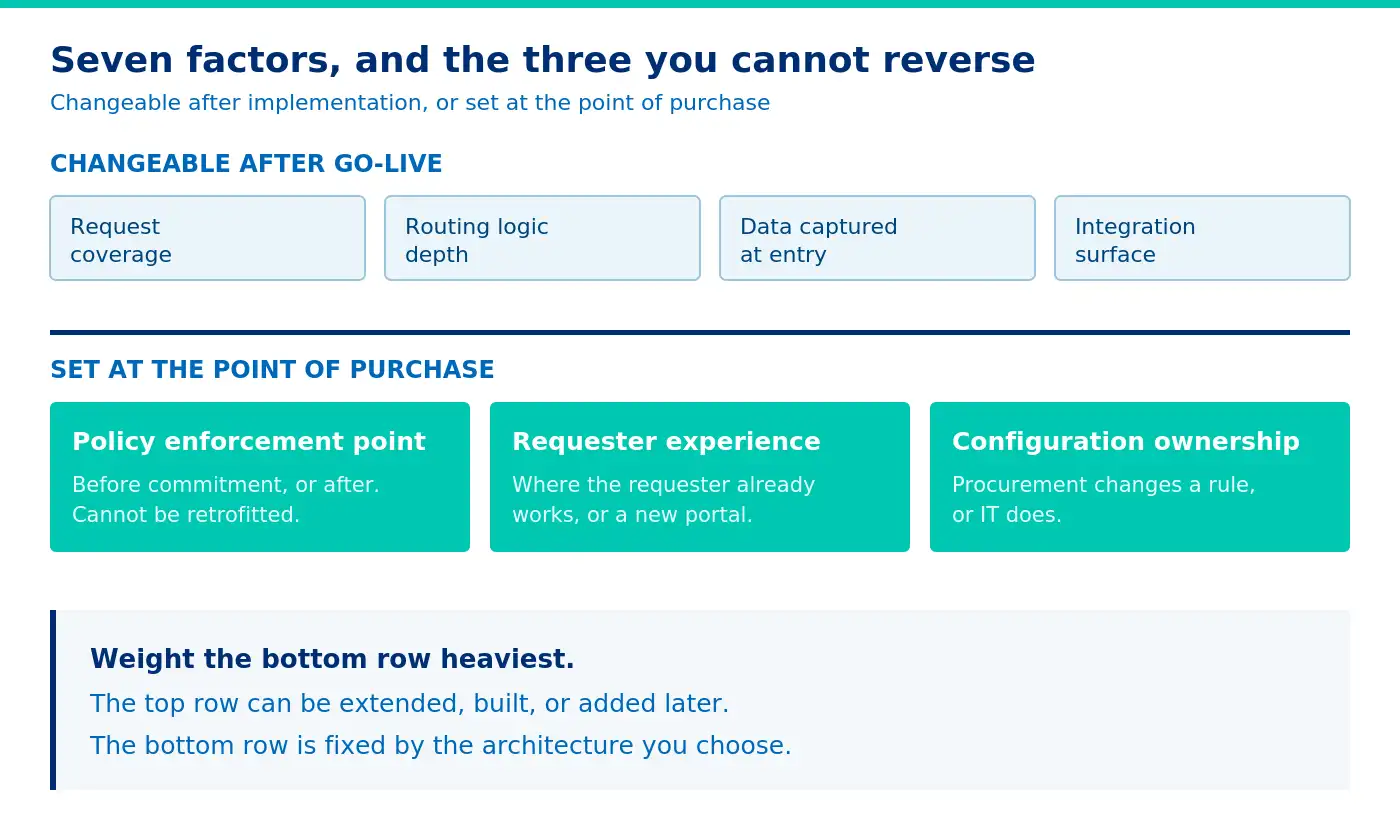
Seven factors meaningfully separate procurement intake platforms. The important question is not simply whether a capability exists, but how it behaves under a real procurement scenario.
- Request Coverage
- Request coverage measures how many procurement request types can genuinely enter through the same front door.
- A platform that handles software purchases but sends contract renewals, supplier onboarding, or sourcing requests elsewhere has not created a single procurement intake experience.
- Coverage gaps matter because requesters quickly learn which needs the platform cannot handle. Those gaps are where email, chat, spreadsheets, and off-channel buying begin to reappear.
- What to test: Run different request types through the same entry point and see whether the requester needs to know which procurement process sits behind each one.
- Routing Logic Depth
- Routing logic determines whether the procurement intake process responds intelligently to the request or simply forwards a form to a predefined queue.
- A strong platform should be able to alter the route based on attributes such as category, value, supplier status, entity, risk, contract status, or other request data.
- What to test: Change one important field during a demo and see whether the workflow changes automatically.
If every request follows essentially the same path until a procurement professional manually triages it, the platform has digitized intake without materially reducing intake work.
- Policy Enforcement Point
- The important question is not whether procurement policy exists in the platform. It is when the policy acts.
- Budget thresholds, preferred-supplier requirements, approval limits, or compliance checks create significantly more value when they influence the purchase before the requester commits.
- Policy applied after a decision has already been made is largely reporting on non-compliance rather than preventing it.
- What to test: Submit a request that violates an approval threshold or supplier rule and observe whether the platform prevents, redirects, or merely flags the issue later.
- Data Captured at Entry
- Procurement intake software should collect the information downstream processes actually require, not simply the information that fits conveniently into a request form.
- The evaluation should focus on whether the platform captures structured, validated data that sourcing, contracting, supplier management, ERP, finance, security, and other systems can use without re-entry.
- What to test: Ask the vendor to show exactly which fields are written downstream and what happens when required information is missing.
Better intake is not simply better forms. It is better data entering the procurement workflow.
- Integration Surface
- A list of integrations does not tell you how an integration behaves operationally.
- Evaluate what the platform reads from and writes to: ERP, contract repository, supplier master, sourcing systems, finance applications, risk platforms, and other relevant systems.
- Then test the failure path.
- What to test: Ask what happens when a downstream system rejects a record. Who sees the failure? Is context preserved? Can the transaction be retried? Does somebody have to copy the information manually?
Integration failures are where procurement intake projects can quietly accumulate operational work after implementation.
- Requester Experience
- Procurement intake succeeds only if employees actually use the compliant path.
- The real competitor is often not another intake platform. It is email, Teams, Slack, or messaging someone in procurement directly.
- A technically capable platform can therefore underperform if users need to understand procurement terminology, find the right portal, select the right process, and complete a long form before they can ask for what they need.
- What to test: Give the platform to a business requester who does not know procurement terminology and ask them to submit an unfamiliar purchase request without assistance.
- Configuration Ownership
- This factor receives less attention during selection than it deserves.
- Routing rules, thresholds, categories, approvers, compliance requirements, and organizational structures will change after go-live.
- Who changes the workflow when procurement changes? If a procurement administrator can modify rules directly, the platform can evolve with the operating model. If every adjustment becomes an IT ticket or vendor request, routine business changes create recurring cost and delay.
- What to test: Ask the vendor to change a routing rule during the demo and watch who performs the change and how long it takes.
Download A Free Revolutionizing Procurement The Rise of Intake Management Whitepaper
How Should You Weight Procurement Intake Software Evaluation Criteria?
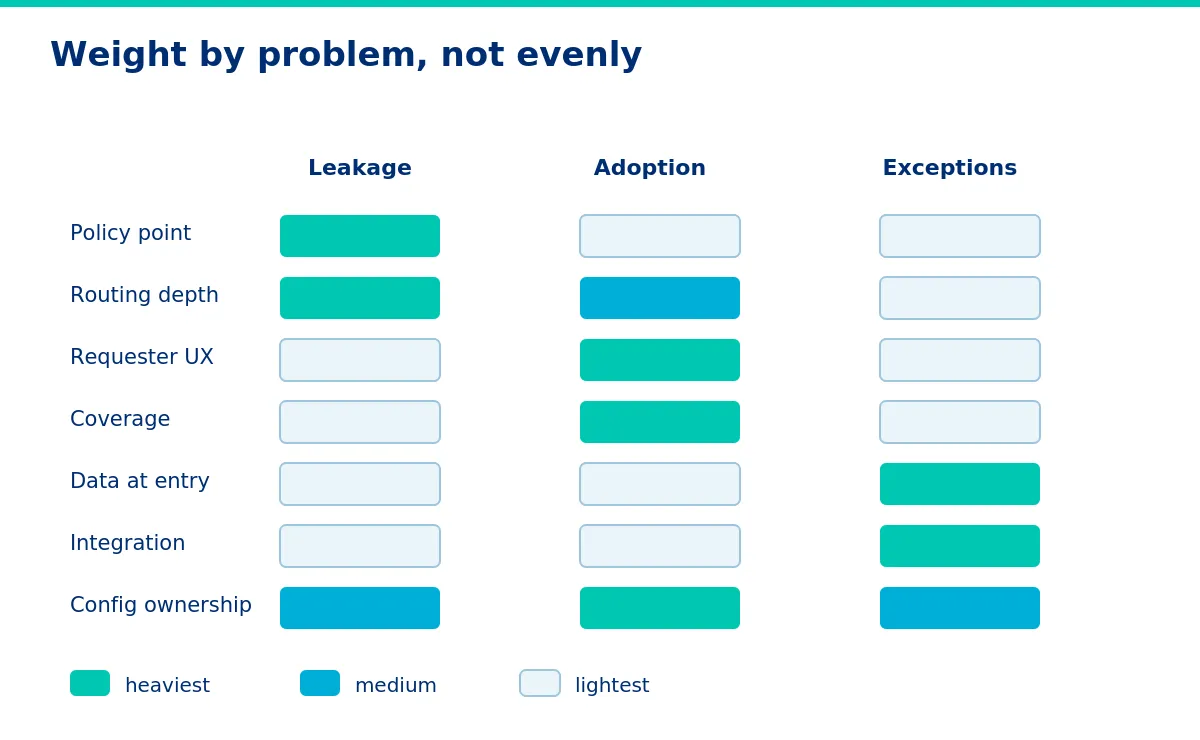
Equal weighting looks objective, but it often hides the actual reason the organization is buying the platform.
The better approach is to identify the failure you are trying to fix first and build the evaluation weights around it.
| Primary problem | Criteria to weight most heavily |
| Spend or policy leakage | Policy enforcement, routing depth, request coverage |
| Low requester adoption | Requester experience, request coverage |
| Downstream errors and rework | Data captured at entry, integration surface |
| Frequent organizational or policy change | Configuration ownership, routing logic depth |
| Fragmented procurement technology | Integration surface, structured data, routing |
- If your primary problem is leakage, policy enforcement and routing depth should matter more than dashboard flexibility.
- If adoption is the problem, requester experience and request coverage should carry more weight.
- If requests arrive downstream incomplete or incorrectly structured, data capture and integration behavior should dominate the scorecard.
- Weighting all seven equally often produces a platform that scores well in aggregate while solving no specific problem particularly well.
- Define the failure mode first. Build the scorecard second.
Which Procurement Intake Software Decisions Are Hardest to Reverse?
Three factors deserve to be treated differently from ordinary feature criteria:
- Policy enforcement point
- Requester experience
- Configuration ownership
These are important because they are closely tied to the platform’s architecture and operating model.
Policy Enforcement Point
A budget or supplier check that happens before commitment can prevent leakage.
The same control operating after a purchase decision has already been made may identify the problem without preventing it.
The evaluation should therefore examine not only whether a platform supports policy controls but where those controls sit in the decision flow.
Requester Experience
A portal-first experience cannot always be transformed later into an experience embedded in the tools employees already use.
The interface through which users interact with procurement influences whether the platform becomes the default path or another system employees learn to bypass.
Configuration Ownership
Request types can often be added later. Integrations can be extended. Additional fields can be introduced.
But the underlying model determining whether procurement or IT controls workflow configuration is usually much harder to change.
That makes configuration ownership an architecture question, not simply an implementation preference.
Gartner surveyed 1,120 respondents and found that 56% of organizations reported a high degree of purchase regret over their largest technology-related purchase in the previous two years, with high-regret organizations taking 7 to 10 months longer on average to complete the purchase.
That research covers enterprise technology purchasing broadly rather than procurement intake specifically. It does not establish that these three intake criteria statistically predict regret.
The practical point is narrower: these three choices deserve heavier scrutiny because changing them after implementation can be materially harder than extending request coverage or adding fields.
For that reason, procurement teams should consider treating them as evaluation gates, not merely additional points in a weighted scorecard.
Download Procurement Automation: Overcoming dearth of Supplier Adoption Whitepaper
Procurement Intake vs. Procurement Orchestration: What Should You Evaluate Separately?
Procurement intake and procurement orchestration are closely related but should not be treated as the same capability.
Procurement intake is the entry layer. It captures the business requirement, collects relevant information, applies initial policy, and determines where the request needs to go.
Procurement orchestration coordinates the work that follows across systems and stakeholders.
For example, a software request may begin through intake but then require procurement, finance, legal, security, supplier management, and ERP workflows to complete.
A strong front door does not automatically prove strong orchestration.
When evaluating procurement intake and orchestration together, test both:
- Can the platform understand and route the original request correctly?
- Can it coordinate the downstream steps without losing context or introducing manual handoffs?
This distinction becomes particularly important when comparing procurement orchestration platforms that also position themselves as intake solutions.
What Does a Strong Procurement Intake Process Look Like in Practice?
A useful way to evaluate procurement intake software is to look at what happens after a requester says, “I need to buy this.”
With Zycus Merlin Intake, that request can begin in Microsoft Teams or Slack in plain language rather than through a separate procurement portal. Merlin Intake gathers the information needed to understand the request, applies procurement policies and approval rules, and dynamically routes it based on factors such as category, supplier, spend threshold, and workflow requirements.
The important distinction is that intake does not stop once the request has been captured. Because Merlin Intake is built into the broader Zycus Source-to-Pay environment, an approved request can move directly into the appropriate sourcing, contracting, supplier, or buying workflow instead of creating another manual handoff between an intake tool and the system that actually executes the work.
That architecture addresses several of the evaluation criteria discussed above at the same time:
- Requester experience: employees can start where they already work.
- Policy enforcement: controls can act at the point of request rather than after commitment.
- Routing depth: workflows can adapt to the context of the request.
- Integration: intake can continue into downstream procurement execution.
- Configuration: workflows can be adapted as procurement policies and operating models change.
For procurement teams comparing platforms, this is the more useful benchmark: not simply whether software can capture a request, but whether it can turn that request into a governed procurement outcome without adding friction for the requester or manual work for procurement.
Request a free demo for Merlin Intake.
Frequently Asked Questions
1. What is procurement intake software?
Procurement intake software provides a structured front door for purchase requests. It captures requester needs, applies policy and routing rules, and passes structured information to sourcing, contracting, supplier management, ERP, or procure-to-pay workflows.
2. How should you evaluate procurement intake software?
Evaluate procurement intake software using real request scenarios rather than feature checklists alone. Test request coverage, conditional routing, policy enforcement, structured data capture, integrations, requester experience, configuration ownership, and how the platform handles exceptions.
3. What features should procurement intake management software have?
Procurement intake management software should support guided request capture, dynamic routing, policy enforcement, structured data collection, downstream integrations, requester status visibility, auditability, exception handling, and business-administered workflow configuration.
4. What is the difference between procurement intake and procurement orchestration?
Procurement intake captures, validates, and routes the initial request. Procurement orchestration coordinates the downstream work across systems and stakeholders such as procurement, finance, legal, security, risk, and suppliers. Evaluate the two capabilities separately even when one platform provides both.
5. What integration capabilities should procurement intake tools have?
Evaluate read and write capabilities across ERP, supplier, contract, sourcing, and financial systems. Also test field mapping, failure handling, retries, reconciliation, audit trails, and what happens when a downstream system rejects a record.
6. Who should be on a procurement intake software buying team?
Include procurement operations, IT, finance, and at least one actual business requester. Add legal, security, or other functions when they frequently participate in procurement workflows. Define decision rights before vendor demos to prevent cross-functional disagreements from distorting the scorecard.
7. Who should own procurement intake software configuration after go-live?
Routine routing, threshold, approval, and request-form changes should ideally be manageable by trained procurement administrators. IT may still own integrations and security, but standard workflow changes should not automatically require engineering work.