







The Complete Guide explained what agentic AI is. This explains what it does mechanically — the three technology shifts, the reasoning loop, and the architecture that determines whether agents create value or create chaos.
TL;DR
- How agentic AI works in procurement comes down to three converging breakthroughs: LLMs that handle unstructured input at collapsing cost, tool use that lets models act on enterprise systems, and MCP that connects everything without custom integration.
- The mechanism beneath every agent is a reasoning loop: think (generate a plan), act (call a tool or retrieve data), observe (process the result), repeat. This is why agents handle novel situations that rule-based systems cannot.
- LLM inference costs have fallen 9–900× per year. Context windows have grown 30× per year. A single agent can now reason over a full contract, spend history, and supplier profile simultaneously.
- Architecture determines outcome: 8 in 10 companies cite data limitations as the primary roadblock to scaling agents. Fragmented data cores produce fragmented decisions. Unified data cores produce coordinated intelligence.
- Governance is tiered, not binary. Leading organizations run human-in-the-loop for high-stakes decisions and human-out-of-the-loop for routine ones — calibrated by risk level and agent accuracy, not blanket policy.
- 40% of enterprise applications will embed AI agents by end of 2026. The teams that benefit will be the ones that understood the mechanism, not just the marketing.
Most procurement leaders can now explain what agentic AI is — software that perceives, reasons, acts, and adapts toward outcomes without step-by-step instruction. Far fewer can explain how it works. That gap matters. When a vendor says “our agents handle sourcing autonomously,” the buyer who understands the mechanism can ask the questions that separate real systems from marketing: What model architecture? What data does the agent reason over? How does it decide what to do next? What happens when it encounters something it has never seen? The answers to those questions determine whether an agent deployment creates value or creates a new category of expensive failure — and eight in ten companies cite data and architecture limitations as the primary roadblock to scaling agentic AI.
Read more: The Autonomous Advantage: How Agentic AI is Redefining Competitive Edge in Procurement
Three Things that Changed Between 2022 and 2025
Agentic AI in procurement is not one breakthrough. It is three breakthroughs that converged in a narrow window — each one solving a problem the previous generation could not touch.
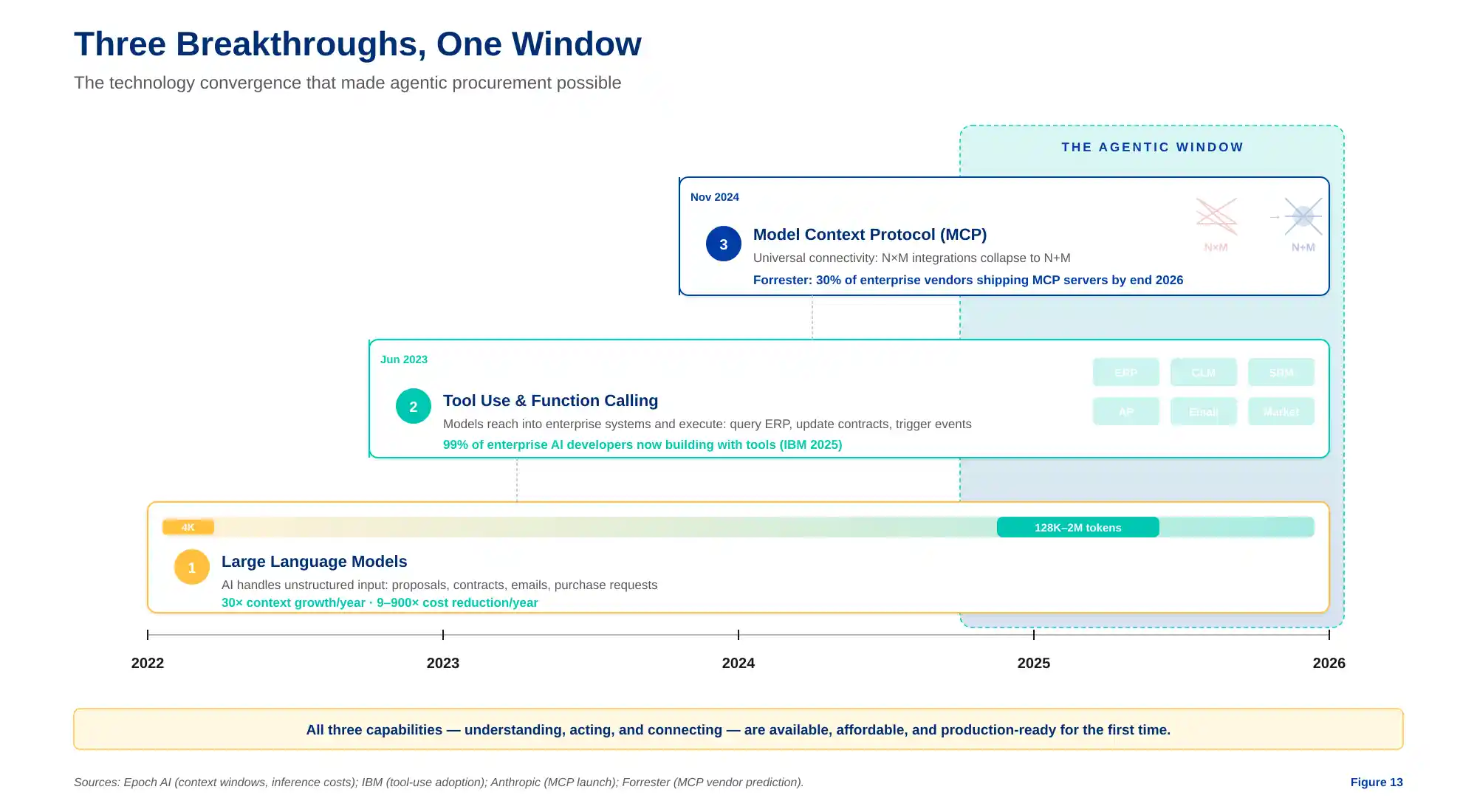
The first is the language model itself. Large language models gave procurement AI the ability to handle unstructured input — supplier proposals, contract clauses, natural-language purchase requests, negotiation emails — without requiring structured data entry. But the change that made this enterprise-viable was not intelligence. It was economics. LLM inference costs have fallen between 9× and 900× per year depending on the benchmark, and context windows — the amount of information a model can reason over in a single pass — have grown roughly 30× per year. In 2022, processing a full supplier proposal exceeded most models’ context limits. By 2025, a single agent can reason over a master service agreement, eighteen months of spend data, and a supplier risk profile simultaneously — at a fraction of the cost.
The second is tool use. Language models that only generate text are copilots — they recommend, but they cannot act. Tool use, also called function calling, gave models the ability to reach into enterprise systems and execute: query an ERP, update a contract record, trigger a sourcing event, send a supplier communication. IBM’s 2025 developer survey found that 99% of developers building enterprise AI applications were either exploring or actively developing agents. Tool use is what turns a recommendation engine into an execution engine — the difference between “you should renegotiate this contract” and “I have drafted the renegotiation terms, benchmarked them against market rates, and sent them to the supplier.”
The third is connectivity. The Model Context Protocol (MCP), introduced by Anthropic in November 2024, created an open standard for connecting AI agents to enterprise data sources and tools. Before MCP, connecting N models to M enterprise systems required N×M custom integrations — a combinatorial nightmare that made multi-system agent deployment prohibitively expensive. MCP collapses that to N+M. Forrester predicts 30% of enterprise application vendors will ship their own MCP servers by the end of 2026. The protocol has already been donated to the Linux Foundation’s Agentic AI Foundation, co-founded by Anthropic, Block, and OpenAI with support from Google, Microsoft, and AWS. MCP is to agentic AI what HTTP was to the web: the connective layer that lets everything talk to everything else.
Figure 1 — Three breakthroughs, one window: all three capabilities converged between 2023 and 2025.
How an Agent Actually Decides What to do Next
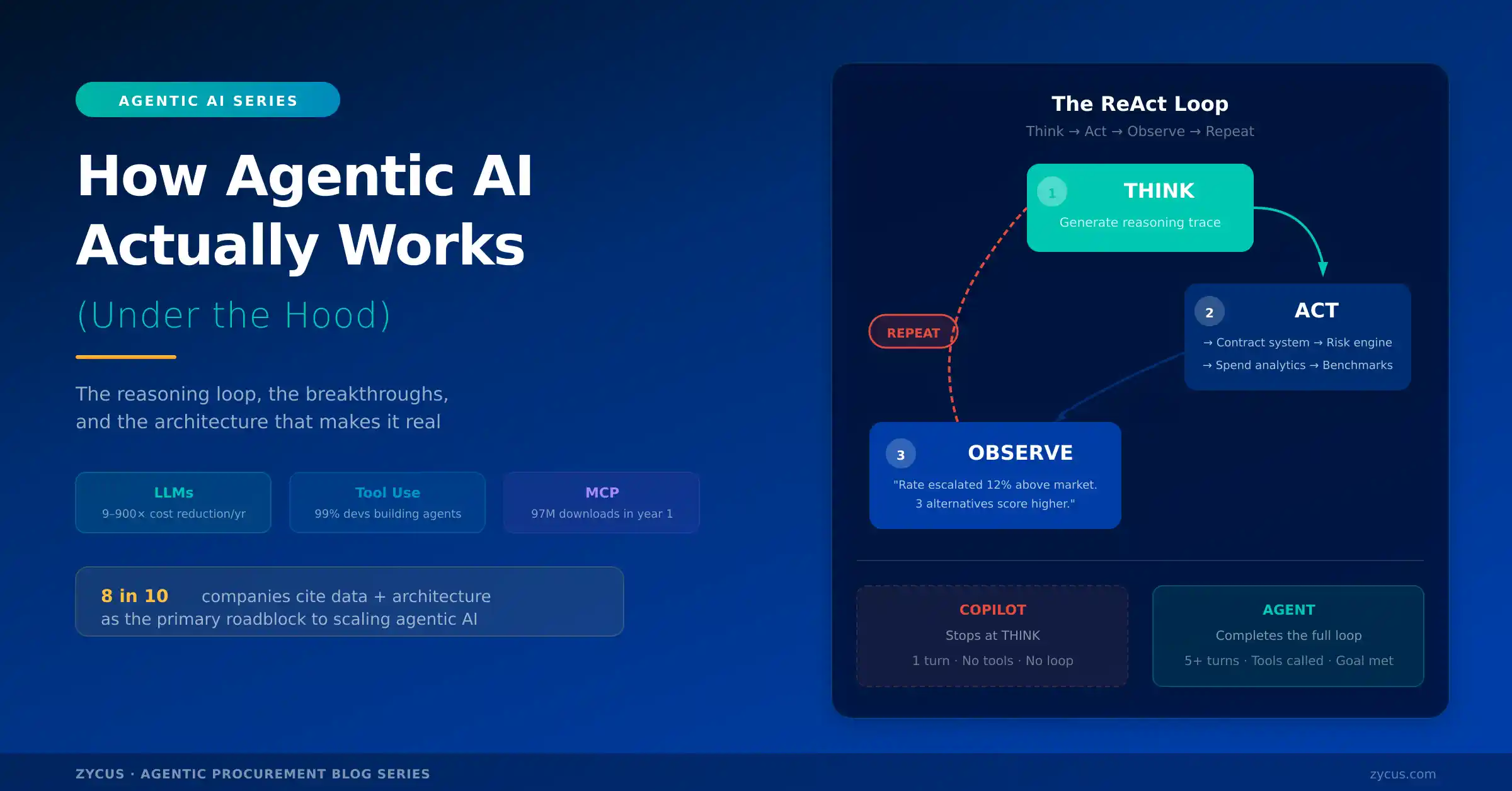
The mechanism beneath every procurement agent is a reasoning loop. The most widely adopted pattern is called ReAct — Reasoning and Acting — formalized by researchers at Google Research and Princeton University in 2022. The loop has three steps that repeat until the goal is achieved: the agent thinks (generates a reasoning trace about what it knows and what it needs), acts (calls a tool or retrieves data), and observes (processes the result and decides what to do next).
Figure 2 — The ReAct loop in procurement: how an agent reasons through a contract renewal decision.
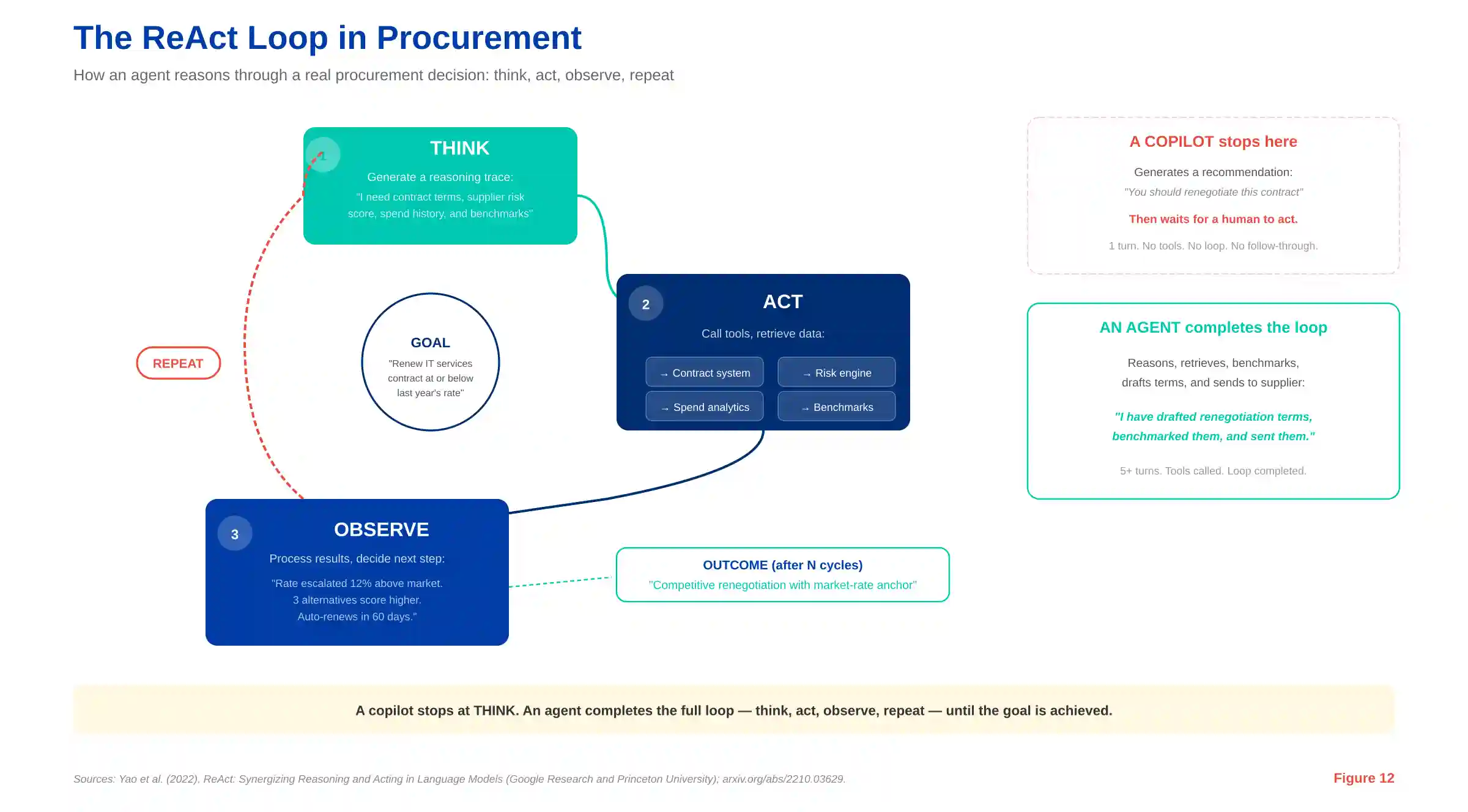
In procurement, this plays out concretely. An agentic sourcing system receives a goal: “Renew the IT managed services contract at or below last year’s rate.” The agent thinks: “I need the current contract terms, the supplier’s risk score, recent spend data, and market benchmarks for this category.” It acts: queries the contract management system, pulls the supplier scorecard, retrieves spend history from the analytics engine, and fetches community benchmark data. It observes: “The current rate has escalated 12% above market. Three alternative suppliers score higher on delivery reliability. The contract auto-renews in 60 days.” It thinks again: “The best move is a competitive renegotiation with a market-rate anchor, not a renewal.” Each cycle — think, act, observe — narrows the decision space until the agent either resolves the task or surfaces the decision to a human.
Modern agents extend this basic loop with planning hierarchies and self-correction mechanisms. Tree-of-Thoughts allows agents to explore multiple reasoning paths in parallel before committing. Reflexion lets agents critique their own outputs and revise before acting. These are not theoretical — they are the architectural patterns now shipping in production agent frameworks from Microsoft, Google, and the open-source ecosystem. The result is an agent that does not just follow a script. It reasons, adapts, and learns from each step — which is why a well-architected sourcing agent can handle an event it has never seen before, while a rule-based system cannot.
Why Architecture Determines Whether Agents Succeed or Fail
The reasoning loop only works if the agent has access to the right data at the right time. This is where most deployments break. McKinsey’s research is direct: nearly two-thirds of enterprises have experimented with agents, but fewer than 10% have scaled them to deliver tangible value. The reason is almost always architecture, not intelligence. A sourcing agent cannot benchmark against market rates if the spend data lives in a silo the agent cannot reach. A contract agent cannot flag renewal risks if the obligation data is not connected to the supplier performance data. An AP agent cannot resolve exceptions intelligently if it has no visibility into the purchase order or the contract terms that generated the invoice.
The architectural requirement is a unified data core — a single layer beneath all agents where spend, contracts, suppliers, risk signals, and market intelligence converge. Agents built on fragmented data cores make inconsistent decisions from incomplete information. Multi-agent systems built on fragmented data lose coordination entirely — one agent optimizes for cost while another optimizes for risk, and neither knows what the other is doing. The distinction between AI-native platforms (where intelligence is built into the architecture from the ground up) and AI-bolted platforms (where intelligence is layered onto existing systems) is not cosmetic. It determines whether agents compound value over time or accumulate integration debt.
Read more: The Evolution of Intake Management: From Bolt-On to Built-In
Governance follows architecture. MIT Sloan and BCG’s 2025 research on the emerging agentic enterprise found that leading organizations deploy both human-in-the-loop and human-out-of-the-loop governance for the same AI systems — calibrated by risk level, not by blanket policy. A tail-spend negotiation within pre-set guardrails can run autonomously. A strategic category sourcing decision above a spend threshold requires human approval before the agent acts. The governance model is tiered, not binary — and the best systems make the tier assignment itself intelligent, adjusting autonomy based on the agent’s historical accuracy and the stakes of the specific decision.
Gartner predicts that 40% of enterprise applications will embed task-specific AI agents by the end of 2026, up from less than 5% in 2025. The procurement teams that benefit will not be the ones that deployed the most agents. They will be the ones that understood what was running under the hood — the reasoning loop, the data architecture, the governance tiers — and built accordingly. Platforms designed for this, Zycus’s Merlin Agentic Platform among them, treat the S2P lifecycle as a single connected data core — an intake-to-outcomes (I2O) architecture — with agents coordinating across the spine rather than operating in silos beside it.
The question is no longer whether your procurement AI can generate text. It is whether it can think, act, observe, and learn — and whether the architecture beneath it was built for that from the start.
FAQs
Q1. What is the ReAct loop in agentic AI?
ReAct (Reasoning and Acting) is the reasoning loop that powers agentic AI systems. Formalized by researchers at Google Research and Princeton University in 2022, it works in three repeating steps: think (generate a reasoning trace and plan), act (call a tool, query a system, or retrieve data), and observe (process the result and decide the next step). The loop repeats until the goal is achieved. In procurement, a ReAct loop might reason through a contract renewal by checking terms, benchmarking rates, drafting renegotiation terms, and sending them to the supplier — all without human intervention at each step.
Q2. What is the Model Context Protocol (MCP)?
MCP is an open standard, originally released by Anthropic in November 2024 and later donated to the Linux Foundation, that lets AI models connect to enterprise systems through a universal interface. Before MCP, every AI-to-system integration required custom connectors (an M×N problem). MCP collapses this to M+N: each system publishes one server, each model uses one client. Within a year of launch, MCP reached 97 million monthly SDK downloads and over 16,000 active servers, with adoption by OpenAI, Google, and Microsoft.
Q3. Why do agentic AI deployments fail?
McKinsey research shows that 8 in 10 companies cite data and architecture limitations as the primary roadblock. The most common failure modes are: fragmented data across disconnected systems (the agent cannot reason over what it cannot see), bolted-on AI layers that lack native access to enterprise data, and insufficient governance — no audit trails, no policy enforcement, no escalation logic. Deployments succeed when the AI is wired through the platform, not layered on top of it.
Q4. What is AI-native architecture vs. AI-bolted architecture?
AI-native architecture means the AI layer was designed as part of the platform from the ground up. Agents have direct, governed access to the unified data core — spend, suppliers, contracts, transactions — and can act on enterprise systems natively. AI-bolted architecture means AI was added after the fact, sitting on top of disconnected systems. Bolted agents must reconstruct context at every step, governance is retrofitted, and each new agent adds integration debt rather than compound value.
Q5. Why do context windows matter for procurement agents?
Context windows determine how much information an agent can reason over in a single pass. A procurement agent evaluating a complex sourcing decision may need to hold a full RFP, supplier risk profiles, historical spend data, contract terms, and market benchmarks simultaneously. Context windows have grown roughly 30× per year — from 4,000 tokens in early LLMs to 128,000–2,000,000 tokens today — making it possible for agents to reason over enterprise-scale procurement data without losing context mid-task.
Related Reads:
- Model Context Protocol (MCP): Revolutionizing Source-to-Pay with Agentic AI Solutions
- A Day in the Life of a Procurement Team Running on Agentic AI
- Whitepaper: A CPO’s Guide to Agentic AI
- Magazine: Intake to Outcomes (I2O) with Agentic AI-powered Procurement
- eBook: Agentic AI in Procurement: A Comic Book Exploration
- Whitepaper: Beyond GenAI: The Dawn of Agentic AI in Procurement