






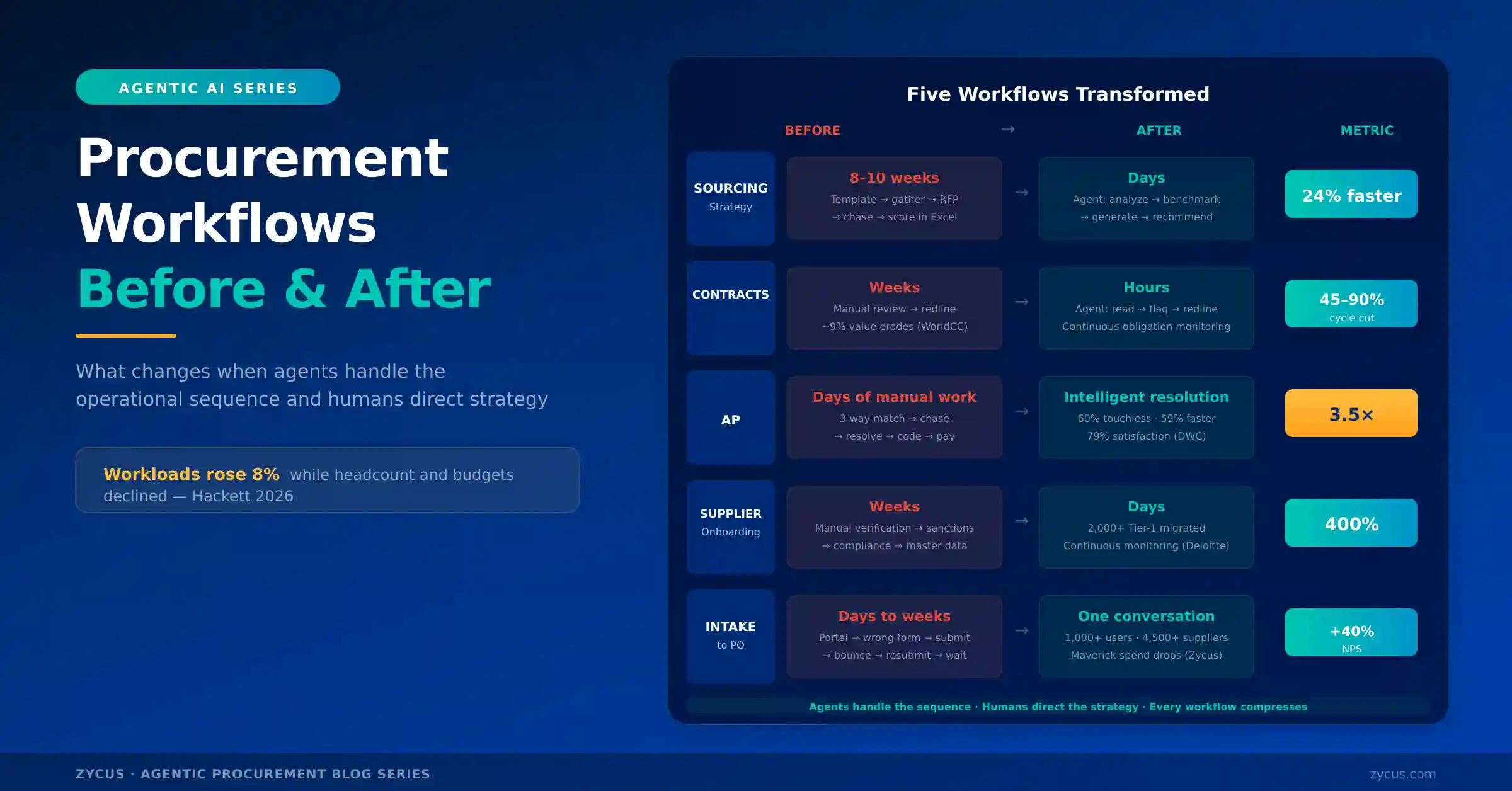

Five workflows, five transformations. Here is what procurement actually looks like when agents handle the operational sequence, and humans direct the strategy.
TL;DR
- Procurement workflows before and after agentic AI start with sourcing: 8–10 week template-driven cycles compress to days when agents handle spend analysis, benchmarking, RFP generation, and bid evaluation. Up to 80% faster sourcing cycles reported.
- Contracts: draft-to-approval drops from 45 days to 12 (73% reduction). After signing, agents monitor obligations continuously — not quarterly. Contract errors that affected 30% of manual agreements are caught before execution.
- AP: invoice processing compresses from 10–14 days to 2–3 days. Touchless rates hit 60% at best-in-class. Late payments drop 57%. The analyst shifts from processing to payment strategy.
- Supplier onboarding: 35 days to 4 days in pharma (88% reduction). Documentation errors drop 50%. After onboarding, continuous monitoring replaces quarterly reviews.
- Intake to PO: compliance checks drop from 36 hours to 6 minutes. 50% of transactions run touchless. The compliant path becomes the easiest path — and maverick spending drops.
- The pattern is the same in every workflow: agents handle the operational sequence. Humans direct the strategy. The architecture stops requiring people to be the connective tissue between systems.
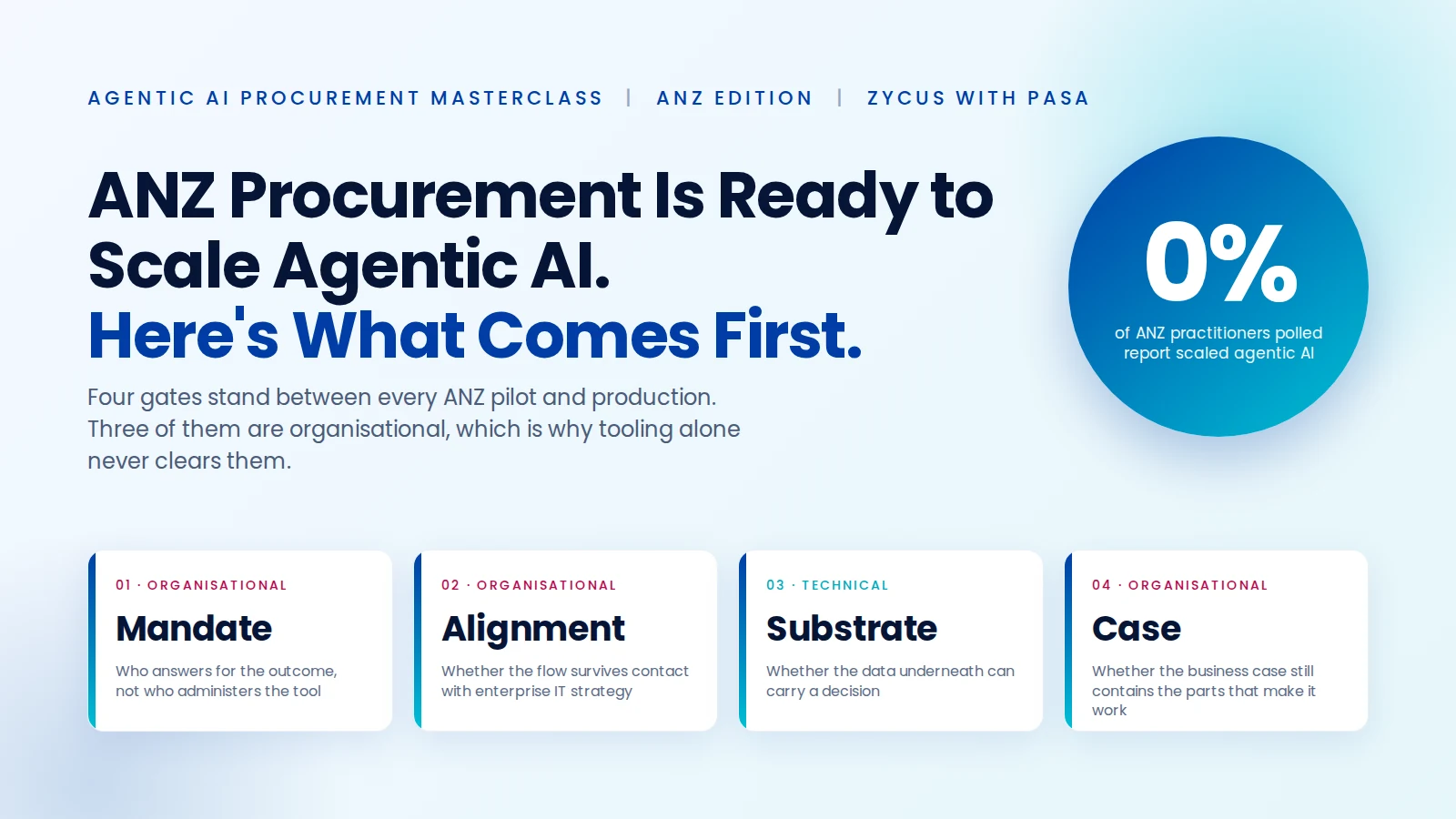
That is not a one-year anomaly — it is the structural condition procurement has operated under for a decade: more work, same headcount, higher expectations. Only 12% of organizations have reached large-scale AI deployment, even as 43% are actively pursuing it. The response so far has been to add tools. The result has been more tools, more handoffs, and more time spent on the operational sequence — gathering, formatting, reconciling, routing — rather than on the strategic work those tools were supposed to enable.
Agentic AI does not add another tool. It changes the workflow itself. The operational sequence that consumed most of a procurement professional’s time — the assembly, the chasing, the matching, the re-keying — is handled by agents. What remains is the work that requires human judgment: setting strategy, evaluating trade-offs, managing relationships, and making decisions the organization will be accountable for. Here is what that shift looks like across five core workflows.
Figure 1 — Five workflows transformed: what changes when agents handle the operational sequence.
Sourcing: From Twelve Weeks of Assembly to Days of Strategy
Before: A category manager opens a template, gathers spend data from the analytics tool, pulls contract terms from the CLM, chases stakeholder requirements through email, formats evaluation criteria, builds the RFP, distributes it to suppliers, waits for responses, scores bids in a spreadsheet, runs scenarios manually, and prepares an award recommendation. Typical timeline: eight to ten weeks. The majority of that time is operational — gathering and formatting information that already exists in the organization’s systems but has never been connected.
After: The agent receives a sourcing goal in natural language. It analyzes spend history, benchmarks against community and market data, scores supplier risk, identifies the optimal event type (RFP, RFQ, renegotiation, or extension), generates the document structure, evaluates responses against weighted criteria, and recommends award scenarios. Organisations deploying AI-driven sourcing report up to 80% faster sourcing cycles — compressing months of work into days. The category manager directs strategy and approves the outcome. The assembly disappears.
Read more: 5 Ways AI is Revolutionizing Supplier Strategy in 2026
Contracts: From Weeks of Review to Hours of Exceptions
Before: A legal reviewer receives a draft contract, reads it against the organization’s playbook, redlines clause by clause, sends it back, waits for the counterparty’s response, reviews the counterproposal, escalates non-standard terms, and logs the final version in the CLM. , and 64% of companies reported missed opportunities due to contract lifecycle inefficiencies. A complex agreement could take 45 days from draft to approval.
After: The contract agent reads the draft against the organization’s clause library, flags deviations, generates redlines aligned to policy, benchmarks commercial terms against market data, and routes only genuine exceptions to the legal team. Deployed systems report draft-to-approval compression from 45 days to 12 — a 73% reduction — with a 15% increase in closed deals in the first year. After signing, the agent monitors obligations continuously rather than quarterly, surfacing renewal risks and compliance gaps months before they materialize.
Accounts Payable: From Exception Queues to Intelligent Resolution
Before: An AP analyst receives an invoice, manually checks it against the purchase order and receiving documents (the three-way match), investigates discrepancies by emailing the requester or the supplier, resolves the exception, codes the invoice, queues it for approval, and schedules payment. Processing time: ten to fourteen days on average, with exception rates of 22% and late-payment penalties eroding early-pay discounts.
After: The AP agent ingests the invoice, extracts data with 97–99% accuracy (up from 70–80% three years ago), matches it against PO and contract terms automatically, resolves routine exceptions by checking supplier history and policy rules, and routes only genuine anomalies to a human. Processing compresses to two to three days. with AP cycle times improving 59% post-implementation. Late payments drop 57%. Early-pay discount capture improves 30–35% as invoices clear faster. The analyst’s role shifts from processing invoices to managing supplier payment strategy and working-capital optimization.
Supplier Onboarding: From Months of Paperwork to Days of Verification
Before: A new supplier submits documentation — tax certificates, insurance, banking details, compliance questionnaires, ESG disclosures. A procurement analyst manually verifies each document, cross-references against regulatory databases, checks sanctions lists, validates banking information, and enters the supplier into the master data system. In complex regulated industries like pharmaceuticals, this process historically consumed 50 or more hours per supplier and stretched across 35 days or longer.
After: The supplier agent receives the documentation, extracts and validates data automatically, cross-references against sanctions databases and regulatory registries in real time, flags discrepancies for human review, and provisions the supplier in the master data system once verification is complete. In pharmaceuticals, onboarding compresses from 35 days to 4 — an 88% reduction. A global manufacturer reported a 60% reduction in onboarding time and a 50% decrease in documentation errors. After onboarding, the agent monitors the supplier continuously — financial health, ESG exposure, cyber risk, geopolitical signals — rather than waiting for the next quarterly review cycle.
Intake to PO: From Six Systems to One Conversation
Before: A business user needs to purchase software licenses. She searches the intranet for the procurement portal, selects the wrong category, fills out a form that asks for information she does not have, submits it, waits for approval routing that she cannot see, gets bounced back for additional information, resubmits, waits again. Elapsed time from request to purchase order: days to weeks. The procurement team spends hours re-routing, re-categorizing, and policy-checking requests that could have been handled at the point of entry.
After: The user types a natural-language request: “I need 50 licenses for the design team.” The intake agent identifies the category, checks policy (preferred supplier, budget authority, contract coverage), routes for approval through the correct chain, and generates the purchase order. Manual compliance checks that took 36 hours compress to 6 minutes. Fifty percent of transactions run end-to-end without human intervention. The requester gets what they need faster, the procurement team gets compliance without chasing, and maverick spending drops because the compliant path is now the easiest path.
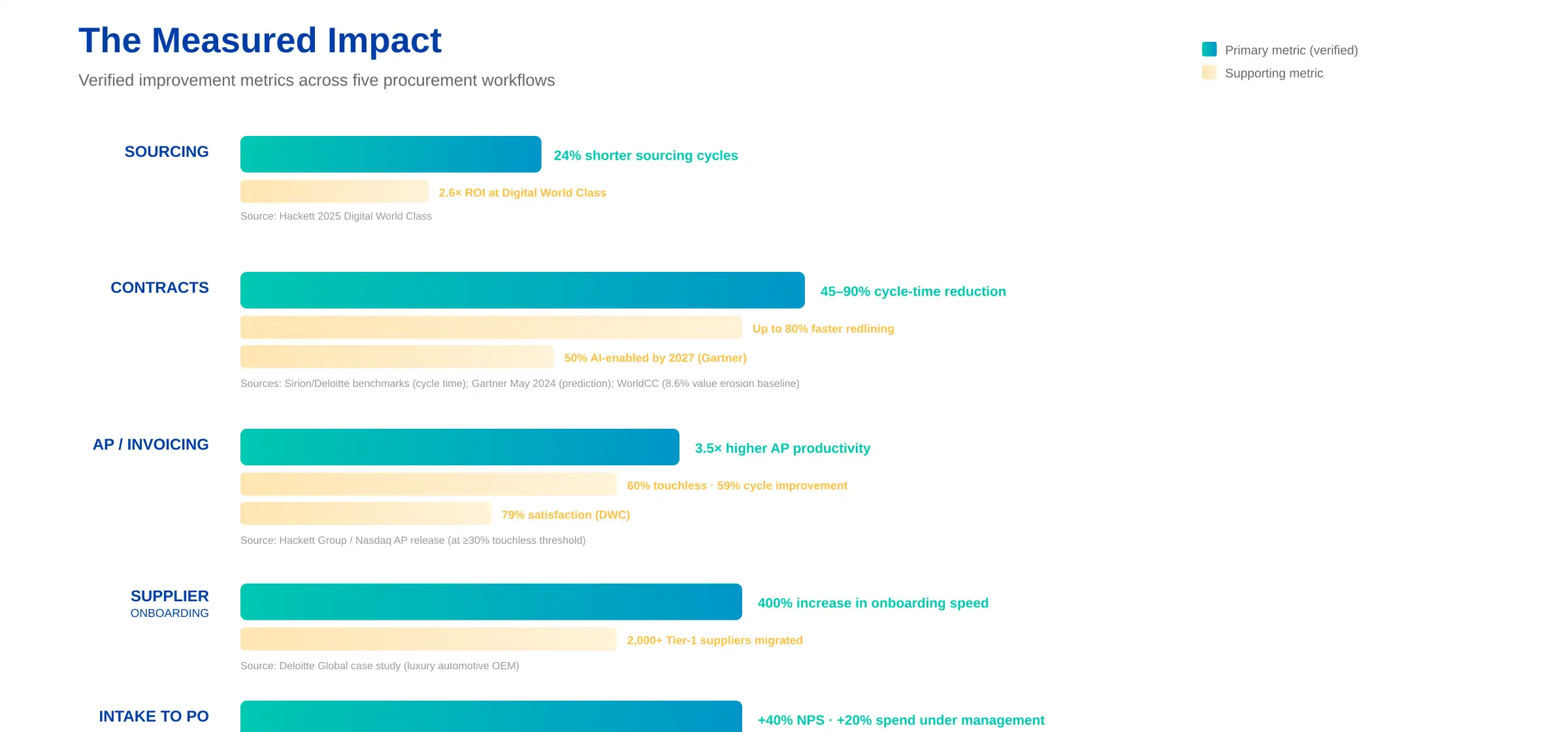
Figure 2 — The time compression: before and after cycle times across five procurement workflows.
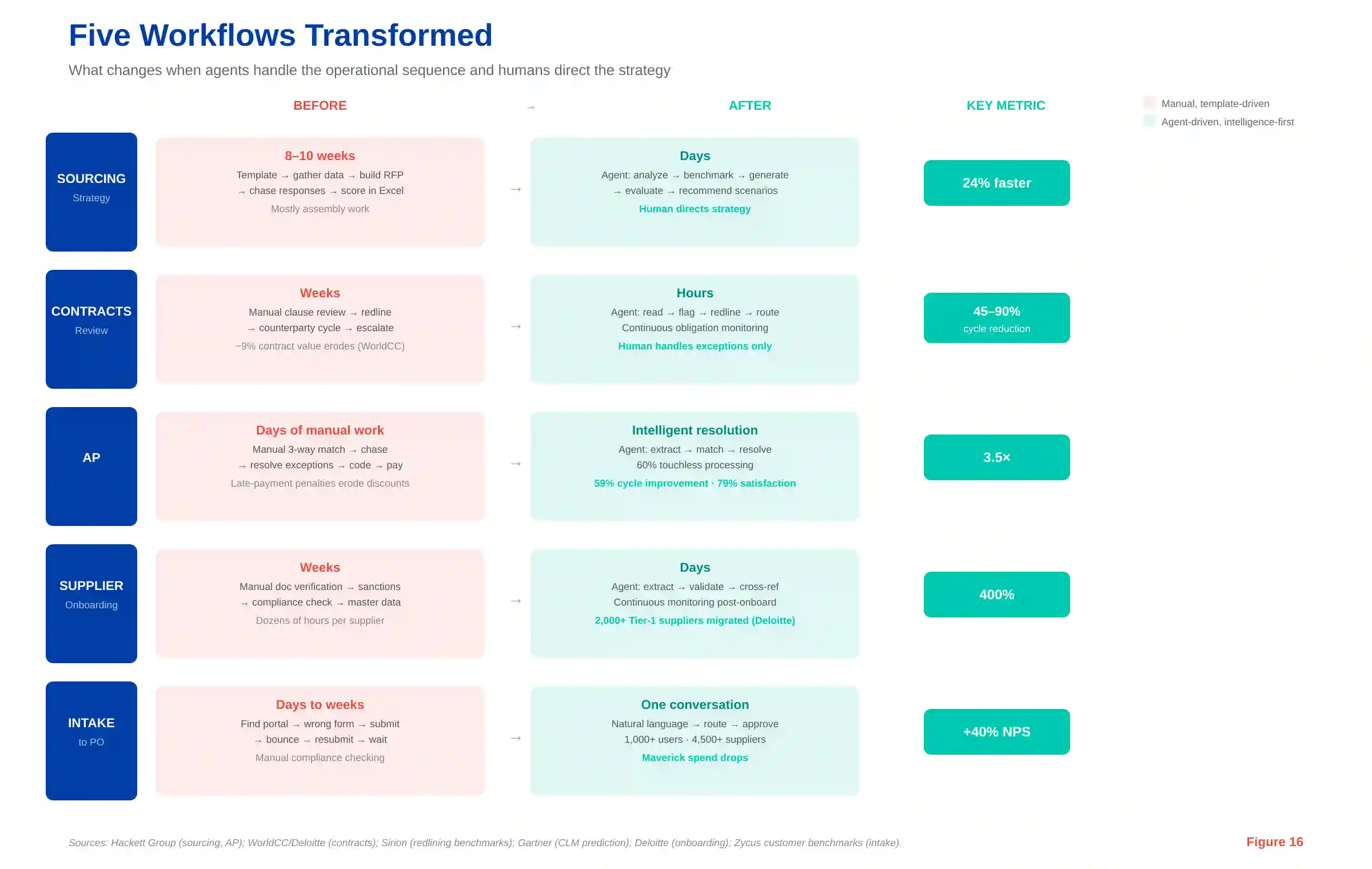
The pattern across all five workflows is identical: the agent handles the operational sequence that consumed the majority of human time — gathering, formatting, matching, routing, checking — and the human directs the strategic work that the agent’s intelligence makes possible. The compounding effect emerges when these workflows connect. Platforms architecturally designed for this — Zycus’s Merlin Agentic Platform among them — run these agents on a unified data core so that context flows between workflows rather than breaking at every handoff. The sourcing agent’s benchmark feeds the contract agent’s terms. The contract agent’s obligations feed the AP agent’s matching. The supplier agent’s risk score feeds everything. The result is not five separate improvements. It is a single connected architecture where each agent makes the next one smarter.
The workflow did not change because the tools got better. It changed because the architecture stopped requiring humans to be the connective tissue between systems.
Related Reads:
- Why Agentic AI Is the Future of Source-to-Pay Automation by 2026
- The Complete Guide to Agentic AI in Procurement
- From Co-Pilots to Commanders: How Agentic AI is Redefining Procurement Transformation
- On-demand Webinar: Watch AI Agents Transform Procurement
- Harnessing Agentic AI: Revolutionizing Spend Analysis for Smarter Procurement