









TL;DR
In uncertain times, procurement offers one of the fastest and most controllable paths to profit protection or improvement.
Savings drop straight to the bottom line: A $1 cost reduction in procurement is often equivalent to $5–$10 in new revenue, depending on margins.
- Rapid payback: Targeted digital tools such as e-Auctions, Autonomous Negotiation Agents (ANA), Spend and Savings Analysis, and AI-driven Intake Management can deliver measurable savings fast.
- Dual impact: These solutions not only reduce external spend (5–15% in key areas) but can also lower internal operating costs (SG&A efficiency).
- Low risk, high control: Unlike revenue growth, procurement-led improvements are largely within organizational control and less exposed to market volatility.
Bottom line: Investing in procurement technology during a downturn is not discretionary. It is one of the most effective ways to protect margins, improve cash flow, and strengthen economic resilience.
Periods of geopolitical shock, instability, and economic pressure, such as the current conflict impacting both the Gulf countries and the global economy, tend to trigger a predictable corporate response: cost control, budget scrutiny, and often delayed investment decisions. Yet the most economically resilient organizations take a different path. They invest selectively, deliberately, and with a clear focus on protecting or improving resilience.
For procurement leaders, this is not a contradiction. It is a strategic playbook, one with margin-protection outcomes that help their organizations weather the storm and emerge stronger.
The Procurement Lever in Volatile Times
In constrained environments, procurement becomes one of the few functions capable of delivering immediate and measurable financial impact. Unlike revenue growth, which may be externally constrained, procurement can directly influence:
- Cost reduction and avoidance
- Working capital optimization
- Risk mitigation and supply continuity
- Compliance and leakage control
Critically, procurement savings flow almost entirely to the bottom line.
A simple but powerful principle applies: a dollar saved in procurement is typically worth multiple dollars in revenue. For an organization operating at a 10% EBITDA margin, generating $1 of additional profit through revenue requires approximately $10 of incremental sales. By contrast, $1 saved through procurement drops directly into profit with minimal dilution.
In today’s environment, where revenue expansion may be uncertain or delayed, this asymmetry becomes decisive.
Traditional approaches such as manual sourcing, fragmented supplier engagement, and reactive buying lack the speed and scale required. This is where AI-powered intake-to-outcomes procurement platforms fundamentally shift the equation, unlocking hidden value quickly.
Research perspective
Recent research reinforces the point. Procurement sits on one of the largest controllable cost bases in most enterprises and remains one of the most under-leveraged profit levers.
Organizations applying agentic AI end-to-end, from intake through sourcing and contract execution, are capturing materially greater bottom-line impact than peers relying on traditional digital procurement alone.
Source: The Hackett Group, Agentic AI in Procurement Adoption Index 2026
Where Technology Delivers Immediate Economic Impact
Not all digital investments are equal. In challenging economic conditions, procurement leaders should prioritize capabilities that deliver rapid, tangible returns and address the problems that escalate fastest during a downturn. Four stand out.
1. Closing the Price Discovery Gap, Fast
In constrained markets, suppliers often hold an information advantage. They know exactly where their margins sit, while buyers typically do not. Every month spent running on outdated supplier pricing is a month spent subsidizing that asymmetry.
The practical implication for procurement leaders is simple: the speed at which you can re-test price becomes more important than the sophistication of the process. Firms that wait two quarters to run a “strategic sourcing event” leave margin on the table every week in between.
In a downturn, the frequency of competitive tension matters as much as the size of any single negotiation. Reverse auctions are the clearest example. They compress sourcing cycles and make price discovery a repeatable action rather than an annual event.
Capability in focus: e-Auctions
Reverse auctions remain one of the fastest ways to unlock competitive tension in supplier markets. Properly deployed, they can deliver:
- ~5–15% or more savings in addressable categories
- Transparent price benchmarking
- Shortened sourcing cycles
Every successful auction not only reduces cost but amplifies EBITDA without requiring additional sales effort.
2. The Tail Spend Problem Headcount Cannot Solve
Tail spend is procurement’s most persistent open secret. Almost every organization knows the Pareto pattern, where a long tail of suppliers carries a meaningful share of spend, yet very few have the headcount to actively manage them.
The reason is economic, not operational. The savings per supplier in the tail rarely justify a human category manager’s time, so traditional category management hits a hard wall. In a downturn, that wall becomes expensive.
The only way to address tail spend efficiently is to remove humans from the transactional loop. This is where agentic AI becomes a true bottom-line driver. Autonomous negotiation agents do not replace strategic buyers. They unlock a layer of spend that was never economical to manage manually, while reducing the cost of running procurement itself.
Capability in focus: Autonomous Negotiation (e.g., Zycus’ ANA)
Tail spend, often 20% of spend across 80% of suppliers, is typically unmanaged and inefficient. Autonomous agents, such as Zycus’ ANA (Autonomous Negotiation Agent), fundamentally change this dynamic:
- Automated sourcing and negotiation for low-value, high-volume transactions
- Continuous competition without human intervention
- Reduction in maverick spend and off-contract buying
The economic impact is twofold:
- Direct savings (often ~5–10% in tail categories)
- Structural reduction in procurement operating costs (SG&A)
3. Stopping Value Leakage Before Sourcing Begins
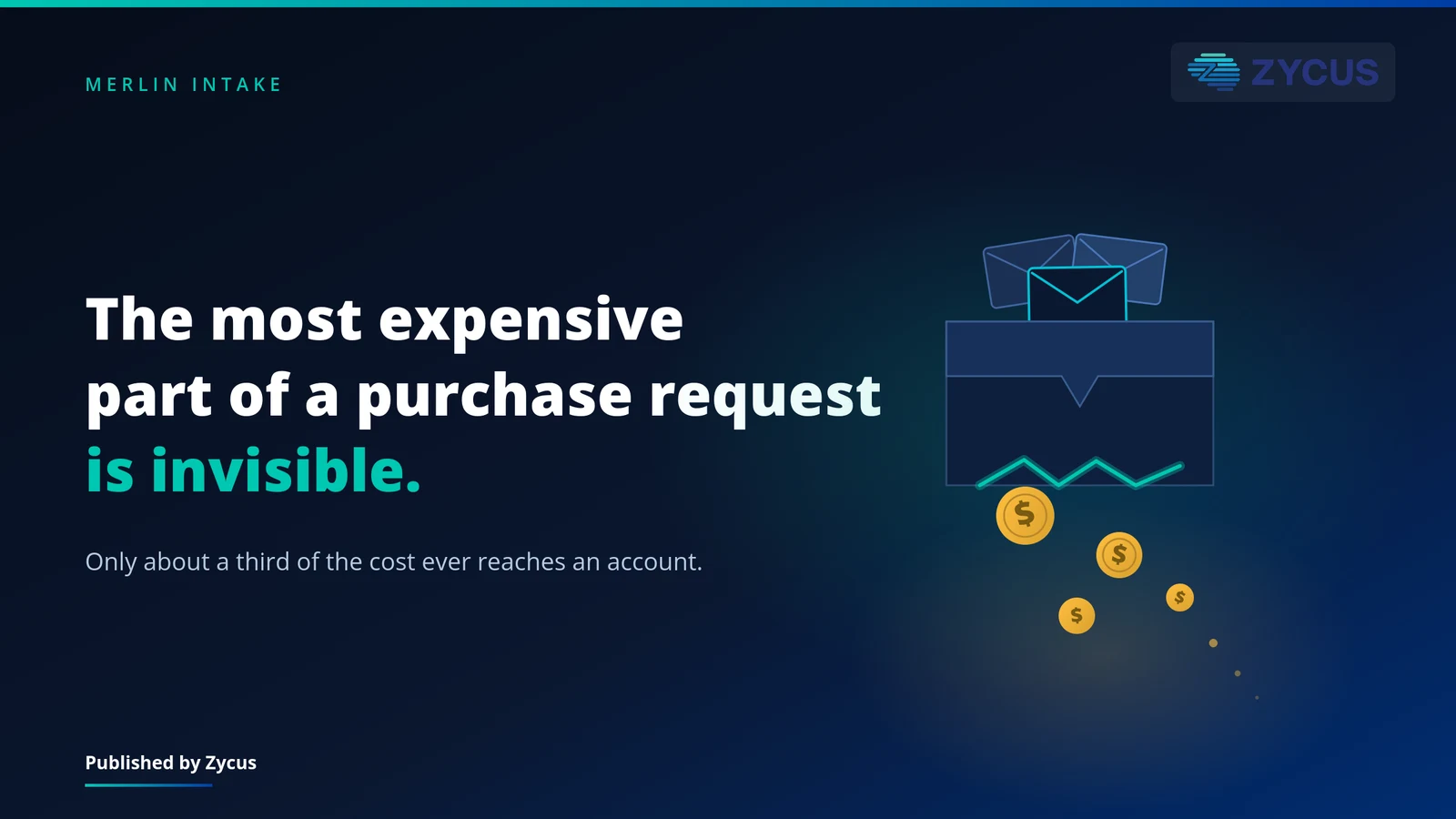
Most value leakage is invisible to procurement, because it happens before procurement is even involved. A poorly-framed requisition, a maverick buying channel, a duplicate purchase across two business units: these are not sourcing failures; they are demand failures.
In a downturn, controlling demand is often more valuable than negotiating harder on what is already being demanded. The fastest CFO-level wins are often not “we negotiated 8% off” but “we prevented spend that should never have happened in the first place.”
Framed this way, intake is not just a convenience. It is the earliest and most efficient point of margin capture, where AI-driven orchestration changes the economics of prevention versus recovery.
Capability in focus: Intake & Orchestration (e.g. Zycus’ Merlin AI)
In many organizations, value leakage begins before sourcing even starts, through poor demand management and uncontrolled requisitions. AI-driven intake platforms:
- Guide users to compliant buying channels
- Aggregate demand to increase leverage
- Eliminate unnecessary or duplicate purchases
This can preserve ~2–3% of spend that would otherwise be lost, effectively converting wasted expenditure into retained profit.
4. Knowing Where the Next Dollar of Effort Pays Back
In a steady state, well-resourced procurement teams can afford to work the whole spend map. In a downturn, they cannot. The binding constraint becomes attention, not ideas.
Without clear visibility, effort gets distributed evenly, which is inefficient when time is limited and every delayed saving impacts margins. Leading organizations prioritize ruthlessly. They identify the categories with the highest impact and focus resources there first.
Spend analytics, in this light, is less about dashboards and more about where to send your next negotiation email. The value is in the prioritisation, not the reporting.
Capability in focus: Spend Analytics
Advanced analytics tools enable procurement teams to rapidly identify:
- Savings opportunities across categories
- Supplier consolidation potential
- Price variances and anomalies
In volatile times, this level of visibility ensures that procurement effort is directed where it delivers the highest incremental return on margin.
A Strategic Reframing: Procurement as a Profit Engine
The key shift for leaders is to move from viewing procurement technology as a cost center to recognizing it as a profit engine, connected end to end from intake to measurable outcomes.
Consider the math:
- $10M in procurement savings at a 10% margin is equivalent to ~$100M in new revenue
- Savings are faster to realize, lower risk, and within internal control
- Digital tools compress the time to value, from years to quarters, and in some cases, months
In the context of geopolitical uncertainty, especially in regions with exposed supply chains and logistics, this becomes even more critical. Delaying modernization risks locking in inefficiencies at the worst possible time.
Recommended next steps:
- Identify the high-impact procurement levers to prioritize (e.g., eSourcing/e-Auctions, tail spend automation, intake management, spend analytics, quick sourcing)
- Quantify the bottom-line impact using margin-based scenarios
- Prioritize deployments that deliver measurable EBITDA improvement within 6–12 months
- Don’t forget: finding and unlocking hidden value is relatively straightforward, but retaining it requires the systems to prevent leakage through weak contract, performance, and risk management
For procurement leaders, the mandate is clear. Treat every dollar saved as a strategic advantage, not just a cost reduction.
The companies that emerge strongest from this period will not be those that cut deepest, but those that convert procurement into a sustained driver of profitability protection and economic resilience.
If any of these ideas connect with what you are navigating right now, I would value the exchange. Whether it is pressure-testing your current priorities, comparing notes on what is working elsewhere in the region, or simply thinking out loud about where procurement can create the most leverage in the months ahead, I am always happy to connect, peer-to-peer, without an agenda.
Related Reads:
- Characteristic of a World-Class Procurement Organization
- Guide to Tail Spend Analysis: What it is and Why it Matters
- Autonomous Procurement Agents: The Future Workforce of Digital Enterprises
- Whitepaper: Mastering Autonomous Procurement AI with Zycus
- What is Autonomous Sourcing? And Why Every CPO Should Care Now
- How Agentic AI is Creating Autonomous Procurement Teams?