








TL;DR
- Procurement’s most expensive habit is the handoff — every seam between systems costs time, context, and savings that never come back. Intake-to-outcomes procurement is the architectural fix.
- The numbers are stark: a 10x cycle-time gap between the best and slowest teams, 5–16% of negotiated savings lost to off-contract buying, and 40% of practitioners planning to leave within a year.
- The root cause is not bad tools — it is disconnected tools. Confusing P2P workflows are the single most common trigger for maverick spending.
- Digital Masters who connect their systems outperform followers by 16 points on cost savings, 25 on stakeholder satisfaction, and 32 on innovation enablement.
- The fix is architectural: intake-to-outcomes, powered by agentic AI — a unified spine where agents coordinate across every S2P stage so context, policy, and value flow with the request instead of breaking at every seam.
- Organisations that eliminate the handoff tax will not just buy better — they will keep the people who know how to.
Somewhere right now, a category manager is toggling between a sourcing tool, a contract repository, an ERP, a supplier risk platform, and a spreadsheet that was supposed to be temporary three years ago. She finds the supplier’s pricing in one system, the compliance certificate in another, and the last negotiation notes in an email thread she has to search for by subject line. By the time she has assembled the full picture, she has lost the thread of what she was actually trying to decide. Research on knowledge work puts a number on this: it takes 23 minutes and 15 seconds to fully recover focus after switching contexts. She will switch again in under three minutes.
This is not an exceptional day. This is Tuesday. And it is the single most expensive routine in procurement — not because anyone chose it, but because nobody designed the alternative.
Figure 1 — The journey of a single purchase request: same stages, radically different architecture.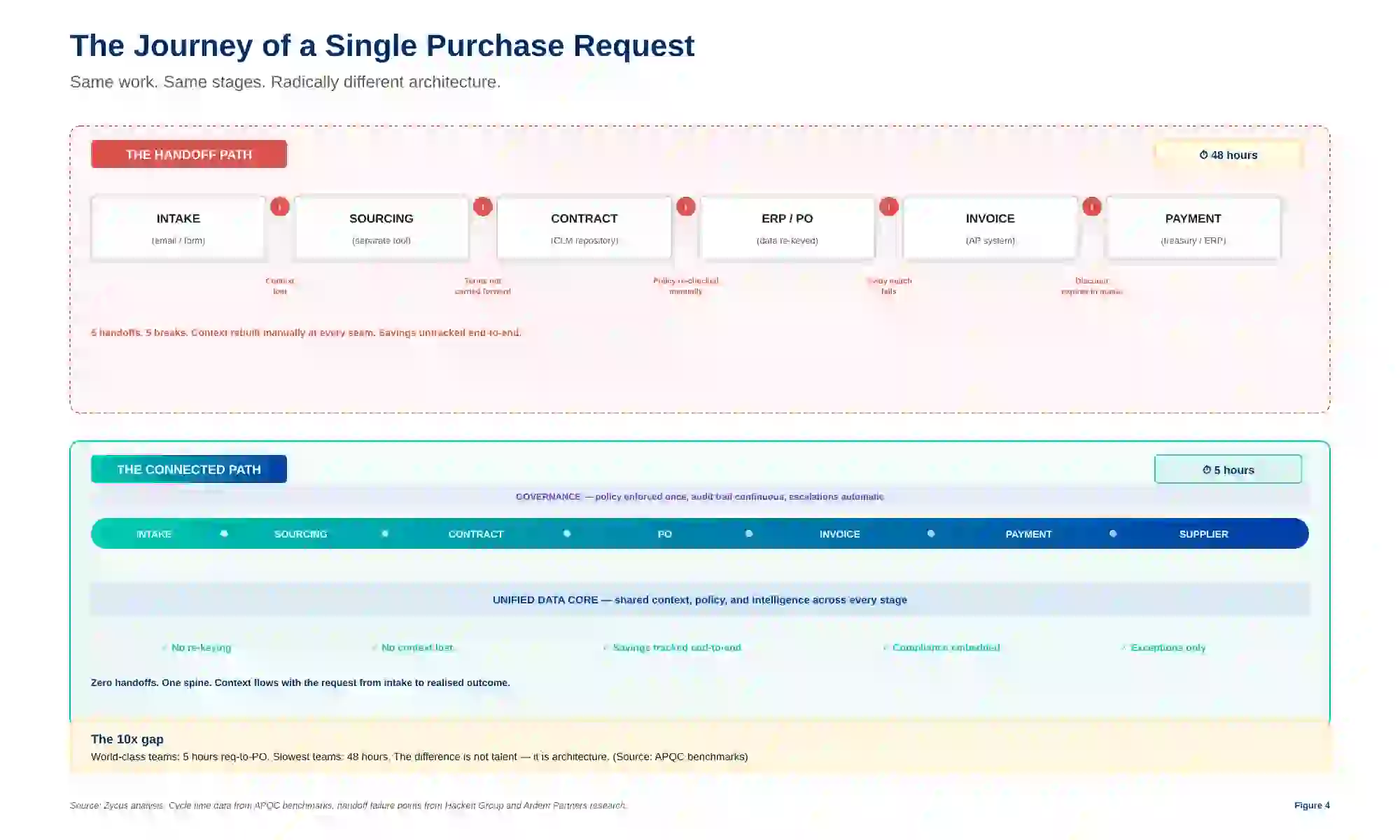
The Cost nobody measures
Procurement’s fragmentation problem has always been felt, but it is only recently that the numbers have become precise enough to be uncomfortable. APQC benchmarking data shows that world-class procurement teams move a requisition to a purchase order in about five hours. The slowest teams take closer to forty-eight. That is not a marginal gap — it is nearly a 10x difference, and nearly all of it sits in handoff time: approvals queued in one system, data re-entered in another, context lost at every seam.
The cognitive cost compounds silently. Harvard Business Review research found that the average knowledge worker toggles between applications more than 1,200 times per day, losing roughly four hours every week simply reorienting after each switch. For procurement professionals — whose work crosses more functional boundaries than almost any other role in the enterprise — the tax is worse. Every requisition touches intake, risk, legal, finance, and sometimes IT security before it becomes a purchase order. Each of those touchpoints lives in a different tool. The buyer doesn’t just process the transaction; they personally bridge five or six systems that were never designed to talk to each other.
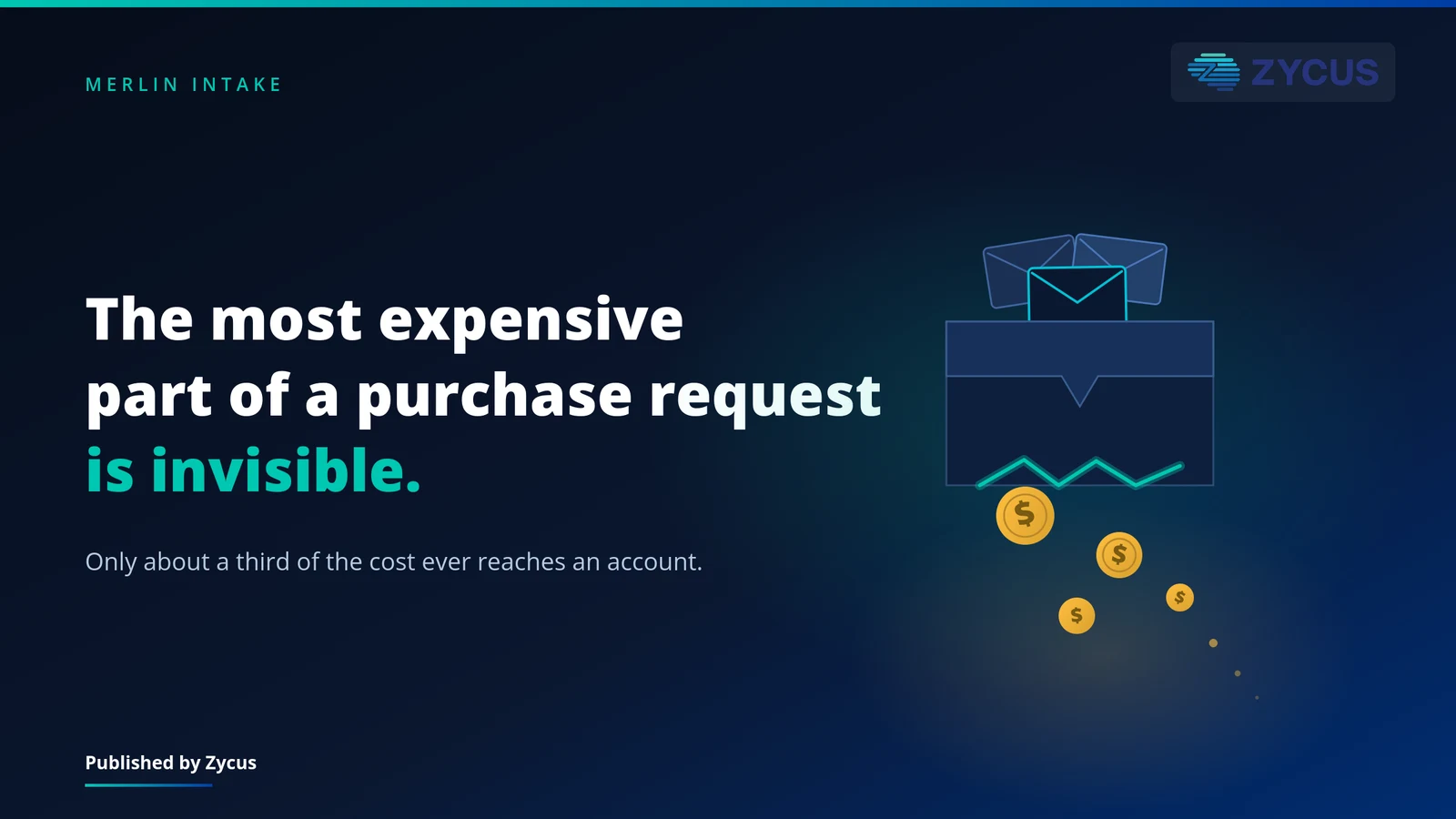
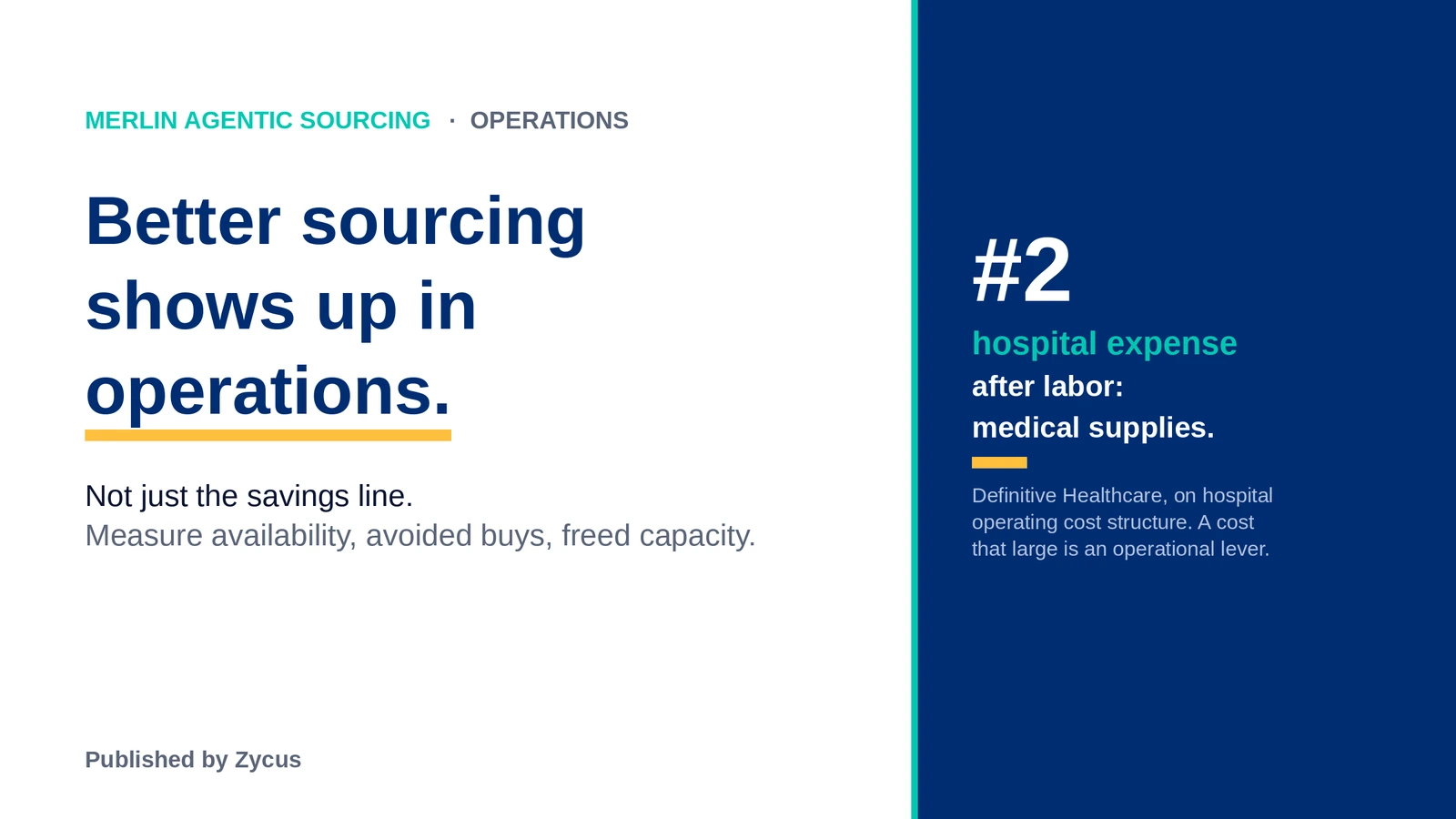
The downstream effect is predictable. A significant share of enterprise software spending now bypasses procurement — not because employees are defiant, but because the approved path is slower than the unapproved one. The Hackett Group’s analysis identifies confusing procure-to-pay workflows as the single most common trigger for maverick purchasing. When compliance is harder than non-compliance, the system has already failed. The spend just makes the failure visible.
Where the Value Leaks
The handoff problem doesn’t just slow procurement down. It erodes the value procurement creates. Savings negotiated in sourcing drift when contracts aren’t monitored after signing. Contracted prices erode when invoices aren’t matched against original terms. Supplier consolidation plans unravel when onboarding isn’t connected to category strategy. Early payment discounts expire because the invoice sat in an exception queue for eleven days while someone chased a three-way match across two systems that don’t share a common supplier ID.
The data tells a consistent story from multiple angles. Ardent Partners’ 2024 benchmarks show that contract-compliant spend reaches 74.9% at top performers but only 59.5% on average — meaning roughly four in ten purchases at a typical organisation deviate from negotiated terms. Ardent Partners estimates that every additional dollar of spend placed under procurement’s control yields 6–12% in savings. Hackett Group research puts the savings lost to off-contract buying at between 5% and 16% of the total targeted. The maths is uncomfortable: a procurement team can negotiate brilliantly and still watch a quarter of the value disappear into the seams between systems.
Figure 2 — The savings erosion waterfall: what happens to $100 of negotiated savings between the handshake and the P&L.
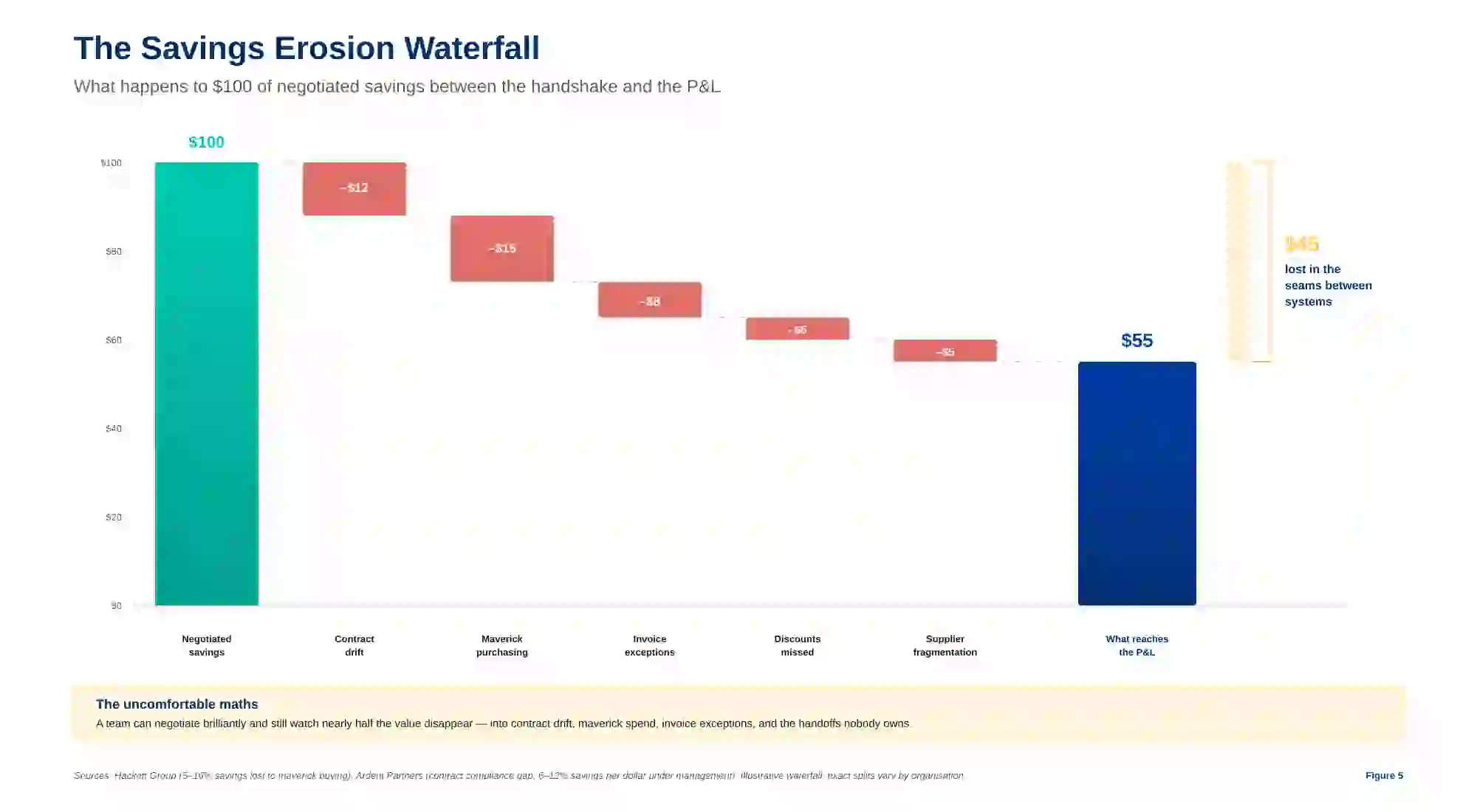
Every one of those seams is a handoff — a place where one system’s output becomes another system’s input, and where context, policy, and accountability quietly drop out of the picture.
What Changes When the Handoffs Stop
The transformation evidence is now consistent enough to describe a pattern, not just a collection of anecdotes. Deloitte’s 2025 CPO Survey segments procurement organisations into “Digital Masters” and “Followers,” and the performance gaps are not small. Digital Masters outperform followers by 16 points on cost savings delivery, 25 on internal stakeholder satisfaction, and 32 on innovation enablement. The mechanism is not mysterious: those teams have stopped asking humans to do coordination work that software can do, which frees those humans to do the judgment work that software cannot.
At the practitioner level, the shift is felt before it is measured. The category manager who used to spend her morning assembling context across six tools now starts with the context already assembled — because an agentic AI system has synthesised spend data, supplier risk scores, and contract terms before she opens her queue. The sourcing lead who used to chase approvals through email now sees requests routed, enriched, and policy-checked by AI agents before they reach her. The AP analyst who used to process exceptions manually now reviews only the exceptions that genuinely require human judgment — because an agent has already resolved the routine ones. Organisations running connected systems report that the most efficient teams spend 19% less on procurement operations while generating 2.6x greater ROI. The difference is not that they work harder. It is that their architecture — and the agents running on it — has stopped making them work around it.
The Architecture that Makes it Possible
What connects these outcomes is not a single tool or a cleverer dashboard. It is a structural decision: to stop treating procurement as a sequence of handoffs — intake to sourcing, sourcing to contract, contract to PO, PO to invoice, invoice to payment — and start treating it as a single continuous flow. From the initial request to the realised outcome, every stage shares data, policy, and context without a human having to carry it between systems. No re-keying. No “let me check the other system.” No savings claimed in one tool and invisible in another.
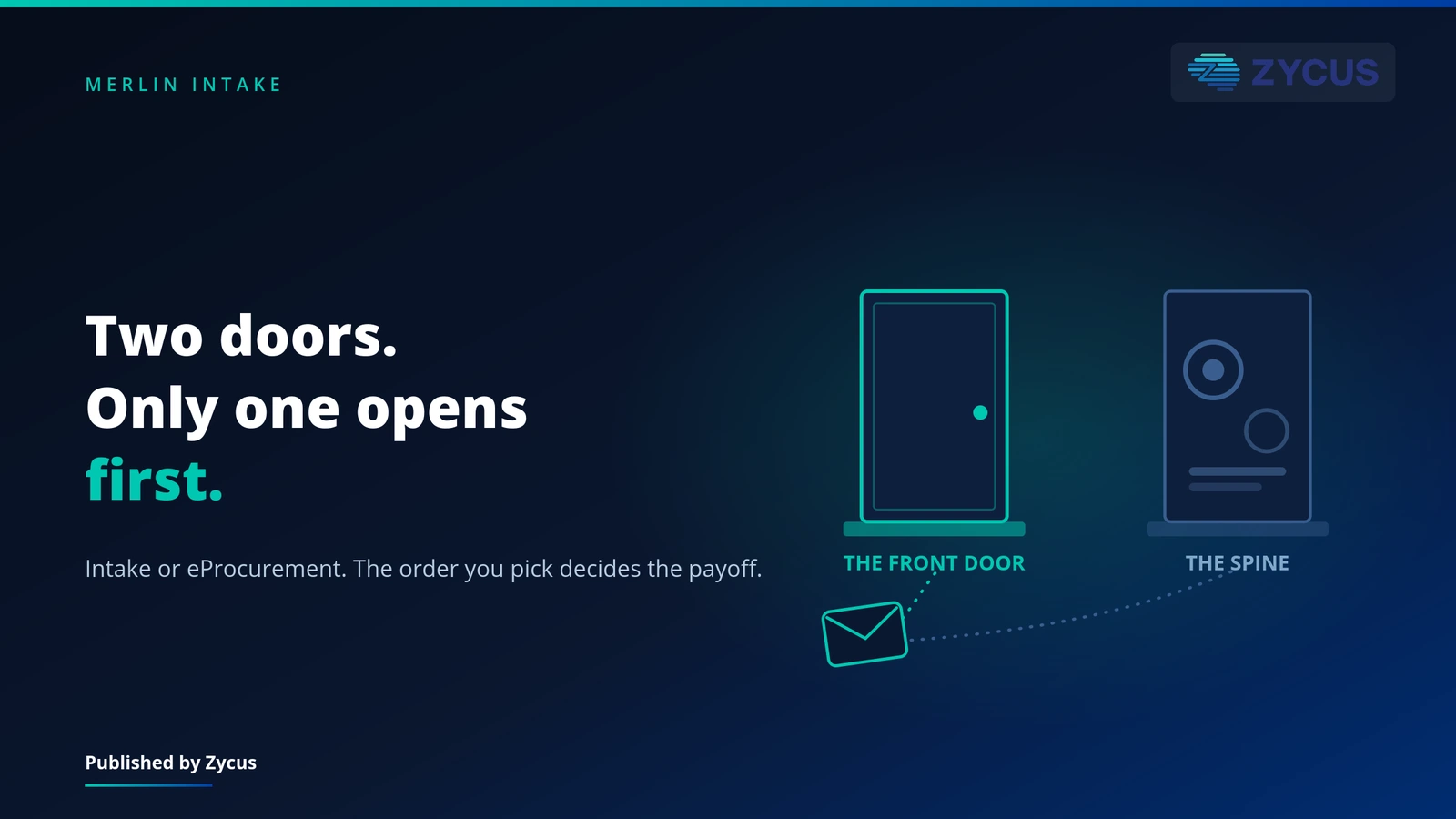
This is the architecture an increasing number of analyst firms and practitioners are converging on: intake-to-outcomes. Not a product name, but a design principle — and agentic AI is what makes it operational. The intake layer captures the request in natural language and routes it through policy. Agentic sourcing, negotiation, contract, and payment agents execute against shared intelligence across the S2P spine. The supplier management layer monitors continuously rather than in quarterly reviews. And beneath all of it, a unified data core ensures that every agent and every human is working from the same version of the truth. Platforms built on this principle — Zycus’s Merlin Agentic Platform among them — are demonstrating what procurement looks like when the handoffs are replaced by agents that coordinate across the architecture rather than operating beside it.
There is a final dimension to this shift that is easy to overlook and difficult to overstate. The CIPS 2025 Salary Guide found that 40% of procurement professionals expect to change employers within the next year. The top reason professionals choose to stay is not compensation or remote-work policy. It is access to training and development — a proxy for the belief that their role will become more interesting, not less. Procurement cannot become the strategic function its leaders aspire to build if the practitioners inside it are spending their sharpest hours reconciling fields across disconnected tools. The function has spent two decades asking for a seat at the table. The question now is whether, once seated, its people will have any attention left to contribute.
The handoff was never the work. It was the tax on the work. And the organisations that eliminate it first will not just buy better — they will keep the people who know how to.
Related Reads:
- On-demand Webinar: How AI-Enabled Intake Turns Into Measurable Outcomes
- From Intake Chaos to Business Outcomes: A Procurement Transformation Story
- Beyond S2P to I2O: Intake to Outcomes with Agentic AI
- Watch Video: Watch the Merlin AI Agents in Action: From Intake to Outcomes
- From Intake to Outcomes: How Aviation CPOs are Closing the Loop with Merlin AI
- From Intake to Outcomes: How Agentic AI Is Transforming the Source-to-Pay Lifecycle