








TL;DR
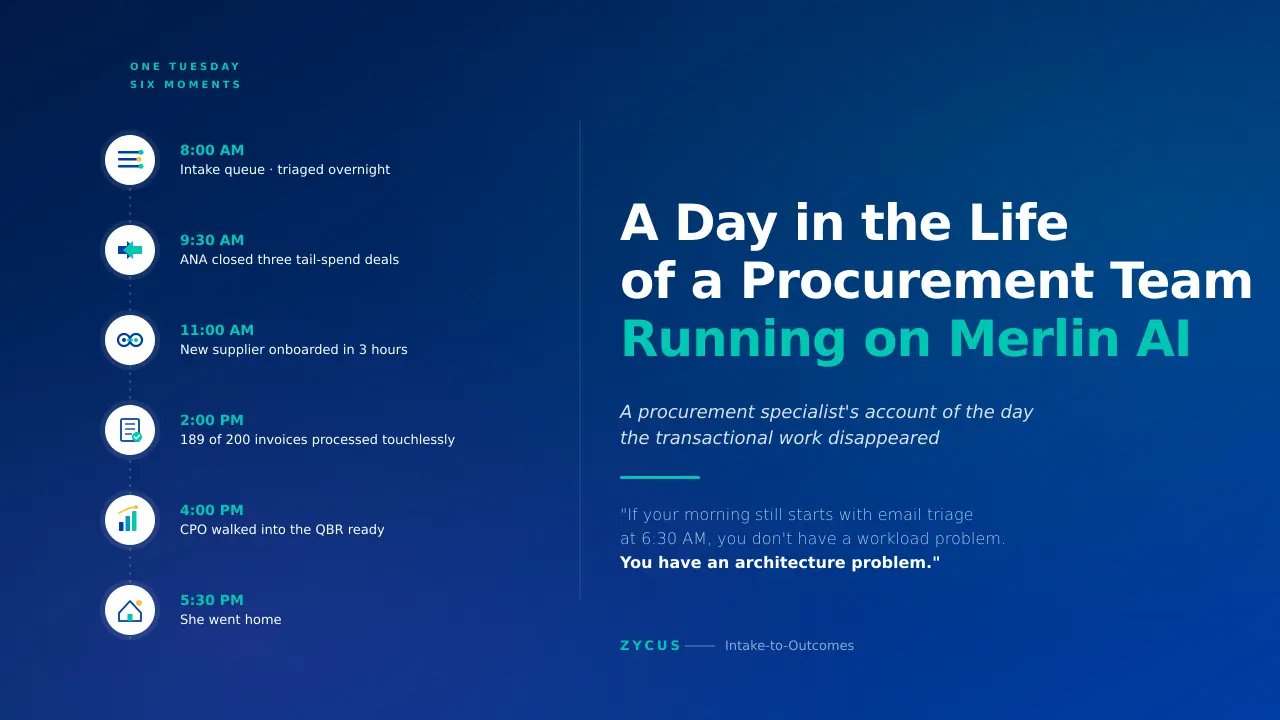
- This is a day in the life of a procurement specialist with AI — where agentic AI, autonomous negotiation, and touchless invoicing have replaced the transactional grind of traditional procurement work.
- Intake triages itself: 23 overnight requests are classified, policy-checked, and routed by Merlin Intake — 7 auto-resolve without any human touch.
- Tail spend negotiates itself: ANA (Autonomous Negotiation Agent) closes 3 deals overnight, capturing 2–3% savings with zero hours from the specialist.
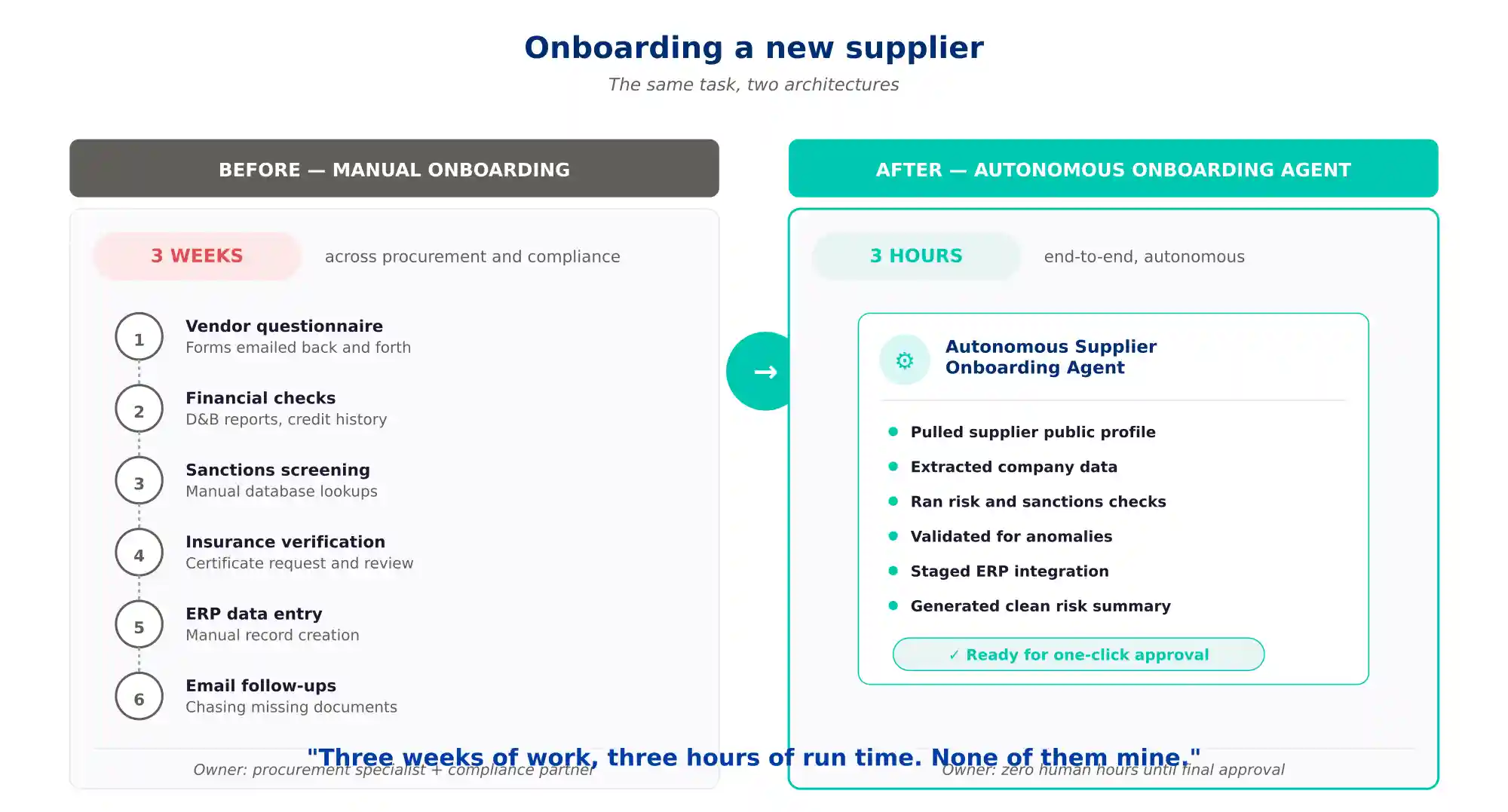
- Suppliers onboard themselves: 3 weeks of onboarding work (risk checks, sanctions screening, ERP setup) compresses to 3 hours of agent runtime.
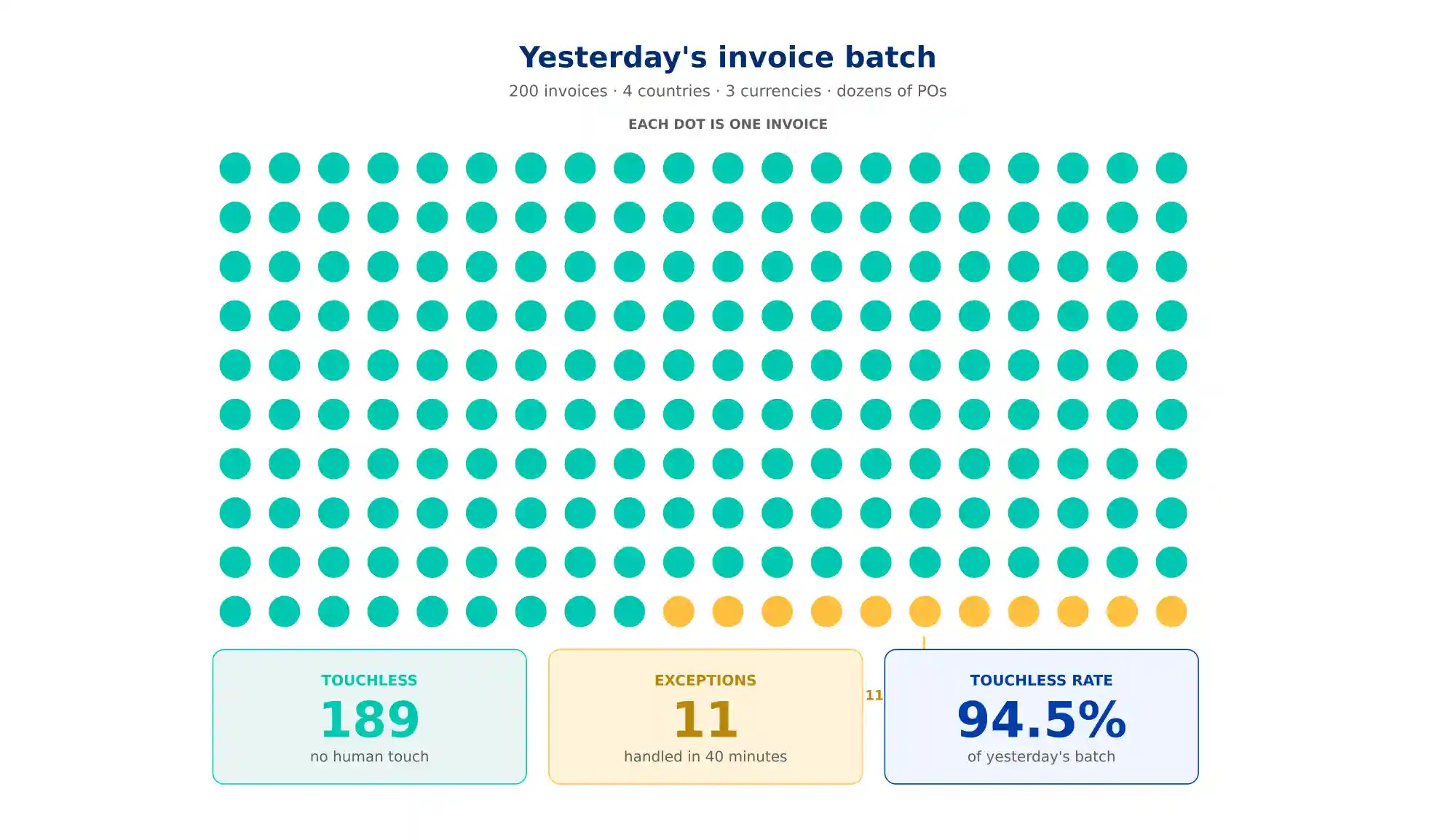
- Invoices process themselves: 189 of 200 invoices clear touchlessly; 11 exceptions take an AP analyst 40 minutes — not a full week.
- The real unlock isn’t AI, it’s architecture: Intake-to-Outcomes connects conversational intake, specialized agents, 1,121 APIs, and a unified data core — so the specialist goes home at 5:30 PM and spends the day on judgment work, not triage.
A Procurement Specialist’s Account of the Day the Transactional Work Disappeared
It’s 8:14 AM. In our London office, a marketing manager opens Microsoft Teams and types: “I want display stands for my upcoming conference.”
Within seconds, Merlin Intake responds. How many do you need, and when is the conference? She confirms. The AI surfaces three options from our catalog with supplier scores and pricing, recommends a contracted vendor, verifies policy compliance, and generates a purchase requisition. The whole exchange takes three minutes. She never opens a portal, never fills out a form, and goes back to her conference.
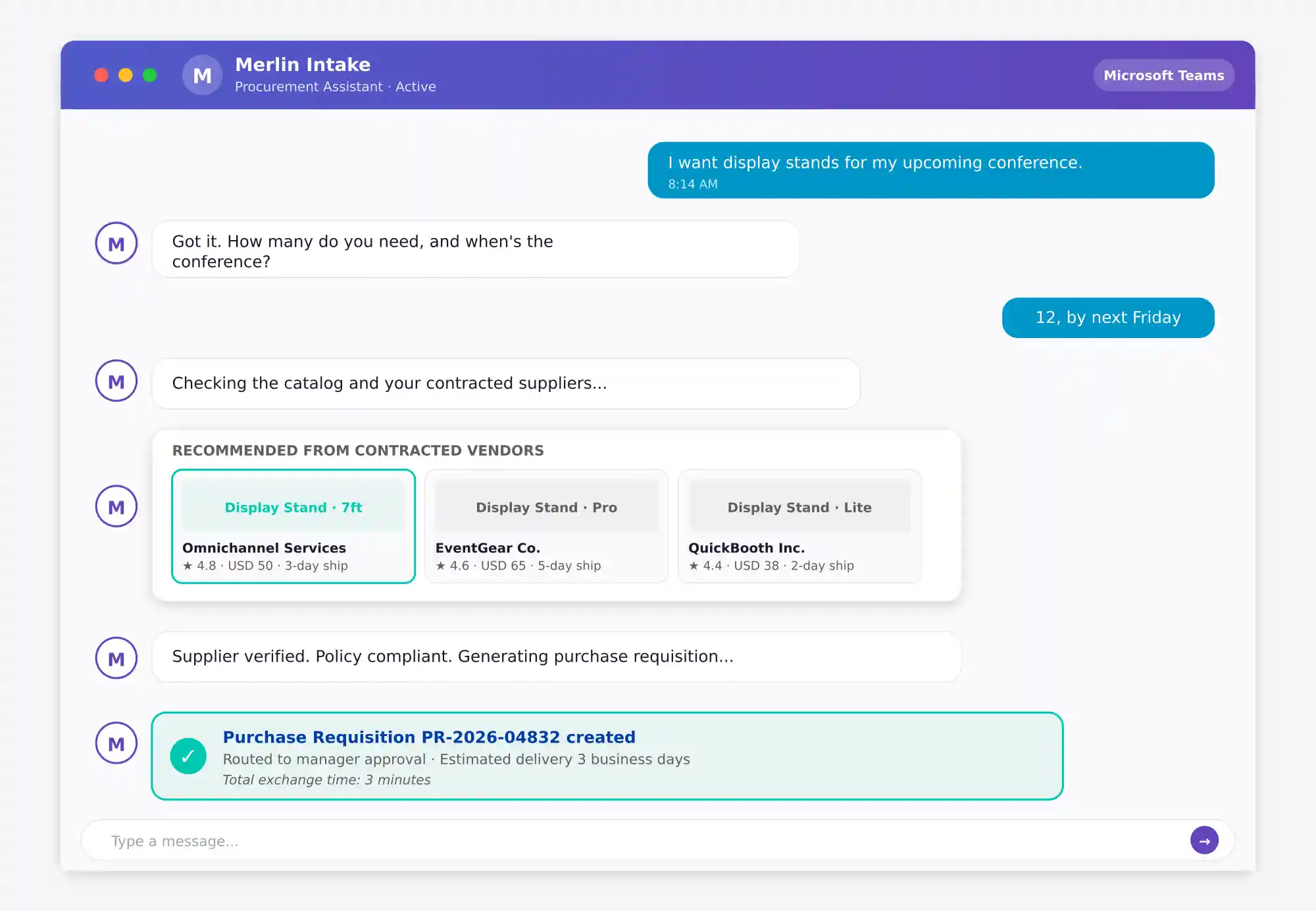
I watch the PR drop into my queue, fully formed. In the old world, this same request would have landed in my inbox as a confused email, and I would have spent half an hour walking her through a portal she didn’t want to use. Today she did it herself in three minutes. She just doesn’t know that.
This is Tuesday morning for a procurement specialist on a team running Merlin AI, and that request is one of twenty-three that came in overnight.
8:00 AM — The queue that triages itself
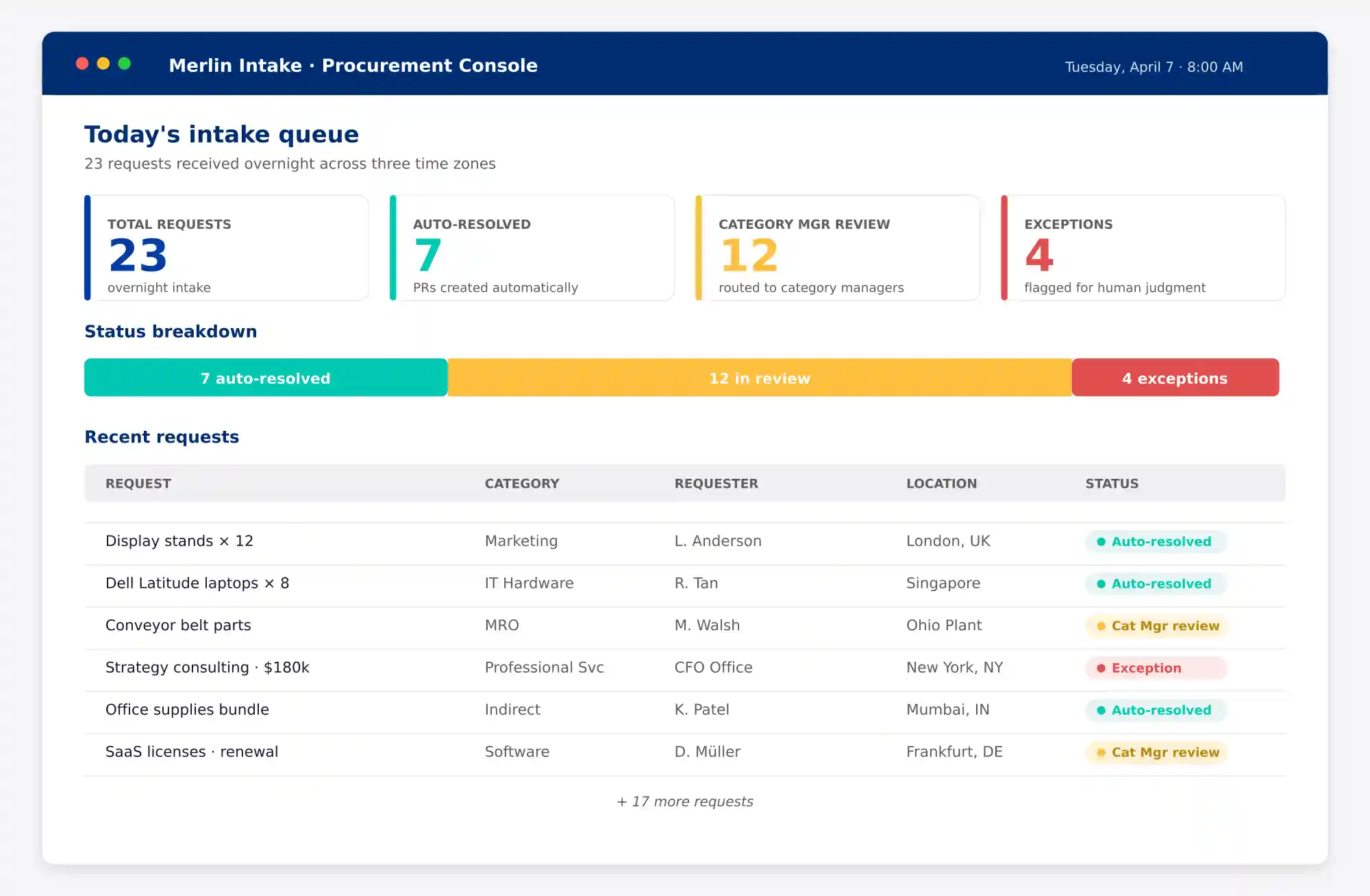
I open my dashboard. Twenty-three requests came in across three time zones while I slept — laptops for Singapore, maintenance parts for Ohio, a consulting engagement from the CFO’s team, and the display stands from London. In the old setup, these would be sitting in a shared inbox waiting for someone to read each one. Usually me.
Merlin Intake has already done the read-through. Each request is classified, checked against policy, matched to catalog items where available, and routed to the right workflow. Seven have already auto-resolved — Merlin asked the clarifying questions, surfaced the contracted supplier, and generated the PR. The requesters never opened a portal. Most of them probably don’t know one exists.
Twelve are waiting for the category manager review. Four are flagged as exceptions. I start with the four. The other nineteen handled themselves.
9:30 AM — The negotiation I didn’t have to run
I check on ANA — the Autonomous Negotiation Agent — to see what it did overnight. Last month we configured it for a batch of tail spend categories: office supplies, IT peripherals, and facility maintenance parts. The low-value, high-volume work that used to fill my Tuesdays and Wednesdays — pulling supplier histories, drafting RFPs, chasing bids. Three suppliers per event, weeks of back-and-forth, and at the end, a 2% saving on a $40,000 contract I’d spent more time assembling than capturing.
ANA doesn’t wait for instructions. It picked up the eligible PRs, ran the negotiations — counter-offering, comparing terms, optimising for total cost — and awarded contracts. By the time I finish my second coffee, three deals are closed. Savings of 2–3% on tail spend, captured without a single hour from me.
The first time this happened, I was uncomfortable. Tail spend coordination had filled most of a calendar like mine, and watching ANA do it without me felt strange. But here’s what I figured out: ANA isn’t replacing me. It’s doing the part of my job I never learned from — the repetitive volume that needed someone to show up, but never taught me anything new. I’m becoming the procurement professional I joined this team to become, instead of the one I was on track to become.
11:00 AM — The supplier I didn’t onboard
One of ANA’s overnight wins flagged a new supplier — a regional parts distributor that wasn’t in our system. In the old world, “new supplier” meant three weeks of work: forms, financial checks, sanctions screening, insurance verification, and ERP data entry. The single most thankless part of my job — and any mistake became my problem six months later.
The Autonomous Supplier Onboarding agent has already done it. It pulled the supplier’s public profile, ran risk checks, validated for anomalies, and staged the ERP integration. I open a clean risk summary: financials verified, no sanctions flags, insurance current. Approved.
Three weeks of work, three hours of run time. None of them is mine.
2:00 PM — The invoices nobody touched
After lunch, I check in with the AP team. Half my week used to be invoice exception work — chasing missing POs, reconciling price discrepancies, calling suppliers about duplicates. I still feel a twinge of sympathy whenever I see an invoice queue.
Yesterday’s batch was 200 invoices across four countries and three currencies. The AP SmartDesk agent processed 189 of them touchlessly — captured, validated, three-way matched, and queued for payment. The eleven exceptions landed with the AP analyst, who handled them in forty minutes.
When I started in procurement, “touchless invoicing” was something we put on roadmap slides. Today it’s a Tuesday afternoon.
4:00 PM — The meeting I built without building
At four, the CPO has a quarterly business review with the CFO. I’m not in the room, that’s the CFO’s conversation to lead, but in the old world, my job for the two weeks before that meeting was building it. Pulling spend data from five systems, building slides, reconciling numbers, and revising the deck at 11 PM for someone else to present.
Today, the analytics layer has already surfaced everything they need. Real-time spend, savings versus target, supplier risk, and compliance rates by business unit. There’s a flag on facilities management — maverick spend spiked because the approved supplier’s lead times slipped, and a regional team started ordering outside contracts.
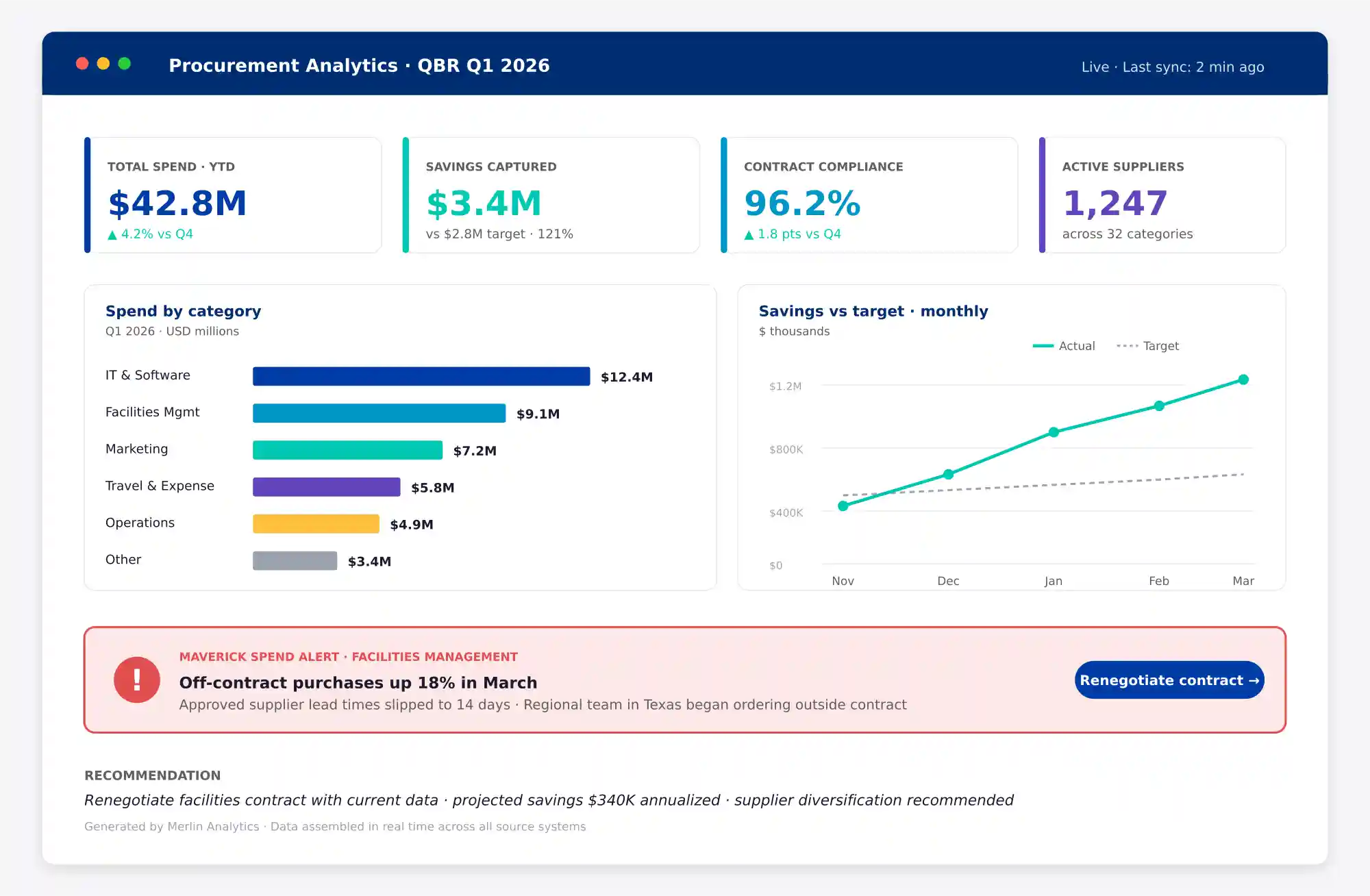
I watch the CPO walk into the meeting carrying nothing but a laptop. She doesn’t present what procurement processed. She presents what it delivered: costs avoided, risks mitigated, cycle times compressed, and a recommendation to renegotiate facilities — with the data already assembled. When the CFO asks a follow-up, she answers from the same dashboard.
Two weeks of my old work, replaced by a dashboard that I already knew.
5:30 PM — I went home
No late-night PO chasing. No follow-ups on stalled approvals. No invoice exceptions over dinner. No weekend data pulls for Monday’s leadership deck.
The transactional work — intake, routing, matching, low-value negotiation, supplier diligence, invoice processing, slide-building — was handled by agents. I spent my day on the things that actually require my judgment: the four exceptions this morning, a strategic supplier negotiation this afternoon, and the category analysis I’d been pushing off for weeks.
This is what McKinsey describes when they project that procurement functions could become 25–40% more efficient through AI agents. Not by making people work faster. By removing the work that shouldn’t have been theirs in the first place.
What’s Actually Underneath
People ask me how this works. The honest answer: it isn’t one tool. It’s an architecture.
Our team runs on what Zycus calls Intake-to-Outcomes. Merlin Intake captures demand through conversation. The Merlin Agentic Platform orchestrates downstream execution through specialised agents — negotiation, onboarding, invoicing, analytics — connected to the source-to-pay backbone through 1,121 APIs and an MCP Server. The S2P Suite holds the structured workflows, contracts, catalogs, and compliance rules underneath. The Zycus Data Core unifies it all.
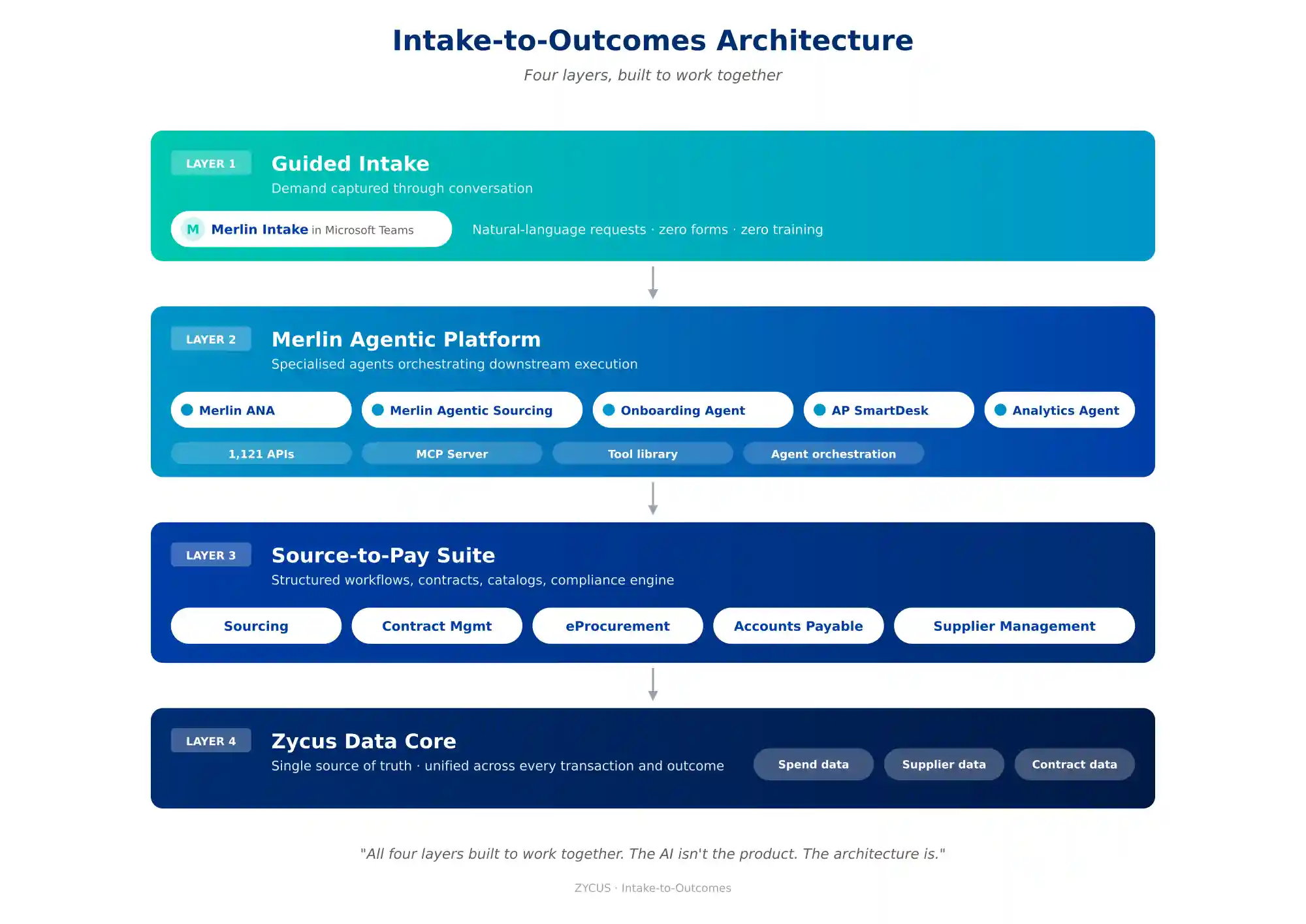
A conversational front door bolted onto a fragmented backend just creates a friendlier entrance to the same broken house. Agents running on disconnected data make confident mistakes faster than humans do. The AI isn’t the product. The architecture is.
The day I had yesterday
The day I described isn’t a fantasy or a future state. It’s a Tuesday. I can write about it in the first person because it’s the day I had yesterday.
The gap between where most procurement teams are today and where mine is isn’t talent or budget. It’s whether the transactional work is still being done by people who shouldn’t be doing it — or by agents that should have taken it years ago.
If your morning still starts with email triage at 6:30 AM, you don’t have a workload problem. You have an architecture problem.
Related Reads:
- Understanding the Future of Procurement: The Comprehensive Guide to the Intake Process
- 10 Game-Changing Use Cases of AI-Powered Intake Management You Need to Leverage Now
- Introduction to Intake Management: What It Is and Why It Matters
- Intake Management Automation: Revolutionizing Procurement Requests
- The Evolution of Intake Management: From Bolt-On to Built-In
- Unlocking Success: Intake Management Best Practices And Key Strategies
- eBook: Intelligent Intake Management – From Bolt-on to Built-in: The Key to Faster, Smarter Decision-Making
- eBook: A Practical Guide to Conversational Intake Management
- Revolutionizing Procurement: The Rise of Intake Management