






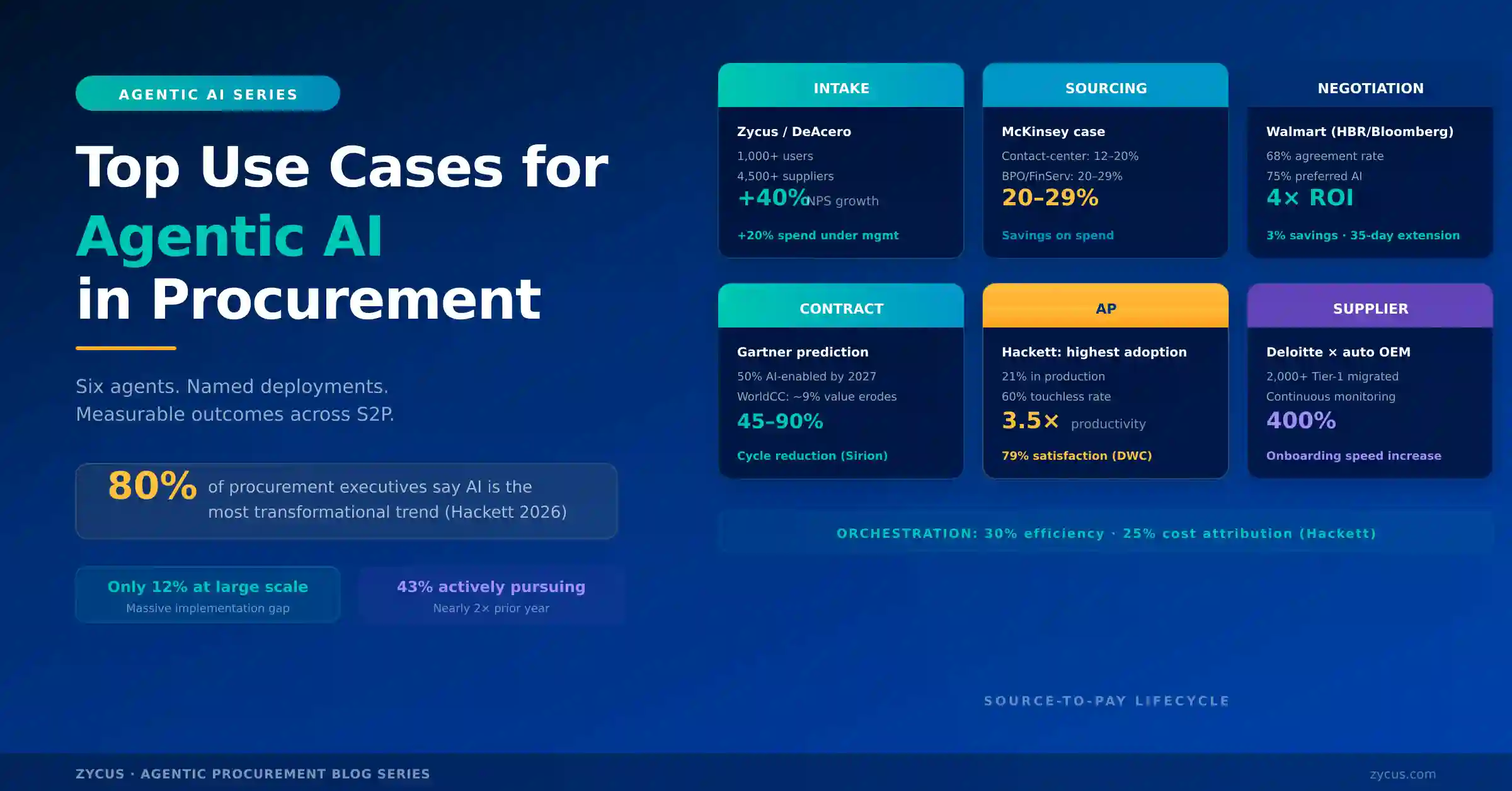

Agentic AI is no longer a concept deck. It is running in production at enterprises from pharmaceuticals to retail — and the outcomes are measurable. Here is where it is deployed, who is deploying it, and what they are getting.
TL;DR
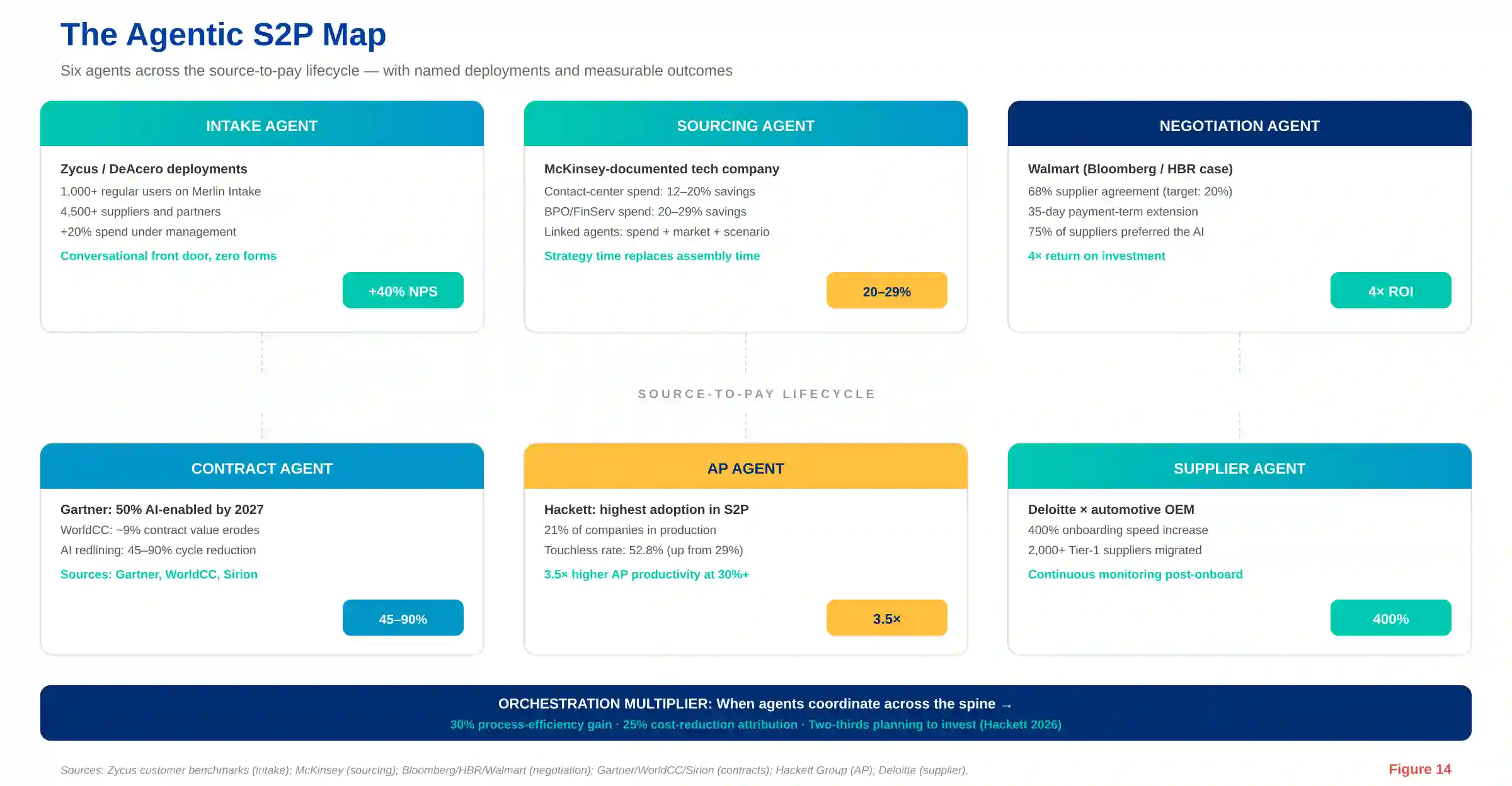
- Agentic AI procurement use cases start at intake: across Zycus deployments, 1,000+ users and 4,500+ suppliers run procurement intake through a single conversational front door. Aggregate customer benchmarks show +40% NPS growth and +20% improvement in spend under management.
- Sourcing: A McKinsey-documented tech company achieved 12–20% savings on contact-center and 20–29% on BPO spend using linked AI agents for strategy and scenario modeling.
- Negotiation: Walmart’s autonomous negotiation delivered 68% supplier agreement, 3% savings, 35-day payment extensions, and 4× ROI. 75% of suppliers preferred the AI to a human.
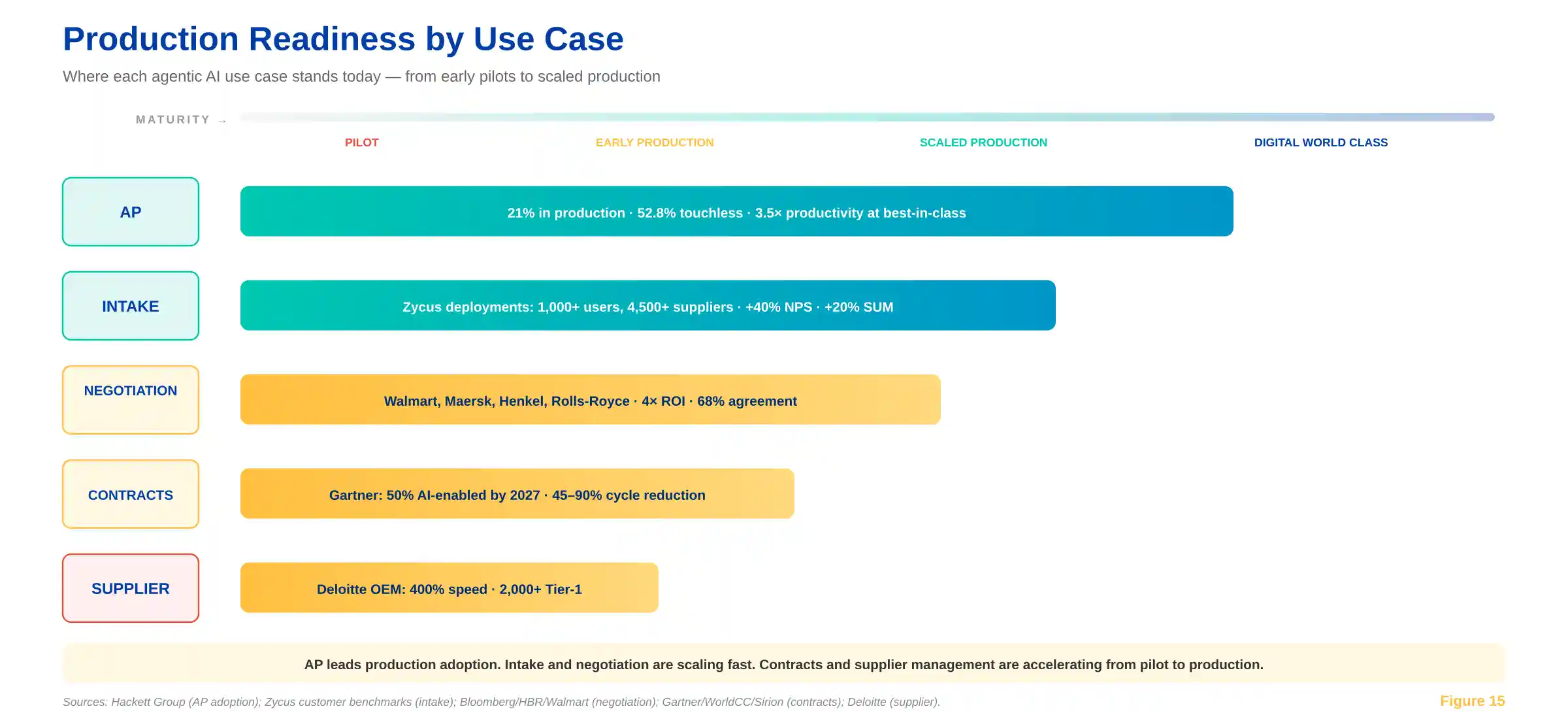
- AP has the deepest production footprint: 21% of companies running agentic AI in payables. Best-in-class touchless rates hit 52.8%, delivering 3.5× higher productivity.
- Orchestration is the multiplier: when agents coordinate across S2P, organizations report 30% process-efficiency gains and attribute 25% of cost reduction to orchestration.
- PwC estimates agentic AI will transform 75% of procurement activities, with productivity gains up to 70% in agent-driven tasks.
Eighty percent of procurement executives now identify AI-enabled technology as the most transformational trend affecting the function. Yet only 12% of organizations report large-scale AI implementation — even as 43% are actively pursuing deployment, nearly double the prior year. The gap is not skepticism — it is specificity. Leaders know AI matters. What they need is evidence of where it is working, at which companies, and with what results. This is the evidence: six use cases across the source-to-pay lifecycle, each with named deployments and measurable outcomes.
Read more: Pioneering Procurement: Building Your First Agentic AI Use Case
Figure 1 — The Agentic S2P Map: six agents, six proof points, one connected spine.
Intake: The Front Door that Routes Itself
The intake agent converts natural-language purchase requests into structured, policy-compliant purchase paths — without requiring the requester to know which form to fill out, which category to select, or which approval chain applies. This is the use case that eliminates maverick spending at the source, because the compliant path becomes the easiest path. Across Zycus deployments, organizations have adopted an AI-powered procurement front door with more than 1,000 regular users and 4,500+ suppliers running procurement intake through a single conversational front door. Aggregate Zycus customer benchmarks show +40% NPS growth where Merlin Intake is deployed, +20% improvement in spend under management, and +2–3% tail savings when Merlin ANA and Merlin Intake operate together. AppXtend and the MCP Server provide the integration backbone, connecting Merlin Intake to ERP, CLM, and supplier systems without custom development.
Download the free ebook on AI Agents in Procurement: The Next Wave of Digital Transformation
Strategic Sourcing: From Weeks of Assembly to Hours of Strategy
Sourcing agents compress the operational sequence — spend analysis, supplier shortlisting, RFP generation, bid evaluation, scenario modeling — so the category manager spends time on strategy rather than assembly. McKinsey’s 2025 procurement research documents a technology company that deployed linked AI agents to rebuild its external-services sourcing strategy. One agent integrated spend and market data for real-time price-trend insights; another simulated demand evolution under different scenarios. Outcomes: 12–20% savings on contact-center spend and 20–29% savings on BPO and financial-services spend. A chemicals company is piloting autonomous sourcing agents in consumables — automating tender preparation, supplier prequalification, bid analysis, and supplier-query routing end to end. The pattern is consistent: the agent handles the operational sequence that used to consume six to twelve weeks of category-manager time, and the human directs the strategy that the agent’s intelligence makes possible.
Check out The Agentic AI Shift in Procurement: A Live Showcase (Techwatch)
Autonomous Negotiation: The Tail Spend Nobody Managed
Tail spend — the long tail of low-value contracts that procurement teams historically ignore because the cost of negotiating exceeds the savings — is the use case where agentic AI has the longest production track record. Walmart deployed AI-powered autonomous negotiation across its supply base. The results, documented by Bloomberg and the Harvard Business Review case program: a 68% supplier agreement rate (against a 20% target), 3% average cost savings, a 35-day average payment-term extension, and a 4× return on investment. Eighty-three percent of suppliers rated the system easy to use. Seventy-five percent said they preferred negotiating with the AI over a human. The program has since expanded across the US, Chile, and South Africa, with deployments at Maersk, Henkel, Rolls-Royce, and Honeywell following the same pattern.
Read more: The Hidden Cost of Tail Spend: Why Manual Negotiation Doesn’t Scale
Check out How Autonomous Sourcing Speeds Savings in Procurements
Contract Management: From Periodic Review to Continuous Intelligence
Contract agents review, redline, and monitor obligations continuously rather than in quarterly cycles. Gartner predicts that by 2027, 50% of organizations will support supplier contract negotiations through AI-enabled contract risk analysis and editing tools. The production evidence is already emerging: WorldCC research shows contract inefficiencies erode up to 9% of total contract value through missed obligations, unenforced terms, and renewal delays. Enterprise deployments using AI-powered redlining report 45–90% cycle-time reductions across implementations, according to Sirion and Deloitte benchmarks. The shift is from lawyers reviewing documents to agents monitoring obligations — surfacing renewal risks, compliance gaps, and cost-escalation patterns months before they become emergencies.
Accounts Payable: The Most Mature Production Deployment
AP is where agentic AI has the deepest production footprint. Hackett Group research shows 21% of companies are already running agentic AI in production in accounts payable — the highest adoption rate of any S2P function. The performance benchmarks are precise: organizations achieving 30%+ touchless invoice processing deliver 3.5× higher AP productivity than peers, with the best-in-class touchless rate now reaching 52.8%, up from 29% in 2023. The trajectory is steep: invoice processing times have compressed from 10–14 days to 2–3 days for organizations deploying AI-powered capture, and late payments have dropped 57%. AP agents do not just match invoices. They resolve exceptions intelligently — checking against purchase orders, contract terms, and supplier history before deciding whether to pay, hold, or escalate. The routine work disappears. The human reviews what genuinely requires judgment.
Supplier Management: From Quarterly Audits to Continuous Monitoring
Supplier agents verify, score, and monitor the supply base continuously. Deloitte and ServiceNow deployed digitized supplier onboarding for a luxury automotive OEM, achieving a 400% increase in onboarding speed — quadrupling the number of suppliers onboarded weekly, with 2,000+ Tier-1 suppliers migrated to a new EDI system. In pharmaceuticals, AI-driven document understanding has compressed onboarding from 35 days to 4 days — an 88% reduction. A separate global manufacturer reported a 60% reduction in onboarding time and a 50% decrease in documentation errors using generative AI for vendor qualification. The larger shift is from periodic supplier reviews to always-on intelligence: financial health, ESG exposure, cyber risk, and geopolitical context monitored in real time rather than discovered in a quarterly deck that arrives too late to act on.
The Compounding Effect: When Agents Work Together
The individual use cases are impressive. The real value emerges when agents coordinate. An intake agent routes a request to a sourcing agent that benchmarks against market data, triggers a contract agent to draft terms, and hands off to an AP agent for payment — with each agent sharing context through a unified data core rather than operating in isolation. Hackett Group’s orchestration research shows organizations achieving a median 30% improvement in process efficiency and attributing 25% of cost reduction to orchestration initiatives. Two-thirds of surveyed organizations plan to invest in or upgrade orchestration capabilities within the next three years. The implication is architectural: the value of each individual agent multiplies when it operates on a shared data core with the others. A point agent in a silo automates the silo. A network of agents on a unified spine automates the workflow.
Figure 2 — Production readiness by use case: AP leads, intake and negotiation scale fast, contracts and supplier accelerate.
PwC’s modeling estimates that agentic AI will transform at least 75% of procurement activities, with productivity gains of 30% overall and up to 70% in agent-driven tasks. Platforms architecturally designed for this, Zycus’s Merlin Agentic Platform among them — treat the S2P lifecycle as a single connected spine with agents coordinating across intake, sourcing, contracts, payments, and supplier management rather than operating as point solutions.
The evidence is no longer conceptual. It is operational, measurable, and expanding. The question for every procurement leader is not whether agentic AI works — it is which use case to deploy first.
Related Reads:
- Pioneering Procurement: Building Your First Agentic AI Use Case
- Harnessing Agentic AI: Revolutionizing Spend Analysis for Smarter Procurement
- Top 7 AI Use Cases Transforming Sourcing Today
- Top 5 Use Cases for Advanced Analytics in Procurement by Gartner®
- The Complete Guide to Agentic AI in Procurement
- From Co-Pilots to Commanders: How Agentic AI is Redefining Procurement Transformation