




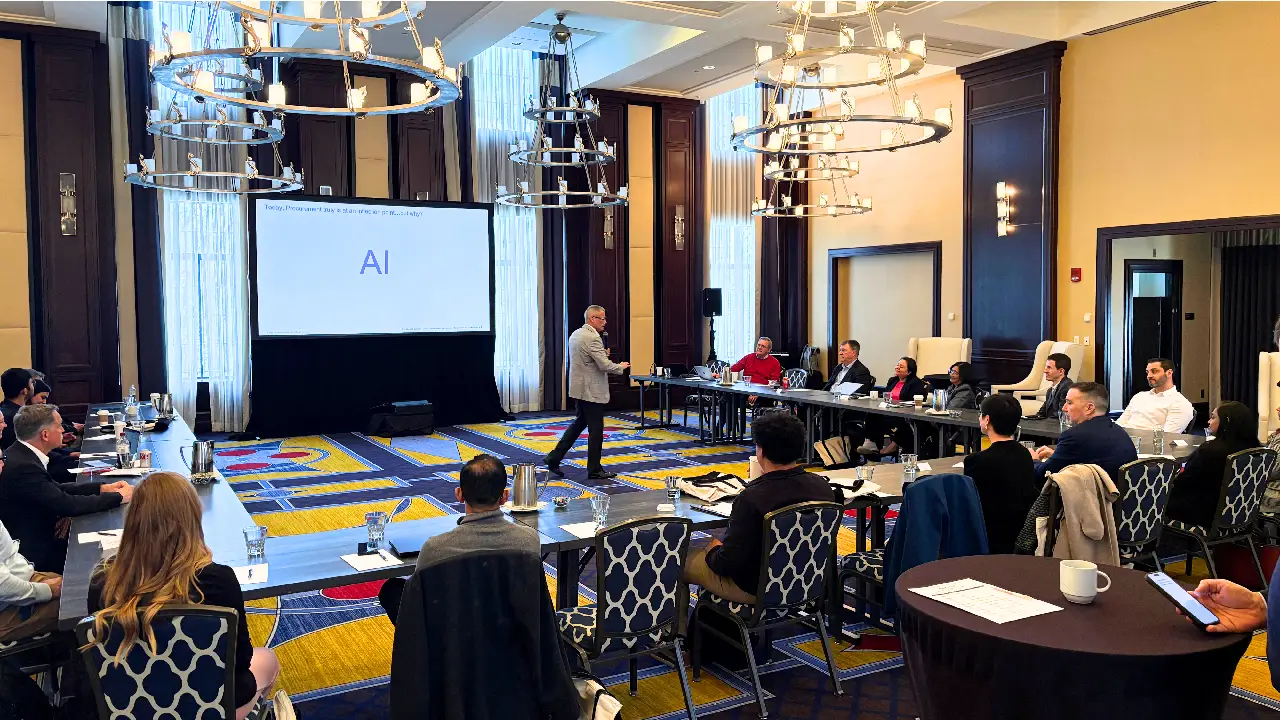

Last week in Boston, as part of Zycus’ Procurement AI World Tour 2026, we brought together CPOs and senior procurement leaders for an invite-only executive briefing focused on one central question: what does agentic AI mean for procurement in practice?
The evening was anchored by the first public presentation of The Hackett Group Agentic AI in Procurement Adoption Index 2026, delivered by Chris Sawchuk. That immediately gave the conversation weight. This was not a generic AI discussion. It was a grounded look at how procurement leaders are thinking about value, readiness, and risk.
What stood out was how quickly the room moved past broad AI excitement. The real discussion was about where autonomy can create value, where governance needs to be tighter, and what needs to be in place before agentic workflows can scale responsibly.
That is what made Boston different. Procurement is no longer talking about AI as a future concept. It is starting to treat it as an operating model decision.
Download Analyst Report: The Hackett Group Agentic AI in Procurement Adoption Index — 2026
Why the Boston Conversation Felt Different
There is no shortage of AI noise in the market right now. But Boston felt different because the conversation was grounded in benchmark data, not speculation.
The Hackett research shows that 58% of procurement leaders expect agentic AI to have a high or very high impact on their organisation, while 91% expect benefits in process efficiency and autonomy. That makes one thing clear: this is no longer a side conversation. Procurement leaders are beginning to see agentic AI as a serious lever for change.
At the same time, the tone in the room was measured. Leaders were not asking, “How much can we automate?” They were asking, “Where do we start, what do we trust first, and how do we stay in control?” That shift made the event feel less like a technology showcase and more like a leadership conversation.
Why Governance Came Before Hype
One of the clearest themes from the evening was that governance is becoming the real test of agentic AI maturity.
The most useful conversations were not about flashy possibilities. They were about boundaries, oversight, and decision rights. Procurement leaders kept returning to practical questions: who sets out the rules, where should human judgment remain, and which workflows can safely be delegated?
That focus matters because the readiness gap is still real. Only 60% of procurement executives say they are confident in their teams’ awareness of agentic AI technology. In other words, interest is growing faster than organizational fluency.
That may become one of the biggest dividing lines in the market over the next year. The organizations that move well will not simply be the ones experimenting with AI. They will be the ones that know how to govern it.
Where Leaders See the Fastest Value
What also came through clearly in Boston was that procurement leaders are not trying to start everywhere at once. They are looking for practical, lower-risk entry points.
That is why one of the strongest findings in the Hackett research matters so much: 86% of procurement leaders are likely or very likely to consider using AI-powered agents to negotiate autonomously in low-risk purchasing scenarios such as tail spend.
That tells us a lot about how adoption is likely to happen. Not through blanket automation across the entire function, but through focused use cases where the business value is visible, the risk is manageable, and the guardrails can be clearly defined.
Tail spend is one obvious example. Negotiation support is another. More broadly, the conversation pointed to a familiar procurement priority: how to improve execution across repetitive, rules-based workflows without losing oversight or commercial discipline.
Read more: Autonomous Tail Spend Negotiation: The 86% Opportunity Procurement Is Missing
Why Integrated Workflows Matter More than Point Agents
Another strong theme from the research is that procurement leaders do not want a future built on disconnected AI tools.
In fact, 65% of procurement leaders say they prefer integrated agentic workflows over standalone agents. That is significant because it shows the market is already thinking beyond isolated AI features and toward something more structural: AI that can operate across connected procurement processes, approvals, policies, and data environments.
That has important implications. Success is unlikely to come from layering agents on top of fragmented workflows and hoping the experience feels seamless. It will come from building the right foundation underneath them.
That was one of the most useful dimensions of the Boston discussion. The room did not stop at what AI could do. It pushed further into a more important question: what kind of procurement environment is needed for AI to work well at scale?
Where Zycus Brought the Discussion Closer to Reality
One reason the Boston format worked so well is that it did not stop researching. It connected insight to execution.
Following the Hackett keynote, Zycus brought the discussion closer to reality with a live look at Merlin Agentic Platform and demonstrated Merlin Intake Agent and Merlin ANA (Autonomous Negotiation Agent). That part of the evening mattered because it translated benchmark findings into something tangible for the room.
It showed that the conversation is no longer just about whether agentic AI will shape procurement. It is about how procurement teams will actually use it inside workflows, decisions, and day-to-day execution.
That made the roundtable discussion even more relevant. Leaders were not only reacting to the research. They were also seeing how these ideas are beginning to show up in practical procurement scenarios.
For teams looking to understand where they stand today, The Hackett AI Adoption Index Assessment is a useful next step:
https://www.zycus.com/resources/tool/agentic-ai-procurement-readiness-assessment
What the Boston Roundtable Signals for 2026
Taken together, the conversations in Boston point to a clear shift.
Procurement is moving beyond the question of whether AI belongs in the function. The conversation is becoming more specific and more practical. Leaders are now asking where autonomy should begin, where human judgment needs to remain, which use cases should come first, and what needs to be strengthened before agentic AI can scale with confidence.
That is what makes this moment significant. The strategic case for AI in procurement has largely been made. The pressure is now shifting to execution. But what stood out most in Boston was not the excitement around AI alone — it was the quality of the questions.
This was not a room for buzzwords. It was a room trying to understand how procurement can adopt autonomy in a way that is commercially useful, operationally realistic, and properly governed.
The leaders who move well from here will likely be the ones who prioritize practical use cases, strengthen governance early, build internal understanding, and invest in connected workflows rather than isolated automation.
Boston made one thing clear: procurement leaders are no longer watching the agentic AI conversation from the sidelines. They are beginning to define the terms on which it will actually work.
Related Reads:
- Agentic AI in Procurement: What Hackett’s Adoption Index Reveals About Control
- The CPO’s First 90 Days in the AI Era | Forrester x Zycus
- Why Less Than One-Third of Procurement Organizations Can Scale Agentic AI
- IT vs Procurement: Who Should Own Your Agentic AI Strategy?
- Point Agents vs Agentic Workflows: What the Hackett Group’s 2026 Research Reveals
- eBook: AI-Enabled or AI-Exposed? Agentic AI in Procurement