







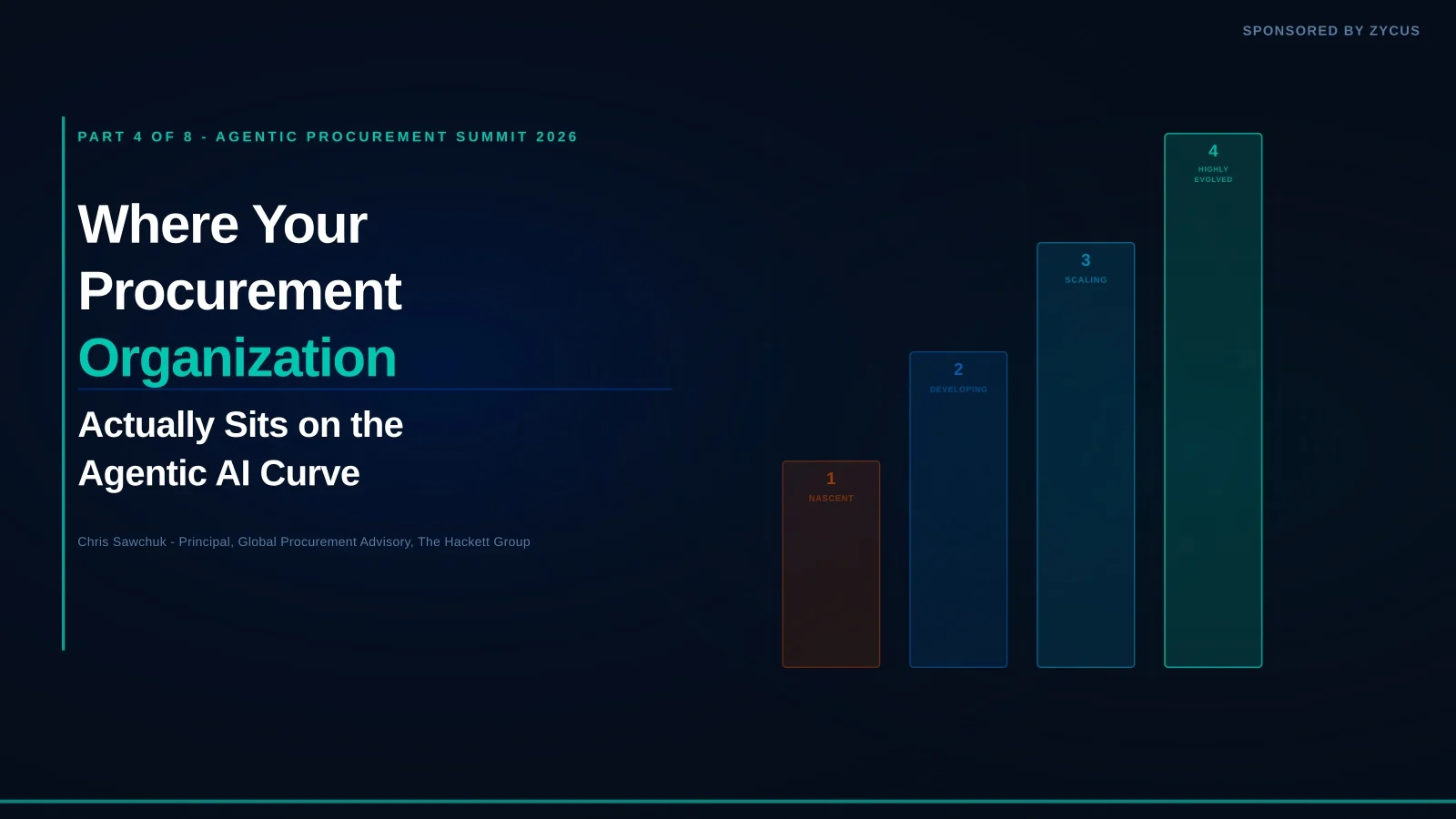

The Hackett Group’s first-ever agentic AI maturity benchmark for procurement. Four stages. Six dimensions. One diagnostic question most CPOs have not asked yet.
From the Agentic Procurement Summit 2026 · Session 3 · Chris Sawchuk, Principal and Global Procurement Advisory Practice Leader, The Hackett Group
TL;DR
- The most important procurement AI question right now is not which agents to deploy first. It is where your organization actually sits on the agentic AI maturity curve. Most CPOs have not answered it.
- The Hackett Group\u2019s Agentic AI in Procurement Adoption Index 2026 reveals how far back most organizations are: fewer than half of CPOs feel confident monitoring agentic AI, only 24% have defined KPIs, and only 19% have governance infrastructure in place.
- The Hackett four-stage model, Nascent through Highly Evolved, is a diagnostic instrument, not a progress chart. Each stage has a checklist of indicators, a risk profile, and calls to action. This blog walks through all four.
- Stage 1 organizations face high competitive risk: peers who are moving may be compounding an advantage that becomes harder to close. The single most important call to action: own the agenda. Today, 58% of organizations have delegated it to IT.
- Stage 3 is where organizations begin measurably separating from peers. Stage 4 is where competitive risk becomes very low. This blog covers the six readiness dimensions that determine how fast an organization moves between them.
- Chris Sawchuk, Principal and Global Procurement Advisory Practice Leader at The Hackett Group, presents the full maturity model and Adoption Index findings at APS 2026. Watch the session
The Question Nobody is Asking First
Every procurement conversation right now is about deployment: which agents, which processes, what ROI timeline. Very few ask the diagnostic question that comes first. Where are you actually starting from?
The previous blogs described what agentic AI is, what it should produce, and what kills a deployment before it delivers. Chris Sawchuk of The Hackett Group opened APS 2026 Session 3 with the diagnostic framing that runs through the entire session: if you do not know where you are today and where you need to be, any road will take you there. The previous blog in this series discussed the architecture required. This blog provides the benchmark for where to begin.
Where Post Organizations Actually Are
Surface numbers look more advanced than the reality. Gartner’s September 2025 survey of 360 IT application leaders found that three-quarters had deployed some form of AI agents, but only 15% were considering, piloting, or deploying fully autonomous ones. Three-quarters have the components. One in seven has the capability.
McKinsey’s 2025 State of AI, drawing on nearly 2,000 organizations, found that only about one-third are scaling AI across the enterprise. The other two-thirds are still in experimentation.
The Hackett Adoption Index makes the gap precise: fewer than half of CPOs feel confident monitoring or controlling agentic AI, only 24% have defined KPIs, and only 19% have governance infrastructure in place.
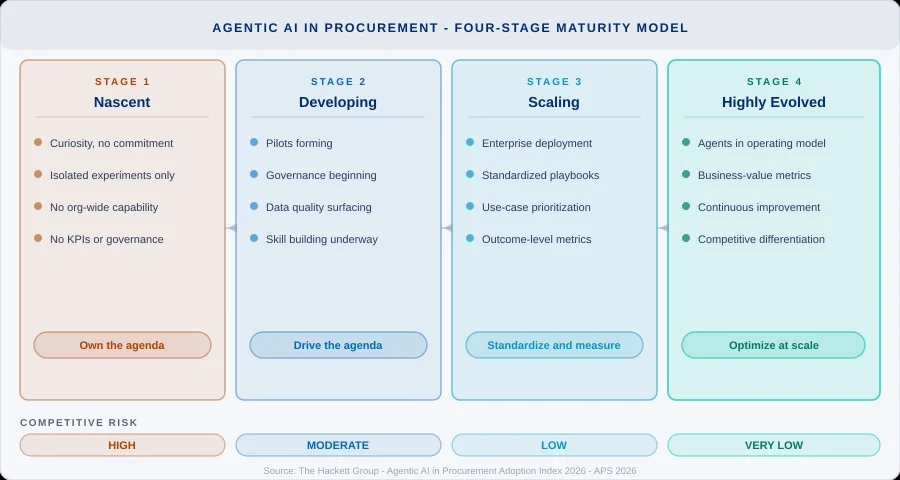
Four stages, each with a checklist of indicators, a risk profile, and calls to action. Work through the indicators before planning any deployment.
A Maturity Model Built for this Diagnostic
The Hackett Agentic AI in Procurement Maturity Model defines four stages: Nascent, Developing, Scaling, and Highly Evolved. Its value is as a diagnostic instrument, not a progress chart: a structured way to identify where you are, define where you need to be, and architect the path between the two. Each stage carries specific indicators designed as a self-assessment checklist. Work through them before committing to any deployment plan.
Stage 1 and 2: Where Most CPOs Are Today
Nascent organizations have curiosity without commitment. Experimentation is isolated at the individual level, not the functional one. There is no organization-wide capability, no formal training, and no defined success metrics. Operational risk is low, but competitive risk is high: peers who are moving may be compounding an advantage that becomes harder to close.
Developing organizations have begun to build. Pilots exist, governance is forming, and data quality is surfacing as a real constraint. Benefit delivery remains limited because nothing has scaled to organization-level outcomes, but competitive risk drops to moderate: the organization is moving, even if not yet separating.
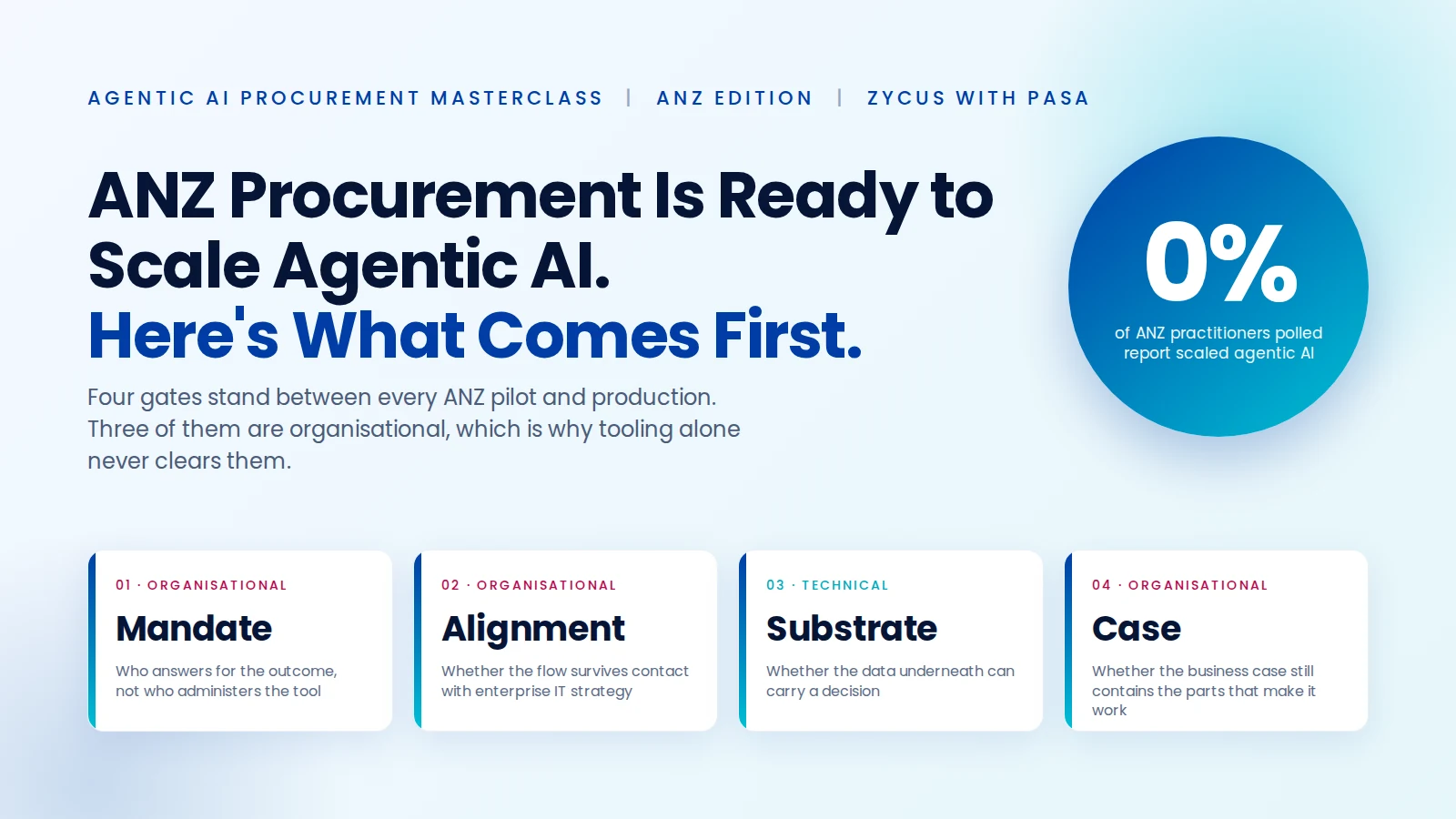
The Hackett data makes the ownership problem visible at both stages. In 58% of surveyed organizations, IT, not procurement, is leading the agentic AI strategy. Sawchuk’s call to action for Stage 1 is clear: own the agenda. The Hackett Adoption Index provides the benchmarking detail for this stage.
Stage 3 and 4: What Separation Looks Like
Scaling organizations have moved pilots to enterprise-wide deployment. They have standardized playbooks, use-case prioritization schemas, and outcome-level metrics. Competitive risk drops sharply. Stage 3 is where organizations begin measurably separating from peers.
A June 2025 Gartner survey of 432 organizations confirms why position matters: 45% of high-maturity organizations sustain AI in production three or more years, compared to only 20% of low-maturity ones. Maturity is the structural condition that enables sustained value rather than stall.
Bain’s 2025 Technology Report found that AI leaders who scaled across core workflows improved EBITDA by 10% to 25%, while laggards remained in pilot mode. The compounding pattern Hackett maps for procurement is visible at enterprise scale across every function.
The Highly Evolved stage is where agents are embedded in operating models, business-level metrics replace function-level KPIs, and competitive risk becomes very low. Others are trying to catch you.
Six Dimensions to Evaluate Before you Build
The maturity model is underpinned by six readiness dimensions that organizations should assess before committing to any deployment path: strategy and leadership, governance and ethics, organization culture and talent, tech enablement, data, and AI enablement.
Sawchuk specifically called out data as the “foundation fuel” for agentic AI. The agents have to be able to access the right data, in the right quality, with the right context to act reliably. Organizations that skip the data dimension discover the constraint in production, not in the pilot.
When asked what stalls most organizations: the volume of use cases, no prioritization schema. The corrective is deliberate. Identify the use cases aligned with your objectives and start there. For Stage 1, that entry point is almost always tail spend.
The Single Decision that Changes the Trajectory
The Hackett Adoption Index makes the leadership question concrete. Fifty-eight percent of organizations have IT leading a function-defining technology strategy. Sawchuk’s call to action for a genuinely nascent CPO was unambiguous: take ownership. Own the agenda personally, not delegate it to IT or wait for a vendor to define it. Every other readiness dimension is downstream of this one. The maturity model does not move if the person responsible for the function does not hold it.
The Model as a Planning Instrument
The four-stage model is most valuable before the next deployment. The questions it forces: which stage describes where you are, which checklist items are missing, and what the calls to action for that stage require.
For Nascent organizations: ownership, a proving ground with lower risk and higher volume, and building skills. For Developing organizations: expand governance from the pilot level, and plan the deliberate path from pilots to enterprise-wide production.
The organizations at Stage 4 are not running a better S2P system. They have built from Intake-to-Outcomes: agents run with the full context they need to act, from the first request to the delivered result.
The competitive window is not static. The next session at APS 2026 examines what it takes once the diagnostic is done: the Forrester research on why the CPO must own what comes next.
Agentic Procurement Summit 2026. On-Demand Access. Chris Sawchuk presents the full Agentic AI in Procurement Adoption Index 2026 findings, including the complete four-stage maturity model and readiness assessment. Sponsored by Zycus. → Watch the session. Download the full Hackett Adoption Index.
Previous Blog in the series: Why “Source-to-Pay” Is the Wrong Way to Describe What Procurement Is Building Next
Next blog in the series: Tailwind in Action: What Agentic AI Actually Looks Like in Procurement
FAQs
Q1. How do we know which stage we are at?
Work through the checklist indicators for each stage. The markers are specific: KPIs defined, governance in place, pilots progressing to production. Match the description that most accurately reflects your organization’s current state.
Q2. What is the most common stage procurement organizations are at today?
The Hackett Adoption Index data indicates most are in Stage 1 or Stage 2. Only 24% have defined KPIs and only 19% have governance infrastructure in place. Both are Stage 2 prerequisites that most organizations have not yet met.
Q3. What breaks an organization out of Stage 1?
Ownership. The CPO taking personal ownership of the agentic AI agenda is the primary call to action for Stage 1. In 58% of organizations, IT currently owns this. The transition begins when procurement reclaims it.
Q4. Is tail spend the right starting point for agentic AI?
The Hackett data places it at the top of the proving-ground list for a specific reason: lower operational risk, higher volume, measurable outcomes. Eighty-six percent of surveyed CPOs said they are likely to use agents for autonomous tail spend negotiation.
Q5. How long does it take to move from Nascent to Scaling?
The model does not prescribe a timeline because the path depends on business objectives and investment committed. Organizations that move deliberately, owning the agenda and prioritizing use cases, compress the timeline significantly.
Q6. What is the most common governance mistake at Stage 2?
Building governance for the pilot rather than the enterprise deployment. Stage 2 governance that covers only the current experiment creates structural gaps at Stage 3. Build for where you are going, not where you are.
Related Reads: