







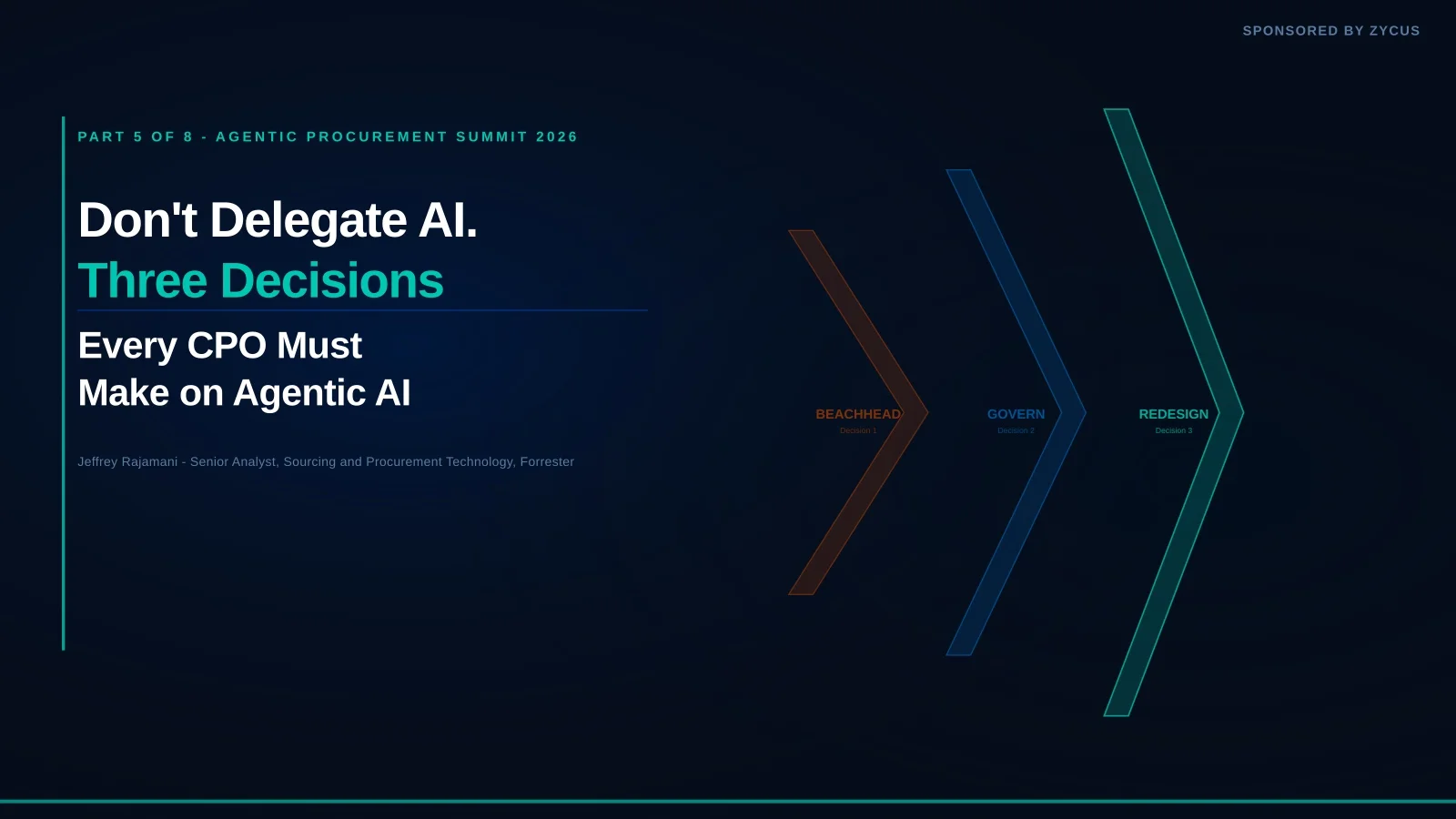

Forrester’s research on why procurement leaders must own their agentic AI agenda personally, and the three decisions that separate CPOs who lead from those who are left watching.
From the Agentic Procurement Summit 2026 · Session 4 · Jeffrey Rajamani, Senior Analyst, Sourcing and Procurement Technology, Forrester
TL;DR
- When told they must own AI, most CPOs’ first instinct is governance committees and vendor selection. This blog opens with why that instinct delegates the agenda right back to IT through a different door.
- Owning agentic AI means designing the system of work that agents operate inside. This blog covers what that actually requires and why the CPO, not the CIO, is the only leader with the procurement context to do it.
- Decision 1: Choose a beachhead. Not everywhere at once, not a thousand pilots. One process, three characteristics, a measurable return in three months. This blog explains how to choose it.
- Decision 2: Govern it like a product, not an IT policy. This blog covers the governance question, the one-page mandate, and why only one in five organizations currently has a mature model for governing autonomous AI agents.
- Decision 3: Scale is redesign, not replication. When an agent handles tail spend at scale, KPIs, skills, and roles all change. This blog covers what the CPO must redesign simultaneously, and why that is a strategic transformation, not a technology rollout.
- Jeffrey Rajamani, Senior Analyst at Forrester, presents the full session and the Don’t Delegate AI findings at APS 2026. → Watch the session
The Wrong First Instinct
The previous blog in this series provided the diagnostic: where procurement organizations sit on the agentic AI maturity curve, and the Hackett Adoption Index data showing most are at Stage 1 or Stage 2. The natural next question is who takes ownership of the path forward.
For most CPOs, the answer arrives as an instinct: governance committees, vendor selection panels, oversight frameworks. Jeffrey Rajamani, Senior Analyst at Forrester covering sourcing and procurement technology, opened his APS 2026 session by reframing it directly. That instinct sends AI back to IT through a different door.
What Owning AI Actually Means
Owning agentic AI means designing the system of work that agents will operate inside. Rajamani’s framing from the session is precise: it is a product management skill, not an IT project. The CPO defines the outcomes the agents should deliver, establishes the scope they operate within, and decides what a machine is authorized to do, what it is not, and when a human must intervene.
The CIO lacks the procurement context needed to make these calls. The CPO has it. McKinsey’s 2025 State of AI found that AI high performers are three times more likely than their peers to strongly agree that senior leaders at their organizations demonstrate ownership of and commitment to their AI initiatives.
Decision 1: Choose your Beachhead
The first mistake is treating “own AI” as permission to move fast everywhere simultaneously. Rajamani’s instruction at APS 2026 was specific: do not let a thousand flowers bloom. You cannot pilot everywhere. Go deep in one place.
The right beachhead has three characteristics: the work is repetitive, the data is rich, and the outcome is measurable. Gartner’s June 2025 research predicted that over 40% of agentic AI projects will be canceled by the end of 2027 due to escalating costs, unclear business value, or inadequate risk controls. Most of those cancellations will trace to organizations that deployed broadly without establishing measurable value in a single flow first. Spend management, supplier onboarding, and sourcing events are natural starting points for procurement.
Decision 2: Govern it like a Product, Not a Policy
IT governance is written to prevent things from happening. CPO governance is written to enable the right things at speed. This distinction determines whether agentic AI in procurement functions as a brake or a steering wheel.
The governance problem is structural. Deloitte’s 2026 State of AI in the Enterprise, based on 3,235 leaders across 24 countries, found that only one in five companies has a mature model for governance of autonomous AI agents. The remaining four in five have either no governance or governance that treats AI like an IT deployment rather than a product in production.
The governance question Rajamani posed is direct: what is the agent authorized to decide alone, what is it not authorized to decide, what can it escalate, and how do you know when it is wrong? Those four questions define a product specification, not an IT policy.
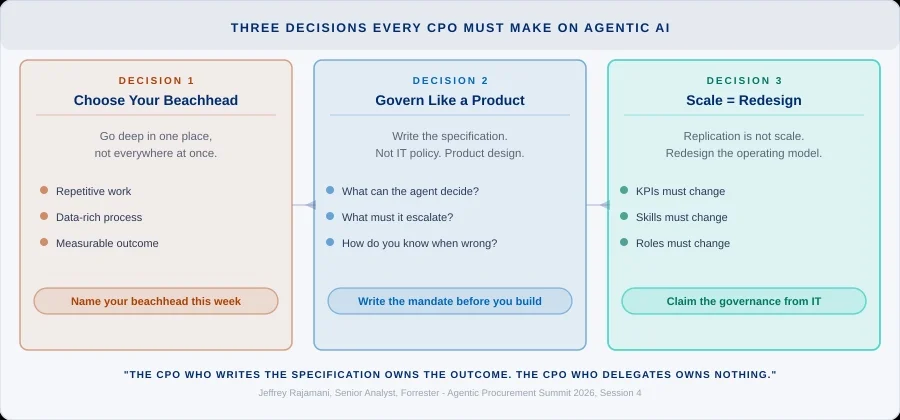
The CPO who writes the specification owns the outcome. The CPO who delegates owns nothing.
Think of each agentic workflow as a new hire with extraordinary speed and limited common sense. You define the scope, watch the first decisions, adjust, and expand the mandate as trust is earned.
Decision 3: Scale is Redesign, Not Replication
Most organizations that succeed with a pilot treat it as a proof of concept and then try to replicate it across additional use cases. That is the wrong model for scaling agentic AI.
When an agent handles tail spend at scale, KPIs, skill profiles, and roles all change. If none of those three things changes when an organization scales its agentic AI program, the program has not actually scaled. It has been bolted onto an operating model still designed for manual work.
The CPO who scales agentic AI has to redesign the operating model simultaneously. Rajamani’s framing at APS 2026 was unambiguous: scaling is a strategic transformation, not a technology rollout. That is exactly why the CIO cannot own it.
The operating model that agentic AI scales into must be built from Intake-to-Outcomes, not assembled from agents applied over processes designed for manual work. Built-in beats bolt-on because agents act correctly only when they have full context across the whole system they serve.
The Captain of the Ship
An agent cannot be made accountable. Legal frameworks do not recognize AI as a legal person. An agent cannot be deposed, sued, or dismissed. Accountability flows to the human who deployed it.
Rajamani’s framing: the CPO is captain of the ship, not steering every second but absolutely accountable if something goes wrong. Governance structures, segregation of duties, and real-time auditability make that accountability manageable. But accountability never moves to the agent.
What the Next 18 Months Determine
Rajamani’s prediction at APS 2026: if CPOs take the three decisions seriously in the next 18 months, operational procurement disappears from their purview by 2028. The 80/20 rule applies: automate the 80% of suppliers who contribute 20% of spend, and the team concentrates entirely on the 20% of suppliers who drive 80% of strategic value.
Friction with IT, with finance, and with your own team is not a sign something is wrong. Rajamani’s closing line at APS 2026: that friction is a sign you are moving fast enough to matter.
Four Moves to Make this Week
Rajamani closed with four concrete actions, each executable this week.
Identify your beachhead: one agentic flow, one process, measurable return achievable in three months. Name it this week.
Write the mandate: a one-page scope defining what the agent can do, what it cannot, and when it escalates. Write it before you build anything.
Claim the governance: tell your CIO that procurement owns the agent specifications. IT owns the infrastructure. Procurement owns the AI.
Benchmark your position: the Forrester Don’t Delegate AI report maps the structural gaps most organizations carry on AI strategy, ownership, and agent readiness. Use it to audit where you stand before the next deployment decision.
The next session at APS 2026 moves to the execution evidence: what it looks like when a procurement organization puts these decisions into practice.
Agentic Procurement Summit 2026. On-Demand Access. Jeffrey Rajamani, Senior Analyst at Forrester, presents the full Don’t Delegate AI findings at APS 2026. Sponsored by Zycus. → Watch the session. Download the Don’t Delegate AI report.
Previous blog in the series: Where Your Procurement Organization Actually Sits on the Agentic AI Curve
Next blog in the series: Tailwind in Action: What Agentic AI Actually Looks Like in Procurement
FAQs
Q1. What is the difference between owning AI and governing AI?
Owning AI means the CPO designs the system of work agents operate inside, including outcomes, scope, and boundaries. Governance is the set of specifications that emerge from that ownership. You cannot have real governance without ownership first.
Q2. Why can the CIO not lead the procurement AI strategy?
The CIO lacks procurement context: which approvals are structural versus historical, where judgment is genuine versus administrative, and where the 80/20 rule creates autonomous negotiation opportunities. The CPO has that context. The CIO does not.
Q3. What should a one-page agent mandate include?
Three things: what the agent is authorized to decide without human input, what it must escalate and to whom, and how you will know when it has made a wrong decision. One page forces the clarity that longer governance documents routinely defer.
Q4. What makes tail spend the right beachhead for most organizations?
Repetitive, data-rich, and measurable outcome: the three characteristics Rajamani named for a beachhead. Tail spend autonomous negotiation meets all three, which is why 86% of CPOs surveyed by The Hackett Group said they are likely to use agents there.
Q5. When does a CPO know the governance model needs updating?
When the agent is consistently escalating decisions that should be in-scope, or consistently making decisions that should have been escalated. Both signals indicate the mandate boundaries need adjustment. Update the spec, not the technology.
Q6. What does ‘operational procurement disappears’ mean in practice by 2028?
Category managers stop spending time on routine sourcing, tail spend negotiations, and supplier onboarding. Agents handle that work. The procurement team concentrates entirely on strategic supplier relationships and complex category decisions.
Related Reads: