

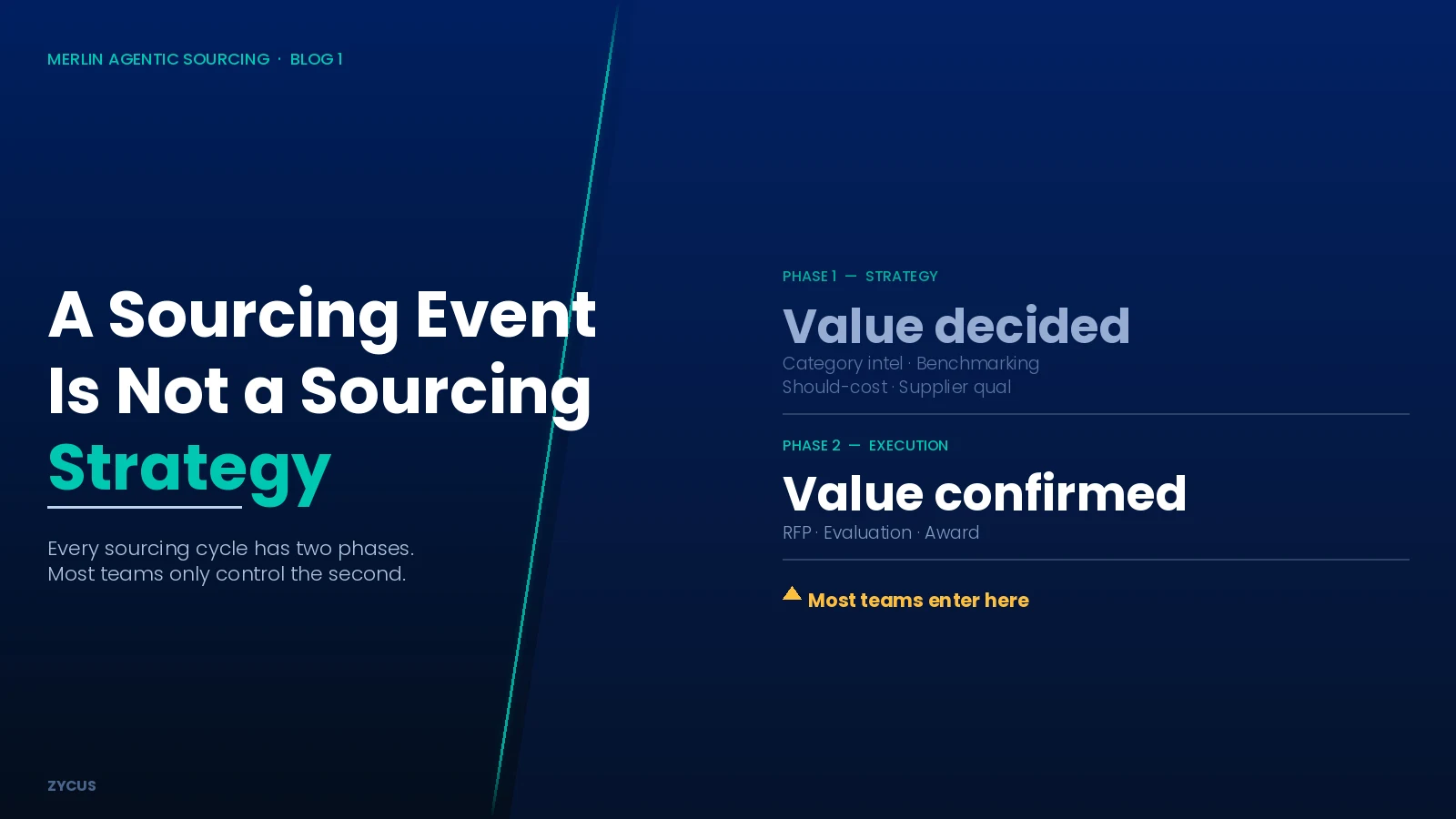

Every sourcing cycle has two phases: one where value is decided, and one where it is confirmed. Most procurement teams only control the second.
TL;DR
- A sourcing event executes a decision. A sourcing strategy determines whether that decision was worth making.
- Scope, budget, timeline and supplier preference are typically set before the event launches. All four without procurement.
- Hackett 2026: workloads up 8%, headcount and budgets falling. No capacity for upstream strategy work.
- Top-quartile teams: 2.03x the savings, 24% shorter sourcing cycles (Hackett, 2025). They enter the category earlier.
A sourcing event is an execution mechanism. A sourcing strategy is the upstream work that determines whether that event delivers maximum value or ratifies decisions made by others. What separates top-quartile teams from the rest is not event quality. It is when they enter the category.
What is the Difference Between a Sourcing Strategy and a Sourcing Event?
The two terms are used interchangeably across most procurement functions. They describe fundamentally different activities.
A sourcing event is the structured process of engaging suppliers for a specific requirement: an RFP, an RFQ, or a reverse auction. It has a defined scope, a deadline, and a clear output: a contract award or sourcing decision.
A sourcing strategy is the intelligence work that precedes it: category spend analysis, supplier market mapping, should-cost modeling, and pricing benchmarking. It is the work that determines whether an event is positioned to capture maximum value before any supplier is contacted.
These are two different phases of the sourcing cycle. Phase 1 is the strategy phase, where the category is understood and the procurement position is established. Phase 2 is the execution phase, where that position goes to market through a structured event.
Most procurement teams run Phase 2 with precision. The question is who ran Phase 1.
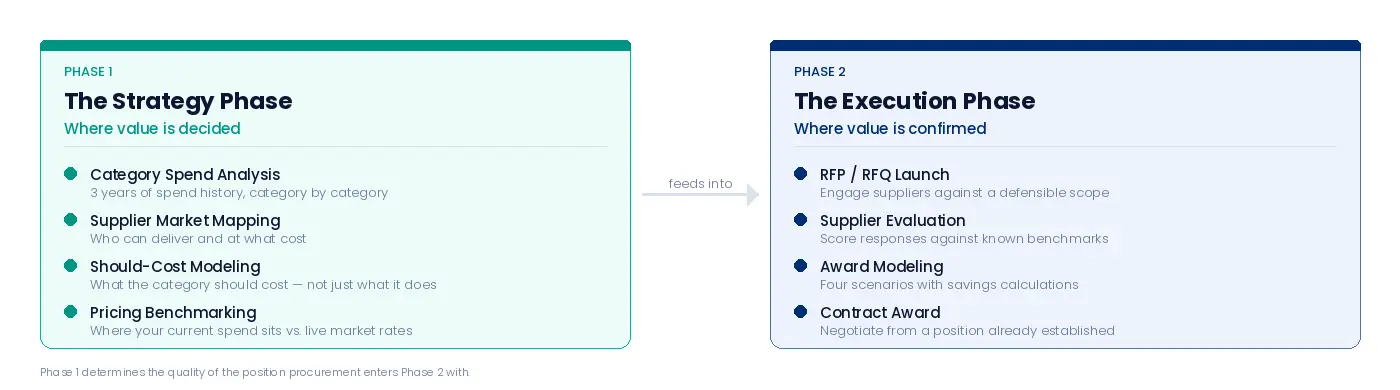
Figure 1: The two phases of the sourcing cycle, where Phase 1 is where value is decided through intelligence work; Phase 2 is where that value is confirmed through a structured event.
Where Does Value Get Decided in a Sourcing Cycle?
Before any RFP is written, four decisions are typically made that together determine the majority of the outcome.
The first is requirement scope. A business unit defines what it needs. If procurement is not involved at this stage, the specification often locks in technical requirements that favor an incumbent or limit the competitive field.
The second is budget commitment. Finance approves a number. Set without a market benchmark, it either leaves savings on the table or prices the event out of competition.
The third is timeline. Urgency is declared. A compressed timeline collapses competitive processes into negotiations with limited shortlists.
The fourth is supplier preference. The business stakeholder has a preferred vendor in mind. The sourcing event is launched to ratify that preference, not challenge it.
By the time the RFP is issued, the strategic outcome is substantially predetermined. Phase 2 confirms it.
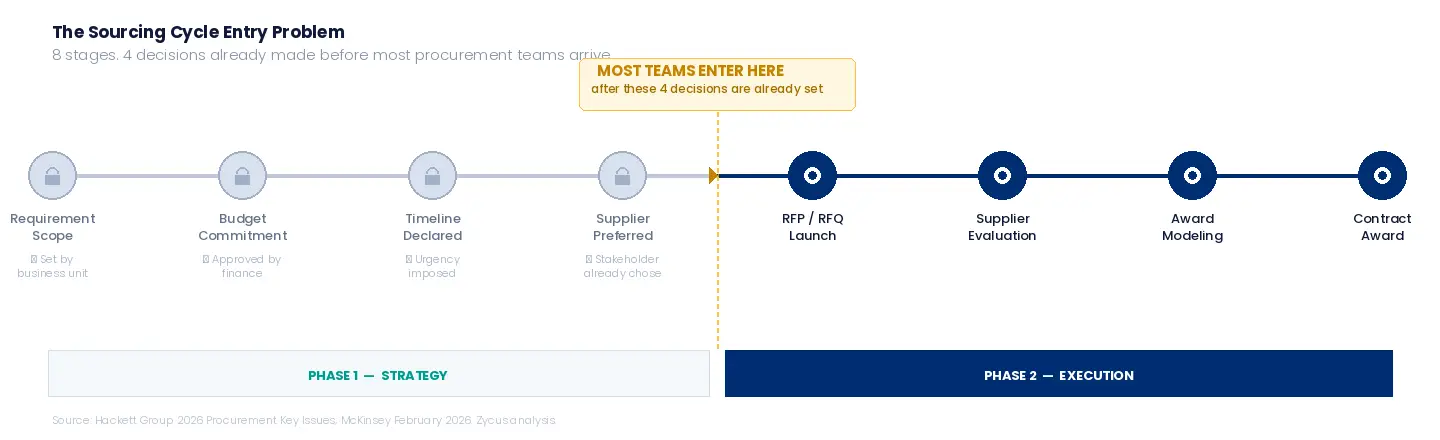
Figure 2: The Sourcing Cycle Entry Problem. By the time the RFP launches, four value-determining decisions are already set by others. Most procurement teams control only Phase 2.
Why Do Most Procurement Teams Miss the Strategy Phase?
The answer is structural, not motivational.
The Hackett Group’s 2026 Procurement Key Issues study found that workloads are increasing 8% in 2026 while headcount and budgets shrink, producing a productivity gap of nearly 9%. Teams are already stretched on event execution. Building strategy on top of that load is a capacity constraint, not a prioritization failure.
The second factor is data. McKinsey’s February 2026 research on agentic AI in procurement found that procurement functions use less than 20% of available data to support decision-making. Category spend history, contract expiry signals, supplier financial health, and market benchmarks: the intelligence that makes Phase 1 possible exists in most enterprises. It is not assembled at the speed a sourcing cycle requires.
Teams arrive at Phase 2 not because Phase 1 is unimportant but because it requires capacity and intelligence they do not currently have.
What Does It Cost Procurement to Skip Phase 1?
The Hackett Group’s 2025 Digital World Class research quantifies the gap.
Top-performing procurement organizations generate 2.03x greater cost savings as a percentage of spend by anticipating opportunities and maintaining the ability to renegotiate supply agreements. They also execute 24% shorter sourcing cycles. Their digital environments shift analyst capacity from manual data collection toward category intelligence work, the operational signature of Phase 1 ownership.
That time-allocation difference is Phase 1. The additional hours go toward understanding categories before events launch: cost models, benchmarks, and supplier intelligence that determine whether an event captures maximum value or inherits a position set by others.
The 2.03x differential is a timing gap that technology makes possible. Top performers invest in tools that give their analysts hours to own Phase 1. Most others inherit a position established by stakeholders or incumbents and optimize within it.
What Changes When Procurement Owns Both Phases?
When both phases run within the procurement function, the event stops ratifying decisions and starts making them.
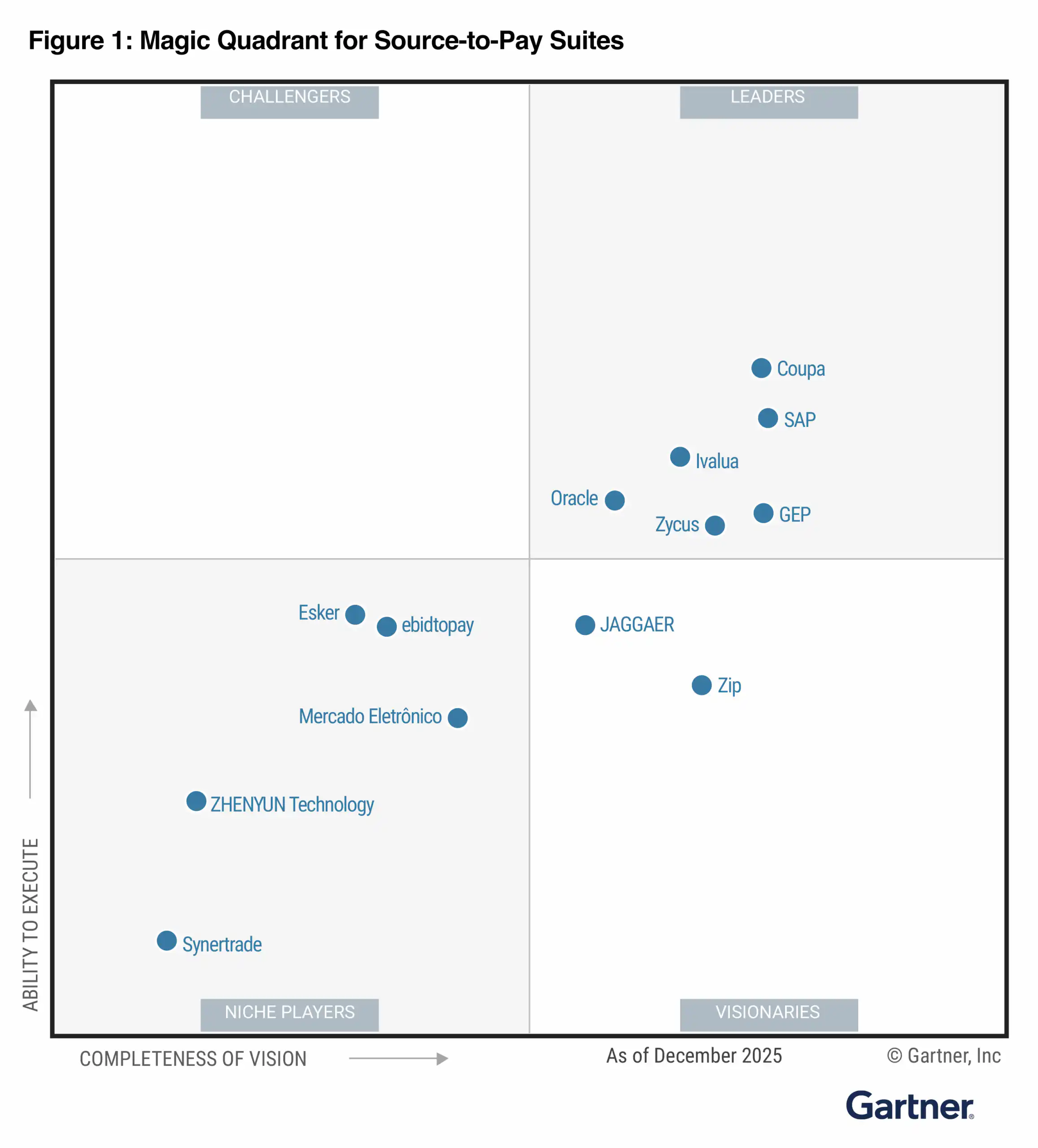
Merlin Autonomous Sourcing (MAS) is Zycus’s agentic sourcing module within the Merlin Agentic Platform. Zycus was recognized as a Leader in the Gartner® Magic Quadrant™ for Source-to-Pay Suites, January 2026. MAS runs both phases through two coordinated agentic flows.
The Strategy Flow handles Phase 1: spend and contract analysis, should-cost models from commodity indices and labor benchmarks, supplier qualification against D&B financial health, AVL compliance, and ESG criteria, and live market benchmarking, all before the first event is issued.
The Execution Flow handles Phase 2: RFP authoring from past playbooks, go/no-go compliance validation, supplier communications, and four-scenario award modeling with savings calculations.
MAS is designed to cut sourcing cycle time from strategy to award by up to 60%. That gain does not come from compressing Phase 2. It comes from arriving at Phase 2 with the strategic position already built.
What Does a Two-Phase Sourcing Model Look Like in Practice?
Consider an illustrative IT managed services category, modeled on a Merlin demo scenario, where spend escalated 196% over three years with current pricing running 15 to 48% above market rates. In a standard Phase 2 model, procurement receives the requirement, issues the RFP, and evaluates responses against a scope set without market context. The contract reflects assumptions, not actuality.
In a two-phase model, procurement enters with the spend escalation already synthesized, the market benchmarks built, and the supplier shortlist pre-qualified against compliance and financial health criteria. The RFP launches with a should-cost anchor. Suppliers respond knowing they are competing against a well-informed buyer.
In live MAS demos, supplier response rates have reached 100%, against the 60 to 75% range sourcing teams typically report. These are demo conditions, not a customer benchmark. Suppliers engage because they recognize the process as credible and the evaluation criteria as defensible.
The outcome changes because the starting position changes.
How Should Procurement Leaders Assess Whether Their Model Owns Both Phases?
Three questions identify the gap.
Does your team engage with a category before the requirement is fully scoped? If the first procurement touchpoint is a purchase requisition with the specification already written, Phase 1 is happening without you.
Does your sourcing event launch with a should-cost model? If procurement learns what a category should cost from the bids themselves, the event has no anchor and negotiation becomes guesswork.
Do suppliers know they are in a competitive process before the RFP is issued? If not, Phase 1 supplier positioning has been skipped, and the competitive field entering Phase 2 reflects whoever the stakeholder called first.
This two-phase model applies to strategic spend categories: those where complexity, contract value, and supplier dynamics make Phase 1 intelligence material. For tail spend and routine purchases, a different architecture applies.
See Merlin Autonomous Sourcing run a live sourcing event on a category from your portfolio. One guided session. Strategy Flow and Execution Flow. Published by Zycus. Request a demo →
Merlin Autonomous Sourcing is part of the Merlin Agentic Platform, Zycus’s Intake-to-Outcomes architecture for governed, multi-agent procurement.
FAQs
Q1. What is the difference between a sourcing strategy and a sourcing event?
A sourcing event is the structured process of engaging suppliers for a specific requirement: an RFP, RFQ, or reverse auction, with a defined scope, deadline, and output. A sourcing strategy is the intelligence work that precedes it: category spend analysis, should-cost modeling, supplier market mapping, and pricing benchmarking. The strategy determines whether the event is positioned to capture maximum value before any supplier is contacted. Running events without strategy is the most common cause of procurement savings falling short of what the market could have yielded.
Q2. Why does procurement get involved in sourcing too late?
The primary cause is a structural capacity constraint. Hackett Group’s 2026 research shows procurement workloads increasing 8% while headcount and budgets decline, leaving teams stretched on event execution with no remaining capacity for upstream strategy work. A secondary cause is data access: McKinsey research finds procurement functions use less than 20% of available data, so the category intelligence for Phase 1 is rarely assembled before events begin.
Q3. What happens to savings when procurement skips the strategy phase?
The Hackett Group’s 2025 Digital World Class research shows top-quartile procurement teams generate 2.03x greater cost savings as a percentage of spend, and run 24% shorter sourcing cycles. Our read: the gap is Phase 1 ownership, not event execution quality. Top performers shift analyst time from manual data collection to category intelligence work, the operational signature of a team that runs Phase 1 before events launch. Skipping Phase 1 means inheriting a market position set by others and negotiating within it rather than setting it.
Q4. What is agentic sourcing in procurement?
Agentic sourcing is the application of multi-agent AI systems to the full sourcing cycle, not just individual tasks within it. Rather than assisting a category manager one step at a time, agentic sourcing runs both the strategy phase and the execution phase through coordinated AI agents that work in sequence, share context, and hand off outputs without manual intervention. The result is a sourcing cycle that starts earlier, runs faster, and produces defensible award decisions with full audit trails.
Q5. How does Merlin Autonomous Sourcing handle the strategy phase?
Merlin Autonomous Sourcing runs Phase 1 through its Strategy Flow: analyzing spend and contract data, building should-cost models from commodity indices and labor benchmarks, discovering and qualifying suppliers against D&B financial health, AVL compliance, and ESG criteria, and benchmarking current pricing against live market rates. This work happens before the first sourcing event is issued, so procurement enters Phase 2 with a fully built category position. MAS is designed to reduce overall sourcing cycle time by up to 60%, with the acceleration concentrated in Phase 1 work.
Related Reads:
- Why Sourcing Is the Highest-ROI Entry Point for Agentic AI in S2P
- Built-In Beats Bolt-On: The Architecture of Autonomous Procurement in Production
- Whitepaper: Elevating Sourcing Process to the Next Level with Advance Deal Sourcing Strategies
- Research Report: The State of Strategic Sourcing: Trends, Challenges & Capabilities