







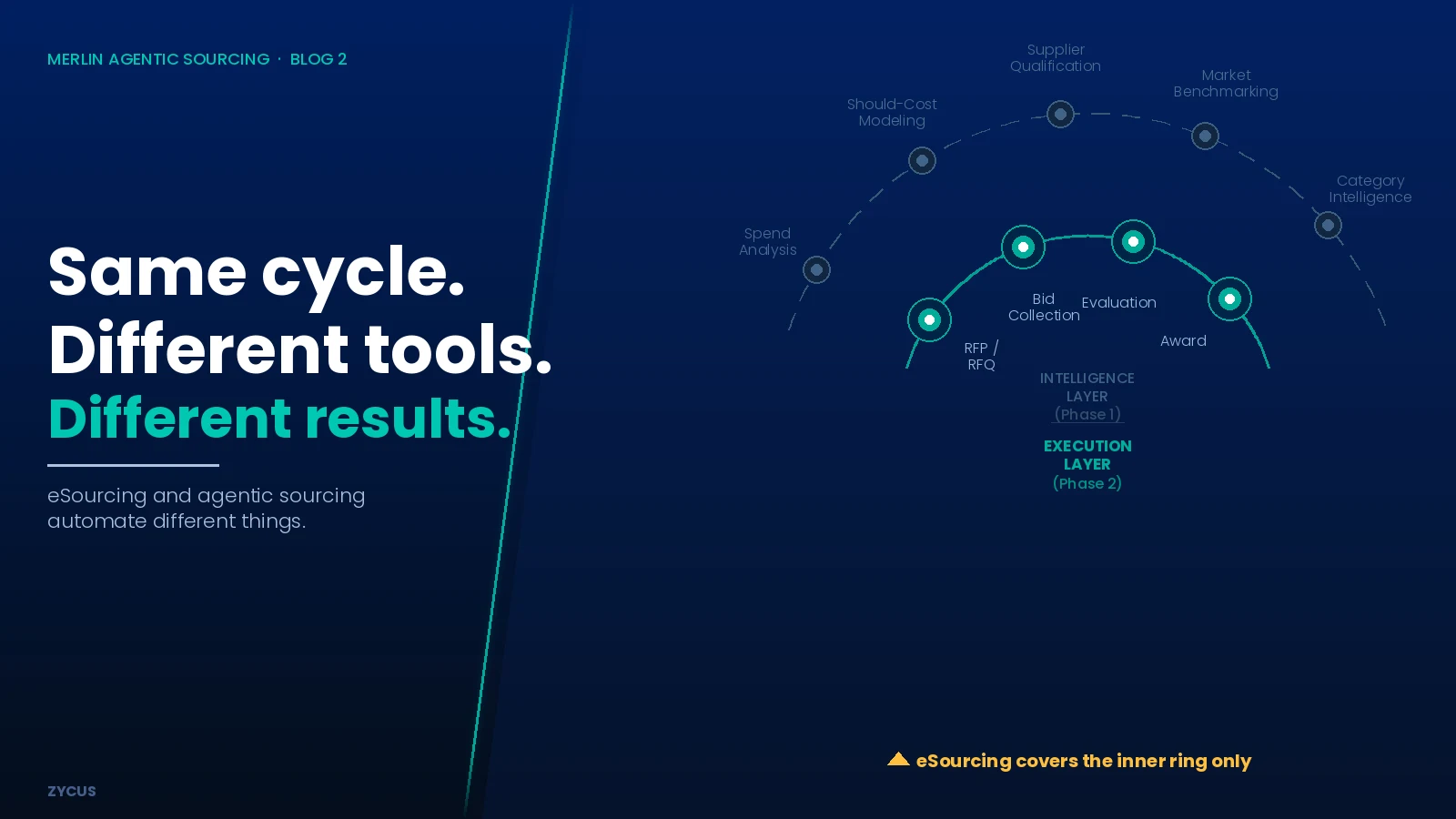

Agentic sourcing vs. eSourcing: two tools managing the same sourcing cycle, but going their separate ways across five key dimensions.
TL;DR
- eSourcing and agentic sourcing both run sourcing events. They differ on which decisions each tool owns and what intelligence it brings.
- eSourcing owns the execution layer: event management, bid collection, comparison, and documentation. It does this well.
- Agentic sourcing adds an intelligence layer: category analysis, should-cost modeling, supplier qualification, and market benchmarking, all before the event begins.
- The gap shows up on five dimensions. Here they are, side by side.
If the first blog in this series established that Phase 1 (the strategy phase, where outcomes are decided before the event launches) is the more valuable half of the sourcing cycle, this blog answers the next question: which tool is designed to run it? When comparing agentic sourcing vs. eSourcing, they are not the same technology. Here is what that means, dimension by dimension.
The comparison runs across five dimensions. For each one: what eSourcing does, what agentic sourcing adds, and what the difference means for the sourcing team.
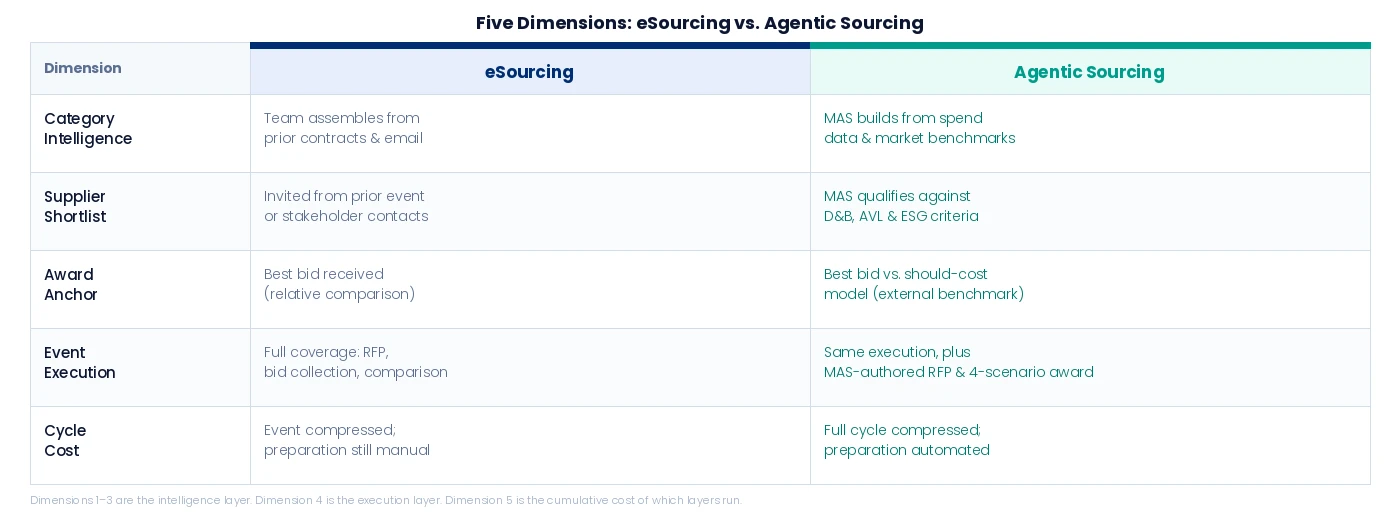
Figure 1: eSourcing vs. Agentic Sourcing across five dimensions. Dimensions 1–3 are the intelligence layer. Dimension 4 is the execution layer. Dimension 5 reflects the cumulative cost of which layers the team runs.
Where Does the Pre-Event Intelligence Come From?
eSourcing: eSourcing assumes the intelligence already exists. It takes the scope the team provides, the supplier lists the team assembled, and the evaluation criteria the team wrote. It has no mechanism for building or challenging any of those inputs. The category knowledge that shapes the RFP is whatever the analyst assembled before opening the platform, typically through prior contracts, email threads, and web searches for benchmark pricing. Deloitte’s 2025 Global CPO Survey found 57% of procurement leaders cite siloed operations as the top barrier to delivering value. Our read: the category intelligence usually exists somewhere in the enterprise. It is just not assembled where the event needs it.
Agentic sourcing: Merlin Agentic Sourcing (MAS) builds the intelligence before the event is created. It analyzes spend and contract history for the category, identifies market rate patterns, and surfaces assumptions in the current scope that may be limiting the competitive field or protecting incumbent pricing. The intelligence is not what the analyst remembered. It is what the data shows.
In practice: The RFP that eSourcing launches reflects what the team knew. The RFP that MAS prepares and eSourcing executes reflects what the market shows.
How Is the Supplier Shortlist Built?
eSourcing: eSourcing manages supplier participation within an event. It sends invitations, tracks acknowledgments, manages deadline communications, and records who responded. What it cannot do is determine whether the right suppliers were invited. The shortlist the team brings to the platform is the shortlist the event runs with. If that list reflects past relationships rather than current market capability, eSourcing surfaces no gap. Deloitte’s 2025 Global CPO Survey found 74% of procurement leaders rank maintaining alternative supply sources as their most effective risk-mitigation strategy. eSourcing runs with whatever shortlist arrives. It has no way to widen it.
Agentic sourcing: MAS qualifies suppliers before the event opens. Financial health is checked against D&B data. Compliance is verified against the approved vendor list. ESG criteria are screened against category requirements. New suppliers matching the category profile are identified and added to the candidate pool. The shortlist entering the event is built from evidence, not habit.
In practice: eSourcing runs the event with the suppliers the team thought of. MAS runs it with the suppliers the category justifies.
What Anchors the Award Recommendation?
eSourcing: eSourcing surfaces the comparison: side-by-side bid analysis, weighted scoring, multi-scenario ranking across the responding suppliers. All of it is relative. What eSourcing cannot provide is an external anchor, a figure for what the category should cost independent of what any supplier chose to quote. The winning bid is the best offer received. Whether it is a good offer is a separate question that eSourcing cannot answer.
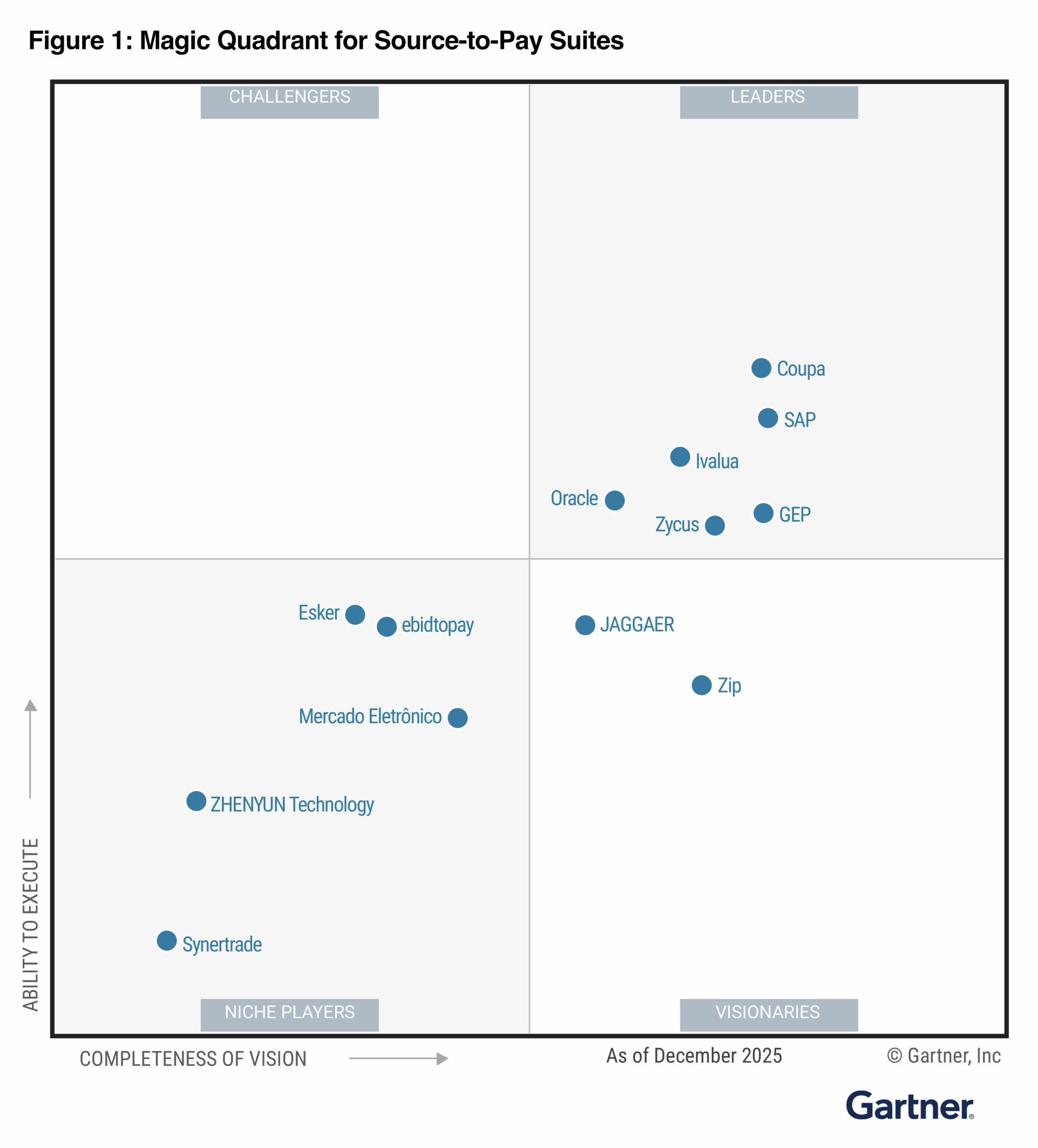
Agentic sourcing: MAS builds a should-cost model before suppliers are contacted, drawing on commodity indices, labor benchmarks, and historical rate data for the category. When bids arrive, each is evaluated against the model, not just against the others. The winning bid is the best offer against an external reference point. Zycus was recognized as a Leader in the Gartner® Magic Quadrant™ for Source-to-Pay Suites, January 2026. MAS is designed to cut sourcing cycle time from strategy to award by up to 60%.
In practice: Without a should-cost anchor, the award recommendation is relative. With one, it is measurable.
How Does the Event Itself Run?
eSourcing: This is eSourcing’s design space and it executes it well. Structured bid forms, standardized evaluation criteria, parallel response windows, compliance documentation, multi-round facilitation, and auditable comparison output. For teams running high volumes of events per year, eSourcing converts weeks of email management into a governed, repeatable process. This is a genuine operational achievement and it is not what agentic sourcing replaces.
Agentic sourcing: MAS runs the same structured event through its Execution Flow: RFP authoring from past playbooks, automated go/no-go compliance gates, structured supplier communications, and four-scenario award modeling with savings calculations attached. The event mechanism is the same. The starting position is different because the intelligence decisions were already made. In live MAS demos, supplier response rates have reached 100%, against the 60 to 75% range sourcing teams typically report. These are demo conditions, not a customer benchmark.
In practice: On event execution, the tools converge. The gap between them opens on the dimensions that precede and surround the event.
What Does the Full Cycle Cost the Team?
eSourcing: The most common description of sourcing from people who run it is not that events execute poorly. It is that everything takes a long time. eSourcing reduces the time an event takes. The time it does not reduce is the time before the event: the category analysis session, the supplier qualification check, the benchmark-sourcing call, the scope review with the business unit. For procurement teams managing large sourcing volumes, this preparation phase consumes the majority of the function’s available capacity. The event tool is efficient. The calendar surrounding it is not.
Agentic sourcing: MAS is designed to cut total sourcing cycle time from strategy to award by up to 60%. The compression does not come from a faster event. It comes from eliminating the preparation work that MAS now produces as outputs rather than analyst tasks. Best-in-Class procurement teams hold 91.7% of enterprise spend under management against 61.1% for all others, per Ardent Partners CPO Rising 2025†. Our read: teams at 91.7% are running all five dimensions. Teams at 61.1% are running dimension four.
In practice: eSourcing compresses the event. Agentic sourcing compresses the whole cycle.
† Zycus co-sponsored Ardent Partners CPO Rising 2025. Statistics cited reflect Ardent’s independent research findings.
Which Dimensions Is Your Team Running?
One question per dimension:
- Does the RFP scope reflect current market data, or last cycle’s assumptions?
- Is the supplier shortlist built from current qualification data, or from the last event’s participants?
- Is the award recommendation anchored to a should-cost model, or to the best bid received?
- Does the event itself run in a governed, auditable environment?
- How much of the team’s time goes to preparing for events rather than running them?
For strategic and complex categories, all five dimensions determine the outcome. For spot purchases and catalog items, the intelligence layer is lighter and a different model applies.
The next blog in this series examines what MAS produces on dimensions one through three: the specific outputs the team has before the first RFP goes out.
See Merlin Agentic Sourcing run all five dimensions on a category from your portfolio. One guided session. Published by Zycus. Request a demo →
Merlin Agentic Sourcing is part of the Merlin Agentic Platform, Zycus’s Intake-to-Outcomes architecture for governed, multi-agent procurement.
Frequently Asked Questions
Q1. What is the difference between agentic sourcing and eSourcing?
eSourcing digitizes and manages the sourcing event: the RFP or RFQ, bid collection, supplier comparison, and award documentation. It assumes the category intelligence, supplier list, and pricing benchmark already exist when the event opens. Agentic sourcing builds those inputs before the event begins: spend analysis, should-cost modeling, supplier qualification, and market benchmarking. eSourcing covers the execution layer. Agentic sourcing covers the intelligence layer that makes the execution layer competitive.
Q2. Is agentic sourcing a replacement for eSourcing?
No. They are complementary. eSourcing remains the right tool for the execution dimensions of the sourcing cycle: event design, bid collection, evaluation, and documentation. Agentic sourcing adds the intelligence layer that precedes those dimensions. Merlin Agentic Sourcing is designed to run both in sequence: Phase 1 intelligence first, Phase 2 execution second.
Q3. What does eSourcing handle well in the five-dimension model?
Dimension 4, event execution, is eSourcing’s design space and it handles it well. Structured bid forms, parallel supplier responses, weighted scoring, compliance documentation, and auditable output are all eSourcing strengths. It also provides dimension 5 partially: the event itself runs efficiently. The preparation that precedes it does not.
Q4. What does agentic sourcing add on dimensions 1 through 3?
Dimension 1 (category intelligence): MAS analyzes spend and contract history and benchmarks current assumptions against market data before the RFP is written. Dimension 2 (supplier shortlist): MAS qualifies candidates against D&B financial health, approved vendor list compliance, and ESG criteria. Dimension 3 (award anchor): MAS builds a should-cost model so bids are evaluated against an external reference, not just against each other.
Q5. Can agentic sourcing work alongside an existing eSourcing platform?
Yes. MAS is designed as an upstream intelligence layer, not a replacement for the event execution tool an organization already has. It prepares the intelligence for dimensions 1 through 3, then the event runs through the organization’s existing eSourcing environment. The two layers are designed to work in sequence.
Q6. How does Merlin Agentic Sourcing reduce sourcing cycle time?
MAS is designed to cut sourcing cycle time from strategy to award by up to 60%. The reduction does not come from running the event faster. It comes from eliminating the analyst preparation time that currently produces the inputs for dimensions 1 through 3: category research, supplier qualification, and benchmark sourcing. When MAS produces those outputs automatically, the team arrives at the event ready to execute rather than ready to prepare.
Related Reads
- 5 Ways eSourcing Tools Deliver ROI for Procurement
- Navigating Compliance with Robust eSourcing Strategy in the Age of Regulations
- Comparing eSourcing Tools for Optimal Performance: Key Considerations
- Why Sourcing Is the Highest-ROI Entry Point for Agentic AI in S2P
- Agentic AI in Sourcing: What’s Real vs Hype