







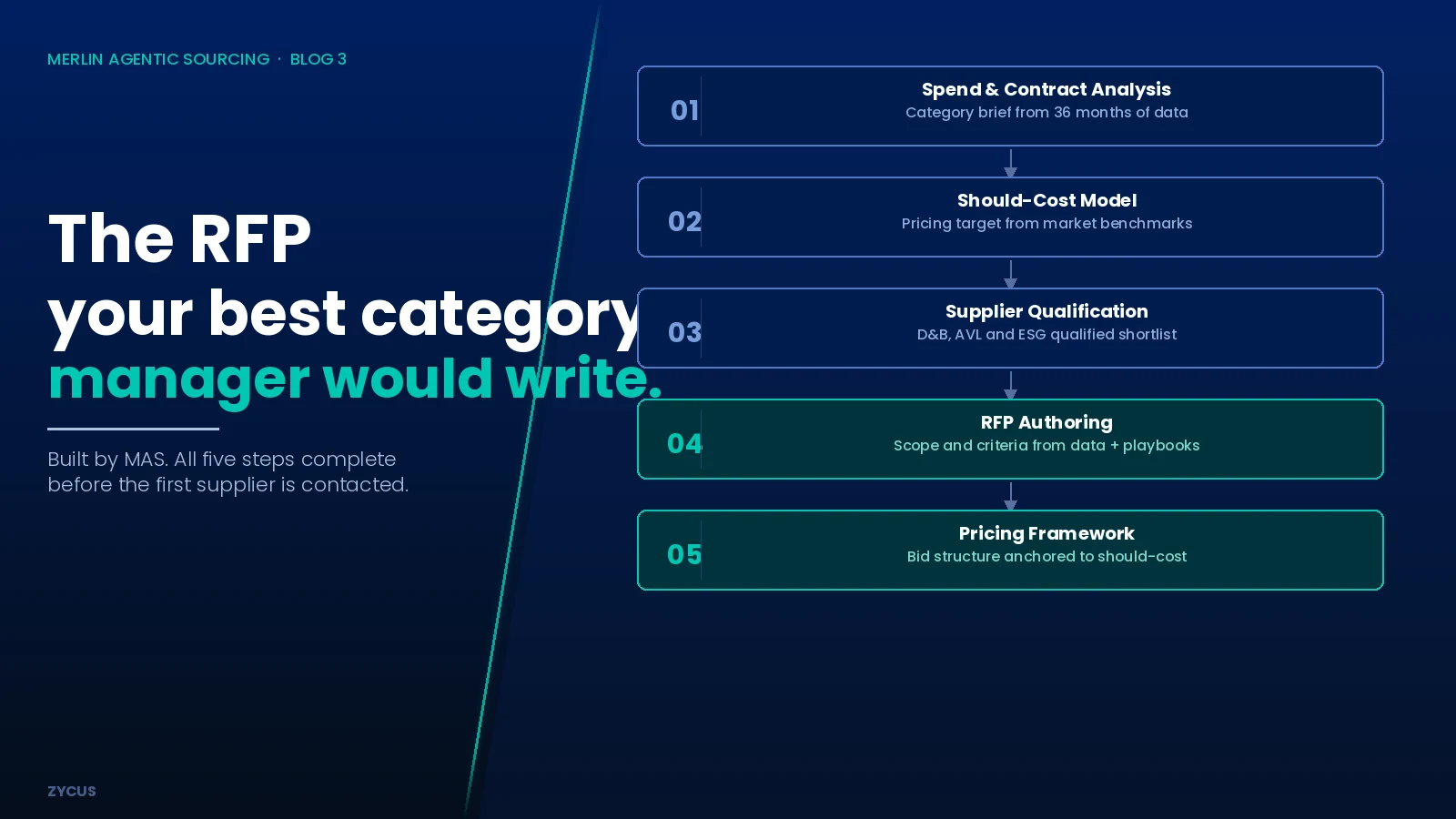

An effective RFP process requires five core inputs before the first supplier is ever contacted. Here is how MAS builds each one, and where regular systems fall back at every step.
TL; DR
- A competitive RFP needs five inputs, from a spend baseline to a pricing framework that anchors the award.
- Most teams assemble all five by hand, across days of analyst work.
- MAS builds all five from data, in sequence, before the first supplier is contacted.
- Faster builds release capacity: more events covered, more renewals caught before they lapse.
The previous blog in this series compared what eSourcing covers to what agentic sourcing adds. This blog goes inside the difference: what MAS produces when it builds an RFP, step by step. Five inputs, five fall-backs, one build sequence.
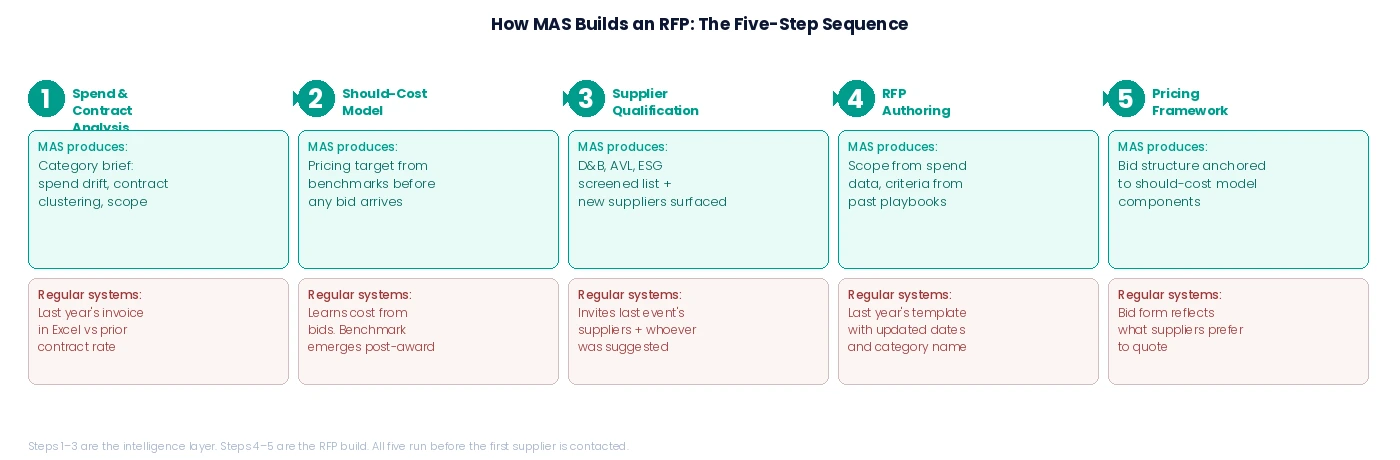
Figure 1: The five-step MAS build sequence. Steps 1–3 are the intelligence layer. Steps 4–5 are the RFP build itself. All five run before the first supplier is contacted.
Step 1: Spend and Contract Analysis
MAS reads the category across the full organization (three years of transaction data) and surfaces four inputs that shape everything that follows:
- Pricing drift: where current rates have moved away from historical baselines by supplier and lane
- Contract clustering: which renewals group in the same quarter, flagging concentration risk
- Scope boundaries: whether the current specification is drawn to drive competition or protect incumbents
- Spend concentration: where volume sits and where it is too fragmented across suppliers
The output is a category brief: not a report to file, but a working document that feeds the next four steps.
Where regular systems fall back: The analyst pulls last year’s invoice run in Excel, compares line items against the prior contract rate, and writes a scope paragraph from the stakeholder brief. The category brief is whatever can be assembled before the team meeting.
IDC (2024): 44% of CIOs named the cost of sourcing exercises as their number one procurement pain point, a cost that accrues almost entirely in this manual assembly phase.
Step 2: Should-Cost Model
A should-cost model is a structured price estimate built from external market data, independent of what any supplier has previously quoted. With the spend baseline set, MAS builds one before any supplier is contacted, drawing on:
- Commodity indices and spot market rates for the relevant category
- Labor benchmarks by region and function
- Historic rate evolution for comparable categories and lanes
For a logistics event, this means lane-level carrier rate benchmarks, fuel adjustment factors, and accessorial charge history. The output is a specific number: what this category should cost, supported by market data.
This is what separates an anchored evaluation from a relative one. When bids arrive, they are measured against the model, not just against each other.
Where regular systems fall back: The team learns what the category should cost from the bids themselves. The RFP goes to market without an anchor. When responses arrive, they are ranked against last year’s contract rate and against each other. The benchmark is the best offer received. Whether it is a good offer is a question the process is not equipped to answer.
Step 3: Supplier Qualification
Before the invitation list is built, MAS runs each candidate through a four-part qualification framework:
| Qualification check | Data source | Result |
|---|---|---|
| Financial health | D&B data | Suppliers below threshold flagged before any invite goes out |
| List compliance | Approved vendor list | Non-compliant suppliers excluded at this step, not after award |
| ESG criteria | Category-specific screening | Suppliers below category ESG thresholds filtered out |
| Market coverage | Category profile matching | New suppliers meeting the category profile added to the candidate pool |
The shortlist entering the event reflects current qualification data, not relationship history.
Where regular systems fall back: The team invites the suppliers used in the last event, plus whoever operations or the category manager suggested. Qualification is assumed, not verified. Financial risk surfaces after a supplier wins, if it surfaces at all.
Deloitte’s Global TPRM Survey 2022 found that 41% of organizations take an ad hoc approach to assessing third-party ESG risk, one of the four qualification checks in the table above.†
Step 4: RFP Authoring
Merlin Agentic Sourcing (MAS) drafts the RFP from the intelligence assembled in the first three steps:
- Scope language drawn from the spend analysis, anchored in current market patterns rather than last cycle’s assumptions
- Evaluation criteria built from past sourcing playbooks relevant to the category and updated to reflect what would differentiate suppliers on this event
- Compliance gates from the approved vendor list, embedded in the supplier-facing document before it goes out
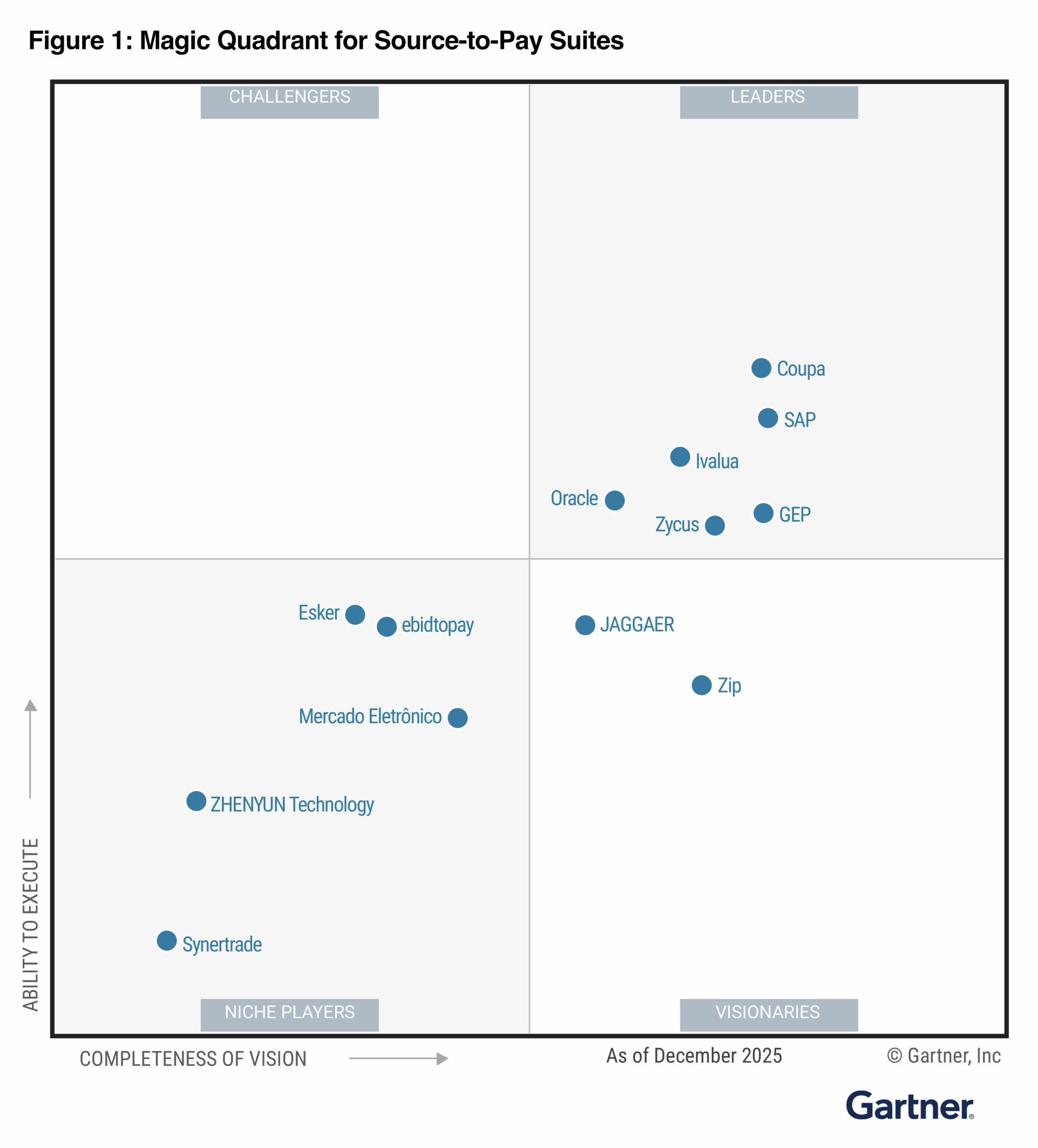
The RFP carries its own intelligence into the event. Zycus was recognized as a Leader in the Gartner® Magic Quadrant™ for Source-to-Pay Suites, January 2026. MAS is designed to reduce sourcing scoping time by up to 70%.
Where regular systems fall back: The analyst opens last year’s template, updates the dates, changes the category name, and adjusts line items to match the stakeholder brief. The scope reflects what was asked for, not what the market supports. Evaluation criteria reflect what was used before, not what would differentiate suppliers on this specific event.
Step 5: Pricing Framework
The bid form is structured around the should-cost model’s components, designed for what procurement needs to evaluate, not around what suppliers prefer to quote. For a logistics event, this means separate line items for:
- Base rates by lane
- Fuel adjustment factors
- Accessorial charges by type
- Service level commitments and penalty structures
Suppliers respond in a format that makes comparison meaningful and anchored, not just relative. Structured bid forms and parallel response collection are a genuine strength of established eSourcing platforms; MAS runs the event through that same discipline. The difference is the should-cost anchor behind the form.
In live MAS demos, a 30-line pricing table is built in three minutes. These are demo conditions, not a customer benchmark.
Where regular systems fall back: Bid forms are built from last year’s template. Suppliers fill in the fields provided. Comparison is possible: the team can identify the lowest bid among those received, but without a should-cost anchor, they cannot determine whether any response reflects market value.
What the Team Holds When the Build Is Complete
When all five steps have run, the team holds a pre-event package assembled from data, not from analyst memory:
| Step | Pre-event deliverable |
|---|---|
| 1. Spend Analysis | Category brief: spend concentration, pricing drift, contract clustering, scope boundaries |
| 2. Should-Cost Model | Market-referenced pricing target from commodity indices and labor benchmarks |
| 3. Supplier Qualification | Shortlist vetted against D&B financial health, approved vendor list, and ESG criteria |
| 4. RFP Authoring | Scope from spend data, evaluation criteria from playbooks, compliance gates embedded |
| 5. Pricing Framework | Bid structure anchored to the should-cost model so bids arrive evaluation-ready |
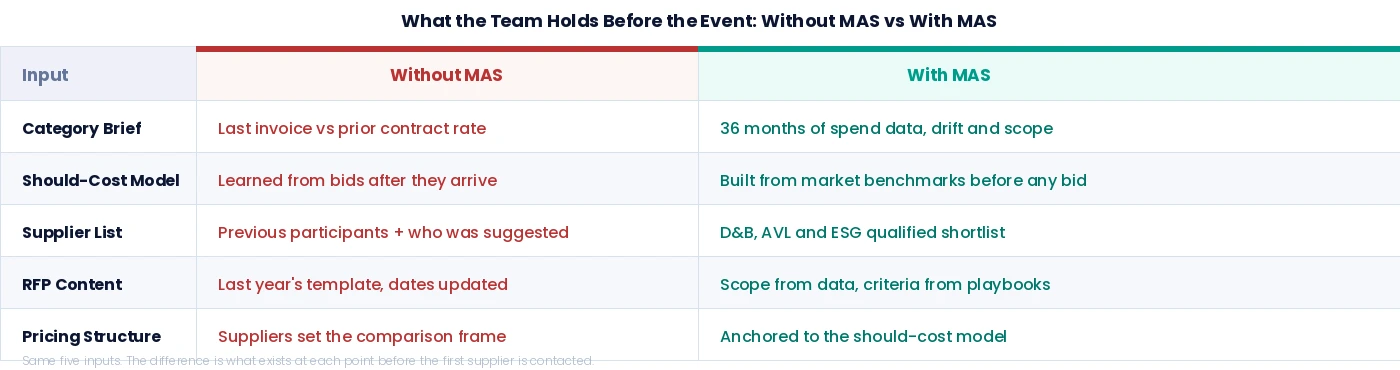
Figure 2: The same five inputs, side by side. Without MAS, each is assembled manually. With MAS, each is built from data before the first supplier is contacted.
Faster RFP builds release capacity for more events, more categories covered, and more contract renewals caught before they lapse. IDC has reported that RFP processes can stretch project timelines to three times their planned length. MAS is designed to enable the same team to run three to five times more sourcing events in the same period.
The next blog in this series introduces the second agent in the Merlin Agentic Platform, built for a different zone of the spend portfolio entirely.
† Deloitte TPRM Survey 2022 (41% ad hoc ESG): pending PDF confirmation. Pooja to verify figure is on the linked page before upload. If not confirmed, revert to narrative: “Many organizations have no formal process for ESG qualification at the third-party level.”
See Merlin Agentic Sourcing build an RFP on a category from your portfolio. Five steps. One session. Published by Zycus. Request a demo →
Merlin Agentic Sourcing is part of the Merlin Agentic Platform, Zycus’s Intake-to-Outcomes architecture for governed, multi-agent procurement.
Frequently Asked Questions
Q1. How does agentic sourcing build an RFP?
Merlin Agentic Sourcing builds an RFP in five steps, all of which run before the first supplier is contacted. Step 1 analyzes spend and contract data to produce a category brief. Step 2 builds a should-cost model from market benchmarks. Step 3 qualifies the supplier list against D&B financial health, approved vendor list compliance, and ESG criteria. Step 4 authors the RFP scope, evaluation criteria, and compliance gates from the category intelligence. Step 5 structures the pricing framework around the should-cost model so bids arrive in a format that can be evaluated against the benchmark.
Q2. What does MAS produce before a sourcing event launches?
Before the first supplier invitation is sent, MAS produces five deliverables: a category brief drawing on 36 months of spend history, a should-cost model from commodity indices and labor benchmarks, a supplier shortlist qualified against compliance and financial health criteria, a drafted RFP with evaluation criteria built from past playbooks, and a pricing framework anchored to the should-cost model. Together these form the pre-event package the sourcing team holds before the event opens.
Q3. What is a should-cost model and how does MAS build one?
A should-cost model is a pricing target for a category that exists before any supplier is contacted. It represents what the category should cost based on external market data, not on what suppliers have previously quoted. MAS builds it from commodity indices, labor benchmarks, and regional rate data for the specific category. For a logistics category, this means lane-level benchmarks, fuel adjustment factors, and comparable carrier rate history. The model anchors the award recommendation so the evaluation measures bids against market reality, not just against each other.
Q4. How does MAS qualify the supplier list?
MAS runs each candidate through a four-part qualification framework before any invitation is sent: financial health against D&B data, compliance status against the approved vendor list, ESG criteria relevant to the category, and a market-coverage check that identifies new suppliers matching the category profile. Suppliers below qualification thresholds are flagged before the event opens. Suppliers that meet the profile but were not on the team’s original list are added to the candidate pool.
Q5. How does MAS reduce the time to build an RFP?
MAS is designed to reduce sourcing scoping time by up to 70%. The reduction comes from replacing the manual assembly of pre-event inputs with an automated intelligence chain: each step runs from data rather than from analyst research, email threads, and prior-contract comparisons. In live MAS demos, a 30-line pricing table is built in three minutes. These are demo conditions, not a customer benchmark.
Q6. What is the difference between an AI-generated RFP and a manually built one?
A manually built RFP reflects the intelligence the analyst could assemble before the deadline: last year’s invoice comparison, the scope from the stakeholder brief, the supplier list from the last event, and a pricing framework from the prior template. An MAS-built RFP reflects what the data shows: a scope derived from spend analysis, a should-cost model from live benchmarks, a supplier list qualified against current criteria, and a pricing structure designed to evaluate bids against that model. The event mechanism is the same. The starting position is different.
Related Reads
- AI-Driven Procurement Marketplaces- The End of Traditional RFPs
- Built-In Beats Bolt-On: The Architecture of Autonomous Procurement in Production
- RFP Automation for Mid-Market Procurement: Smarter Proposal Evaluation with AI
- How to Write an Effective RFP for Autonomous Sourcing
- RFI, RFQ, and RFP Explained: A Practical Guide [2026]