








TL;DR
- Ardent Partners elevates supplier risk management from a periodic assessment to an always-on core operating discipline. BIG Trend #5 makes the case explicitly: in a fragmented world, episodic risk reviews cannot keep pace with the speed of disruption.
- The report’s framing is direct: “In a fragmented world, a supplier’s failure is the buyer’s failure.” Continuous monitoring across financial stability, operational capacity, geopolitical exposure, and ESG compliance is no longer optional.
- The K-shaped divergence applies to suppliers too. Technically mature, resilient suppliers will thrive while legacy-bound suppliers stagnate or fail. Procurement must incorporate supplier maturity into risk segmentation and category strategy.
- Always-on risk monitoring is not a standalone tool. It requires native integration with the S2P platform — connecting supplier risk signals to intake decisions, contract terms, sourcing strategies, and payment policies in real time.
- BIG Trend #12 redefines the supplier relationship itself: from cost negotiation counterparty to value co-creation partner. Supplier management becomes a value engine, with a “total supplier value” KPI replacing narrow cost-focused metrics.
Once a year, the procurement team distributes a supplier risk questionnaire. A spreadsheet with 40 questions about financial stability, business continuity plans, cybersecurity posture, and ESG compliance. Suppliers complete it — some thoroughly, some perfunctorily, some not at all. The results are compiled. A heat map is produced. The findings are presented at a quarterly business review. And then the spreadsheet goes dormant until next year.
In the intervening twelve months, a supplier’s financial position may deteriorate. A key manufacturing facility may experience a disruption. A geopolitical event may render their operating region unstable. A regulatory change may create compliance exposure. None of these developments is captured by the dormant questionnaire. Procurement discovers them when the supply chain breaks.
Ardent Partners’ Procurement 2026: BIG Trends and Predictions calls this model what it is: inadequate. BIG Trend #5 elevates supplier risk from a periodic assessment function to an always-on core operating discipline. The report’s framing is uncompromising: “In a fragmented world, a supplier’s failure is the buyer’s failure.”
In our previous analysis, we explored the external threat landscape — tariffs, trade wars, and the geopolitical chaos that defines 2026. The Tariff War Room addresses where you source from. Always-on supplier risk management addresses the deeper question: can the suppliers you depend on actually deliver? These are complementary disciplines, and in 2026, you need both.
Why Episodic Assessment Fails
The case against periodic supplier risk assessment is not theoretical. It is mathematical. In a world where Ardent describes the economy as permanently in beta mode — perpetual volatility as the default state — a risk snapshot taken in January is operationally irrelevant by April.
Supplier financial distress does not announce itself on a quarterly schedule. A key customer defaults, cash flow tightens, credit lines are pulled, and within weeks a supplier that scored green on the annual assessment is in crisis. Geopolitical events move faster still. Sanctions are imposed overnight. Export restrictions take effect within days. And ESG compliance failures — a labor violation, an environmental incident, a governance scandal — can surface at any moment, creating regulatory exposure for every buyer in that supplier’s portfolio.
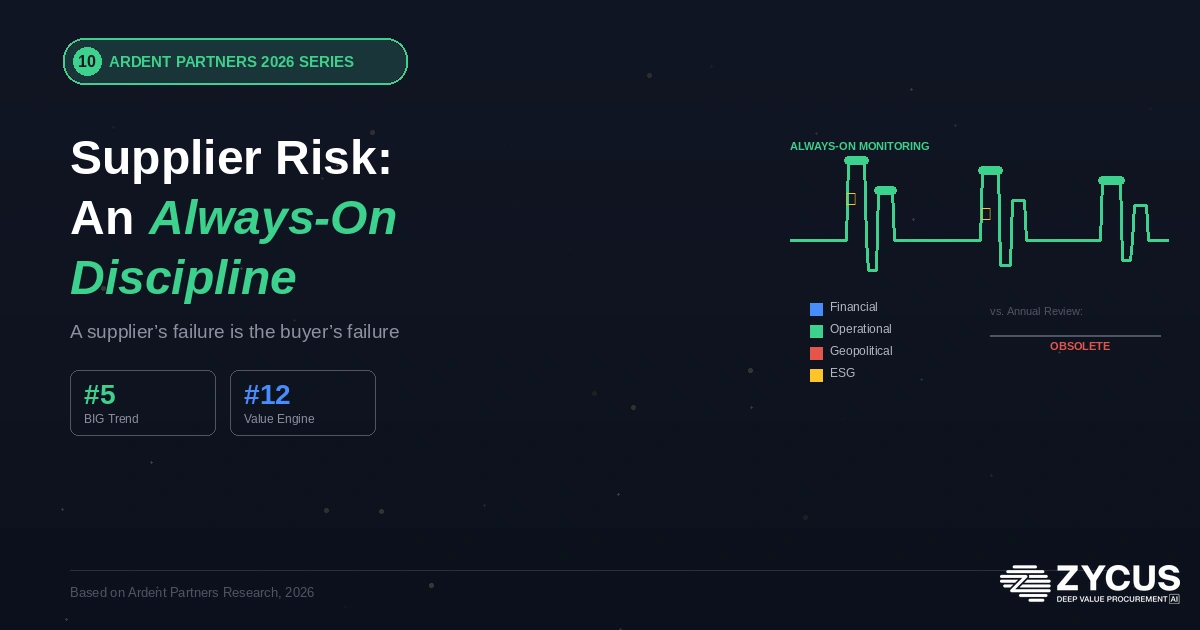
Always-on monitoring replaces the annual snapshot with a continuous feed. Financial health indicators are tracked in real time. Operational disruptions are flagged as they occur. Geopolitical exposure is mapped dynamically against current events. And ESG compliance is monitored through ongoing data feeds rather than self-reported questionnaires that may not reflect reality.
The result is not just better risk visibility. It is the ability to act before a disruption hits. Continuous monitoring triggers contingency plans before a supplier failure cascades into a production stoppage. It activates emergency sourcing before a trade corridor closure becomes a supply chain crisis. The shift from episodic to continuous is the shift from reactive to preemptive.
The K-Shaped Supplier Landscape
The K-shaped divergence that Ardent predicts for procurement organizations applies equally to the suppliers those organizations depend on. BIG Prediction #5 describes a world where technically mature, operationally resilient suppliers expand their competitive position while legacy-bound suppliers — those wedded to outdated processes and last-gen technologies — stagnate or fail.
For procurement, this divergence introduces a new dimension to supplier risk assessment. It is no longer sufficient to evaluate a supplier’s current financial health and operational capacity. You must evaluate their trajectory. Is this supplier investing in digital capabilities? Are they building the resilience to survive the next disruption? Or are they running on a model that worked five years ago and is now eroding?
Suppliers that cannot adapt to 2026’s demands — real-time data exchange, digital integration with buyer systems, agile response to tariff changes, transparent ESG reporting — are not just underperformers. They are liabilities. The CPO who identifies these liabilities early and begins transitioning to more resilient alternatives protects the supply chain. The one who discovers them during a crisis pays the full cost of disruption.
Supplier Management as a Value Engine
Ardent’s BIG Trend #12 takes the supplier relationship further: supplier management is evolving from a cost negotiation exercise into a value creation engine. The shift reflects a maturing understanding that suppliers are not adversaries to be squeezed but partners whose capabilities, innovation, and resilience directly impact the buyer’s competitive position.
The report introduces a concept that should reshape how procurement measures supplier relationships: total supplier value. This KPI goes beyond negotiated price to capture innovation contribution, risk profile, operational reliability, compliance posture, and strategic alignment. A supplier that costs 3% more but delivers zero disruptions, co-develops product innovations, and maintains impeccable ESG compliance may generate more total value than a cheaper alternative with spotty delivery and opaque labor practices.
This is the operational expression of what the report calls procurement’s move from cost management to margin management. The CPO who evaluates suppliers on total value rather than unit cost is managing the enterprise’s competitive position, not just its procurement budget.
The Platform Integration Imperative
Always-on supplier risk monitoring is not a standalone tool. Its value depends entirely on how tightly it integrates with the procurement decisions it is supposed to inform.
When risk signals are embedded in the S2P platform, they flow directly into the processes that matter. A risk alert on a supplier automatically flags pending purchase orders for review. A financial distress signal triggers an escalation to the category manager before the next payment is released. An ESG compliance failure surfaces during the intake process when a business user requests that supplier, redirecting the request to a compliant alternative.
When risk monitoring sits in a separate system, these connections do not exist natively. The risk team generates alerts. The procurement team receives them — eventually. The time between signal and action is the window in which supply chain failures occur. The unified platform eliminates that window by making risk intelligence a native element of every procurement transaction.
Always-on risk monitoring, like every capability we have explored in this series, demands a different kind of procurement professional. The team that managed annual risk questionnaires is not the team that operates a continuous intelligence function. As we explore next, the procurement workforce itself is reshaping — and the CPOs who invest in talent transformation will lead the function into its next era.
The Ardent Partners report covers supplier risk, the Five-Wave CPO Playbook, and 12 additional trends shaping procurement in 2026. Download Procurement 2026: BIG Trends and Predictions for the complete analysis.
Continue Reading
Previous in this series: Tariffs, Trade Wars, and the War-Time CPO
Next in this series: The Hourglass Workforce: How AI Is Reshaping Procurement Talent
FAQs
Q1. Why is periodic supplier risk assessment no longer sufficient?
In an environment Ardent Partners describes as permanently in beta mode, a risk snapshot from January is operationally irrelevant by April. Supplier financial distress, geopolitical disruptions, and ESG compliance failures do not occur on quarterly schedules. Always-on monitoring replaces annual snapshots with continuous data feeds that enable preemptive action before disruptions cascade into supply chain failures.
Q2. What does always-on supplier risk monitoring include?
Continuous monitoring across four dimensions: financial stability indicators tracked in real time, operational disruption flags as they occur, geopolitical exposure mapped dynamically against current events, and ESG compliance monitored through ongoing data feeds rather than self-reported annual questionnaires. The goal is shifting from reactive crisis response to preemptive risk mitigation.
Q3. How does the K-shaped divergence affect suppliers?
The same divergence Ardent predicts for procurement organizations applies to suppliers. Technically mature, resilient suppliers expand their competitive position while legacy-bound suppliers stagnate or fail. Procurement must evaluate not just a supplier’s current health but their trajectory — whether they are investing in digital capabilities, resilience, and the agility to survive 2026’s disruptions.
Q4. What is the “total supplier value” KPI?
Total supplier value is a metric that goes beyond negotiated price to capture a supplier’s full contribution: innovation, risk profile, operational reliability, compliance posture, and strategic alignment. A supplier that costs more but delivers zero disruptions, co-develops innovations, and maintains strong ESG compliance may generate more total value than a cheaper alternative with reliability and compliance issues.
Q5. Why must supplier risk monitoring be integrated with the S2P platform?
When risk signals are embedded in the S2P platform, they flow directly into procurement decisions: flagging pending orders for review, triggering escalations before payments release, and surfacing compliance failures during intake. Standalone risk tools create a time gap between signal and action — the window in which supply chain failures occur. Native platform integration eliminates that gap.
Q6. How does supplier management become a value engine?
Ardent Partners describes the evolution from treating suppliers as cost negotiation counterparties to recognizing them as value co-creation partners. By evaluating suppliers on total value rather than unit cost, procurement manages the enterprise’s competitive position — not just its procurement budget. This reflects the broader shift from cost management to margin management that defines procurement’s 2026 mandate.
Related Reads:
- Empowering Your Business with Effective Supplier Risk Management Tool Strategies
- Supplier Risk Management Framework: A Comprehensive Approach to Mitigating Supplier Risks
- Ensuring Efficiency with Supplier Risk Management Software Ensuring Efficiency for Supply Chain Transparency
- Tariffs, Trade Wars, and the War-Time CPO
- The CPO’s Five-Wave Strategic Playbook for 2026