








TL;DR
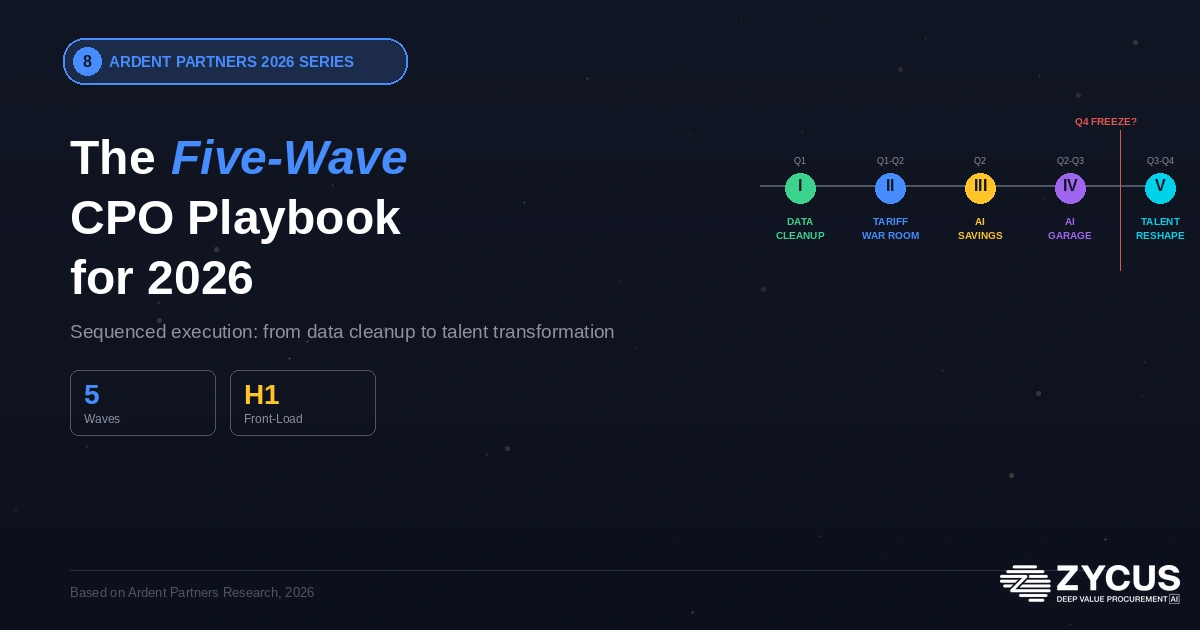
- Ardent Partners’ Five-Wave CPO Strategic Playbook provides a sequenced execution roadmap for 2026. The sequence matters: each wave builds on the one before it, and skipping steps creates compounding failures downstream.
- Wave I — Sanitize the Source: The Great Data Cleanup. Without boardroom-grade data, every AI initiative, risk model, and autonomous agent produces unreliable outputs. This is the unglamorous foundation that makes everything else possible.
- Wave II — Tariff War Room: Map sub-tier suppliers, build tariff-scenario models, and prepare for dozens of HTSUS amendments. Wave III — Aggressive Savings: Deploy autonomous negotiation agents across the 40% of unmanaged spend.
- Wave IV — Procurement AI Garage: Launch agile teams to pilot AI capabilities at speed, bypassing enterprise IT timelines. Wave V — Reshape the Talent Hourglass: Upskill teams from process experts to orchestrators and market analysts.
- A potential policy-driven budget freeze by Q4 means CPOs must front-load Waves I–III in the first half of 2026. The playbook is designed for urgency, not perfection.
Strategy without sequence is just a list of good ideas.
Procurement leaders in 2026 do not lack ambition. They understand that AI is transforming their function. They know that savings remains the top mandate. They recognize that supply chains are fragmenting and that their platforms need to become intelligence layers. The problem is not awareness. It is the execution order.
Ardent Partners’ Procurement 2026: BIG Trends and Predictions addresses this directly with the Five-Wave CPO Strategic Playbook — a sequenced execution framework that tells CPOs not just what to do, but when to do it. The sequence is not arbitrary. Each wave builds on the capabilities established in the wave before it. Skip a step and the compounding failures cascade downstream.
Through this series, we have explored each of the capabilities that the Playbook organizes: autonomous procurement, intake orchestration, precision savings, category intelligence, platform evolution, disciplined pilots, and budget strategy. The Playbook is the thread that ties them together into an executable plan. Here is how the waves unfold.
Wave I: Sanitize the Source
The first wave is the least exciting and the most important. Ardent calls it The Great Data Cleanup — elevating spend, supplier, and contract data into a trusted, boardroom-grade asset.
Without clean data, AI models hallucinate. Risk assessments produce false positives. Autonomous agents make decisions on flawed inputs. Spend analytics generate numbers the CFO does not trust. The Genesis of Autonomy that defines 2026 cannot begin without audited, reliable data flowing through the platform.
Wave I is not a multi-year initiative. It is a focused sprint designed to establish the data foundation in the first months of 2026. Classify spend data. Cleanse supplier records. Standardize contract repositories. The goal is not perfection but sufficiency — data clean enough to power AI reliably and trusted enough for the CFO to present to the board.
Wave II: The Tariff War Room
With the data foundation in place, Wave II addresses the most immediate external threat: trade chaos. Ardent’s research documents dozens of HTSUS amendments in 2025 alone, with no sign of stabilization. The Tariff War Room is a dedicated function that maps sub-tier suppliers, builds tariff-scenario models, and prepares contingency plans for the next wave of trade disruptions.
This wave requires the clean data from Wave I. You cannot model tariff exposure if you do not know which suppliers are in which countries, which components flow through which trade corridors, or which contracts contain escalation clauses tied to tariff changes. The sequence is critical: data cleanup enables tariff intelligence.
The War Room is not a one-time planning exercise. It is a standing capability that operates continuously through 2026, adapting as trade policies shift. The CPO who builds this function early has a structural advantage when the next tariff announcement disrupts competitors who are still mapping their supply chains.
Wave III: Aggressive Savings — The AI Scale-Up
Wave III is where AI delivers its most tangible financial impact. Ardent recommends deploying autonomous negotiation agents and real-time should-cost modeling to capture deep savings in tail-spend and mid-tier categories. The target: the roughly 40% of enterprise spend that remains unmanaged.
This wave builds directly on the first two. Clean data feeds the AI agents. Tariff intelligence informs the cost models. And the savings generated create the financial proof that funds continued AI investment — a virtuous cycle where early results underwrite later waves.
The report frames this as procurement’s primary defense against persistent inflation — the “low-grade fever” of sticky costs that erode margin through contract mini-escalators. Autonomous agents operate at the speed and scale needed to counter this pressure across hundreds of categories simultaneously, delivering margin-impacting liquidity to the enterprise.
Wave IV: The Procurement AI Garage
Wave IV launches the agile piloting environment that Ardent calls the Procurement AI Garage. These small, cross-functional teams bypass standard enterprise IT timelines to test AI capabilities rapidly. The Garage operates as a fail-fast lab — testing, validating, and pushing proven capabilities into production.
By Wave IV, the organization has clean data, tariff intelligence, and AI-powered savings running. The Garage uses this foundation to expand into adjacent use cases: autonomous contract analysis, predictive supplier risk scoring, AI-powered category intelligence, and stakeholder-facing intake orchestration. Each successful pilot is graduated from the Garage into the production environment.
The key discipline is knowing when to stop. Not every pilot will succeed. The Garage exists to identify failures quickly and cheaply, before they consume production resources. The CPOs who maintain this discipline will build a portfolio of validated AI capabilities. Those who let pilot enthusiasm override evaluation rigor will accumulate dead-end integrations.
Wave V: Reshape the Talent Hourglass
The final wave addresses the human dimension that every technology transformation eventually confronts. Ardent describes an hourglass-shaped workforce emerging in procurement: strategic leaders and AI specialists thrive at the top and bottom, while the manual, process-heavy middle is compressed.
Wave V is not about cutting headcount. It is about redefining roles. The procurement professionals who have spent their careers running RFPs, compiling category reports, and managing approval workflows need a path to becoming process orchestrators, market analysts, and AI system managers. The CPO’s responsibility in this wave is to invest in upskilling before the market forces a more painful restructuring.
Ardent’s warning on this point is direct: companies that cut procurement staff too aggressively, betting that AI replaces human judgment, will face what the report calls a “productivity mirage” — short-term savings that collapse when the AI lacks the institutional judgment and tribal knowledge that departed employees carried. Automation without orchestration creates chaos.
Why Sequence Matters
The Playbook is designed for urgency. With a potential policy-driven budget freeze by Q4, CPOs must front-load Waves I through III in the first half of 2026. Data cleanup, tariff preparedness, and AI-powered savings need to be underway before the budget window potentially narrows.
The sequence is not a suggestion. It is an architectural dependency chain. Skip data cleanup and the AI agents fail. Skip tariff mapping and the cost models are blind. Skip savings and the financial proof for continued investment evaporates. Each wave creates the conditions for the next.
Wave II of the Playbook — the Tariff War Room — operates against a geopolitical backdrop that demands its own analysis. As we explore next, 2026’s trade landscape is not just volatile. It is structurally chaotic, and the CPO must become a wartime operator to navigate it.
The Five-Wave CPO Strategic Playbook is the centerpiece of the Ardent Partners report. Download Procurement 2026: BIG Trends and Predictions for the complete wave-by-wave breakdown, detailed recommendations, and supporting analysis.
Continue Reading
Previous in this series: The AI Budget Siphon: How to Fund Procurement’s AI Future
Next in this series: Tariffs, Trade Wars, and the War-Time CPO
FAQs
Q1. What is the Five-Wave CPO Strategic Playbook?
Ardent Partners’ Five-Wave Playbook is a sequenced execution framework for CPOs in 2026. It organizes the procurement transformation agenda into five dependent waves: data cleanup, tariff preparedness, AI-powered savings, agile AI piloting, and talent transformation. The sequence matters because each wave builds on capabilities established in the previous one.
Q2. Why is data cleanup the first wave?
Without clean, trusted data, every subsequent initiative fails. AI models produce unreliable outputs, risk assessments generate false positives, autonomous agents make decisions on flawed inputs, and spend analytics produce numbers the CFO does not trust. Wave I — Sanitize the Source — establishes the boardroom-grade data foundation that powers everything else in the playbook.
Q3. What is the Tariff War Room?
Wave II establishes a dedicated function that maps sub-tier suppliers, builds tariff-scenario models, and prepares contingency plans for trade disruptions. With dozens of HTSUS amendments documented in 2025 alone, this standing capability operates continuously through 2026, adapting as trade policies shift and giving the CPO a structural advantage over competitors still mapping their exposure.
Q4. How does Wave III address the 40% unmanaged spend problem?
Wave III deploys autonomous negotiation agents and real-time should-cost modeling to bring the roughly 40% of unmanaged enterprise spend under active procurement influence. Clean data from Wave I feeds the AI agents, tariff intelligence from Wave II informs cost models, and the savings generated create financial proof that funds continued AI investment across later waves.
Q5. Why must CPOs front-load the playbook in the first half of 2026?
Ardent Partners predicts a potential policy-driven market correction by Q4 2026 that could trigger budget freezes. CPOs who have not initiated Waves I through III before this potential freeze will see their transformation agenda pushed to 2027. The playbook is designed for urgency: data cleanup, tariff mapping, and AI-powered savings should be underway in the first two quarters.
Q6. What is the productivity mirage Ardent warns about in Wave V?
The productivity mirage occurs when companies cut procurement staff too aggressively, assuming AI replaces human judgment. Short-term savings collapse when the AI lacks the institutional judgment, tribal knowledge, and relationship context that departed employees carried. Wave V advocates upskilling existing professionals into orchestrators and market analysts rather than simply reducing headcount.
Related Reads:
Related Reads:
- The CPO’s Playbook: 5 Strategic Nuances for Proactive Procurement Excellence
- Procurement 2025: A CPO’s Guide to Strategic Priorities, Trends, and Innovations
- Navigating the New Tariff Landscape: Strategic Imperatives for CPOs in 2025
- Top 10 strategies for managing innovations in the Procure to Pay Software for CPOs
- Podcast: Procurement Tariff Strategy: What CPOs Must Do Before the Next Shock Hits