








Most organisations think they’re building AI capability. New research suggests they’re building technical debt — with an AI badge attached
At Zycus Horizon EU & UK 2026, Aatish Dedhia — Founder and CEO of Zycus — posed a question that landed harder than most conference audiences expected: “Are you AI-enabled, or are you AI-exposed?” The room went quiet. Not because no one knew the answer, but because too many people in it suspected they knew exactly which one they were — and it wasn’t the one they’d been telling their boards.
Dedhia’s point wasn’t academic. It was structural. The organisations investing the most aggressively in procurement AI right now are, in many cases, the ones building the most fragile foundations. And the gap between looking AI-enabled and being AI-enabled is widening every quarter.
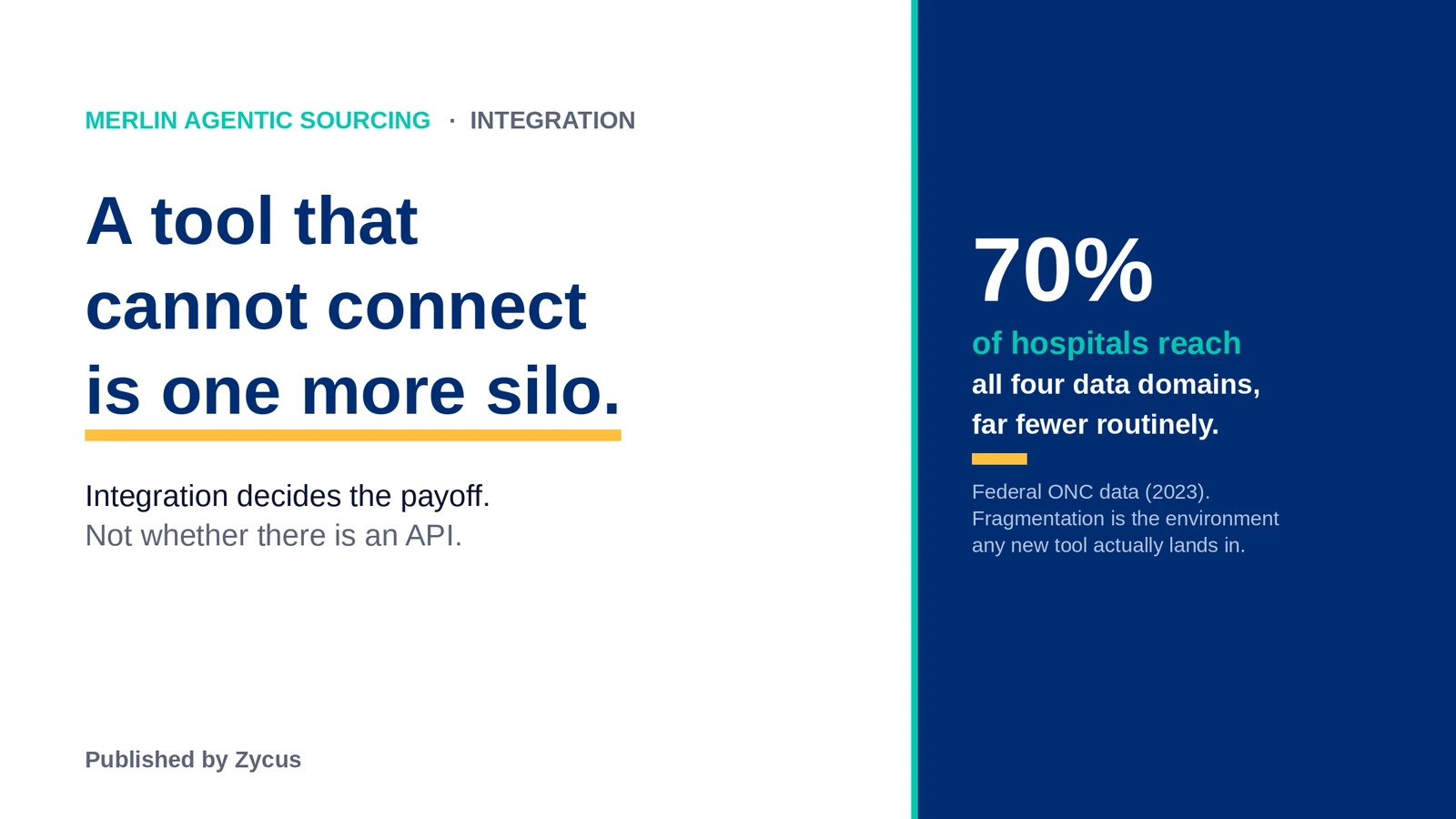
According to the Hackett Group Agentic AI in Procurement Adoption Index 2026 — commissioned by Zycus — only 29% of organisations report mature application integration. The other 71% are operating with fragmented data foundations beneath a layer of AI that amplifies every crack rather than filling it.
The uncomfortable question procurement leaders need to ask isn’t “Do we have AI?” It’s “Are we AI-enabled — or just AI-exposed?”
The Distinction That Changes Everything
There’s a critical terminology problem at the heart of most AI procurement strategies, and Dedhia addressed it directly at Horizon: organisations are calling point agents “agentic AI.” They are not the same thing, and the confusion is expensive.
Point agents are single-purpose tools — an AI that drafts RFPs, another that summarises POs, another that flags contract alerts. Each completes a discrete task in isolation. They look impressive in demos. They create fragmentation in practice.
Agentic AI flows are integrated, self-learning ecosystems. Demand intake connects to autonomous sourcing, which connects to contract lifecycle, which connects to payments and compliance — all orchestrated around a human-in-the-loop hub. The agents share context, hand off decisions, and accumulate learning across every transaction.
This distinction wasn’t just theoretical at Horizon. The Zycus product management team followed Dedhia’s keynote with a live demonstration of a fully orchestrated agentic procurement flow — walking a sourcing event from demand intake through autonomous supplier selection, negotiation, contract generation, and compliance sign-off, without a human touching the workflow until a deliberate escalation point triggered a review. Attendees watching a single unified thread replace what, in their own organisations, would require five separate tools and three manual handoffs described it as the moment the argument clicked.
Calling point agents “agentic AI” is the first design mistake. According to Forrester’s Don’t Delegate AI report, procurement leaders must personally shape — not outsource — AI-driven decision frameworks. The organisations that confuse the label with the capability are the ones delegating the architecture to vendors, and inheriting the consequences.
Two Traps. One Outcome.
The Hackett Index identifies two dominant failure patterns among organisations that have invested heavily in procurement AI. Dedhia named both at Horizon and was notably unsentimental about how many enterprise procurement teams he’s seen fall into each.
The Agent Sprawler deploys AI across hundreds of S2P touchpoints using different tools and different vendors, adding new agents to fill gaps as they appear. The belief: “We’re AI-first, leveraging best-of-breed agents for efficiency.” The result: fragmented capabilities, governance chaos, and integration overhead that scales with every new deployment.
The Monolithic Builder goes the other direction — committing to build a single, grand AI platform from scratch, allocating multi-year development cycles in pursuit of a “perfect” system. The belief: “We’re building the ultimate unified AI infrastructure.” The result: slow ROI, inability to adapt as the market accelerates, and expensive maintenance on a system that was already outdated before it launched.
Different symptoms. Same prognosis. Both paths lead to AI-Exposed.
Three Structural Reasons Exposed Organisations Stay That Way
The Hackett research points to three specific design failures that keep organisations locked in AI-Exposed status — and why they compound over time.
- Data doesn’t connect: Fragmented S2P stacks produce fragmented data: supplier masters, spend taxonomies, and contract repositories that never align. AI trained on disconnected inputs doesn’t average out the errors — it amplifies them. Every output becomes a probability calculation built on an unstable foundation.
- No collaboration between agents: Disconnected point agents operate in silos without a unified workflow. Without central orchestration, decisions made by one agent contradict or ignore the context held by another. The result is uncoordinated output that no human can easily audit or reverse.
- Governance is an afterthought: Post-hoc governance frameworks cannot monitor agentic decisions in real time. AI agents become black boxes — making critical, un-auditable, and potentially non-compliant decisions outside of organisational control. The Forrester Don’t Delegate AI report is direct on this point: the escalation framework must be defined before autonomy is granted, not retrofitted after something goes wrong.
Together, these three failures explain why 65% of procurement leaders now say they prefer agentic workflows over point agents — according to the Hackett Group 2026 data. They’ve seen what happens without them.
The Hidden Cost Structure Nobody Calculates
The “patching is cheaper than replacing” assumption is one of the most persistent and expensive beliefs in enterprise procurement. At Horizon, Dedhia called it the direct cost fallacy — and the Hackett Index puts hard numbers to exactly why it fails:
- Direct cost fallacy Patchwork integration — middleware, parallel maintenance, per-module vendor fees — typically costs 2–3× the equivalent total cost of ownership on a unified platform within three years. The unified platform has a higher sticker price. It has a lower TCO.
- The opportunity cost multiplier: Agentic workflows accumulate learning every quarter. Fragmented AI does not. The productivity gap between organisations running unified agentic S2P and those running augmented fragmented stacks is already 2–3× according to Hackett Group 2026 benchmarks. That gap is not linear. Competitors compressing cycle times now are building a lead that widens automatically.
- The upside ceiling: The highest-value agentic use cases in procurement — tail spend negotiation, autonomous supplier onboarding, end-to-end contract lifecycle management — are simply inaccessible from a patched foundation. Both Forrester and Hackett identify these as the use cases that deliver the most measurable ROI, and both confirm they require coherent data and orchestration that bolt-on tools cannot provide.
Patchwork AI costs more, compounds slower, and caps lower. The gap widens every quarter.
What AI-Enabled Actually Looks Like: The Four Pillars
Based on the Hackett research and validated through Zycus’s work with global procurement organisations, AI-enabled operating models share four consistent design principles. These are the same pillars Dedhia outlined at Horizon as the architecture that separates high-performing procurement functions from the rest.
- Unified data foundation: One source of truth for spend, suppliers, contracts, and risk — unified by design, not connected via middleware. Without this, every AI output is a guess with a confidence score attached. During the Horizon live demonstration, the Zycus product team showed this concretely: the same supplier risk data that informed an autonomous sourcing decision was simultaneously accessible to the contract agent and compliance monitoring layer — no reconciliation, no lag, no version conflict across systems.
- Orchestrated agentic workflows: Not 100 agents doing 100 things. Agents operating within defined workflows with shared context, clear handoffs, and human-in-the-loop escalation at the moments that matter. The live demo made this tangible: the product team triggered a deliberate escalation scenario — a supplier risk flag mid-sourcing event — and the audience watched the system pause, surface full context to a human reviewer, and resume only after approval, with that decision logged in the audit trail in real time.
- Governance before autonomy: Define what AI can decide, what it must escalate, and how you audit it — before you deploy it. AI encodes procurement judgement into systems. That judgement must be deliberately designed, not inherited from a vendor’s defaults. Forrester’s Don’t Delegate AI is unambiguous on this: CPO-level ownership of the AI decision framework is not optional. Dedhia reinforced this at Horizon with a line that stuck with the room — you don’t design guardrails for a car after it’s already on the motorway.
- Platform coherence: Pre-built agents designed to work together outperform hand-stitched point solutions at launch and at scale. The Hackett Group’s 2026 survey shows an overwhelming preference among procurement leaders for pre-built, interoperable agentic platforms over assembled best-of-breed stacks. This is a lessons-learned signal from early adopters, not a vendor preference.
These four pillars compound. Each one makes the others more powerful.
The Diagnostic: Five Questions Before You Deploy Any Agent
The fastest way to assess your current position is to answer five questions honestly — the same ones Dedhia put to the Horizon EU & UK 2026 audience as a live self-assessment exercise, and the ones the Zycus Agentic AI Readiness Assessment is built around:
- Do all our AI agents operate from a single, consistent data foundation — or different versions of the truth?
- If an agent makes a wrong decision today, how do we detect it, correct it, and prevent recurrence?
- Do our AI deployments have defined human escalation points — or are they operating without guardrails?
- Are our agents designed to work together as orchestrated workflows, or assembled from vendors with no shared context?
- Has our CPO defined which decisions AI can make autonomously — and has the board approved that framework?
Two or more “no” answers: your organisation is not AI-enabled. It is AI-exposed.
The Path Forward is not More Agents
The Hackett Agentic AI Adoption Index lays out a three-step progression that distinguishes the organisations pulling ahead from those accumulating debt — and it mirrors the practical roadmap Dedhia presented to CPOs leaving Horizon.
Audit, don’t assume: Map every agent touchpoint in your S2P cycle. Identify where governance gaps exist and where orchestration breaks down. Benchmark against the Hackett Agentic AI Adoption Index to understand where you actually stand relative to peers — not where you hope you stand.
Govern before you scale: Define the AI decision-making and escalation framework before expanding deployment. Establish an audit and control system. Secure CPO ownership with C-suite alignment. The Forrester Don’t Delegate AI finding is relevant here: organisations where the CPO personally shapes AI decision boundaries consistently outperform those where it’s treated as an IT or vendor problem.
Build on platform, not on patches: Prioritise coherent S2P architecture. Use pre-built, interoperable agentic workflows on a unified platform. The efficiency gains that look attractive from bolt-on tools at launch erode rapidly at scale — and they never unlock the strategic use cases that justify the investment in the first place.
Download eBook: AI-Enabled or AI-Exposed procurement? Get the 4 pillars, design traps & agentic AI readiness assessment.
The Bottom Line
The AI question in procurement has moved past “should we?” Most organisations have already answered that. The question now is whether what they’ve built is actually making them more capable — or just more exposed.
What made the Horizon EU & UK 2026 session particularly striking wasn’t the research or the frameworks alone — it was the live demonstration that followed. Watching the Zycus product team execute a fully orchestrated agentic procurement flow in real time, with human escalation built in by design rather than bolted on as an afterthought, made the argument in a way that slides and statistics cannot. The gap between what most organisations currently have and what AI-enabled actually looks like is not a feature gap. It’s an architectural one.
The Hackett Group’s research, the Forrester findings on AI delegation, and what Dedhia laid out at Horizon all point to the same conclusion: the design decisions made in the next 12 months will determine which organisations compound their AI advantage and which ones spend the next three years untangling the technical debt they’re currently calling a strategy.
The iceberg is visible. The question is whether you’re navigating around it.
This article draws on findings from the Hackett Group Agentic AI in Procurement Adoption Index 2026 (developed in partnership with Zycus), Forrester’s Don’t Delegate AI: Why Procurement Leaders Must Personally Shape AI-Driven Decisions, and insights shared by Aatish Dedhia, Founder & CEO of Zycus, at Horizon EU & UK 2026. For the full research and to take the Agentic AI Readiness Assessment, visit zycus.com.
Related Reads:
- Why Agentic AI Is the Future of Source-to-Pay Automation by 2026
- Revolutionizing Procurement: Agentic AI-Driven Autonomous Purchase Orders & Automation
- Agentic AI in Procurement: Transforming Supplier Network Optimization
- Whitepaper: Beyond GenAI: The Dawn of Agentic AI
- On-demand Webinar: Agentic AI in Procurement for Payment Processors
- eBook: AI-Enabled or AI-Exposed?