





TL;DR
- Ardent Partners describes 2026 trade policy as “borderline chaos” — an infinite loop of tariff announcements, retaliatory actions, and regulatory amendments that no historical playbook can navigate. Dozens of HTSUS amendments in 2025 alone signal the scale of disruption.
- The global market is splintering into competing economic blocs: US, China, EU, and emerging coalitions. Traditional trade alliances are degrading while new ones form and fracture. This is not a temporary disruption — it is the permanent operating reality for procurement.
- BIG Prediction #13 warns that a major power may threaten or invade a neighbor in 2026, creating supply chain disruptions that dwarf tariff volatility. CPOs must scenario-plan for geopolitical events, not just trade policy changes.
- The CPO’s response is the Tariff War Room — Wave II of the Strategic Playbook. This standing capability maps sub-tier suppliers, builds tariff-scenario models, and activates contingency plans before disruptions hit.
- With the 10-year US Treasury approaching 5%, the cost of capital amplifies every supply chain misstep. Tariff miscalculations do not just increase costs — they destroy margin in an environment where capital is expensive and investor patience is thin.
There was a time when procurement’s relationship with trade policy was straightforward. Tariffs changed slowly. Trade agreements were negotiated over the years. Compliance was a reference table maintained by the logistics team. The CPO’s involvement was minimal.
That era is over. And it is not coming back.
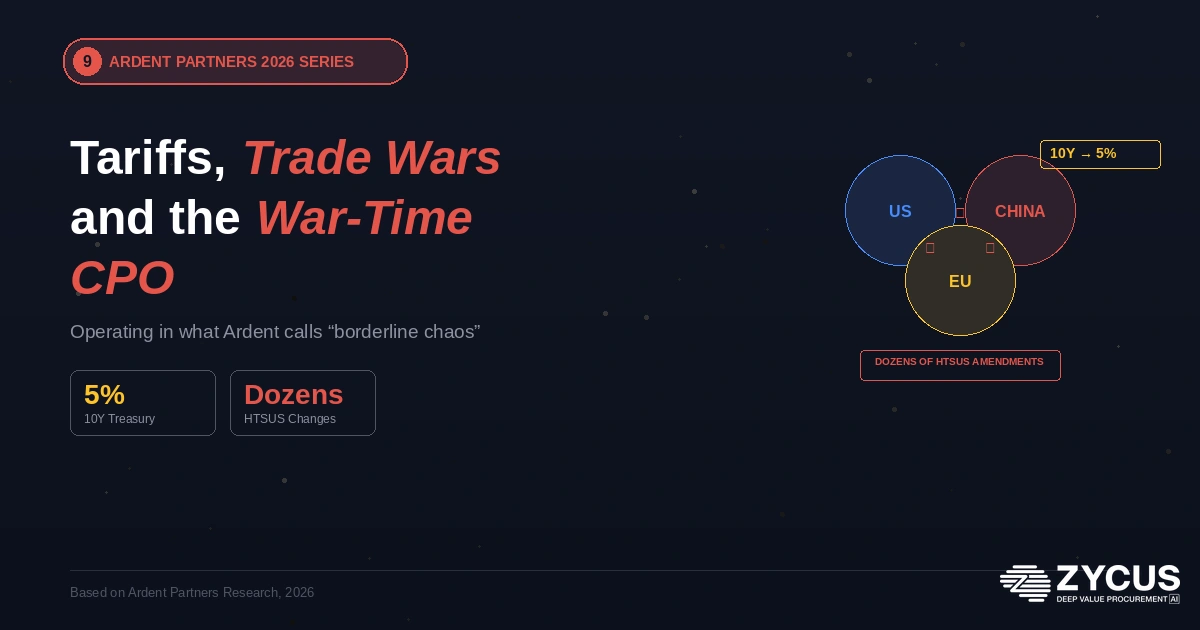
Ardent Partners’ Procurement 2026: BIG Trends and Predictions describes the current trade landscape with a phrase that should make every procurement leader uncomfortable: “borderline chaos.” BIG Trend #4 documents an infinite loop of tariff announcements, retaliatory actions, and regulatory amendments. Dozens of HTSUS amendments in 2025 alone demonstrate that this is not a temporary disruption. It is the operating environment.
In our previous analysis of the Five-Wave CPO Strategic Playbook, we identified the Tariff War Room as Wave II — the critical capability that sits between data cleanup and AI-powered savings. This blog explores why that capability is no longer optional and what CPOs must build to survive in a fractured trade landscape.
The Splintering World
BIG Trend #2 frames the macro picture: global market turbulence driven by the world economy splintering into competing blocs. The US, China, and EU are pulling apart into distinct spheres of economic influence. Traditional alliances are degrading. New coalitions form around commodity access, technology control, and military alignment — and then fracture as interests diverge.
For procurement, this splintering has immediate operational consequences. A supplier in one bloc may face export restrictions to another. A component manufactured across bloc boundaries may trigger tariff obligations at each crossing. A sourcing strategy optimized for a unified global market becomes a liability in a world of competing economic zones.
Ardent’s assessment is stark: the economy is “permanently in beta mode” — perpetual volatility as the default operating state, not a temporary condition to weather. CPOs cannot wait for stability to return. There is no return. The function must build the capability to operate continuously in turbulence.
The Tariff Infinite Loop
The granular reality is even more challenging than the macro picture suggests. Trade policy in 2026 does not move in predictable cycles. It moves in cascading reactions.
A tariff is announced. Trading partners retaliate. Exemptions are issued, then revoked. Industries lobby for carve-outs. The SCOTUS issues rulings that create regulatory uncertainty about which tariffs are enforceable. HTSUS codes are amended to capture previously exempt products. And the cycle repeats, with each iteration adding complexity to compliance requirements that were already stretching procurement teams thin.
The operational burden falls disproportionately on procurement. Every tariff change requires re-evaluation of supplier costs, contract terms, landed cost models, and sourcing strategies. Manual processes cannot keep pace. By the time a procurement team has recalculated the cost impact of one amendment, three more have been announced.
This is where the Tariff War Room becomes essential. Not as a one-time planning exercise, but as a standing function with the tools, data, and authority to respond in real time. Mapping sub-tier suppliers to understand where components originate — not just where they ship from. Building scenario models that calculate the cost impact of tariff changes before they take effect. Maintaining contingency sourcing plans that can be activated when a trade corridor closes.
The Geopolitical Escalation Risk
Beyond trade policy, Ardent issues a prediction that elevates the risk profile further. BIG Prediction #13 states directly: a major power will threaten or invade a neighbor in 2026. Whether this materializes as military action, aggressive posturing, or economic coercion, the supply chain implications are severe.
Military conflict in a major manufacturing or raw material region does not just disrupt one supplier. It disrupts entire supply networks. Shipping lanes close or become prohibitively expensive to insure. Sanctions are imposed overnight. Payment systems are restricted. And procurement teams that have not mapped their deep-tier supplier dependencies discover, too late, that a critical component flows through the conflict zone.
The CPO’s response to this risk is not military analysis. It is a supply chain architecture. Building redundancy into critical categories. Identifying alternative sourcing regions before a disruption forces emergency action. And investing in the visibility tools that show where the organization’s supply chain is exposed to geopolitical flashpoints — not just the tier-one suppliers, but the sub-tier dependencies that are invisible until they break.
The Cost of Capital Amplifier
Every supply chain misstep in 2026 is amplified by a financial reality that Ardent highlights throughout the report: the 10-year US Treasury approaching 5%. The higher cost of capital means that margin erosion from tariff miscalculations, supply disruptions, or poorly modeled landed costs hits the enterprise harder than it would in a low-rate environment.
When capital is cheap, procurement mistakes are absorbed. When capital is expensive, every dollar of unnecessary cost directly reduces the enterprise’s ability to invest, grow, and compete. The CFO’s tolerance for supply chain surprises — an unexpected tariff hit, a supplier disruption that forces emergency airfreight, a contract that did not account for trade policy changes — has dropped to near zero.
This financial pressure makes the Tariff War Room not just a risk management function but a margin protection function. The CPO who can quantify tariff exposure, model mitigation scenarios, and present the board with a clear-eyed assessment of trade risk is protecting the enterprise’s financial position in the most direct way possible.
Operating in Permanent Beta
Ardent’s CPO takeaway distills the 2026 trade reality: “Build a dedicated ‘tariff war room’ with real-time trade intelligence, map your sub-tier supplier network for geographic vulnerability, and prepare contingency sourcing strategies for at least three disruption scenarios.”
The War-Time CPO is not a metaphor. It is an operating model for a world where trade policy is weaponized, alliances are unreliable, and the next disruption is not a question of if but when. The CPOs who build this capability in 2026 will navigate the chaos. The ones who rely on last year’s sourcing strategies will learn the cost of complacency in real time.
But navigating external threats is only half the equation. The suppliers themselves — their financial stability, operational capacity, and resilience — determine whether the CPO’s contingency plans actually work. As we explore next, supplier risk management in 2026 is no longer a periodic assessment. It is an always-on discipline.
The Ardent Partners report provides the complete analysis of trade disruption, geopolitical risk, and the CPO’s strategic response. Download Procurement 2026: BIG Trends and Predictions for the full set of trends, predictions, and the Five-Wave Playbook.
Continue Reading
Previous in this series: The CPO’s Five-Wave Strategic Playbook for 2026
Next in this series: Supplier Risk as an Always-On Discipline
FAQs
Q1. What does Ardent Partners mean by “borderline chaos” in trade policy?
BIG Trend #4 describes the 2026 trade environment as an infinite loop of tariff announcements, retaliatory actions, and regulatory amendments. With dozens of HTSUS amendments documented in 2025 alone, the pace of change has exceeded the capacity of manual procurement processes to respond. This is not temporary disruption but the permanent operating environment.
Q2. How is the global economy splintering into competing blocs?
The US, China, and EU are pulling into distinct spheres of economic influence, with traditional alliances degrading while new coalitions form around commodity access, technology control, and military alignment. For procurement, this means suppliers in one bloc may face restrictions in another, components crossing bloc boundaries trigger multiple tariff obligations, and sourcing strategies built for unified global markets become liabilities.
Q3. What is the Tariff War Room?
Wave II of Ardent’s Five-Wave CPO Strategic Playbook establishes the Tariff War Room as a standing capability — not a one-time exercise. It maps sub-tier suppliers for geographic vulnerability, builds tariff-scenario models, and maintains contingency sourcing plans. The function operates continuously through 2026, adapting as trade policies shift.
Q4. What geopolitical escalation does Ardent predict for 2026?
BIG Prediction #13 warns that a major power may threaten or invade a neighbor in 2026. Whether this manifests as military action or economic coercion, the supply chain implications are severe: shipping lanes closing, overnight sanctions, payment system restrictions, and procurement teams discovering critical deep-tier dependencies in conflict zones.
Q5. How does the cost of capital amplify trade risk for procurement?
With the 10-year US Treasury approaching 5%, every supply chain misstep — unexpected tariff hits, emergency sourcing, poorly modeled landed costs — erodes margin more severely than in a low-rate environment. The CFO’s tolerance for procurement surprises has dropped to near zero, making tariff intelligence and scenario planning direct margin protection functions.
Q6. What should CPOs do to prepare for trade disruptions in 2026?
Ardent recommends building a dedicated tariff war room with real-time trade intelligence, mapping the sub-tier supplier network for geographic vulnerability, and preparing contingency sourcing strategies for at least three disruption scenarios. The emphasis is on continuous capability, not periodic assessment, in a world where trade policy is weaponized and the next disruption is always imminent.
Related Reads:
- Podcast: Procurement Tariff Strategy: What CPOs Must Do Before the Next Shock Hits
- Procurement Under Tariff Pressure
- Whitepaper: Professional Services Tariff Impact Analysis for Procurement
- Whitepaper: Tariff Impact on Facilities Management Procurement
- Navigating the New Tariff Landscape: Strategic Imperatives for CPOs
- Navigating the Impact of ‘Liberation Day’ Tariffs: The Essential Role of AI-Powered Contract Lifecycle Management