





TL;DR
- The aviation procurement gap is costing airlines billions — fleets are modernized, but buying still runs on emails and spreadsheets.
- Five forces — fleet backlogs, airport capex, ESG mandates, thin margins, and $11B in disruption costs — make transformation urgent.
- The real problem is intake — 40% of procurement time is lost before a request even enters the system.
- Zycus’s Intake-to-Outcomes model captures demand at origin, orchestrates it with agentic AI, and measures results end to end.
- Delta cut cycle time 81%, Swissport unified 25 countries, Cargolux hit 100% PO automation — all by fixing the starting point.
- Without structured intake, agentic AI amplifies chaos. Airlines that close the loop compound value; those that don’t keep leaking it.
Somewhere right now, an operations manager at an airport in Zurich is sending an email to the procurement team about an equipment contract. An MRO technician in Dallas is Slacking a colleague about an urgent parts order. A ground handler in Singapore is filling out a spreadsheet to onboard a new fuel supplier. None of these requests will touch a procurement system for days — if they ever do at all.
Meanwhile, the industry is facing a 17,000-aircraft order backlog, projecting $36 billion in airline profits, and losing an estimated $11 billion to supply chain disruptions. The industry building the most complex machines on earth is running procurement on email threads and disconnected approvals.
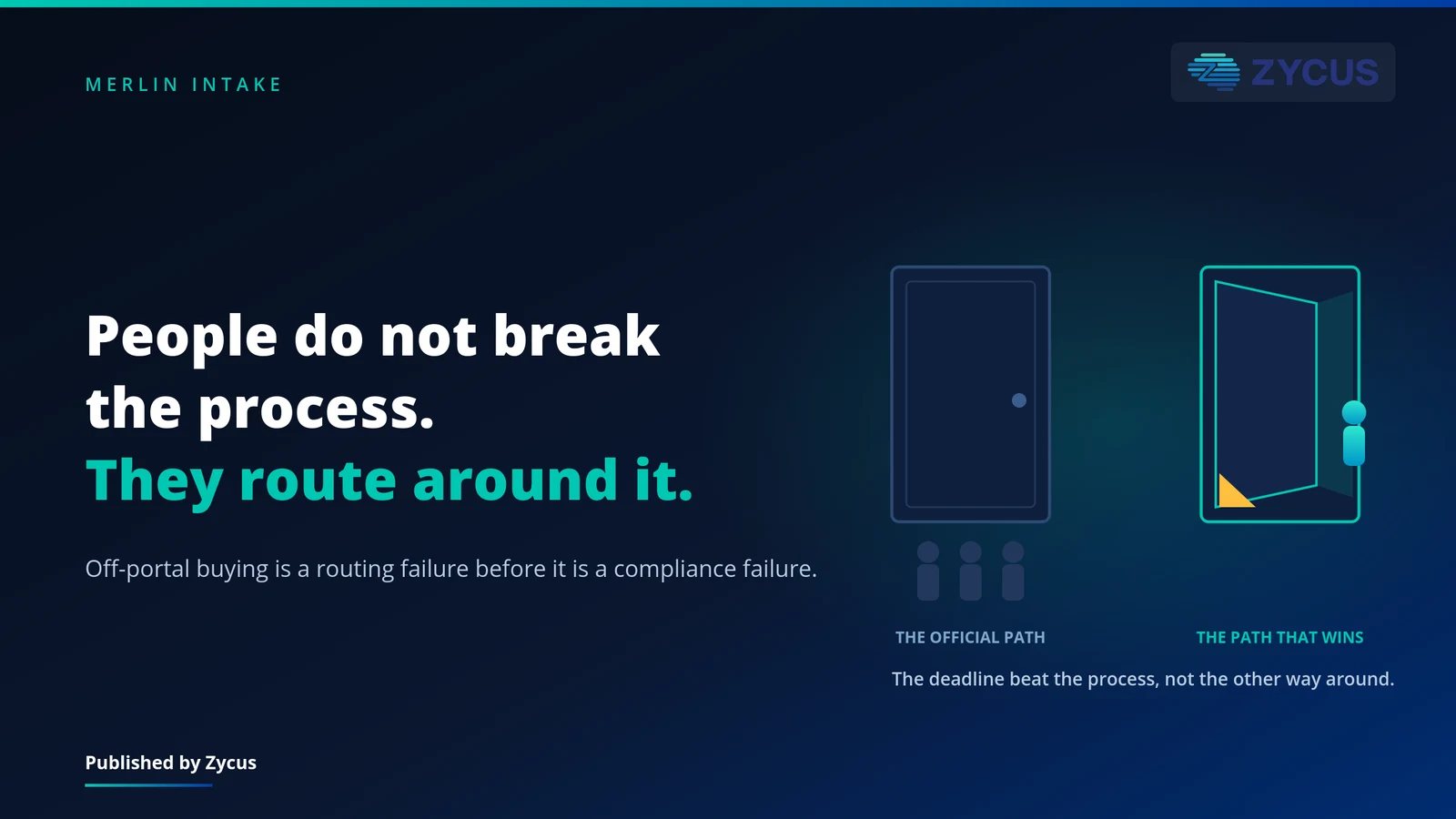
That’s the paradox. Aviation has modernized everything — fleet technology, terminal infrastructure, sustainability systems — except how it buys. And the cost of that gap isn’t showing up in a line item anyone is watching. It’s showing up in the 40% of procurement time lost to intake chaos: triaging ad hoc requests, chasing approvals, figuring out what’s already under contract. By the time procurement sees the demand, the decision has already been made off process. The spend has already gone maverick. The value has already leaked.
If you’re a CPO reading this, you already know the feeling. The question you haven’t been able to answer is: where exactly is the leak?
The Convergence No One Can Ignore
Five macro forces are squeezing aviation procurement at once and anyone of them would independently justify transformation.
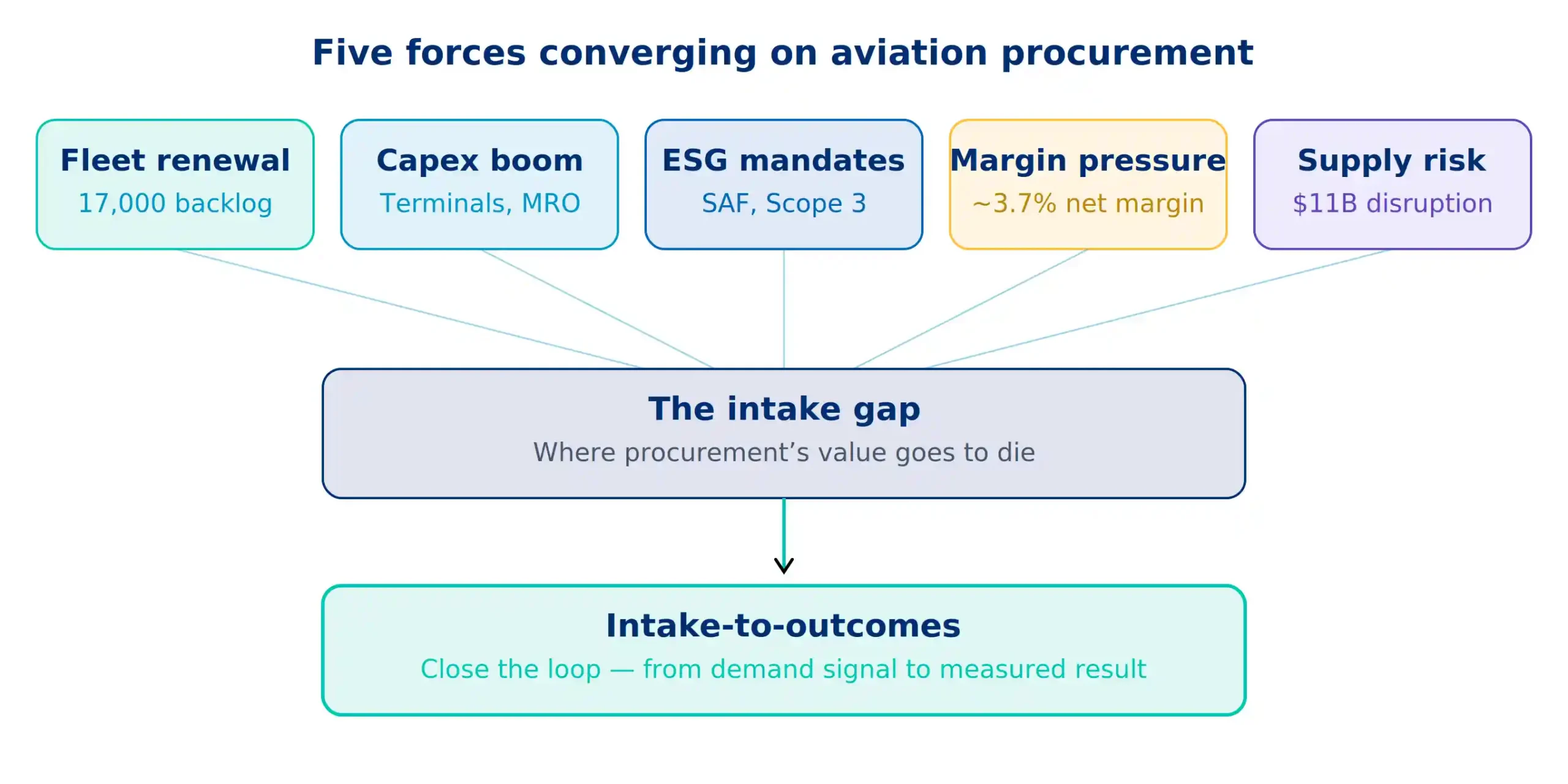
Fleet renewal is accelerating, with backlogs at record highs and growth concentrated in the Middle East, India, and Asia-Pacific. Airport and infrastructure capex is booming — with new terminals, runways, and MRO hubs creating complex, multi-year supply chains. ESG mandates are tightening — from SAF blending requirements under ICAO CORSIA to Scope 3 emissions reporting under the EU’s CSRD — and non-compliance now carries real financial penalties. Profitability has returned, but at razor-thin ~3.7% net margins where every point of uncontrolled spend compresses the upside. And supply chain disruption, driving $11 billion in excess operating costs, is no longer a temporary shock; it is the operating environment.
Together, these forces expose a single structural weakness: the gap between “what the business needs” and “what procurement delivers.” That gap has a name. It’s called intake. And in aviation, this is where procurement’s value proposition goes to die.
From S2P to I2O: A Different Starting Point
The next generation of procurement platforms will be measured not by how efficieently they manage purchase orders, but by whether they can capture demand at its origin and trace it to a measured business outcome. That’s the bar. Zycus built to it.
Source-to-Pay assumes procurement’s job begins at the requisition. Zycus’s Intake-to-Outcomes (I2O) model starts earlier at the moment of demand and ends later, at the measured result. The difference isn’t semantic, it’s architectural.
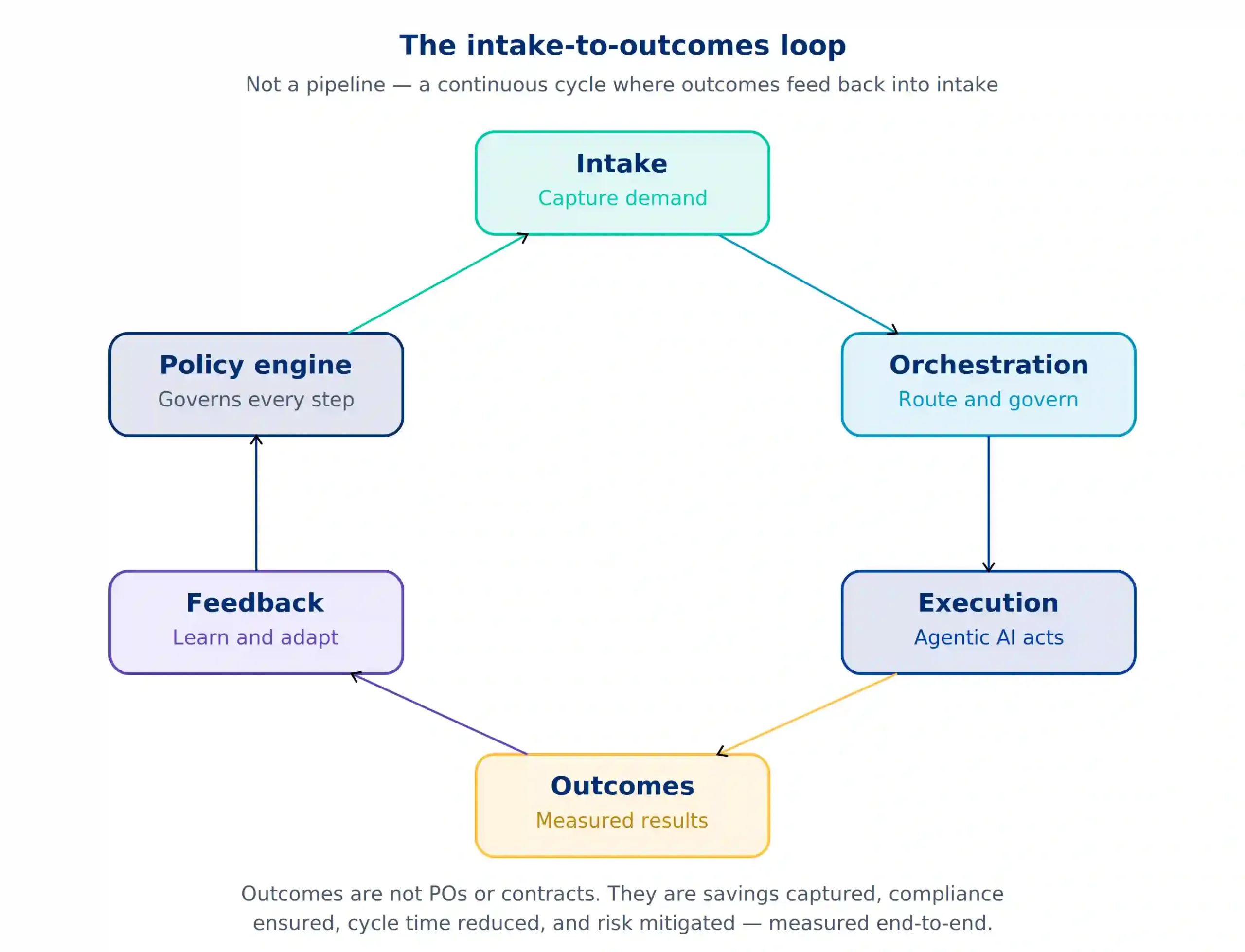
Let’s be precise about what “outcomes” means here, because it isn’t purchase orders and it isn’t contracts. Outcomes are savings captured, compliance ensured, cycle time reduced, and risk mitigated — measured end-to-end, from the first demand signal to the last performance metric. A PO is an artifact. An outcome is proof that procurement creates value.
I2O works only when three layers operate as one — and critically, these layers must be built-in to the same platform, not bolted on. from standalone providers create the exact problem they claim to solve: integration overhead, data silos, and value leakage at every seam between intake and execution.
At the top, Centralized Merlin Intake serves as an AI-powered control tower — not a form, not a portal, but a policy-driven nerve centre where every request from every employee, procurement team member, or supplier is captured in natural language, classified, and routed to the right workflow inside Microsoft Teams. Zero training. Zero change management. Zero procurement jargon.
Beneath intake sits the Merlin Agentic AI Platform — an orchestration layer where specialised AI agents autonomously negotiate with suppliers, draft and monitor contracts, execute purchases, analyse spend, and manage supplier risk. This isn’t a chatbot summarising data. This is autonomous execution within policy guardrails, handling the work that no procurement team has the bandwidth to do manually across hundreds of airports and dozens of countries.
And underneath it all, the Zycus Source-to-Pay Core and Zycus Data Core provide the unified backbone — eSourcing, Contracting, Procurement, Spend Analysis, Supplier Management, Risk Management — organically built over 20 years, not bolted together through acquisitions. One codebase. One data model. No integration seams where value can leak.
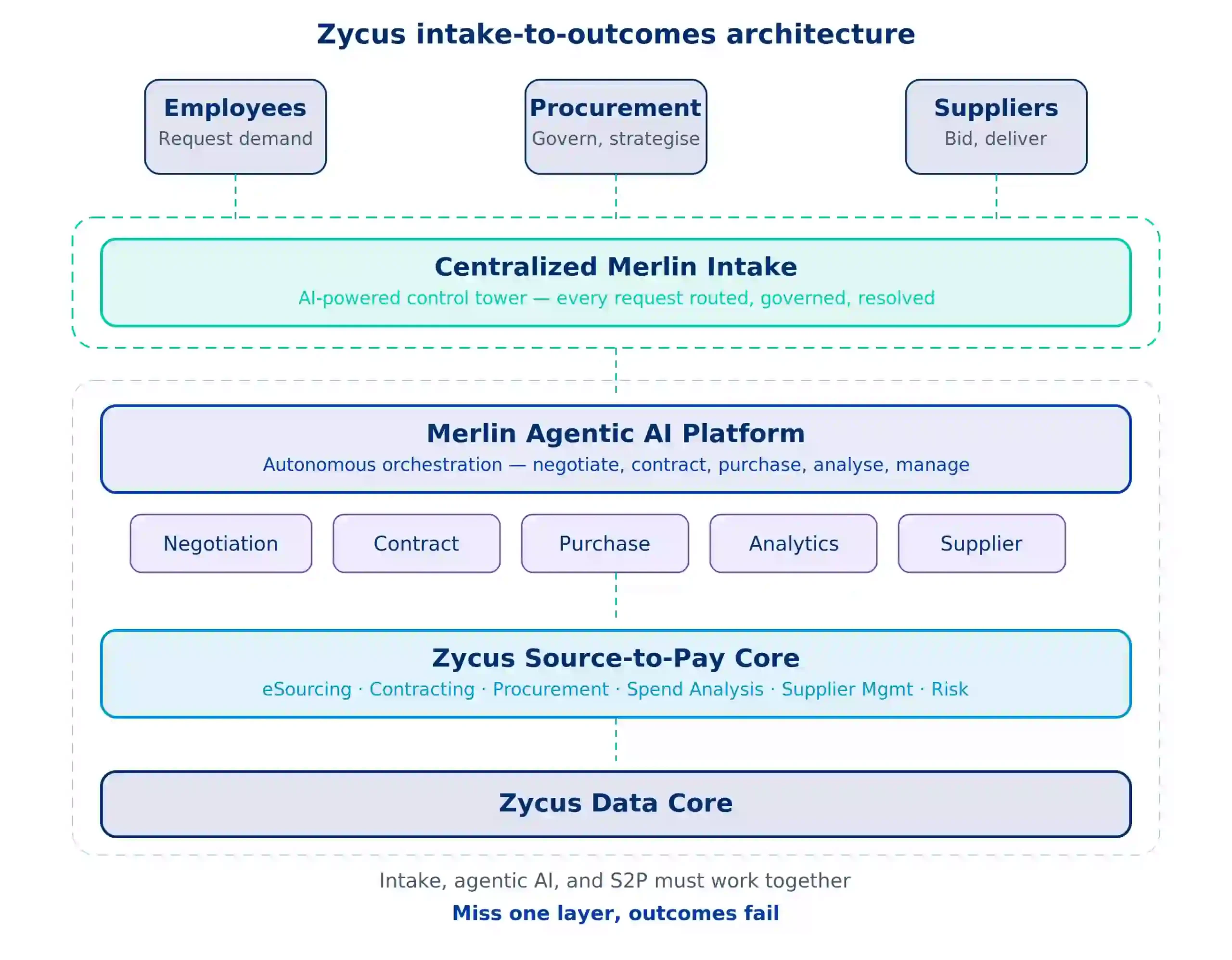
Remove any one layer and outcomes break. That’s the I2O thesis: intake, agentic AI, and a unified suite must work together — miss one, and you’re back to email threads and spreadsheets.
And critically, I2O is not a pipeline. It’s a loop. Intake captures demand. The agentic layer orchestrates and executes. Outcomes are measured. And those measured outcomes feed back into intake — refining policies, sharpening routing, improving the next cycle. Every loop gets smarter.
Aviation Leaders Closing the Loop with Zycus
The concept is clean. But does it hold at altitude? Three Zycus aviation customers prove it does — each starting from a different failure mode, each arriving at the same conclusion.
Delta Air Lines adopted Zycus’s intake-led S2P suite to create what they call “one way to procure” across approximately ten procurement portfolios. By standardising how demand entered the system — ensuring every sourcing decision was visible, governed, and measurable from the moment a request was raised — Delta turned fragmented requests into controlled outcomes. Project cycle time dropped 81%. Overall procurement cycle time fell 60%. Return on investment hit 600%. Their procurement team went from transactional processors to what the business now calls trusted advisors.
“We wanted to make procurement better for the entire community and ecosystem. In Zycus we found such a partner. Now our procurement team is clearly considered a ‘trusted advisor’ across the business.”
— Niteen Suresh, Managing Director – Supply Chain Management, Delta Air Lines
Swissport International, the world’s leading ground services and cargo handler, chose Zycus to replace its legacy provider and consolidate procurement across 25 countries. With 12,000 monthly invoices and over 6,600 operational contracts flowing from 285+ airports, the problem wasn’t just fragmented tools — it was that requests had no single point of entry, no consistent policy enforcement, and no way to trace a demand signal through to a measured result. Zycus gave them exactly that: one intake point, one policy engine, one data core connecting sourcing, contracts, suppliers, and invoicing across every country of operation.
Cargolux Airlines, Europe’s largest cargo carrier, solved the version of the intake gap most endemic in aviation: the people generating procurement demand — logistics operators, non-procurement specialists — couldn’t use the existing system. When Zycus simplified intake through a conversational, user-friendly interface, the gap closed and outcomes followed. PO automation hit 100%. Cycle times dropped 60%. Sourcing savings reached 5–10%. The unlock wasn’t a more powerful backend. It was a front door that non-expert users could actually walk through — and once demand entered the system cleanly, outcomes compounded.
Three organisations. Three legacy failures. One proof point: when you fix the starting point, outcomes take care of themselves.
Why Aviation’s Intake Gap Makes Agentic AI Both Urgent And Fragile?
Here’s the harder truth. In aviation specifically, the room is enormous. Demand is generated simultaneously from ground crews in 45 countries, MRO teams across hundreds of airports, and operations managers handling categories where compliance failure carries safety and regulatory consequences — parts certification, fuel specifications, SAF mandates. No human procurement team can govern intake at that scale manually.
This is why agentic AI only works when the demand entering the system is structured. Without intake, autonomy amplifies chaos.
With Zycus’s I2O architecture, the Merlin Agentic AI Platform operates with both autonomy and governance — negotiating tail spend, managing contracts, processing invoices, onboarding suppliers — all within the guardrails set by the same policy engine that governs intake. The agents don’t replace procurement teams. They free them to govern outcomes instead of orchestrating transactions.
The measurable impact, based on Zycus customer benchmarks:
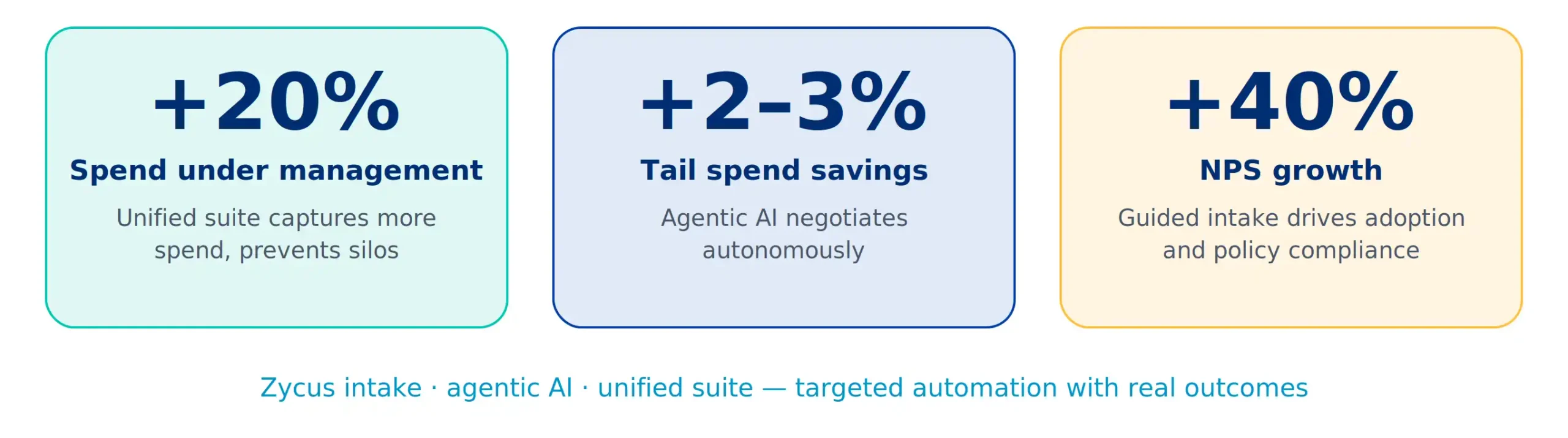
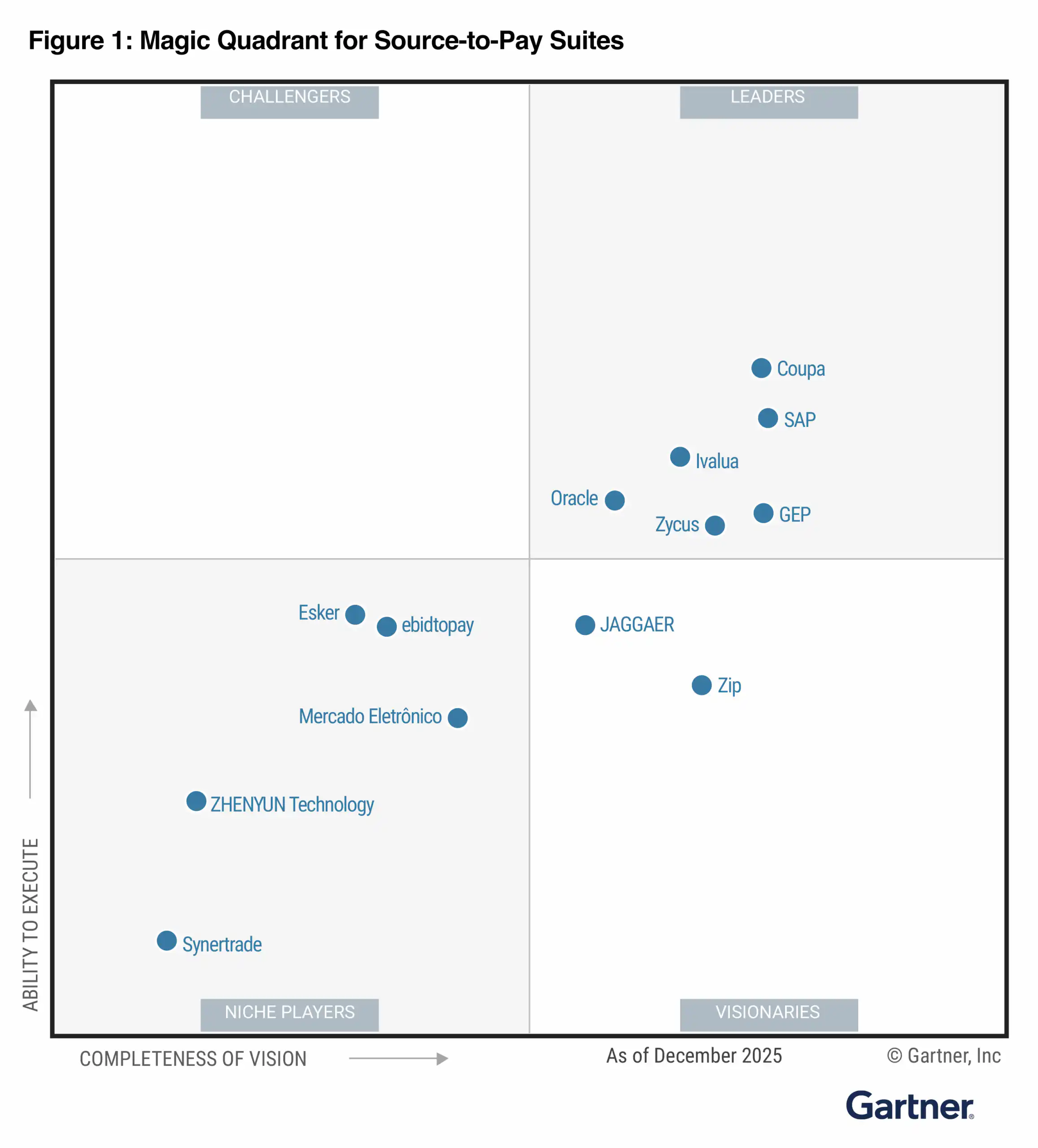
Results that Gartner, Forrester, and IDC have independently validated by positioning Zycus as a Leader across their most recent Source-to-Pay evaluations.
The Real Modernization Agenda
Aviation is pouring billions into fleet renewal, terminal upgrades, SAF infrastructure, and digital operations. The industry is modernising everything — except how it buys.
The CPOs closing the loop aren’t just automating purchases. They’re building resilient, compliant, transparent supply chains where every request is captured, every action is governed, and every outcome is measured — then fed back to make the next cycle better. The airlines that close this loop will compound their advantage every cycle. Those that don’t, will keep losing value in a gap they can’t even see.
The shift starts with a single question: where does demand enter your system today — and who controls it? If you can’t answer that in one sentence, that’s where to begin.
If you’re modernising what you fly, modernise how you buy first.
The new era of aviation efficiency starts at intake.
Related Reads: