







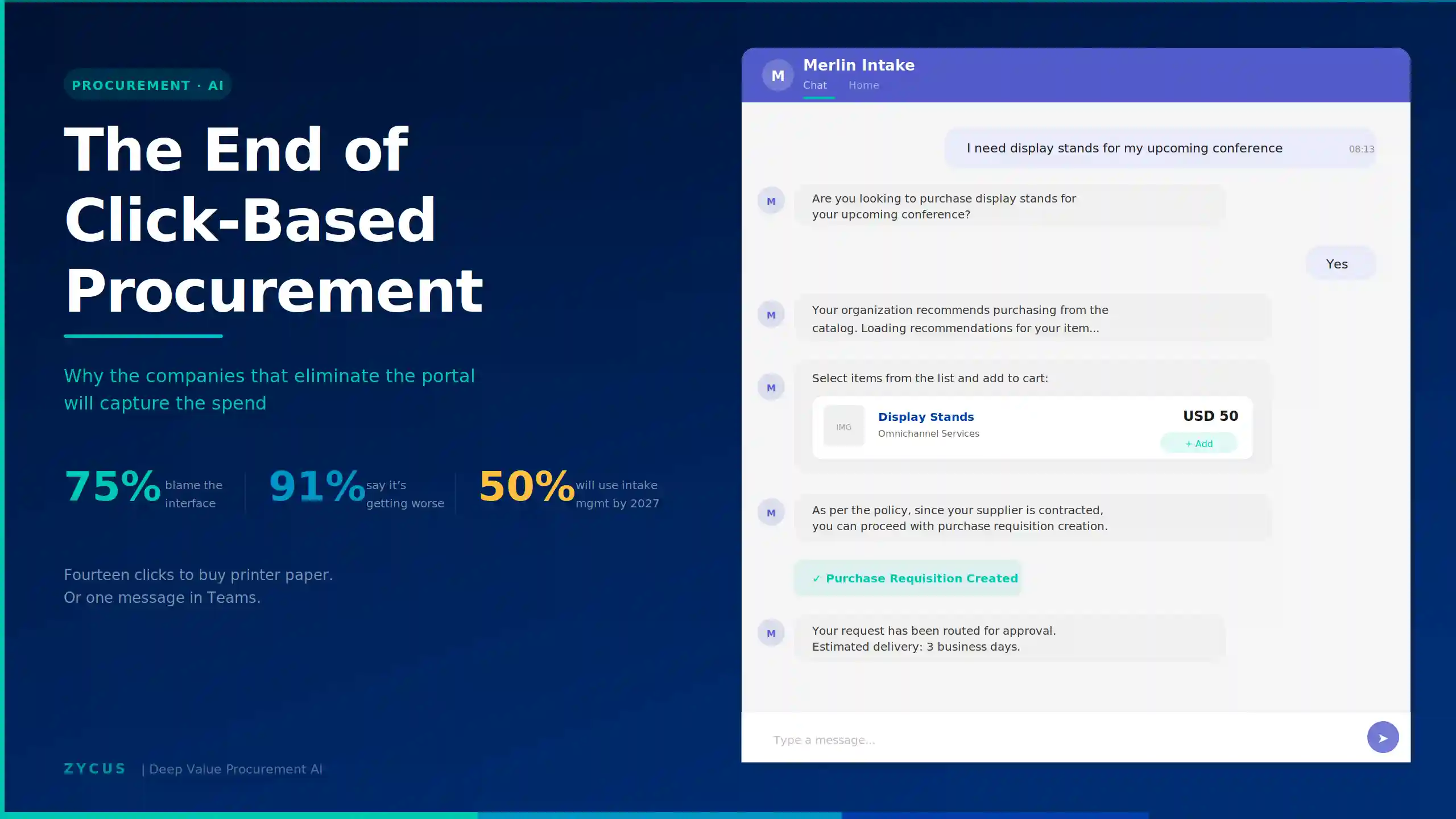

TL;DR
- Click-based procurement forces employees through 14+ steps to place a simple order — most abandon the process and buy off-contract instead.
75% of procurement professionals say poor UX — not policy ignorance — is the top cause of maverick spend, costing organisations 10–20% of their negotiated savings. - Every industry from taxis to banking has replaced menu-driven interfaces with conversational ones. Procurement is next — Gartner predicts 50% of organisations will adopt intake management by 2027.
- Conversational AI intake lets employees request what they need in plain language inside tools like Microsoft Teams, while policy enforcement happens invisibly in the backend.
- The real unlock goes beyond intake — agentic AI handles downstream execution like sourcing, contracting, and invoicing, so the requester never touches a second system.
- The compliant path has to be the easiest path. Organisations replacing clicks with conversations and agents are capturing the spend their competitors are still losing to portal fatigue.
Log in. Navigate to the procurement module. Click “New Request.” Select a category from a dropdown 200 options, no search. Fill in the description field. Attach a justification document. Search the supplier catalogue — three results, none matching. Try a different keyword. Select a cost centre. Choose a delivery location. Route to your manager for approval. Wait. Follow up by email. Get asked to resubmit with a revised budget code. Start again.
This is how most enterprises buy things in 2026. Not complex capital equipment. Not strategic sourcing engagements. Printer paper. Safety gloves. A conference room monitor.
Chances are you skimmed that paragraph. Nobody wants to read through all those steps and that’s exactly the point. This is what it takes to initiate even the simplest procurement request in most organisations: fourteen clicks, give or take, before a single item is ordered.
Every one of those clicks is a decision point, and at each one, a rational employee can choose to abandon the process and buy what they need some other way. Most of them do.
The Click Tax
So where do all those abandoned clicks go? Straight into the line item that keeps CPOs up at night: maverick spend.
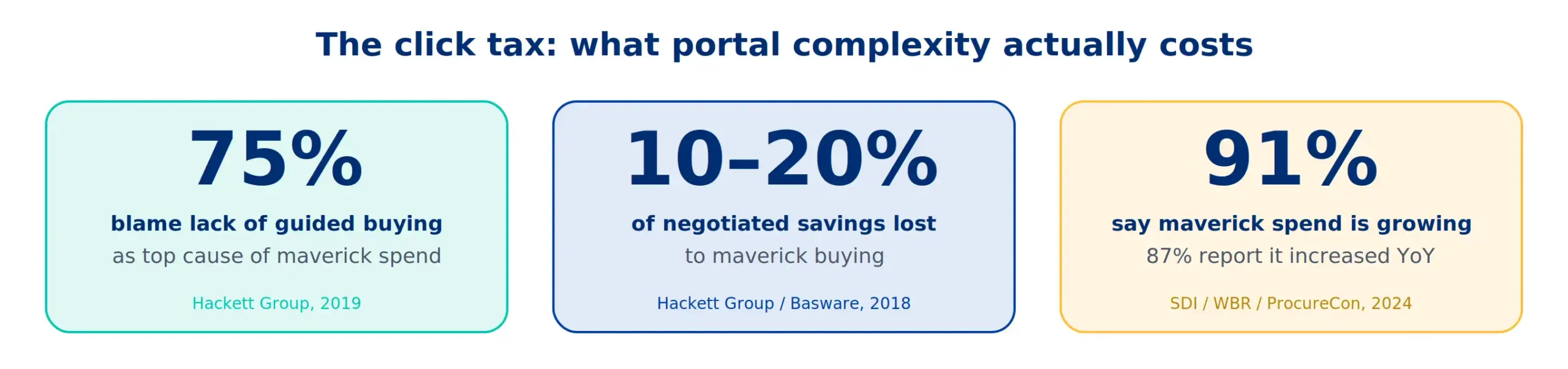
The Hackett Group studied this connection directly. In its research on user experience and maverick spend, 75% of procurement professionals cited the lack of self-service or guided buying tools as the single biggest cause of maverick purchases. Not policy ignorance. Not wilful non-compliance. The interface itself. McKinsey reached a similar conclusion at its 2025 CPO Executive Forum, noting that “a lack of focus on user experience was holding back the use of advanced technologies” across procurement organisations despite those tools being widely available and proven to deliver 2–5% cost reductions.
The financial bleed is real. Hackett found that organisations lose 10–20% of their negotiated savings to maverick buying months of supplier negotiations wiped out because a stakeholder found the portal too difficult and ordered directly from a non-contracted vendor. And the problem is getting worse, not better: a joint study by SDI, WBR Insights, and ProcureCon found that 91% of procurement leaders now view maverick spend as a significant challenge, with 87% reporting that it increased over the past year.
Here’s what makes this a structural problem, not a cultural one. Hackett’s analysis categorises the triggers, and confusing procure-to-pay processes rank as the most common ahead of policy gaps, ahead of training failures. When the compliant path takes longer than the non-compliant path, employees take the shortcut. Every time. The portal doesn’t prevent maverick spend. It causes it.
Procurement’s Portal Moment
Every industry eventually reaches a point where the structured, menu-driven interface gets replaced by something that understands what you want and just does it.
Taxis had dispatch systems call a number, describe your location, wait. Uber replaced it with a single question: Where do you want to go? The dispatch system didn’t disappear. It moved to the backend. The result: 189 million monthly active users and 11 billion trips completed in a single year.
Banks had branch forms and phone trees. Bank of America launched Erica, a conversational AI assistant, and watched it scale to 3 billion interactions across 50 million users, with 98% of queries resolved within 44 seconds. Venmo grew from 3 million to 91 million users by replacing wire transfer forms with “pay @name $50.”
In every case, the old system didn’t vanish. It moved to the backend. The interface became conversational. And adoption exploded because the user no longer had to learn the system’s language, the system learned theirs.
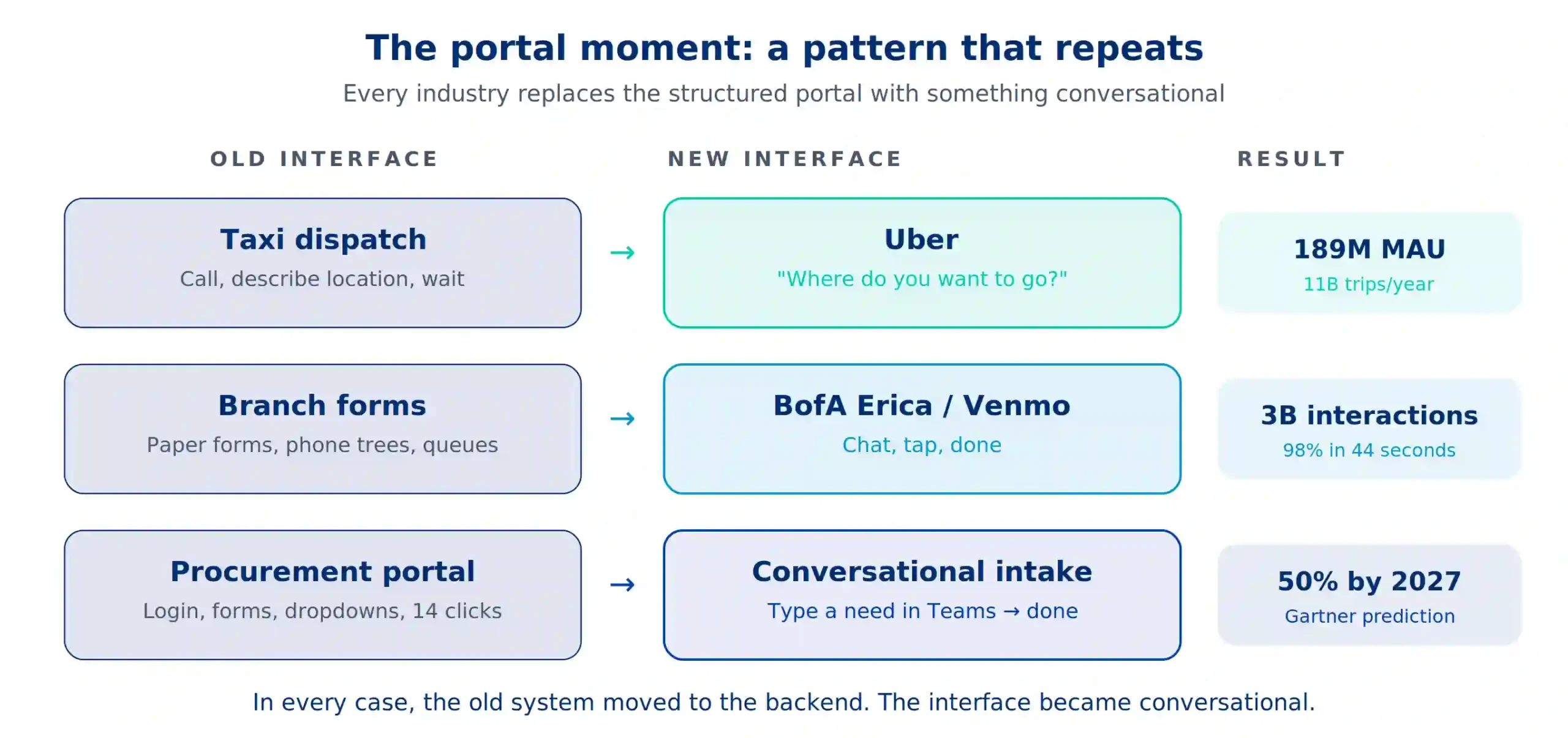
Procurement is having this moment right now. Gartner predicts that by 2027, 50% of procurement organisations will use intake management to simplify how requests enter the system. Its longer-range forecast is more striking: by 2028, 90% of B2B purchases will be handled by AI agents, channelling more than $15 trillion in spend through AI-mediated exchanges.
The click-based requisition portal is the dispatch system. Conversational AI intake is the Uber.
What Replaces the Portal
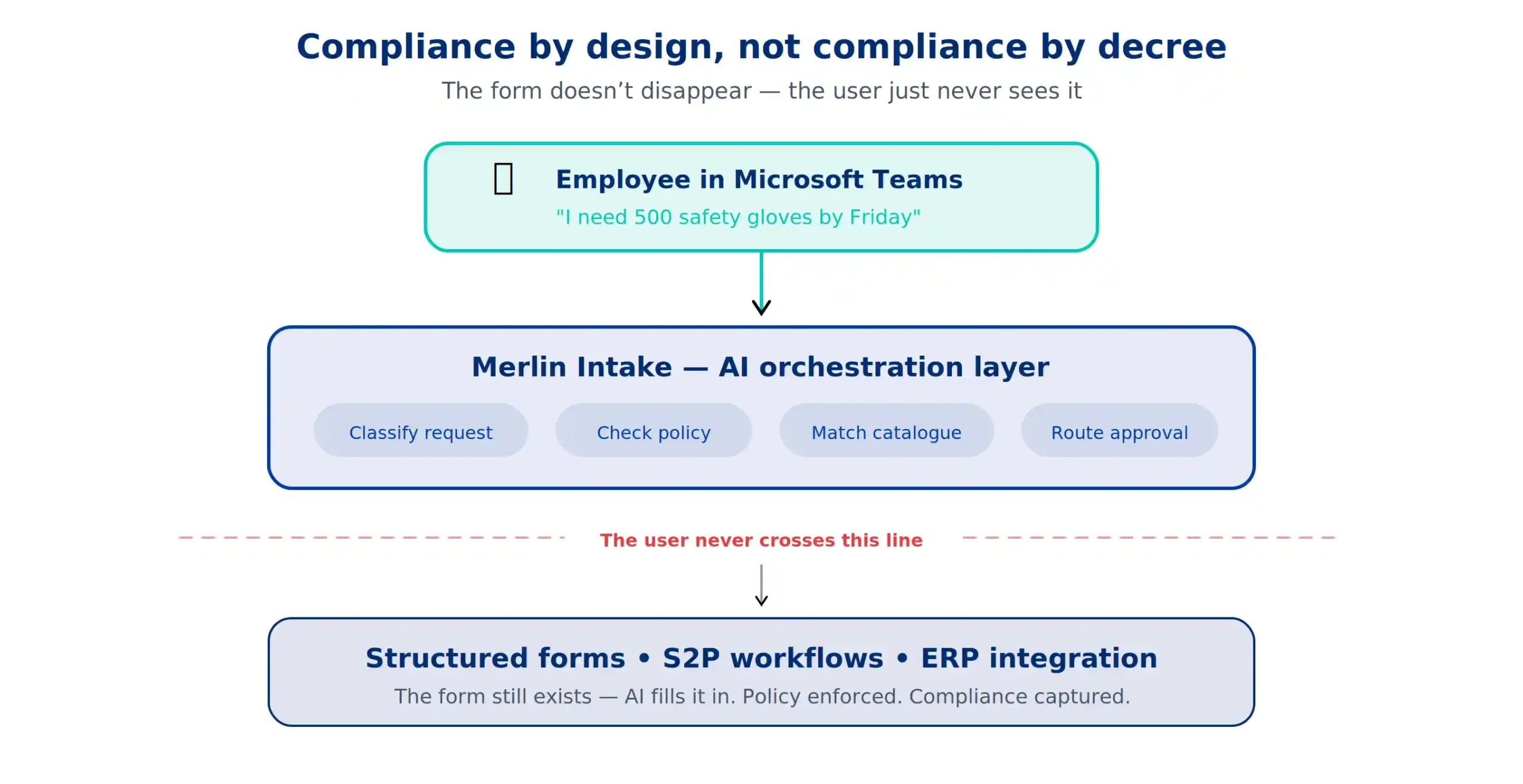
The shift is already visible. Instead of logging into a procurement system, an employee types a request inside Microsoft Teams, the platform where 320 million people already work, used by 93% of Fortune 100 companies. “I need 500 safety gloves for the Houston warehouse by Friday.”
The AI in the case of platforms like Zycus’s Merlin Intake classifies the request, checks it against procurement policy, identifies the right catalog item, and routes it into the appropriate approval workflow. The user never sees a procurement screen. No category dropdowns. No supplier searches. No budget code lookups. The form still exists in the backend the user just never fills it out. The AI handles the structured data. Policy enforcement still happens; it’s simply invisible to the requester.
This is the critical insight the industry has been slow to grasp: the form was never the point. The policy enforcement was. And you can enforce policy through conversation just as effectively as through a dropdown menu, if the AI understands the rules. The result is compliance by design, not compliance by decree.
The data supports the shift. Hackett found that organisations with guided buying tools report 60% less lost savings from maverick spending than those without them. The mechanism is straightforward: when the compliant path becomes the easiest path, adoption follows naturally.
From Intake to Agentic Execution
Conversational intake solves the front-door problem. But procurement doesn’t end when a request enters the system. What happens downstream sourcing, negotiation, contracting, purchase order creation, invoice processing has historically required just as many clicks across just as many disconnected systems. Gartner found that 85% of organisations still rely on disconnected systems that slow progress and frustrate users.
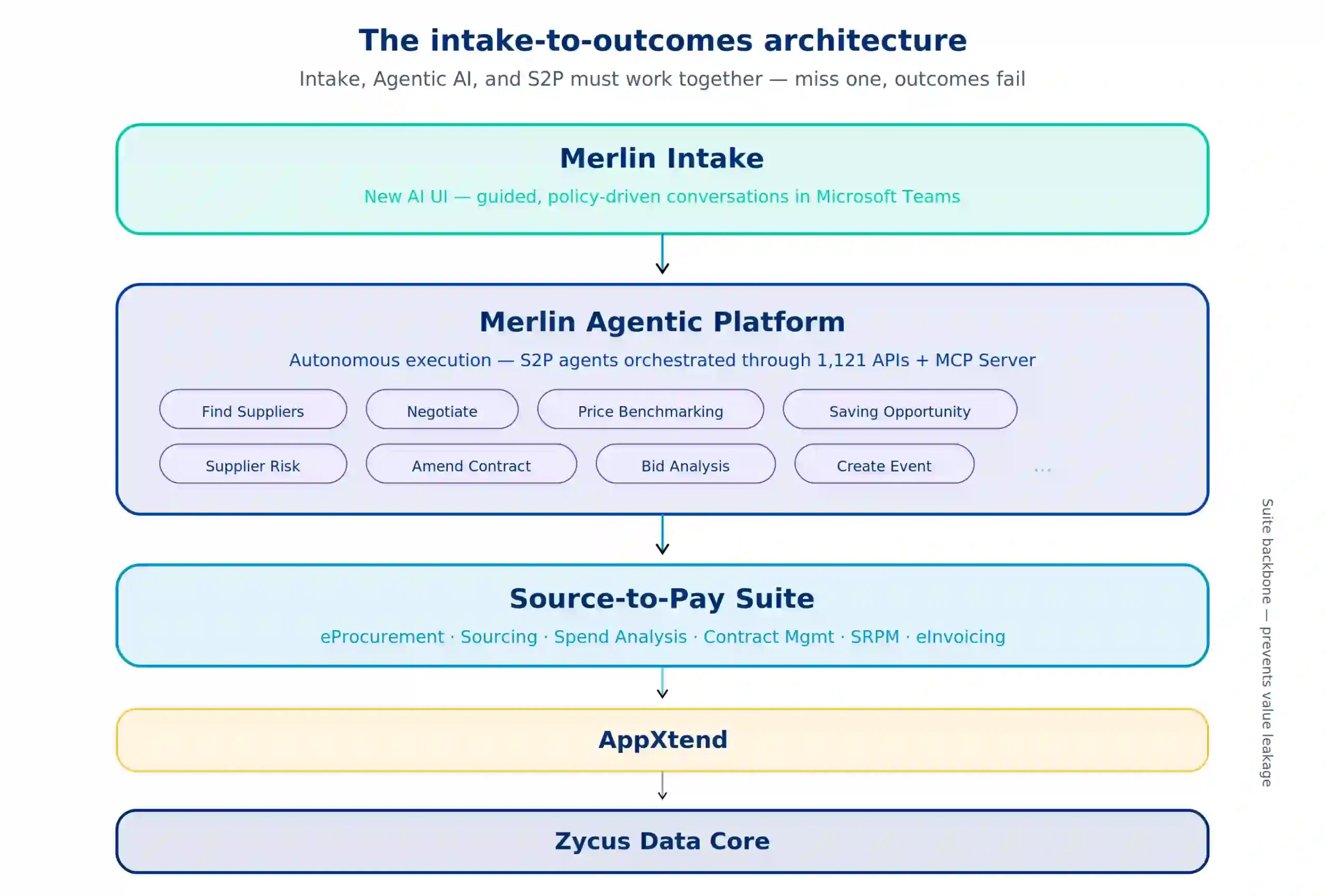
This is where agentic AI extends the logic. Once a request is captured through conversation, AI agents can take over downstream execution: one agent negotiates tail spend autonomously, another drafts compliant contracts, another processes invoices with speed and accuracy. Zycus’s Merlin Agentic Platform, for instance, orchestrates these agents across the full source-to-pay backbone so the human who typed a request in Teams never has to open a second system, chase an approval, or reconcile a purchase order manually.
The architecture that emerges is what Zycus calls Intake-to-Outcomes: guided intake at the front, agentic AI orchestrating in the middle, and a unified S2P core underneath. Each layer depends on the others. A conversational front door bolted onto a fragmented backend just creates a friendlier entrance to the same broken house. McKinsey’s analysis suggests that procurement functions embedding AI agents across the full cycle could become 25–40% more efficient not through incremental automation, but through a structural redesign of how work flows from demand to outcome.
Gartner projects that 40% of enterprise applications will feature task-specific AI agents by the end of 2026, up from less than 5% in 2025. The trajectory is clear. The question is not whether procurement will move from clicks to conversations to agents. It’s how much spend leaks out the door while an organisation waits.
The Compliant Path Should be the Easiest Path
The CPO’s job was never to train people to use the system. It was to make the system so intuitive that training becomes unnecessary. The organisations closing this gap replacing portals with conversations, replacing clicks with agents are capturing the spend that their competitors are still losing to maverick behaviour and portal fatigue.
The question for every procurement leader is simple: where does demand enter your system today? If the answer involves a login screen, a category dropdown, and a twelve-step for the spend is already walking out the door.
Related Reads: