








TL;DR
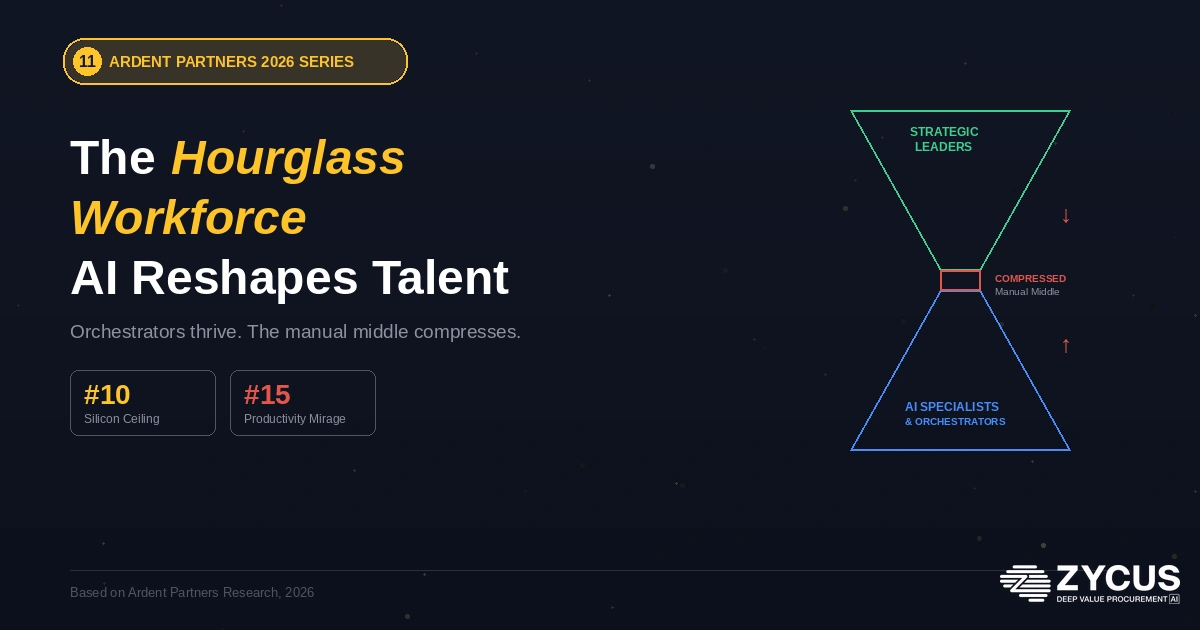
- Ardent Partners predicts an hourglass-shaped procurement workforce: strategic leaders and AI specialists thrive at the top and bottom, while the manual, process-heavy middle is compressed. This is not a future state — it is already underway.
- BIG Trend #10 identifies the “silicon ceiling” — organizations have budgets for AI tools but lack the people with skills to deploy, manage, and optimize them. The talent gap is the binding constraint on procurement’s AI ambitions.
- The productivity mirage (BIG Prediction #15) warns that companies cutting staff too aggressively will face a collapse when AI cannot replace institutional judgment and tribal knowledge. Automation without human orchestration creates chaos.
- Wave V of the CPO Strategic Playbook — Reshape the Talent Hourglass — calls for upskilling existing professionals from process experts to process orchestrators, market analysts, and AI system managers. This is investment, not headcount reduction.
- The CPO who invests in talent transformation in 2026 builds the team capable of orchestrating autonomous systems. The one who only invests in technology discovers that AI without skilled operators delivers a fraction of its potential.
There is a conversation happening in procurement departments that nobody wants to have publicly. It goes something like this: if AI can handle the negotiations, process the invoices, monitor the suppliers, and route the approvals — what exactly does the procurement team do?
It is the wrong question. But it is the question that procurement professionals are privately asking, and the anxiety behind it is real. Ardent Partners addresses it directly.
BIG Prediction #10 in Procurement 2026: BIG Trends and Predictions describes the hourglass job market taking shape: strategic leaders and AI specialists thrive at the top and bottom of the organization, while the manual, process-heavy middle is compressed. The professionals who run RFPs, compile category reports, manage approval workflows, and execute routine negotiations are the most exposed — because these are precisely the tasks that autonomous systems perform well.
Through this series, we have built the case for autonomy, intelligence, and speed across every dimension of procurement. But every one of those capabilities requires human orchestration. The technology is only as good as the team operating it. And as we explored in our analysis of supplier risk, always-on monitoring demands a fundamentally different skill set than annual questionnaire management. The talent question is not peripheral to the AI story. It is central.
The Silicon Ceiling
Before addressing the workforce shape, Ardent identifies the binding constraint: BIG Trend #10 — the AI skill-set deficit, or what the report calls the “silicon ceiling.” Organizations have the budgets for AI tools. They have executive sponsorship. They have validated use cases from their AI Garage pilots. What they lack are the people who know how to deploy, manage, and optimize these systems.
The silicon ceiling is not about hiring data scientists. It is about the gap between the procurement team’s current capabilities and the skills required to operate in an AI-augmented environment. Can the category manager interpret AI-generated recommendations and apply business judgment? Can the sourcing specialist design the guardrails for an autonomous negotiation agent? Can the risk analyst operate a continuous monitoring system and know when to override it?
These are not niche technical skills. They are the baseline competencies for procurement in 2026. And most organizations have not invested in developing them. The result is a paradox: the technology is ready, the budget is available, the strategy is clear, but the team is not equipped to execute. The silicon ceiling becomes the binding constraint on procurement’s AI ambitions.
The Productivity Mirage
Ardent issues a sharp warning to CPOs tempted to solve the talent challenge through headcount reduction. BIG Prediction #15 describes the “productivity mirage”: companies that cut procurement staff too aggressively, betting that AI replaces human judgment, will discover the illusion within 12 to 18 months.
The mirage works like this. AI handles the routine tasks. Headcount is reduced. Short-term productivity metrics improve. Costs drop. The CFO is satisfied.
Then the exceptions start. A supplier negotiation requires understanding of a 15-year relationship history that exists only in the departed category manager’s head. A tariff scenario requires judgment about a regional market that the AI model has insufficient training data to evaluate. A stakeholder conflict requires the political awareness and institutional knowledge that no algorithm possesses. Without the humans who carried that context, the AI’s outputs become unreliable. Decisions slow down. Errors accumulate. And the organization discovers that it cut the people who made the autonomous systems work.
The report is direct: automation without orchestration creates chaos. The humans are not the redundancy. They are the operating system.
Reshaping, Not Reducing
Wave V of the Five-Wave CPO Strategic Playbook addresses the talent question directly: Reshape the Talent Hourglass. The emphasis is on upskilling, not downsizing. Procurement professionals who have spent their careers as process experts need a path to becoming process orchestrators, market analysts, and AI system managers.
Process orchestrators design the strategic intent that autonomous systems execute. They define the guardrails for AI agents, set the negotiation parameters, determine when human intervention is required, and maintain quality control over AI outputs. They do not execute the process. They govern it.
Market analysts leverage the category intelligence feeds and external data sources to provide the business with proactive advice. They interpret the AI-generated recommendations through the lens of market knowledge, supplier relationships, and business context that the AI cannot access independently.
AI system managers ensure the autonomous systems operate correctly, monitor for drift, validate outputs, and continuously refine the models based on real-world outcomes. They are the bridge between the technology team that builds the AI and the procurement team that depends on it.
None of these roles require a computer science degree. They require procurement expertise combined with AI literacy — the ability to work with autonomous systems, not to build them. The CPO’s investment in 2026 is not in technology alone. It is in the training, mentoring, and career pathing that transforms existing talent into the workforce that operates the autonomous procurement function.
The Urgency of Starting Now
Talent transformation is slow. Technology deployment is fast. This mismatch is the single greatest risk to procurement’s AI ambitions in 2026.
A unified AI-native platform can be configured in months. An autonomous negotiation agent can begin delivering savings in weeks. But training a category manager to operate as a process orchestrator — to think differently about their role, to develop new skills, to trust AI outputs while knowing when to override them — takes sustained investment over quarters.
The CPOs who begin this investment in the first half of 2026 will have a workforce capable of operating autonomous systems by the time those systems reach full production. The ones who wait will hit the silicon ceiling precisely when they need to scale. And as Ardent warns, the K-shaped divergence will widen: organizations with skilled, AI-literate procurement teams will accelerate away from those that have the technology but not the people to use it.
The talent transformation is ultimately a leadership story. And it culminates in the most consequential shift of all: the CPO’s own elevation from spend guardian to enterprise strategist. As we conclude this series, the evidence is clear — the CPO’s rise is not aspirational. It is structural, and it is happening now.
The Ardent Partners report covers the hourglass workforce, the silicon ceiling, and the complete Five-Wave CPO Playbook. Download Procurement 2026: BIG Trends and Predictions for the full analysis of procurement’s talent transformation.
Continue Reading
Previous in this series: Supplier Risk as an Always-On Discipline
Next in this series: The CPO Continues to Rise: From Spend Guardian to Enterprise Strategist
FAQs
Q1. What is the hourglass workforce in procurement?
Ardent Partners predicts a workforce shape where strategic leaders and AI specialists thrive at the top and bottom of the organization, while the manual, process-heavy middle compresses. Professionals who run routine RFPs, compile reports, and manage approval workflows are most exposed because these are the tasks autonomous systems perform well.
Q2. What is the silicon ceiling?
BIG Trend #10 describes the gap between organizations’ AI budgets and the skills of their people. Companies have funding for AI tools and executive sponsorship for deployment, but lack procurement professionals who can deploy, manage, and optimize autonomous systems. This skill-set deficit becomes the binding constraint on procurement’s AI ambitions.
Q3. What is the productivity mirage?
BIG Prediction #15 warns that companies cutting procurement staff too aggressively will discover within 12–18 months that AI cannot replace institutional judgment, tribal knowledge, and relationship context. Short-term productivity gains collapse when exceptions arise that require human expertise the organization no longer possesses. Automation without human orchestration creates chaos, not efficiency.
Q4. What new roles are emerging in procurement?
Three primary roles are emerging: process orchestrators who design strategic intent and govern autonomous systems, market analysts who interpret AI recommendations through business context and supplier knowledge, and AI system managers who monitor autonomous systems for accuracy and continuously refine models. None require computer science backgrounds — they require procurement expertise combined with AI literacy.
Q5. How should CPOs approach talent transformation in 2026?
Wave V of Ardent’s Five-Wave Playbook emphasizes upskilling over downsizing. CPOs should invest in training existing procurement professionals to become process orchestrators, market analysts, and AI system managers. This requires sustained investment in training, mentoring, and career pathing — not one-time workshops. Starting early in 2026 is critical because talent transformation takes quarters while technology deployment takes weeks.
Q6. Why can’t organizations simply hire AI specialists to fill the gap?
The silicon ceiling is not about hiring data scientists. It is about the gap between the entire procurement team’s current capabilities and the skills needed to operate in an AI-augmented environment. Every category manager, sourcing specialist, and risk analyst needs to develop AI literacy. External hires add specialized capability but cannot replace the institutional procurement knowledge that existing teams carry.
Related Reads:
- Top 10 Winning Skills for Procurement Professionals
- The Changing Procurement Talent Landscape: New Skills for a Digital Future
- Guide to Procurement Agents: Roles, Skills & How AI is Changing the Game
- You Surely Can’t Beat These Four Traits of a Successful CPO
- How to be a better procurement manager: The latest updates on procurement digitization
- The Year of Pilots: How to Separate AI Value from Marketing Hype
- The AI Budget Siphon: How to Fund Procurement’s AI Future