




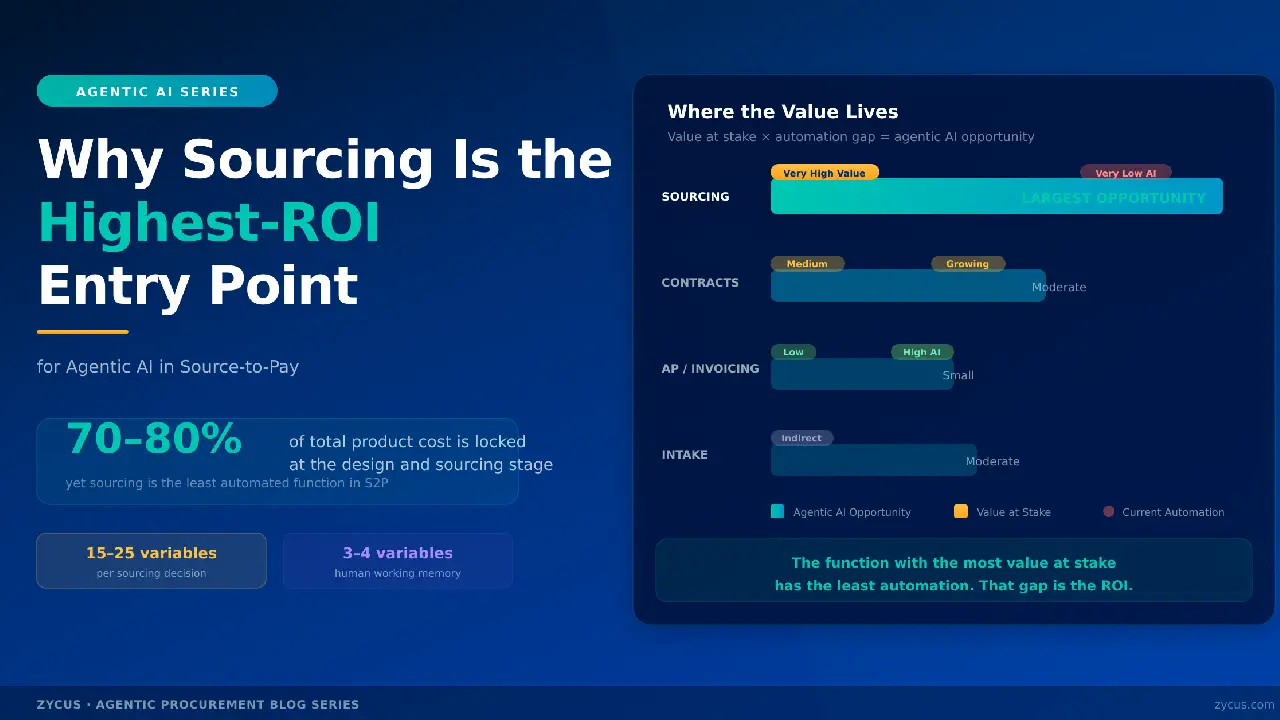

Every procurement function will eventually run on agentic AI. The question is which one proves the case first — and sourcing is the answer nobody is arguing against.
TL;DR
- Agentic Sourcing is the highest-ROI entry point in S2P — 70–80% of total product cost is locked at the sourcing decision, yet sourcing is the least automated function in S2P. That gap is where Agentic Sourcing earns its highest return.
- Sourcing decisions involve 15–25 variables simultaneously. No human can optimize across all of them. Agentic AI can — and the delta between “with agent” and “without agent” is structural, not marginal.
- AP automation returns pennies per dollar invested. Sourcing intelligence returns multiples — because it changes the price at which the organization buys, not just the cost of processing the purchase.
- only 28% of AI use cases in infrastructure and operations fully meet ROI expectations. Sourcing avoids this trap because the outcome is a dollar number the CFO can verify on the first event.
- The data-readiness objection is backwards: 8 of 10 organizations saw data quality improve after deploying AI, not before. Start on your top categories and let the AI clean as it learns.
- Start with sourcing and the first win funds the rest of the S2P roadmap. Start elsewhere, and you spend the next year explaining why the ROI is indirect.
A sourcing lead is building a category strategy for IT managed services. She has eighteen months of spend data in one system, the current contract in another, supplier risk scores in a third, and commodity benchmarks in a PDF from a consultant three months ago. She will spend the next six weeks assembling this into a recommendation her stakeholders will review in thirty minutes. Most of that time is not analysis. It is assembly — gathering, formatting, reconciling, and re-entering information that already exists but has never been connected.
Every other function in the source-to-pay lifecycle has been automated for years. AP runs on three-way matching engines. Contracts have clause extraction. Intake has guided routing. But strategic sourcing — the function where procurement creates the most value and locks in the most cost — still runs largely on spreadsheets, email, and institutional memory. The function that matters most has changed the least. That gap is not an accident. Until recently, no technology could handle the combinatorial complexity of a strategic sourcing decision. Agentic AI changes that — and it changes the calculus of where to invest first.
The Money is Upstream, Not Downstream
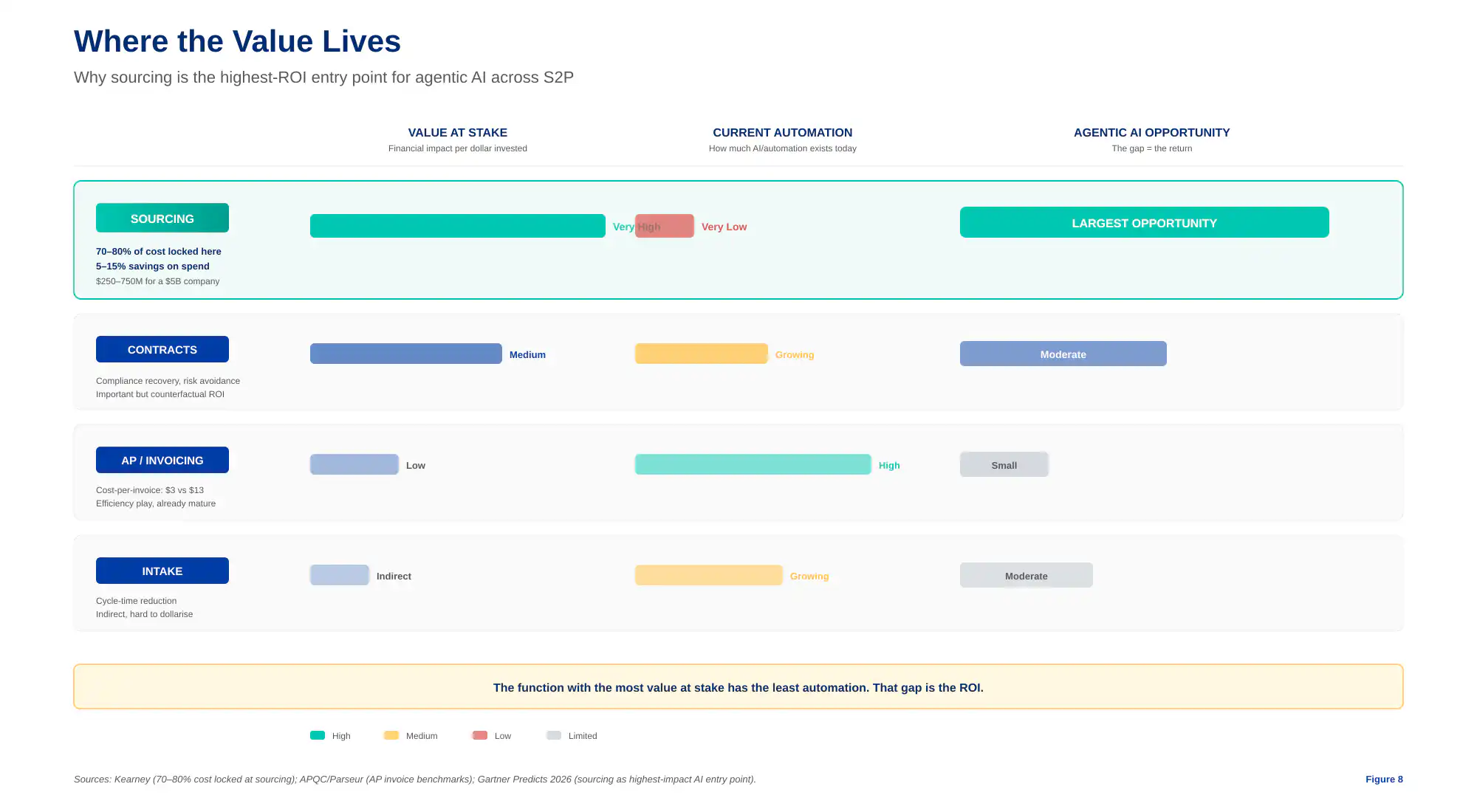
The single most important number in this argument is one that sourcing professionals already know intuitively: roughly 70–80% of total product cost is determined at the sourcing decision, long before an invoice is ever processed. Strategic sourcing programmes consistently deliver 5–15% savings on addressable spend in their first wave. For a company with $5 billion in external spend, that is $250–750 million in value at stake — an order of magnitude larger than the entire budget of most AP automation programmes.
Compare that to the downstream alternative. Best-in-class AP automation has already compressed the cost of processing an invoice to under $3, versus an industry average of nearly $13. That is a real saving — but it is an efficiency play on a cost that was already small. The marginal dollar invested in AP automation returns pennies. The marginal dollar invested in sourcing intelligence returns multiples — because it changes the price at which the organization buys, not just the cost of processing the purchase.
Figure 1 — Where the value lives: the function with the most value at stake has the least automation.
Why Sourcing Complexity is AI’s Advantage, Not its Obstacle
Most organizations assume they should deploy AI where the problem is simplest: high-volume, structured, repetitive. That logic made sense for RPA. It does not hold for agentic AI. Agents are designed for multi-variable reasoning — exactly the kind of problem that strategic sourcing presents.
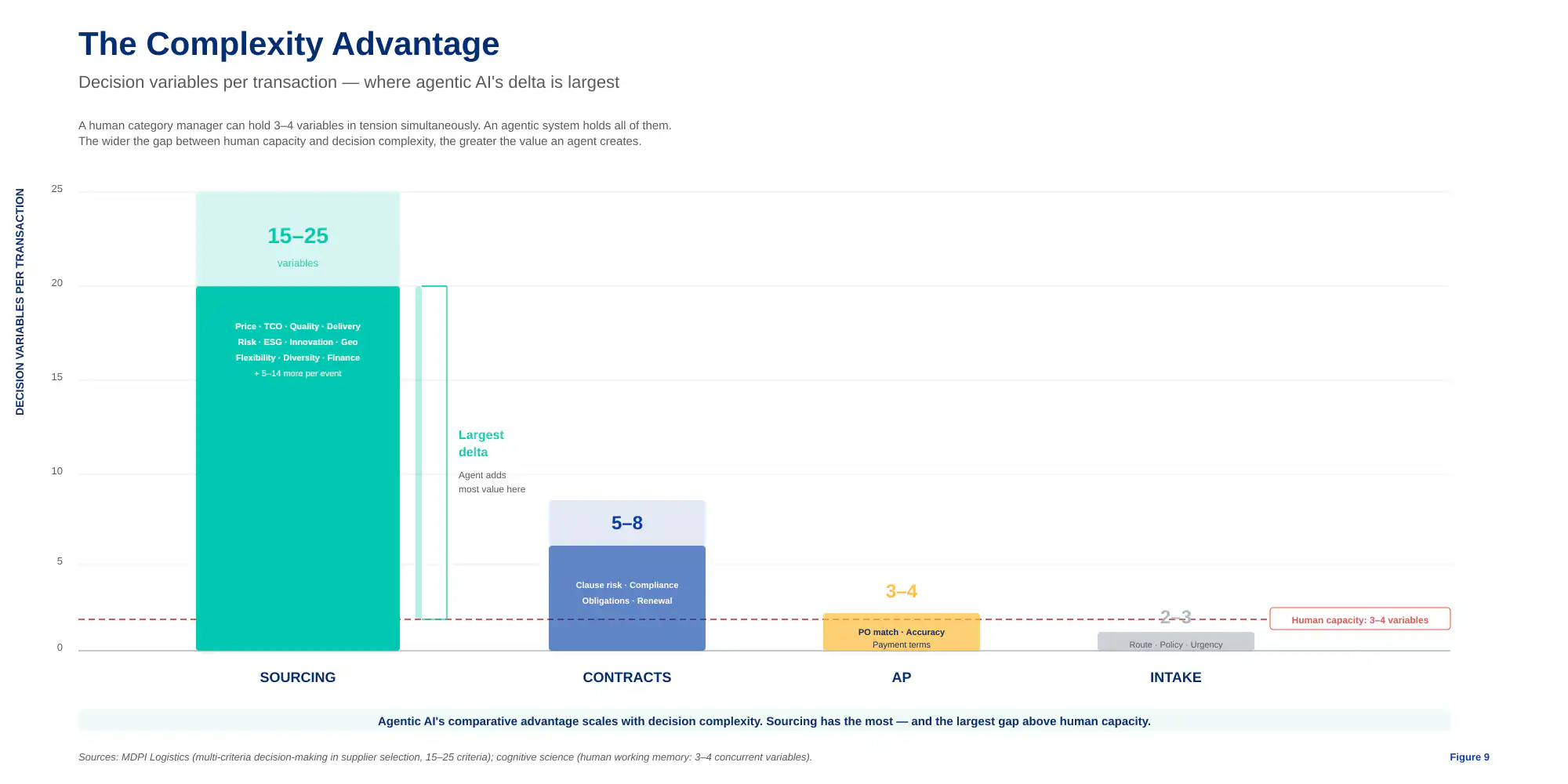
A typical strategic sourcing decision involves trade-offs across ten or more dimensions simultaneously: price, total cost of ownership, quality, delivery reliability, supplier risk, sustainability and ESG compliance, innovation capability, geopolitical exposure, contract flexibility, and financial stability. Academic research on multi-criteria decision-making in supplier selection routinely catalogs 15–25 evaluation criteria per event. A human category manager can effectively hold three or four of those variables in tension at once. An agentic system holds all of them, weights them against policy and historical performance, and optimizes across the full matrix.
No other S2P function has this decision density. AP is high-volume but low-complexity per transaction — the decisions are match or exception. Contract management is text-heavy but the decisions are largely binary: accept, reject, or redline. Intake is routing-intensive but decision-light. Sourcing is where the combinatorial complexity lives — and that is precisely where agentic AI’s comparative advantage is largest. The delta between “with agent” and “without agent” is not marginal in sourcing. It is structural.
Figure 2 — The complexity advantage: decision variables per transaction across S2P functions.
The ROI that Funds the Roadmap
There is a practical reason sourcing should come first that has nothing to do with technology: the ROI is directly measurable. When AI improves sourcing, the outcome is a dollar number — savings achieved, cost avoided, value captured — that the CFO can verify against the baseline. When AI improves intake, the outcome is cycle-time reduction. When it improves supplier risk monitoring, the outcome is risk avoided — important but counterfactual, because you are measuring what did not happen. CFOs fund what they can measure.
This matters because only 28% of AI use cases in infrastructure and operations fully succeed and meet ROI expectations, according to Gartner — most of them because the business case was ambiguous or the scope was too broad. The organizations that successfully scale AI across the enterprise almost always start with a use case that produces an undeniable number in the first quarter. Sourcing is that use case. The first event run with agentic AI produces a savings figure that becomes the business case for deploying AI across the rest of S2P. Start with sourcing, and the first win funds the roadmap.
What Agentic Sourcing Looks Like in Practice
The shift is not incremental. In a traditional strategic sourcing process, a team spends six to twelve weeks assembling spend analysis, building RFP documents, managing supplier communications, evaluating bids, running scenarios, and preparing award recommendations. The majority of that time is operational — gathering information, formatting documents, chasing responses. The strategic work — understanding the market, shaping the negotiation, evaluating trade-offs — happens in the margins.
An agentic sourcing system compresses that cycle by handling the operational sequence autonomously. It analyses spend history, benchmarks against market and community data from thousands of comparable events, scores supplier risk using real-time signals rather than quarterly reviews, generates the RFP structure, evaluates responses against weighted criteria, and recommends award scenarios — surfacing only the decisions that require human judgment. The category manager’s role shifts from building the analysis to directing the strategy. The same team that ran twelve strategic events a year can run forty or fifty — not by working harder, but because the architecture stopped making them do the assembly work that machines should have been doing all along.
Gartner has taken notice. Its Predicts 2026 research specifically names sourcing as the S2P function where AI will deliver the most transformative value — and 72% of procurement leaders are already prioritising GenAI integration into their workflows. The analyst consensus is converging: sourcing is not just a viable starting point for agentic AI. It is the optimal one.
The common objection is data readiness: “Our spend data isn’t clean enough for AI.” The evidence suggests otherwise. APQC found that eight of ten organizations implementing AI in procurement saw data quality improve as a result — because the AI itself performs cleansing, deduplication, and gap-filling that manual processes never could. The way to get AI-ready data is not to delay AI. It is to deploy it on your top categories and let it clean as it learns.
Platforms architecturally designed for this — Zycus’s Merlin Agentic Sourcing among them — combine autonomous RFx execution, real-time market intelligence, community benchmarking from thousands of sourcing events, and outcome-based optimisation that factors TCO, risk, sustainability, and supplier innovation into every award. The agent does the assembly. The human does the judgment. And the CFO sees the number.
Every procurement function will eventually run on agentic AI. The question is which one proves the case first — to the board, to the CFO, to the organization. Sourcing is the answer. Not because it is the easiest. Because it is the one where the difference is impossible to ignore.
Related Reads:
- Transform Strategic Sourcing with Agentic AI
- Agentic AI in Sourcing: What’s Real vs Hype
- Why Agentic AI Is the Future of Source-to-Pay Automation by 2026
- Beyond GenAI: The Dawn of Agentic AI
- Procurement Workflows Before and After Agentic AI
- How Agentic AI Actually Works in Procurement (Under the Hood)