





Why the intake architectures built for capture can’t answer what the agentic era demands — and what the new architecture looks like
TL;DR
- The Agentic AI Intake vs Legacy Intake debate comes down to one shift: legacy intake solved procurement’s capture problem, routing requests into a single channel, while Agentic AI has moved the bar from capturing requests to resolving them into outcomes.
- Four fault lines separate legacy intake from agentic intake: where intake lives, when policy arrives, where the request ends, and which categories are in scope. No incremental upgrade closes them.
- Merlin Intake embeds agentic AI inside Microsoft Teams, enforces policy at the moment of intent, triggers autonomous execution through the Merlin Agentic Platform, and covers every category — including tail spend.
- Aggregate Zycus customer benchmarks show +40% NPS growth, +20% improvement in spend under management, and +2–3% tail savings where Merlin Intake and Merlin ANA operate together.
- The CPO’s choice is architectural: a system built for capture, or a system built for Intake-to-Outcomes (I2O) — where agentic AI turns every request into a resolved business outcome.
Between 2021 and 2024, intake management earned its place in the CPO’s technology stack. It solved a real problem. Email chaos gave way to structured requests. Fragmented ticketing systems were replaced by a single, consistent entry point. Invisibility the quiet, expensive kind, where procurement discovered a purchase only after the invoice arrived, became visibility. For the first time, most enterprises had a coherent answer to the question where do procurement requests live?
That advance should not be minimized. Legacy intake management was not a mistake. It was the right answer to the question procurement was asking at the time.
But the Question Procurement Asks of Intake has changed.
The question is did we capture this request? Did this request resolve itself into an outcome? And the architectures built to answer the first question cannot structurally answer the second. Intake didn’t fail. The question changed and the distance between the old architectures and the new one is becoming visible at the place it matters most: where the request meets the outcome.
Why Did the Intake Question Change?
The shift has a straightforward explanation. Between 2021 and 2024, procurement’s intake problem was one of capture and coordination, getting every request into a single channel, routing it consistently, making it visible. First-generation intake tools and intake orchestration layers were purpose-built for that problem, and they did it well.
What changed was the ceiling. Agentic AI has moved the definition of what “done” means in procurement. The Hackett Group’s 2025 Digital World Class research found that top-performing procurement teams now execute 58% shorter requisition-to-purchase order cycle times than their peers, not because their intake is faster, but because their execution is autonomous. The bar has moved from managing the request to resolving it.
This is the shift underneath everything that follows. Legacy intake management asks how quickly a request can be routed to the right human. Agentic AI intake asks how quickly a request can resolve itself into a negotiated purchase, an onboarded supplier, a matched invoice, a closed loop without the eleven hand-offs that used to sit between intake and outcome. One is a system of coordination. The other is a system of resolution.
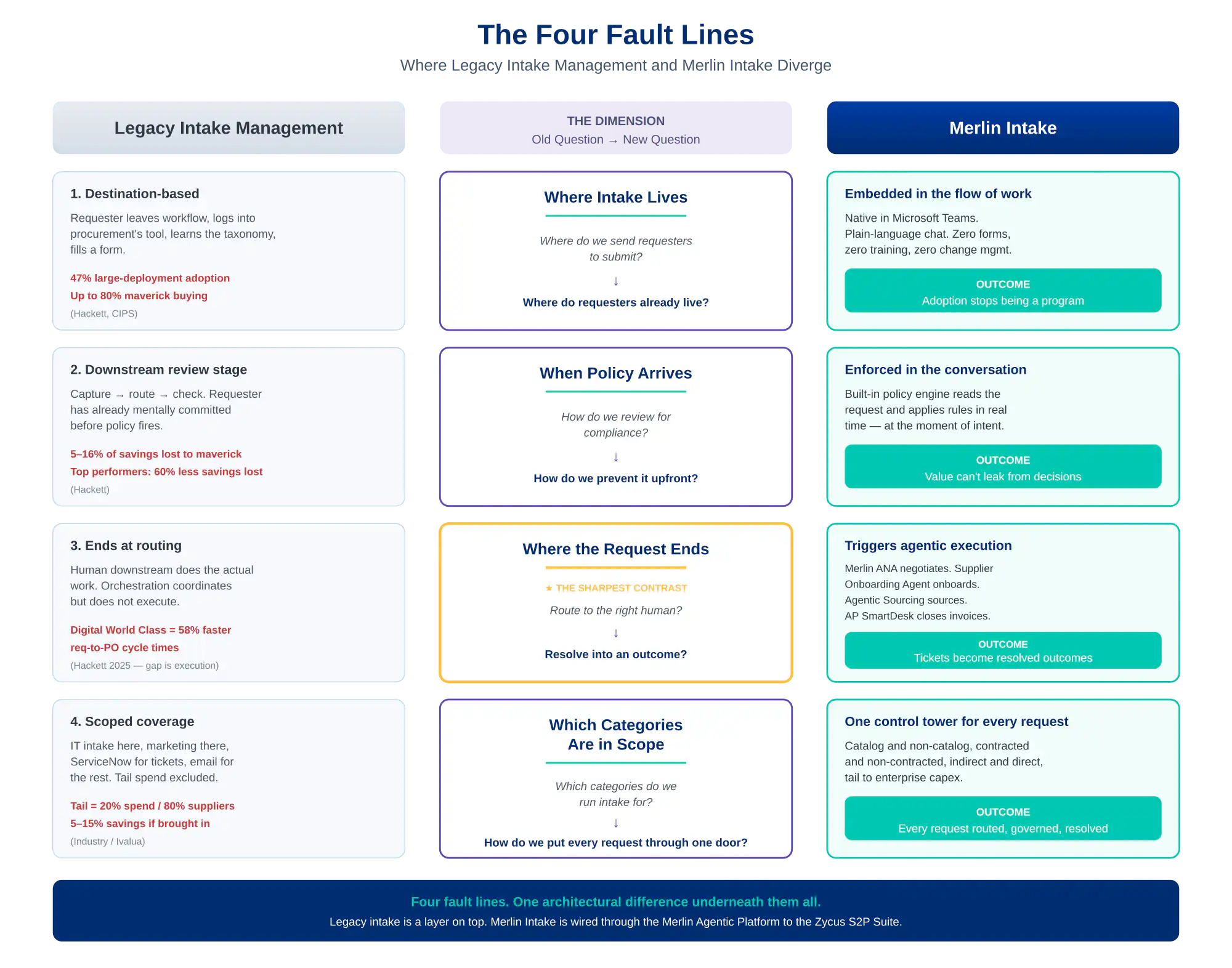
Where the two architectures diverge can be mapped precisely. There are four fault lines.
Figure 1 — The four fault lines where Legacy Intake Management and Merlin Intake diverge
The Four Fault Lines
Fault Line 1: Where intake lives
The old question: where do we send requesters to submit?
The new question: where do requesters already live?
Legacy Intake Management treats intake as a destination. The requester leaves their workflow, logs into procurement’s tool, learns procurement’s taxonomy, and fills out procurement’s form. This is true whether the tool is an email template, a ServiceNow ticket, a suite-bolted intake module, or a first-generation orchestration layer, the architectural premise is the same. The requester must come to procurement. Adoption becomes the silent cost. Hackett’s 2022 Procurement Agenda found that large-scale procurement deployment projects typically achieve 47% adoption, and Hackett and Ivalua research suggests maverick buying can account for up to 80% of all invoices even at enterprises with dedicated procurement teams, both symptoms of the same gravity problem.
Merlin Intake inverts the gravity. It lives natively inside Microsoft Teams, where the requester already works. A plain-language message — “I’d like to place an order for office stationery supplies” — is the entire intake interaction. No portal, no form, no training. Procurement shows up where work already happens.
The outcome difference: Adoption stops being a change-management program and becomes a non-issue.
Fault Line 2: When policy arrives
The old question: how do we review for compliance?
The new question: how do we prevent non-compliance before it happens?
Legacy Intake Management treats policy as a downstream workflow stage. The request is captured first, then routed, then reviewed against contract terms, preferred suppliers, spend thresholds. By the time policy fires, the requester has already mentally committed to the vendor, the price, the path. Procurement becomes the function that says “no” after the fact. The cost shows up in the savings line: Hackett’s 2025 Digital World Class research indicates organizations lose between 5–16% of targeted savings to maverick buying, and top-performing Digital World Class procurement teams show 60% less savings lost largely because they close the upstream governance gap.
Merlin Intake enforces policy inside the conversation itself. A built-in policy engine reads the request as it is made and applies the rules in real time — “since your supplier is contracted, you can proceed with purchase requisition creation.” Governance moves from workflow-stage to conversational-primitive, fired at the moment of intent rather than the moment of review.
The outcome difference: Value cannot leak in a decision that has not yet been made.
Fault Line 3: Where the request ends
The old question: how fast can we route this to the right human?
The new question: how fast can this resolve itself into an outcome?
This is the sharpest of the four fault lines, and the one closest to the agentic era’s actual demand. Legacy Intake Management ends at routing. The request is captured, validated, classified, handed off — and a human downstream does the actual work of negotiating, onboarding, sourcing, matching, paying. Even modern orchestration layers — thin coordination layers over the real systems of record — are structurally bounded at this point. They route faster; they do not resolve.
Merlin Intake does not end. It triggers autonomous execution through the Merlin Agentic Platform. Merlin ANA (Autonomous Negotiation Agent) negotiates the tail-spend purchase. The Autonomous Supplier Onboarding Agent handles the new vendor. Merlin Agentic Sourcing creates the event. AP SmartDesk closes the invoice. Intake is not the end of the requester’s journey — it is the start of the agent’s work. This is the architectural meaning of Intake-to-Outcomes (I2O): a single continuous motion from request to resolution, not a relay of ticket hand-offs.
The outcome difference: Requests stop being tickets and start being resolved outcomes.
Fault Line 4: Which categories are in scope
The old question: which categories do we run intake for?
The new question: how do we put every request through one door?
Legacy Intake Management is scoped by design. IT intake sits in one place, marketing intake in another, ServiceNow absorbs the tickets, email absorbs the rest. Tail spend is almost always excluded because the cost of running a full intake process against a small-value purchase historically exceeded the savings. The consequence is a mosaic of partial coverage — and the mosaic is exactly where spend leaks. Tail spend typically represents 20% of total spend across 80% of suppliers, according to Hackett benchmarks, and bringing it under management can unlock 5–15% in savings, according to Ivalua research — a value pool that legacy architectures were simply not built to reach.
Merlin Intake is one AI-powered control tower for every request — catalog and non-catalog, contracted and non-contracted, indirect and direct, tail spend to enterprise capex. A supplier recommendation step runs before the user can volunteer a vendor of their own, steering intent toward preferred suppliers at the moment of decision. The mosaic collapses into a single front door.
The outcome difference: Every request routed, governed, and resolved.
What is the Architectural Difference?
The four fault lines are not four unrelated gaps. There are four symptoms of a single architectural choice.
Legacy Intake Management — across the full spectrum from email to first-generation orchestration — was built as a layer on top. It coordinates, it routes, it captures. It does not own the execution underneath. That is not a feature gap that a product release can close; it is an architectural premise. An intake layer that does not own the S2P suite beneath it cannot dissolve any of the four fault lines, no matter how much AI is layered onto it.
Figure 2 — Legacy intake sits on top. Merlin Intake is wired through the Merlin Agentic Platform to the Zycus S2P Suite.
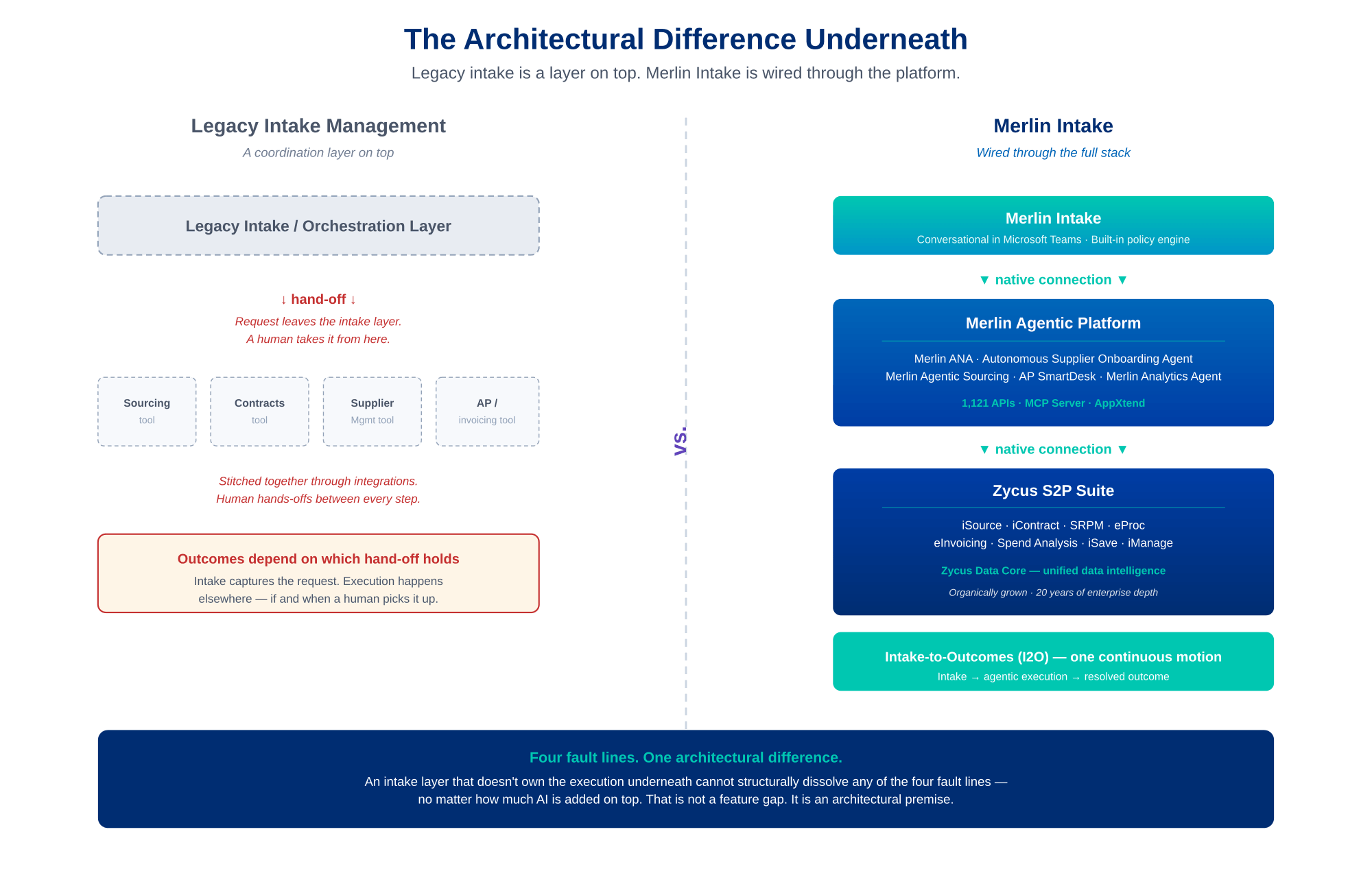
Merlin Intake is built on the Merlin Agentic Platform, connected through 1,121 APIs and the MCP Server to the full Zycus S2P Suite — Sourcing, Contracts, Supplier Risk and Performance Management, eProcurement, eInvoicing, Spend Analysis, and the Zycus Data Core. Intake, agentic AI, and the S2P foundation work as one architecture. Miss one layer, and outcomes fail.
This is what Intake-to-Outcomes actually means. Not a marketing frame. An architectural requirement.
What does agentic AI intake deliver in practice?
The shift from legacy intake to agentic AI-powered intake is not yet abstract. Across Merlin Intake deployments today, more than 1,000 regular users and 4,500 suppliers and partners across deployments now run their procurement intake on this architecture. The pattern in aggregate Zycus customer benchmarks is consistent: +40% NPS growth where Merlin Intake is deployed, +20% improvement in spend under management, and +2–3% tail savings when Merlin ANA and Merlin Intake operate together, with AppXtend giving enterprises the flexibility to extend the platform into whatever adjacent systems their stack already runs.
Figure 3 — Aggregate outcomes across Merlin Intake deployments, mapped to the fault lines they close
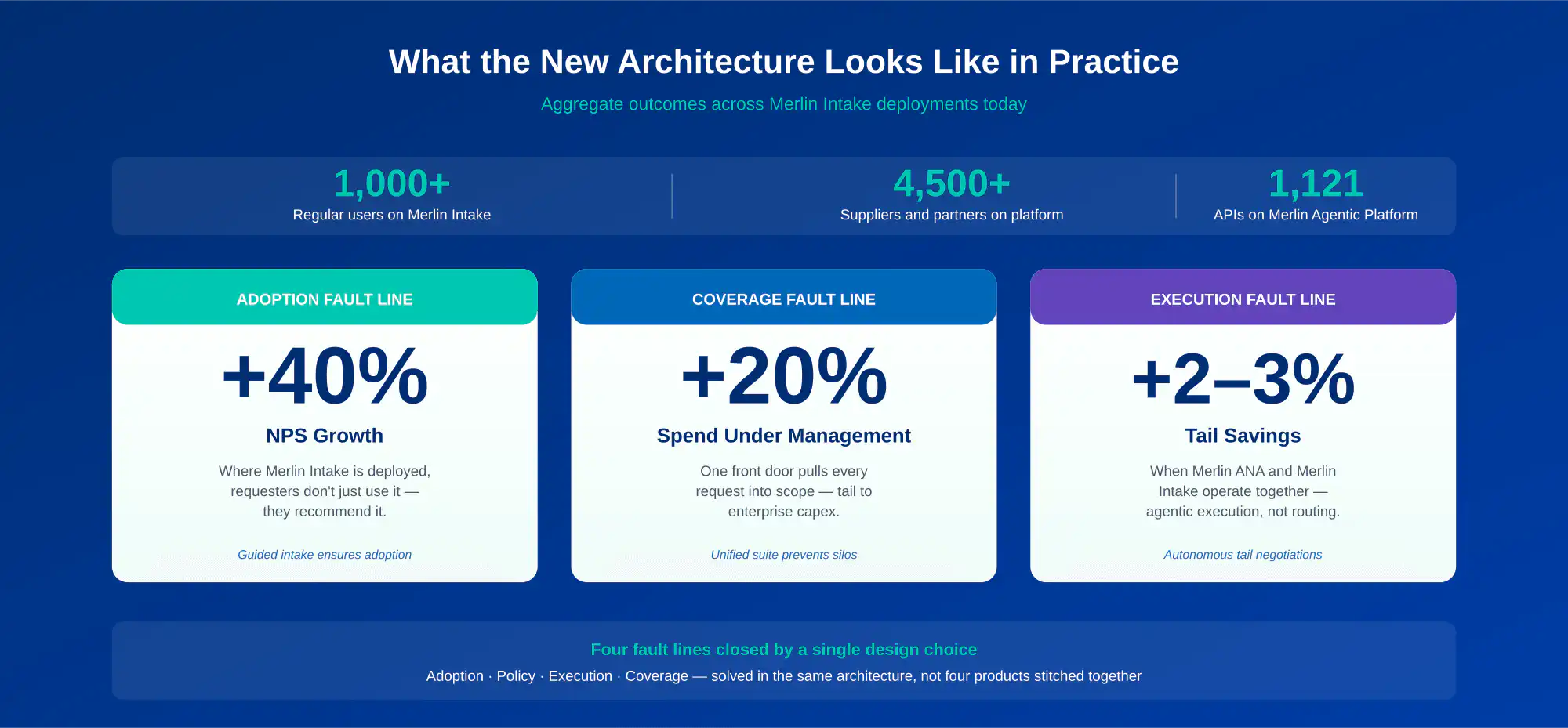
These are not isolated feature wins. They are what outcomes look like when adoption, policy, execution, and coverage are solved in the same architecture — four fault lines closed by a single design choice rather than four separate products stitched together.
What should the CPO choose?
The CPO evaluating intake today is not choosing between vendors. They are choosing between architectures — between a system built to answer the old question of capture and a system built to answer the new question of outcomes.
FAQs
Q1. What is agentic intake?
Agentic intake is an AI-powered procurement intake system that does not just capture and route requests — it resolves them. Instead of handing off a ticket to a human, an agentic intake system triggers autonomous execution: negotiation, supplier onboarding, sourcing events, and invoice matching — all within defined policy guardrails.
Q2. How is Merlin Intake different from a ServiceNow intake?
ServiceNow and similar ITSM tools capture and route procurement requests through ticket workflows. Merlin Intake lives natively inside Microsoft Teams, enforces policy at the moment of intent, and triggers agentic AI execution through the Merlin Agentic Platform — turning requests into resolved outcomes rather than routed tickets.
Q3. What does Intake-to-Outcomes mean?
Intake-to-Outcomes (I2O) is an architectural framework where a procurement request flows continuously from intake through sourcing, contracting, purchasing, invoicing, and payment — with agentic AI handling execution at every stage. It replaces the traditional relay of hand-offs between disconnected systems with a single connected motion from request to resolution.
Q4.What is the Merlin Agentic Platform?
The Merlin Agentic Platform is Zycus’s AI execution layer. It connects Merlin Intake to the full S2P Suite through 1,121 APIs and the MCP Server, enabling autonomous agents — including Merlin ANA (Autonomous Negotiation Agent), Merlin Agentic Sourcing, and AP SmartDesk — to act on procurement requests without manual intervention.
Both architectures have their place in the recent history of procurement. One of them has its place in its future.
Related Reads:
- Solution: Zycus Intake vs. Legacy Intake Systems
- RPA, Intelligent Automation and Agentic AI: Navigating the Automation Revolution
- How Agentic AI Actually Works in Procurement (Under the Hood)
- Agentic AI in Sourcing: What’s Real vs Hype
- Agentic AI for IT Spend: Revolutionizing Service Category Classification
- eBook: Intelligent Intake Management – From Bolt-on to Built-in: The Key to Faster, Smarter Decision-Making