

The strategic playbook for finance leaders who want to stop managing cash in the dark — and start connecting procurement, accounts payable, and treasury into one intelligent system.
TL;DR
- A treasury management system (TMS) is software that manages cash positions, forecasts liquidity, automates payments, and optimizes working capital — and the market is growing at 8–16% CAGR through 2030.
- Most organizations run treasury, procurement, and AP as disconnected functions — creating cash blind spots, missed early-payment discounts, and inaccurate forecasts.
- Connecting these three functions in real time can improve cash forecast accuracy from 60–70% to 85–95% and release $2M–$10M in trapped working capital annually.
- When evaluating treasury management system providers, prioritize procurement integration depth, AP connectivity, AI-powered forecasting, and bank connectivity over standalone feature checklists.
- Zycus’s Merlin AI platform embeds treasury-relevant intelligence across its Source-to-Pay suite — linking intake, AP automation, analytics, and autonomous negotiation to give treasury teams real-time visibility into committed spend and payables.
- Industry leaders like PwC, McKinsey, and Deloitte all point to the same conclusion: the future of treasury is API-driven, AI-powered, and deeply integrated with procurement workflows.
Ask any CFO what keeps them up at night, and the answer rarely surprises: “I need to know where our cash is — right now, not three days from now.”
According to the PwC 2025 Global Treasury Survey, most organizations now have a treasury management system in place, yet few fully realize its potential. The gap is not in technology. It is in how treasury, procurement, and accounts payable continue to operate as disconnected functions — each with its own tools, data, and blind spots.
Research Report: Show Them the Money: Building the AP Automation Business Case
The result? Cash forecasts are built on incomplete data. Working capital trapped in payment cycles nobody is optimizing. Discount opportunities expiring before anyone notices. This is changing. Forward-thinking organizations are converging procurement, AP, and treasury onto platforms that share data in real time — and the impact on cash visibility and working capital management is profound.
What are Treasury Management Systems?
A treasury management system (TMS) is specialized software that helps organizations manage cash positions, forecast liquidity, process payments, mitigate financial risk, and optimize investments. Unlike general ERP modules, a dedicated TMS is purpose-built for modern corporate finance complexity. According to Gartner’s research on source-to-pay suites, the line between procurement platforms and treasury tools is blurring rapidly as enterprises demand unified, end-to-end financial solutions.
| Core TMS Function | What It Does | Why It Matters |
| Cash Position Reporting | Aggregates balances across all bank accounts and entities in real time | Eliminates the morning scramble across multiple bank portals |
| Cash Forecasting | Projects future inflows and outflows using historical and AI-driven models | Enables proactive liquidity planning |
| Payment Processing | Centralizes and automates outgoing payments across channels | Reduces fraud risk, manual errors, and banking fees |
| Risk Management | Monitors FX exposure, interest rate risk, and counterparty risk | Protects margins in volatile markets |
| Working Capital Optimization | Analyzes payment timing, discount terms, and borrowing needs | Frees up trapped cash |
| Bank Connectivity | Integrates with banks via SWIFT, APIs, and host-to-host connections | Creates a single source of truth for all transactions |
The global TMS market is projected to grow at a CAGR of 8–16% through 2030, driven by real-time payment adoption, open banking APIs, and the convergence of treasury with procurement and AP workflows.
Why Do Procurement, AP, and Treasury Need to Be Connected?
Here is the reality most organizations live with: procurement commits spend in a sourcing platform. That commitment does not reach treasury until weeks later, when AP processes the invoice and schedules payment. By then, the money is already gone.
This disconnect creates three costly problems.
Inaccurate cash forecasts: Treasury cannot predict cash needs when it has no visibility into committed spend. The Association for Financial Professionals (AFP) identified cash management and forecasting as the top priority for treasury professionals in 2025 — yet most organizations still work with delayed, incomplete data.
Missed working capital opportunities: When AP processes invoices without treasury input on optimal payment timing, organizations either pay too early (surrendering deployable cash) or too late (missing discounts worth 1–3% of invoice value). McKinsey’s research on working capital shows that companies routinely unlock tens or even hundreds of millions of dollars by optimizing payment timing alone. Effective working capital management requires AP and treasury to coordinate in real time.
Increased fraud and compliance risk: Siloed systems create gaps where duplicate invoices, unauthorized payments, and policy violations slip through undetected. The AFP 2025 Payments Fraud Survey found that 79% of organizations were victims of attempted or actual payments fraud activity in 2024.
How Do Treasury Management Systems Connect Procurement and AP?
The most effective treasury management systems are not standalone tools — they are platforms integrating tightly with procurement and AP to create continuous data flow from purchase request to payment execution.
From purchase requisition to cash forecast: When a procurement request is approved, committed spend immediately feeds into the treasury forecast — no waiting for invoices, no manual data entry.
From invoice processing to payment optimization: As AP validates invoices, the system evaluates each payment against treasury’s liquidity position and available discount terms automatically. Forrester’s research on AP invoice automation confirms that agentic AI is now enabling autonomous exception handling, fraud detection, and payment optimization across AP workflows.
From contract terms to risk management: Payment terms, penalty clauses, and currency requirements from procurement contracts feed directly into treasury’s risk models in real time.
This integration model aligns with what PwC’s treasury survey calls “connected cash” — where real-time access to cash, exposure, and forecast data is a necessity, not a luxury. The survey found that 65% of organizations plan to expand API use in the coming years to enable exactly this kind of real-time integration across ERPs, TMS platforms, and banking networks.
How to Choose a Treasury Management System Provider
Not all treasury management system providers deliver the integration depth needed for true convergence. Here is a practical evaluation framework:
| Evaluation Criteria | Questions to Ask | Why It Matters |
| Procurement Integration | Does the TMS receive real-time data from sourcing and requisition systems? | Early spend visibility drives forecast accuracy |
| AP Connectivity | Can it coordinate payment timing with live cash positions? | Enables dynamic payment optimization |
| AI-Powered Forecasting | Does the platform improve forecast accuracy over time? | AI-driven forecasts are 25–35% more accurate than spreadsheets |
| Bank Connectivity | How many banks and payment channels does it support? | Multi-bank visibility is the foundation of cash visibility |
| ERP Integration | Does it connect without custom middleware? | Reduces implementation complexity |
| Implementation Speed | How fast can you achieve basic cash visibility? | Some deliver in 90 days; others take 12–18 months |
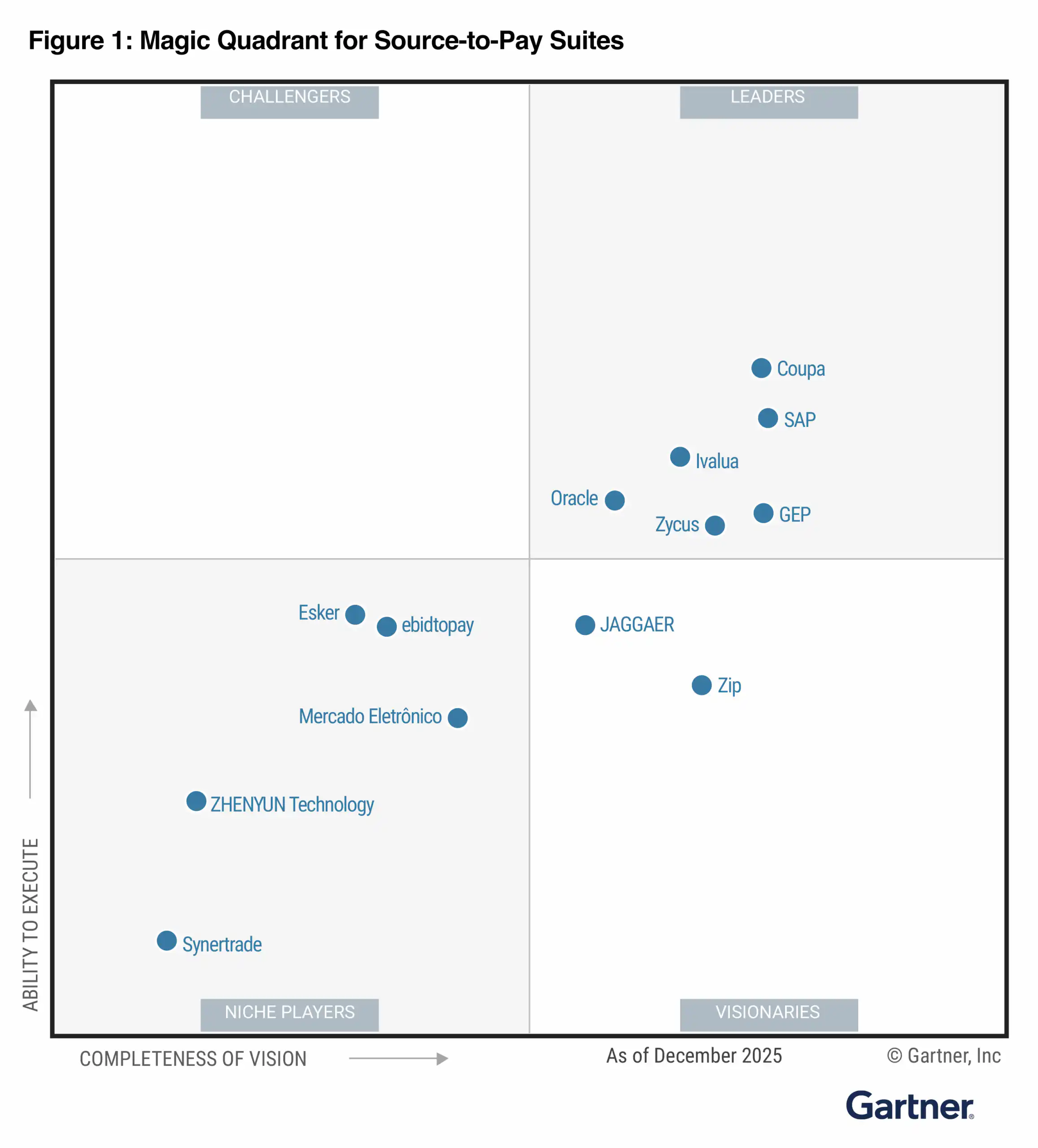
The market includes dedicated TMS providers and source-to-pay platforms that embed treasury-relevant functionality within broader procurement workflows. Gartner’s 2025 Magic Quadrant for Source-to-Pay Suites evaluates these vendors across their ability to execute and completeness of vision, while Deloitte’s treasury transformation practice recommends evaluating cloud-based, modular architectures that integrate with existing ERPs without custom middleware.
How Zycus Connects Procurement, AP, and Cash Visibility
Zycus takes a distinctive approach. Rather than building a standalone TMS, Zycus embeds treasury-relevant intelligence across its AI-powered Source-to-Pay platform — ensuring procurement and AP data feeds directly into financial decisions.
- Merlin AP Agent automates the invoice-to-pay cycle with AI-driven validation, multi-way matching, duplicate detection, and anomaly flagging — giving finance teams real-time payables visibility for accurate cash forecasting.
- Merlin Intake Agent captures procurement demand at the point of request, making committed spend visible to treasury the moment it is approved — not weeks later.
- Merlin Analytics Agent delivers on-demand insights into spend patterns, payment terms, and working capital metrics, unifying procurement and treasury views.
- Merlin Autonomous Negotiation Agent (ANA) optimizes payment terms and pricing at scale through autonomous tail-spend negotiation, directly improving working capital management.
Recognized as a Leader in the 2026 Gartner Magic Quadrant for Source-to-Pay Suites and a Leader in the IDC MarketScape for AI-Enabled Source-to-Pay, Zycus bridges the gap between procurement execution and treasury planning.
What Results Does Treasury and Procurement Integration Deliver?
| Performance Metric | Before Integration | After Integration | Improvement |
| Cash forecast accuracy | 60–70% | 85–95% | +20–30 points |
| Invoice processing cycle | 10–15 days | 2–4 days | 70–80% faster |
| Early payment discount capture | 15–25% | 55–75% | 3x increase |
| Maverick spend | 25–40% | Below 10% | 60–75% reduction |
| Working capital released | Baseline | +$2M–$10M annually | Significant |
| Payment fraud incidents | Reactive | AI-based proactive detection | 40–60% fewer |
What is the Future of Treasury Management Systems?
API-driven ecosystems will eliminate friction between financial tools. Treasury will be embedded directly into procurement platforms through real-time APIs — a trend PwC’s survey identifies as the foundation of modern treasury technology.
AI will shift from descriptive to prescriptive — automatically adjusting payment timing, triggering dynamic discounting, and rebalancing liquidity without human intervention. McKinsey’s analysis of working capital transformation confirms that AI-powered process mining and predictive analytics are already delivering real-time insights into cash positions and forecasting future cash flows.
Deloitte’s emerging trends report on corporate treasury identifies TMS platforms, AI, and API connectivity as the three pillars transforming treasury from a back-office function into a strategic advisory partner to the CFO. With most forward-looking organizations now investing in hyper-automation, real-time cash visibility is moving from aspiration to expectation.
Ready to give your treasury team the visibility they need? Book a demo with Zycus and see how the Merlin AI platform connects procurement and AP to the cash decisions driving your business forward.
FAQs
Q1. What is a treasury management system?
A TMS is software that manages cash positions, forecasts liquidity, automates payments, mitigates financial risk, and optimizes working capital. Modern systems integrate with procurement and AP platforms for end-to-end financial visibility.
Q2. How do treasury management systems improve cash visibility?
They aggregate data from bank accounts, ERPs, AP/AR platforms, and procurement tools into a single dashboard — providing a real-time, consolidated view of all cash positions across entities and currencies.
Q3. What is the role of accounts payable in working capital management?
AP controls the timing of cash outflows. Optimizing when invoices are paid — capturing discounts when beneficial, extending terms when liquidity is needed — makes AP a strategic lever for working capital management.
Q4. Who are the leading treasury management system providers?
The market includes dedicated TMS providers and integrated source-to-pay platforms like Zycus. Gartner’s Magic Quadrant for Source-to-Pay Suites and Forrester’s AP Invoice Automation Landscape provide independent evaluations of leading vendors across these converging categories.
Q5. Why is procurement integration important for treasury?
Procurement commitments represent future cash outflows. Without early visibility into approved spend, treasury forecasts are based on incomplete data — leading to inaccurate projections and missed optimization opportunities.
Q6. Can mid-market companies benefit from treasury management systems?
Yes. Cloud-based, modular solutions make TMS technology accessible beyond large enterprises. Mid-market companies often see the fastest ROI by replacing spreadsheet processes with AI-driven forecasting.
Q7. How does Zycus bridge the gap between procurement, AP, and treasury?
Zycus’s Merlin AI platform connects intake, sourcing, contracts, AP automation, and analytics into a unified Source-to-Pay workflow — ensuring procurement commitments and payables data reach finance and treasury teams in real time for smarter cash decisions.
Related Reads:
- Procurement Forecasting for Emerging Enterprises: Using Machine Learning to Anticipate Costs
- Treasury Wine Estates’ Journey to Source-to-Pay Excellence
- Why We Love AP Automation Services (And You Should, Too!)
- Solution: AP Automation: End-to-End Accounts Payable Software
- 8 Signs Your Business Needs Automated AP Systems
- Leveraging Accounts Payable Automation to Stay Ahead in a Competitive Market