








TL;DR
- Every supply chain model is being forced to evolve: the linear, sequential chain that dominated for decades cannot absorb today’s frequency and severity of disruption. The future is an intelligent, AI-powered network.
- Only 6% of companies report full end-to-end supply chain visibility (GEODIS), yet 93% of senior executives plan to make their networks markedly more flexible, agile, and resilient (McKinsey).
- A digital supply chain is now operational reality, not aspiration — 62% of organizations are already experimenting with agentic AI for supply chain operations, and 70% report advanced AI adoption (McKinsey, Prologis 2025).
- Building a resilient supply chain means engineering adaptability into the network architecture itself: modular design, multi-source optionality, predictive risk intelligence, and autonomous response capabilities.
- The shift from “predictive” to “prescriptive orchestration” defines 2026: AI-powered control towers now integrate procurement, manufacturing, and logistics into unified decision engines that act, not just alert.
- Zycus Merlin AI powers this transformation by embedding intelligent orchestration across the source-to-pay lifecycle — from predictive sourcing and autonomous contract management to continuous supplier risk monitoring and real-time spend intelligence.
Why is the Traditional Supply Chain Model No Longer Viable?
The supply chain model that built the modern global economy was brilliantly simple: a linear sequence of handoffs from raw material to finished product, optimized for cost efficiency. Procurement bought, manufacturers made, logistics moved, and customers received. Each link in the chain knew its upstream supplier and downstream customer, and that was enough.
That model was designed for a stable world. We no longer live in one.
Read more: Top 7 Supply Chain Management Trends To watch in 2026 and beyond
Between 2020 and 2026, supply chain leaders have confronted a pandemic, semiconductor crises, the Suez Canal blockage, Red Sea shipping reroutes, a 97% threat-level rating for geopolitical trade fragmentation (Everstream Analytics 2026), and tariff volatility that can change landed costs overnight. McKinsey’s data shows that disruptions lasting more than a month now strike every 3.7 years on average, costing companies up to 45% of a year’s profit over a decade. Supply Chain Dive puts the daily cost of a major disruption at approximately $1.5 million.
The linear supply chain model fails under these conditions for three structural reasons:
- Visibility deficit: Only 6% of companies have full end-to-end supply chain visibility (GEODIS). Most cannot see beyond their tier-one suppliers, leaving them blind to cascading risks originating deeper in the network.
- Decision latency: 95% of supply chains must react quickly to change, but only 7% can execute decisions in real time (Gartner). The gap between sensing a disruption and acting on it is where value is destroyed.
- Structural fragility: Linear chains have single paths. When one node fails — a port, a supplier, a logistics corridor — there is no built-in alternative. The chain does not reroute; it stalls.
This is why the world’s most advanced supply chain organizations are abandoning the chain metaphor altogether. They are building intelligent networks.
What does the Evolution of Supply Chain Models Look Like?
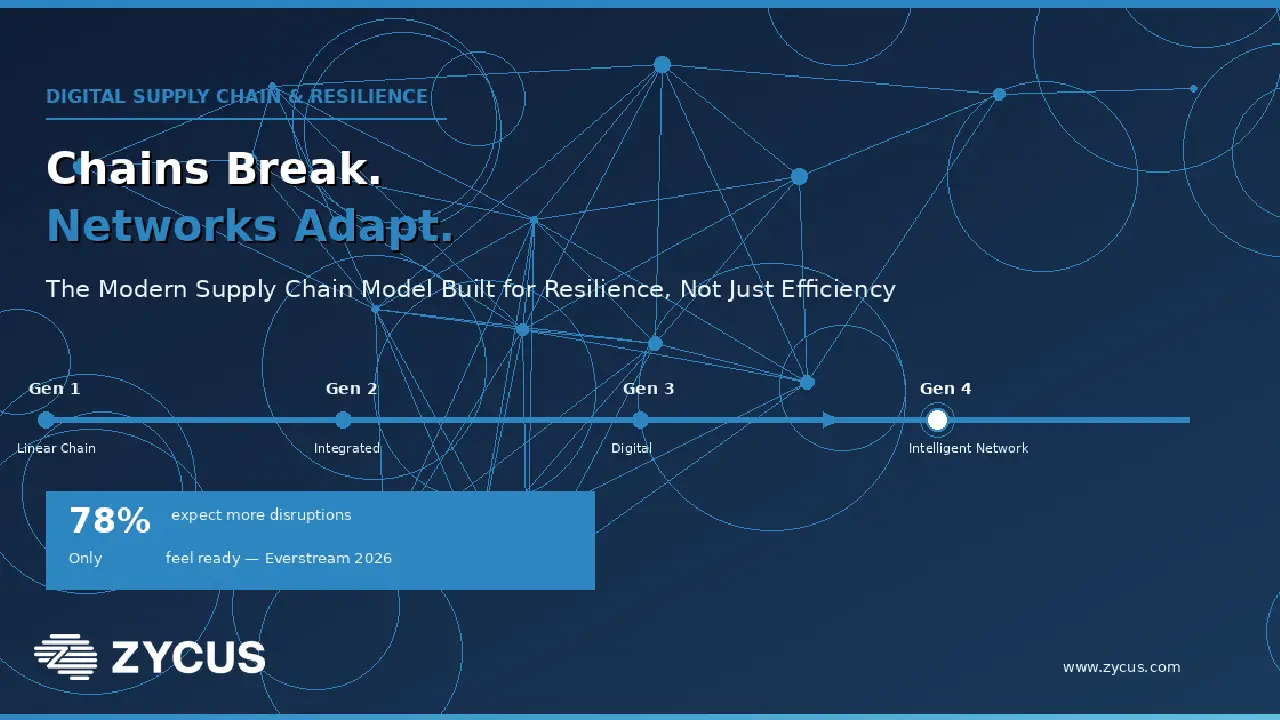
Understanding where your organization sits in the supply chain model evolution is the first step toward knowing where it needs to go. The progression unfolds across four distinct generations:
| Generation | Supply Chain Model | Core Architecture | Critical Limitation |
| Gen 1 (Pre-2000) | Linear Chain | Sequential handoffs; batch planning; paper-based; single-source sourcing | Zero real-time visibility; weeks-long response cycles; total dependency on stable conditions |
| Gen 2 (2000–2015) | Integrated Chain | ERP backbone; centralized planning; demand forecasting; lean/JIT principles | Still sequential; forecast-dependent; limited to tier-one visibility; brittle under shock |
| Gen 3 (2015–2023) | Digital Supply Chain | Cloud platforms; IoT sensors; control towers; advanced analytics; API ecosystems | Better visibility but decisions remain human-paced; reactive to disruption, not predictive |
| Gen 4 (2024+) | Intelligent Network | AI-native; agentic automation; multi-directional data flow; digital twins; predictive orchestration; self-correcting | Requires data maturity, organizational redesign, and AI governance at enterprise scale |
Most enterprises today operate between Gen 2 and Gen 3. They have invested in ERP systems and cloud platforms, but their decision-making still depends on human interpretation of dashboards and manual intervention during disruptions. The competitive frontier — Gen 4 — is where AI makes the network intelligent enough to sense, decide, and act on its own within governed parameters.
What Defines a Digital Supply Chain in 2026?
The term digital supply chain has been used loosely for a decade. In 2026, it has a precise meaning. A digital supply chain is not simply a traditional supply chain with digital tools bolted on. It is a fundamentally different operating model where data, AI, and connected platforms replace manual processes, siloed systems, and sequential decision-making.
Six capabilities define a digital supply chain in 2026:
- Real-time, multi-tier visibility: Not just tracking shipments, but continuously monitoring supplier financial health, production capacity, geopolitical exposure, ESG performance, and logistics status across all tiers. Gartner finds that 83% of companies now place customer-experience enhancement at the center of their digital supply chain strategy.
- Predictive and prescriptive analytics: AI-powered forecasting cuts supply chain errors by 30–50% (McKinsey). But 2026’s leaders are moving beyond prediction to prescription — systems that recommend specific actions, not just flag risks.
- Agentic AI execution: 62% of organizations are already experimenting with agentic AI that autonomously reroutes shipments, triggers alternative sourcing, adjusts inventory positions, and resolves exceptions without human intervention (McKinsey/Infor 2026). BCG reports agentic systems accounted for 17% of total AI value in 2025, projected to reach 29% by 2028.
- Digital twin simulation: 86% of manufacturing executives say digital twins are applicable to their organization, with 44% already implemented (McKinsey). These virtual replicas enable stress-testing against tariff changes, port closures, supplier failures, and demand spikes before they hit.
- Connected ecosystem collaboration: Suppliers, logistics partners, and customers operating on shared platforms where data flows in all directions simultaneously. This is the network architecture that replaces the chain.
- Embedded governance and compliance: Regulatory monitoring, ESG tracking, Scope 3 emissions measurement, and supplier risk scoring integrated into every procurement transaction — not managed as a separate workstream.
Zycus Merlin AI delivers these capabilities across the source-to-pay lifecycle. The Sourcing Agent optimizes supplier selection against cost and risk simultaneously. The Contract Agent ensures compliance obligations are embedded and tracked. The ANA Agent provides real-time spend and risk intelligence dashboards. The Intake Agent governs demand from the moment a purchase request is created. Together, they form the intelligence layer that transforms a digital supply chain from connected to truly intelligent.
Download Whitepaper: Supply Chain Resilience in the Face of Disruption
How do You Build a Resilient Supply Chain That Absorbs Disruption?
Resilience is not a technology purchase. It is a design principle built into the architecture of the supply chain model itself.
McKinsey reports that 93% of senior supply chain executives plan to make their networks more flexible, agile, and resilient. But intention and execution are far apart. The organizations that have actually built a resilient supply chain share five architectural patterns:
Pattern 1: Multi-source network design: Resilient supply chains maintain qualified alternative suppliers across geographies and tiers. The goal is not just dual sourcing for tier-one materials, but visibility and optionality deep into the supply network. In 2025, 86% of companies worked to de-risk their supply chains through diversification.
Pattern 2: Continuous predictive risk intelligence: Replacing annual supplier assessments with AI-driven, always-on risk monitoring. Zycus Merlin AI continuously scans financial signals, geopolitical indicators, news sentiment, ESG data, and operational metrics to generate real-time supplier risk scores that feed directly into sourcing decisions.
Pattern 3: Scenario simulation as a core process. Gartner research finds that organizations lacking scenario-based stress testing endure recovery times up to 30% longer after a major disruption. Leading companies run quarterly “resilience rehearsals” using digital twins — simulating tariff changes, port closures, and supplier bankruptcies before they happen.
Pattern 4: Modular, reconfigurable architecture: Building supply chains with standardized components, interchangeable suppliers, and flexible logistics routing that can shift based on cost, risk, or customer priorities. In 2026, companies are engineering modular networks that reconfigure rather than break under pressure.
Pattern 5: Embedded governance across the S2P lifecycle: Compliance, risk, sustainability, and regulatory checks are not a layer on top of procurement — they are woven into every transaction. Zycus’s unified platform enforces this by design, from sourcing through payment.
How Mature is your Resilient Supply Chain?
| Maturity Level | Visibility & Data | Risk Response | Network Architecture |
| Level 1: Reactive | Tier-one only; manual collection; quarterly reporting; siloed systems | Crisis mode after disruption; no early warning; recovery takes weeks | Concentrated suppliers; fixed routes; single logistics paths |
| Level 2: Aware | Multi-tier mapping begun; basic dashboards; some API connectivity | Risk registers maintained; annual assessments; ad-hoc scenario planning | Dual sourcing for critical items; some regional diversification |
| Level 3: Predictive | Real-time data across tiers; AI analytics active; control tower operational | Continuous risk monitoring; predictive alerts; automated escalation protocols | Multi-sourced network; flexible logistics; modular contracts |
| Level 4: Autonomous | Digital twin of full network; self-updating intelligence; prescriptive analytics | Agentic AI auto-reroutes, rebalances, and mitigates without human intervention | Self-configuring network adapting to cost, risk, demand, and regulation in real time |
Most organizations sit between Level 1 and Level 2. Reaching Level 3 requires a digital supply chain platform with embedded AI. Reaching Level 4 requires what KPMG calls “Connected Intelligence” — enterprise-wide AI linking supply chain with procurement, finance, ESG, and logistics into a single autonomous decision layer.
What Technologies Power the Transition to Intelligent Networks?
The shift from a linear supply chain model to an intelligent network is enabled by an integrated technology stack. No single tool creates the transformation — it requires layers working together:
| Technology Layer | Role in the Network | Zycus Capability |
| AI & Machine Learning | Predictive analytics, anomaly detection, demand forecasting, autonomous decision-making | Merlin AI embedded across Sourcing, Contract, ANA, and Intake Agents |
| Agentic Automation | Multi-step autonomous workflows: sourcing execution, compliance validation, risk response | Autonomous S2P workflows from intake to payment with governed AI agents |
| Cloud-Native Platforms | Scalable infrastructure connecting all supply chain participants in real time | Unified cloud-based S2P platform with real-time integration layer |
| Digital Twins | Virtual supply chain replicas for scenario simulation, stress testing, and optimization | Spend and risk modeling for tariff, demand, and disruption what-if analysis |
| IoT & Sensor Networks | Real-time tracking of shipments, warehouse conditions, production line status | Integration with IoT feeds for supplier and logistics performance monitoring |
| Advanced Analytics & BI | Real-time dashboards, KPI/KRI tracking, executive decision support | ANA Agent: always-on procurement intelligence with autonomous insights |
The critical principle: these technologies must operate as an integrated platform, not as disconnected point solutions. A digital supply chain built on fragmented tools creates its own fragility — data silos, integration overhead, conflicting analytics. Zycus’s unified source-to-pay platform eliminates these seams, providing a single data and decision layer from sourcing through settlement.
How does Procurement’s Role Transform in an Intelligent Network?
In the old supply chain model, procurement occupied a narrow lane: negotiate prices, issue purchase orders, process invoices. In an intelligent network, procurement becomes the strategic nerve center — the function with the broadest data reach and the deepest impact on resilience, cost, risk, and sustainability.
The transformation unfolds across four dimensions:
- From cost center to value orchestrator: Procurement shifts from minimizing unit costs to optimizing total value across the network — balancing cost, risk, resilience, sustainability, and speed-to-market simultaneously.
- From reactive buyer to predictive strategist: AI-powered analytics give procurement leaders forward-looking intelligence on demand shifts, supplier vulnerabilities, market dynamics, and regulatory changes. Gartner predicts that 20% of procurement roles will be entirely new AI-driven positions by 2030.
- From siloed function to connected hub: In an intelligent network, procurement data flows directly into finance, operations, sustainability, logistics, and compliance. Zycus’s platform serves as this integration backbone, breaking the silos that cripple traditional supply chain models.
- From manual executor to AI orchestrator: With nearly 28% of procurement time automatable through AI (Gartner 2026), professionals shift from transactional processing to governing AI-driven workflows, interpreting insights, and making strategic judgments that technology cannot.
ASCM’s 2026 Top 10 Supply Chain Trends report captures this evolution: supply chains have moved from building digital foundations (2024) to executing intelligent, value-driven operations (2026). Procurement sits at the center of that shift.
Download Whitepaper: How prepared are you to combat your supply chain risks?
What Should Supply Chain Leaders Prioritize to Make the Transition?
If your organization still operates a linear or early-digital supply chain model, here is a practical transition roadmap:
- Audit your current model with honesty: Where do you sit on the generational maturity table? Most organizations overestimate their digital supply chain maturity. Measure data quality, visibility depth, decision speed, and risk response capability objectively.
- Fix your data before investing in AI: McKinsey finds that only 53% of supply chain leaders rate their master data quality as adequate. AI on bad data produces confident wrong answers. Start by cleaning spend data, completing supplier records, and consolidating contract repositories.
- Deploy AI at decision points, not just dashboards: Start where intelligence directly accelerates action — supplier risk scoring, sourcing recommendations, compliance gap detection, spend anomaly alerts. Zycus Merlin AI is purpose-built for these operational decision points.
- Engineer for flexibility, not just efficiency: Lean supply chains optimized for stable conditions break under volatility. Build multi-source supplier networks, flexible logistics options, and modular contracts that allow rapid reconfiguration when conditions shift.
- Unify procurement with the broader supply chain: Break the walls between procurement, logistics, finance, and sustainability. Deploy a unified platform like Zycus that creates a single data, intelligence, and governance layer across the entire source-to-pay lifecycle.
- Track network health metrics, not just transaction costs: Measure mean time to detect and respond to disruptions, supplier diversification indices, forecast accuracy improvement, percentage of autonomous decisions, and risk-adjusted total cost of ownership.
Quick-Reference: From Chains to Networks Transformation Roadmap
| Phase | Action | Outcome |
| 1 | Audit current supply chain model maturity and data readiness | Objective baseline of capabilities, gaps, and investment priorities |
| 2 | Clean, connect, and classify master data across S2P | AI-ready data foundation for intelligent decision-making |
| 3 | Deploy Merlin AI at operational decision points (risk, sourcing, compliance) | Faster, data-driven procurement decisions with measurable accuracy gains |
| 4 | Build a multi-source, modular, geographically diversified supplier network | Structural resilience eliminating single-point-of-failure dependencies |
| 5 | Unify procurement with logistics, finance, ESG, and compliance on one platform | Connected Intelligence across the enterprise — KPMG’s Level 4 maturity |
| 6 | Implement network health KPIs and continuous resilience rehearsals | Measurable, sustained progress from linear chain to intelligent network |
FAQs
Q1. What is a supply chain model and why does it matter?
A supply chain model defines how materials, information, and decisions flow through an organization’s sourcing, production, and distribution network. The model you operate determines your resilience, speed, cost structure, and ability to respond to disruption. In 2026, organizations using linear models face structural disadvantages against competitors operating intelligent, AI-powered networks capable of sensing, predicting, and self-correcting in real time.
Q2. What is the difference between a digital supply chain and a traditional one?
A traditional supply chain relies on sequential handoffs, manual decision-making, and siloed systems with limited visibility. A digital supply chain replaces these with connected platforms, real-time multi-tier visibility, AI-powered predictive analytics, agentic automation, and embedded compliance governance. The key differentiator in 2026 is not digitization of old processes but the creation of an entirely new intelligence layer — one that platforms like Zycus Merlin AI provide across the source-to-pay lifecycle.
Q3. What makes a resilient supply chain different from a flexible one?
Flexibility is the ability to adjust. Resilience is the ability to anticipate, absorb, adapt, and recover. A flexible supply chain can change plans when disruption hits. A resilient supply chain detects disruption signals before impact, has pre-qualified alternatives ready, reroutes autonomously through AI, and emerges with minimal value loss. Resilience requires architectural design — multi-sourcing, modular networks, predictive intelligence, and embedded governance — not just operational agility.
Q4. What role does AI play in modern supply chain models?
AI is the enabling technology that makes the transition from linear chains to intelligent networks possible. It powers predictive demand forecasting (reducing errors by 30–50% per McKinsey), autonomous supplier risk monitoring, intelligent sourcing recommendations, automated compliance tracking, and real-time spend analytics. In 2026, 62% of organizations are experimenting with agentic AI that executes multi-step supply chain tasks autonomously within governed parameters.
Q5. What is “Connected Intelligence” in the supply chain?
Connected Intelligence, as defined in KPMG’s 2026 supply chain outlook, represents the most mature stage of digital supply chain evolution. It describes an enterprise-wide AI ecosystem linking supply chain operations with procurement, finance, ESG, HR, and CRM into a single autonomous intelligence layer. Organizations that achieve Connected Intelligence make coordinated, data-driven decisions across all functions simultaneously, replacing functional silos with unified orchestration.
Q6. How do digital twins improve supply chain resilience?
Digital twins create virtual replicas of the entire supply chain network, allowing leaders to stress-test scenarios before they occur in reality: port closures, tariff changes, supplier bankruptcies, demand spikes, climate disruptions. McKinsey reports that 86% of manufacturing executives consider digital twins applicable to their organization. Early adopters report 20–30% gains in forecast accuracy, 50–80% reductions in delays, and 3–6% procurement cost savings through twin-powered scenario simulation.
Q7. Where should supply chain leaders start the transition to an intelligent network?
Data foundations. Every analyst report converges on the same starting point: AI-powered intelligent networks require clean, connected, classified data. Only 53% of supply chain leaders rate their master data quality as adequate (McKinsey). Begin with a rigorous data audit, deploy a unified platform like Zycus to consolidate and classify procurement data, then layer AI at operational decision points where intelligence directly accelerates action and value.
Related Reads:
- Procurement vs. Supply Chain: Key Differences and How They Work Together
- Optimizing Supplier Operations With Strategic Supply Chain Management and Supplier Collaboration
- Improving Supply Chain Visibility with Procurement Orchestration
- Top 7 Supply Chain Management Trends To watch in 2024 and beyond
- Logistics vs. Supply Chain Management: What’s the Difference and Why It Matters