


TL;DR
- Supply chain managed services have evolved from back-office cost plays into AI-powered growth engines that let enterprises scale procurement without proportional headcount growth.
- The procurement outsourcing market hit $6.97 billion in 2025 and is on pace to exceed $17 billion by 2033 at 11.7% CAGR — driven by AI integration, talent shortages, and supply chain complexity.
- Outsourced procurement now reduces indirect spend by 10–15% on average while compressing sourcing cycles by up to 40%, according to Deloitte’s digital procurement managed services benchmarks.
- Nearly 90% of companies increased their use of third-party supply chain services in 2025 (CSCMP), with procurement, compliance, and analytics among the fastest-growing outsourced functions.
- AI-native platforms like Zycus Merlin AI are the critical differentiator: they transform managed services from labor substitution into intelligent orchestration across the entire source-to-pay lifecycle.
- The winning formula: retain strategic control internally, outsource operational execution to technology-enabled partners, and let AI bridge the gap between the two.
What is Driving the Managed Services Surge in Supply Chain?
Something fundamental has shifted in how the world’s best-run supply chains operate. A decade ago, outsourced procurement meant handing off purchase order processing to a low-cost offshore team and calling it a day. That model barely moves the needle anymore.
Today, the top supply chain companies are deploying managed services not to save pennies on transactions, but to unlock capabilities they cannot build fast enough on their own. The catalyst is a convergence of three forces that most procurement leaders are experiencing simultaneously.
Force 1 — The talent crisis is structural, not cyclical. Gartner reports that 74% of procurement leaders say their data is not AI-ready, and the specialized talent needed to close that gap — data engineers, AI-fluent analysts, category strategists with digital expertise — is scarce and expensive. Managed services partners bring these capabilities pre-assembled.
Force 2 — Complexity has outpaced capacity. Companies now source from an average of 12 different countries, up from 8 a decade ago. Add ESG disclosure mandates, sanctions compliance, tariff volatility, and multi-tier supplier visibility requirements, and you have a workload that has grown exponentially while procurement team sizes have grown linearly, if at all.
Force 3 — AI has made intelligence outsourceable. This is the real game-changer. Until recently, you could outsource tasks but not judgment. AI-native platforms like Zycus Merlin AI now embed intelligence directly into workflows — predictive risk scoring, automated compliance checks, spend anomaly detection — making it possible for a managed services partner to deliver insights, not just throughput.
The result: the global procurement outsourcing market reached $6.97 billion in 2025, with more than 75% of Fortune 500 companies using some form of outsourced procurement. And the trajectory is accelerating, not flattening.
Read more: How Managed Procurement Services Empower Your Business
How Does Modern Outsourced Procurement Differ from Traditional BPO?
If your mental model of outsourced procurement is still shaped by the labor-arbitrage BPO era, it needs updating. The gap between what managed services meant in 2015 and what it means in 2026 is enormous.
| Dimension | Legacy BPO Model | AI-Powered Managed Services (2026) |
| Core Promise | “We’ll do your tasks cheaper” | “We’ll deliver better outcomes, faster” |
| Pricing Model | FTE-based; you pay for bodies | Outcome-based; you pay for results |
| Technology | Provider uses your existing tools | Provider brings an AI-native platform (e.g., Zycus Merlin AI) |
| Scope of Work | Transactional: POs, invoices, data entry | End-to-end: sourcing, contracts, risk, analytics, compliance |
| Talent Model | General process operators in offshore centers | Category specialists, data scientists, compliance experts |
| Scalability | Linear: 2x work = 2x people | Non-linear: AI absorbs volume growth |
| Strategic Input | Minimal; the provider executes instructions | Significant; provider co-creates strategy |
| Risk Ownership | Client retains all risk | Shared accountability tied to KPIs |
The defining characteristic of modern supply chain managed services is that technology does the heavy lifting. When a managed services partner operates on Zycus Merlin AI, they are not just executing your processes — they are running them through an intelligence layer that automates routine decisions, surfaces hidden insights, and flags risks your internal team would take weeks to catch manually.
Download Whitepaper: Building an Effective Contract Management Process
Which Supply Chain Functions are Best Suited for Managed Services?
Not every procurement function should be outsourced. The most successful companies are precise about what they hand off and what they hold close. The decision framework is straightforward: outsource what is operationally intensive and technology-dependent; retain what is strategically sensitive and relationship-driven.
| Procurement Function | Outsource Fit | Why It Works | Zycus AI Enabler |
| Invoice & PO Processing | Excellent | High volume, rule-based, automation-ready | Merlin AI auto-matching, exception learning |
| Spend Analytics & Reporting | Excellent | Requires specialized tools and data science | ANA Agent: real-time dashboards, anomaly detection |
| Supplier Onboarding & Qualification | Strong | Repetitive due diligence workflows | Automated risk scoring, compliance validation |
| RFx Management & Bid Analysis | Strong | Technology-intensive, cycle-time sensitive | Sourcing Agent: auto-RFx, bid comparison |
| Contract Administration | Strong | Obligation tracking, renewal management at scale | Contract Agent: clause extraction, alerts |
| Compliance & Regulatory Monitoring | Strong | High regulatory risk, operationally tedious | Regulatory change tracking, gap detection |
| Category Strategy Development | Retain In-House | Requires deep market knowledge, executive judgment | Analytics support; strategy stays internal |
| Key Supplier Negotiations | Retain In-House | Relationship-driven, high-stakes decisions | Data-driven negotiation insights |
What Does the Scaling Playbook Look Like in Practice?
When you study the supply chain companies that have scaled fastest through managed services, five patterns emerge consistently. These are not theoretical frameworks — they are operational practices drawn from how market leaders actually deploy outsourced procurement.
Pattern 1: Standardize first, scale second: Every successful managed services engagement begins with process optimization. Before a partner can scale your procurement, your workflows need to be documented, rationalized, and digitized. Zycus Merlin AI accelerates this phase by auto-mapping existing processes, identifying bottlenecks, and implementing standardized templates across sourcing, contracting, and payments.
Pattern 2: Build a “thin and strategic” internal team: The smartest CPOs keep a lean internal team focused on three things: category strategy, executive stakeholder management, and governance of the managed services partnership. Everything else — the operational volume, the data work, the compliance tracking — runs through the managed services engine.
Pattern 3: Use AI as the integration layer: The biggest failure mode in managed services is the disconnect between the internal team and the outsourced team. AI-native platforms solve this by creating a single shared workspace where both teams see the same data, dashboards, and risk alerts. Zycus Merlin AI serves as this integration backbone.
Pattern 4: Tie contracts to business outcomes: Legacy BPO contracts measured inputs: FTEs deployed, tickets resolved, invoices processed. Modern managed services contracts measure outputs: savings captured, cycle times reduced, compliance rates achieved, supplier risks mitigated. This alignment of incentives is what turns a vendor relationship into a strategic partnership.
Pattern 5: Scale in waves, not all at once: Start with the highest-volume, lowest-risk function — typically P2P processing. Once the model proves itself, expand into sourcing support, then supplier management, then analytics. Each wave builds confidence, refines the operating model, and creates a foundation for the next.
How Does AI Transform the Economics of Supply Chain Managed Services?
AI does not just improve managed services. It rewrites the economic model entirely.
Without AI, the relationship between workload and cost is roughly linear. Doubling the invoice volume requires roughly doubling the processing capacity — more people, more time, more cost. This is the fundamental limitation of traditional BPO.
With AI, the curve flattens. Zycus Merlin AI’s intelligent automation handles routine invoices, POs, and compliance checks without human intervention. Machine learning improves accuracy over time, reducing exception rates. Predictive analytics surface insights proactively rather than requiring analysts to dig through data. The result: managed services can absorb 3x–5x workload growth with marginal cost increases.
Consider the practical impact across key functions:
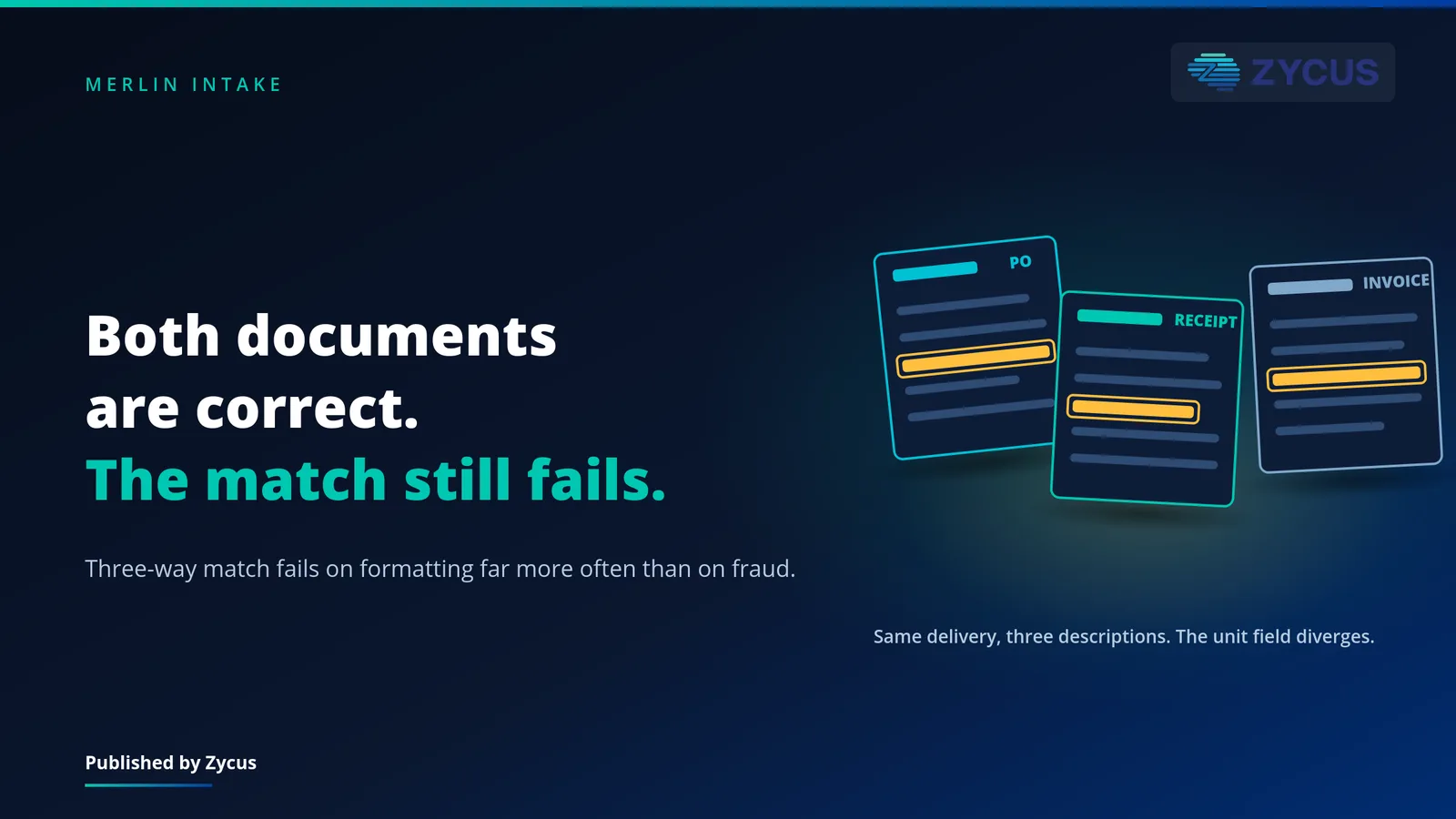
- Invoice processing: AI-powered three-way matching reduces manual touchpoints by 80%+, compressing cycle times from days to hours.
- Spend analytics: The ANA Agent continuously classifies and analyzes spend data, replacing quarterly manual reports with real-time, always-on intelligence.
- Supplier risk: Continuous multi-signal monitoring (financial health, geopolitical exposure, ESG performance, news sentiment) replaces annual supplier assessments.
- Sourcing: The Sourcing Agent auto-generates RFx documents, compares bids algorithmically, and recommends awards based on total cost of ownership — cutting sourcing cycle times by up to 40%.
- Contracts: The Contract Agent extracts key clauses, tracks obligations, flags renewal deadlines, and ensures compliance language is embedded from day one.
This is why the market data is so clear: approximately 40% of outsourced procurement functions now involve AI or automation, and that figure is growing rapidly. Supply chain managed services without embedded AI will be obsolete within two to three years.
What Risks Should Procurement Leaders Watch For?
Managed services deliver significant advantages, but they are not risk-free. The companies that succeed long-term are the ones that go in with clear eyes about the potential pitfalls:
- Knowledge drain: Outsourcing operational functions can erode institutional knowledge. Mitigation: build knowledge-sharing protocols into the contract, maintain process documentation jointly, and retain process architecture expertise in-house.
- Provider lock-in: Over-dependence on a single partner creates concentration risk. Mitigation: ensure data portability, clear exit clauses, and phased transition provisions in every contract.
- Data governance gaps: Sharing procurement and supplier data externally demands enterprise-grade security. Mitigation: require SOC 2 compliance, role-based access, encryption standards, and clear data ownership terms.
- Misaligned incentives: FTE-based contracts incentivize the provider to add headcount, not efficiency. Mitigation: use outcome-based pricing tied to savings, cycle time, compliance, and risk metrics.
- Change management resistance: Internal teams may view managed services as a threat rather than a capability multiplier. Mitigation: invest in communication, redefine roles clearly, and position managed services as an enabler of more strategic internal work.
What Steps Should CPOs Take to Get Started?
If you are considering supply chain managed services as a scaling strategy, here is a practical roadmap:
- Audit your current operational baseline: Document processes, measure cycle times, quantify backlogs, and identify the functions where capacity constraints are most acute.
- Separate strategy from execution: Use a RACI framework to distinguish which activities require internal strategic judgment and which are operationally intensive and outsourceable.
- Clean your data before onboarding a partner: Messy spend data, incomplete supplier records, and fragmented contract repositories will undermine any managed services engagement. Start the cleanup now.
- Choose a technology-first partner: Prioritize providers who bring AI-native platforms rather than those who retrofit technology onto manual processes. Zycus Merlin AI represents this new standard.
- Structure outcome-based contracts: Define success in business terms — savings delivered, risks prevented, cycle times compressed — not in headcount deployed.
- Start with one high-volume function and expand: Prove the model with P2P or spend analytics before scaling into sourcing, contracts, and supplier management.
Quick-Reference: Scaling Through Managed Services
| Phase | Action | Outcome |
| 1 | Operational audit and baseline measurement | Clear picture of capacity gaps and outsource candidates |
| 2 | Data cleanup and process standardization | Foundation ready for partner integration |
| 3 | Partner selection with AI-native platform requirement | Technology-led engagement, not labor-led |
| 4 | Pilot deployment on P2P or spend analytics | Proof of concept with measurable ROI |
| 5 | Expand to sourcing, contracts, supplier management | End-to-end managed procurement at scale |
| 6 | Continuous governance and quarterly performance reviews | Sustained value delivery and continuous improvement |
FAQs
Q1. What are supply chain managed services, and how have they changed?
Supply chain managed services involve partnering with an external provider to manage specific procurement and supply chain functions. In 2026, this has evolved dramatically from the traditional BPO model. Modern managed services are built on AI-native platforms like Zycus Merlin AI, staffed by domain specialists rather than generalist process operators, and priced on business outcomes rather than headcount. They cover end-to-end functions from strategic sourcing and contract management to spend analytics, supplier risk monitoring, and regulatory compliance.
Q2. How does outsourced procurement help companies scale faster?
Outsourced procurement decouples growth from headcount. When revenue doubles, procurement workload multiplies across suppliers, contracts, invoices, and compliance requirements. Internal hiring cannot keep pace. AI-powered managed services absorb this growth non-linearly — automating routine tasks, scaling capacity on demand, and injecting pre-built expertise in category management, data analytics, and compliance that would take years to build in-house.
Q3. Which procurement functions should remain in-house vs outsourced?
Functions that are strategically sensitive and relationship-driven — category strategy development, key supplier negotiations, executive governance — should remain in-house. Functions that are operationally intensive and technology-dependent — P2P processing, spend analytics, supplier onboarding, RFx management, compliance monitoring, contract administration — are ideal candidates for managed services. The most effective model combines a lean strategic internal team with an AI-powered managed services engine handling operational volume.
Q4. What role does AI play in modern procurement managed services?
AI is the core differentiator that separates modern managed services from traditional outsourcing. It enables autonomous invoice processing, predictive spend analytics, real-time supplier risk monitoring, intelligent sourcing recommendations, and automated compliance tracking. Zycus Merlin AI provides this intelligence backbone across the entire source-to-pay lifecycle, allowing managed services to deliver more value at lower marginal cost as volumes scale.
Q5. What should CPOs look for when evaluating managed services providers?
Five criteria matter most: an AI-native technology platform integrated across S2P (not bolted-on point tools); deep procurement domain expertise with industry-specific category knowledge; outcome-based pricing tied to savings, speed, and risk metrics; a flexible delivery model with clear scalability provisions; and a demonstrated track record with enterprises of comparable size and complexity. Providers built on unified platforms like Zycus have a structural advantage over those stitching together disconnected tools.
Q6. What are the biggest risks of supply chain managed services?
The primary risks are knowledge drain from outsourcing operational functions, provider dependency creating concentration risk, data security and governance challenges, misaligned incentives under FTE-based pricing, and internal change management resistance. Each can be mitigated through contractual protections (exit clauses, data portability), governance frameworks (joint documentation, regular reviews), and structural choices (outcome-based pricing, phased rollouts, clear RACI definitions).
Q7. How do companies measure the ROI of procurement managed services?
ROI should be tracked across four dimensions: direct cost savings (spend reduction, invoice processing cost per transaction), efficiency gains (sourcing cycle time reduction, faster contract turnaround), risk reduction (fewer compliance violations, proactive supplier risk alerts), and capacity creation (internal FTEs redirected from operational tasks to strategic activities). Organizations deploying AI-powered managed services on platforms like Zycus typically demonstrate measurable returns within the first two quarters.
Related Reads: