








TL;DR
- The Ardent Partners intake to procure prediction identifies it as a top priority for 2026 — the front end of procurement has become the most critical area for digital investment, not the back end.
- The core insight is stark: if you do not manage the intake, you will not manage the spend. Compliance, savings, and category intelligence are all determined before a requisition is even submitted.
- Retrospective enforcement — flagging non-compliant purchases after the money is spent — is a broken model that breeds maverick spend and stakeholder resentment. Intake orchestration flips this entirely.
- AI agents at the intake layer guide users to compliant, optimized outcomes automatically — not by blocking requests, but by channeling them through the right processes before procurement ever gets involved.
- The shift redefines the S2P model itself. Source-to-Pay starts when procurement gets involved. Intake-to-Outcomes starts when the business need arises — which is always earlier, always messier, and always more impactful.
Most procurement transformations start in the wrong place.
They start with sourcing optimization. With contract lifecycle management. With spend analytics dashboards. With supplier portals and e-invoicing rollouts. All important. All necessary. But all of them share the same blind spot: they assume procurement already knows what the business needs, when it needs it, and from whom.
In reality, by the time most procurement teams engage with a request, the critical decisions have already been made. The business user has identified a supplier. The budget holder has approved the spend — informally, over email, or through a side conversation with a vendor. The specification has been written to match a preferred product. What arrives at procurement’s door is not a request for help. It is a request for paperwork.
In our previous analysis, we explored why Ardent Partners calls 2026 the Genesis of Autonomy — the year procurement crosses from rule-based automation into genuine self-governance. But every autonomous system needs a front door. And this is the problem Ardent places at the center of their 2026 predictions.
In Procurement 2026: BIG Trends and Predictions, analyst Andrew Bartolini makes Intake-to-Procure one of the 20 BIG Predictions for the year — and the logic behind it is disarmingly simple: “If teams do not manage the intake, they will not manage the spend.”
Where Compliance Actually Gets Decided
For years, procurement’s compliance model has been retrospective. A purchase happens. Procurement reviews it — sometimes days or weeks later. The spend gets flagged as non-compliant. A report gets generated. Nothing changes, because the money is already out the door, the supplier is already engaged, and the business user has already moved on to their next priority.
This model does not fail because procurement teams are slow. It fails because it intervenes at the wrong point in the process. By the time a requisition reaches procurement, the decision architecture — who to buy from, at what price, under what terms — has already been set by someone who is not thinking about category strategy, preferred suppliers, or contract leverage.
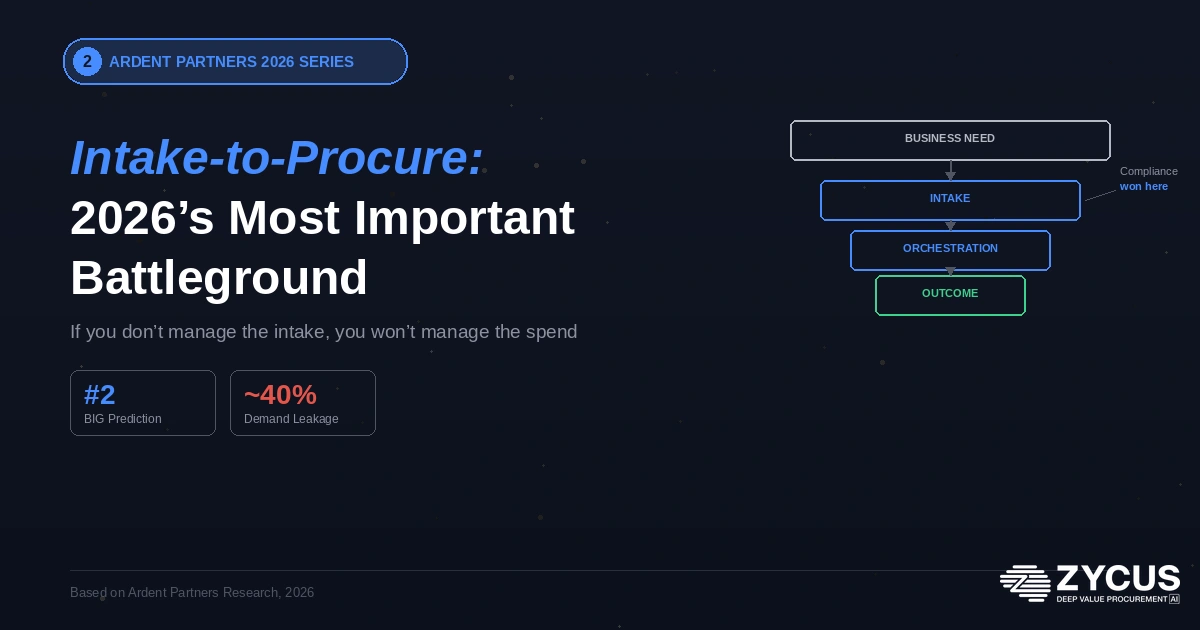
Ardent’s research reframes the entire approach. By orchestrating demand before a purchase is ever made, CPOs can drive better outcomes than they can through retrospective policy enforcement. The intake layer becomes the moment of truth — not a form to fill out, but an intelligent system that captures the business need at its origin and channels it through the right process automatically.
The report is explicit about the mechanism: in 2026, the intake layer is where AI agents guide users to better, more compliant outcomes. Not by adding friction. Not by blocking requests. By making the right path the easiest path — so that compliance becomes a byproduct of a good experience rather than a mandate enforced after the fact.
The Data Trail That Changes Everything
Here is what makes intake management more than a compliance play.
When intake is native to the Source-to-Pay platform — not a separate tool, not a bolt-on form builder, not a disconnected ticketing system — every request generates a data trail from the moment a business need is identified. Every request is captured. Every request is routed intelligently. And every request produces data that feeds downstream processes in ways that are impossible when procurement only sees the requisition.
This data trail transforms category intelligence. When you can see what the business is asking for — before it becomes a purchase order — you can identify demand patterns, consolidation opportunities, and maverick spend trends at their source. The category manager who has visibility into intake data is working with a fundamentally richer intelligence feed than one who only sees approved requisitions.
It also transforms spend visibility. Ardent’s BIG Prediction #3 declares that decision augmentation becomes the primary output from spend visibility in 2026 — AI-powered systems that actively recommend savings opportunities, sourcing strategies, and trade-off analyses. But decision augmentation is only as good as the data it operates on. When intake data is captured natively within the S2P platform, the AI has visibility into demand intent — not just historical transactions. It can recommend before the spend happens, not just analyze it after.
And it transforms how procurement platforms serve the C-suite. Ardent’s BIG Trend #9 predicts that S2P platforms become Systems of Business Insight — where the CEO and CFO go to understand margin risk, market exposure, and compliance posture. Intake data is the leading indicator in that intelligence model. Transaction data tells you what happened. Intake data tells you what is about to happen.
From Source-to-Pay to Intake-to-Outcomes
The implications of this shift extend beyond process improvement to a redefinition of the procurement operating model itself.
Source-to-Pay, as a framework, starts when procurement gets involved. The business submits a requisition. Procurement takes it from there — sourcing, contracting, ordering, paying. The model assumes procurement is the starting point.
Intake-to-Outcomes starts earlier. It starts when the business need arises — which is always earlier, always messier, and always more consequential than the moment a requisition lands in the queue. The organizations that capture demand at the point of origin control the spend. Those that wait for requisitions to arrive manage whatever is left — which, given that roughly 40% of enterprise spend remains unmanaged by the average procurement department, is a significant amount of value leaking through the gaps.
This is not a subtle rebranding. It is an architectural choice. An Intake-to-Outcomes model requires the intake layer to be natively embedded in the S2P platform — sharing the same data model, the same supplier intelligence, the same contract repository, and the same AI engine. When intake exists as a separate system, the data trail breaks. The intelligence fragments. And procurement is back to the retrospective enforcement model that has failed for a decade.
The Stakeholder Experience Is the Strategy
Ardent’s CPO takeaway on this prediction cuts to the core: “Prioritize the intake stakeholder experience; compliance is won or lost before the requisition is even submitted.”
This is not about building a better form. It is about creating an experience so frictionless and intelligent that stakeholders choose to use it — because it makes their work easier, not harder. When a marketing director needs to engage an agency, the intake layer should understand the request, suggest pre-approved suppliers, surface relevant contract terms, route the approval intelligently, and get the director back to their actual job in minutes. No procurement jargon. No policy lectures. No seven-step approval chains that exist because someone abused the process in 2019.
The report connects this trend directly to the Genesis of Autonomy — the defining shift we explored in our previous analysis. AI at the intake layer acts as the first orchestrator of enterprise demand. It is the entry point where autonomous procurement begins. And for CPOs evaluating where to invest in 2026, the message from Ardent’s research is unambiguous: the front end of procurement is where the outcomes get decided. Everything downstream follows from it.
And the most consequential thing that follows from capturing demand at its source? Savings. As we explore next in this series, savings remains the CPO’s #1 KPI in 2026 — but the playbook for delivering it has fundamentally changed.
The Ardent Partners report goes deep on how Intake-to-Procure connects to savings, compliance, and CPO strategy in 2026. Download the full research — Procurement 2026: BIG Trends and Predictions — to read the complete analysis.
Continue Reading
Previous in this series: 2026 Is Year Zero for Autonomous Procurement — Are You Ready?
Next in this series: Savings Is Still the #1 CPO KPI — But the Playbook Has Changed
FAQs
Q1. What is Intake-to-Procure and why does it matter in 2026?
Intake-to-Procure refers to managing procurement at the point where a business need first arises — before a requisition is created, before a supplier is selected, before spend is committed. Ardent Partners identifies it as a top 2026 prediction because the front end of procurement has become the most critical area for digital investment. The core principle is straightforward: if you do not manage the intake, you will not manage the spend.
Q2. How is Intake-to-Procure different from traditional Source-to-Pay?
Source-to-Pay starts when procurement receives a requisition — the business has already decided what it needs and often who to buy from. Intake-to-Outcomes starts when the business need first arises, capturing demand at its origin and orchestrating it through the right procurement processes automatically. This earlier intervention point gives procurement influence over decisions that are otherwise made without category strategy, contract leverage, or compliance considerations.
Q3. Why does retrospective compliance enforcement fail?
Because it intervenes after the money is spent, the supplier is engaged, and the business user has moved on. Flagging non-compliant purchases after the fact generates reports but does not change behavior. Intake orchestration flips this model by embedding compliance into the process at the point of request — making the compliant path the easiest path through AI-guided routing and intelligent supplier suggestions.
Q4. What role does AI play at the intake layer?
According to Ardent Partners, AI agents at the intake layer guide users to better, more compliant outcomes automatically. Rather than blocking requests, AI channels them through the right processes — suggesting pre-approved suppliers, surfacing relevant contract terms, routing approvals intelligently, and capturing data that feeds category intelligence and spend analytics downstream.
Q5. How does intake data improve procurement intelligence?
When intake is natively embedded in the S2P platform, every request generates a data trail from the moment a business need is identified. This gives procurement visibility into demand intent — not just historical transactions. Category managers can identify consolidation opportunities and demand patterns at their source. AI-powered spend visibility can recommend actions before spend occurs rather than analyzing it after the fact. Ardent describes this as the shift from “what happened” to “what should we do next.”
Q6. Why must intake management be native to the S2P platform?
When intake exists as a separate system, the data trail between the business need and the procurement outcome breaks. Intelligence fragments across tools. Compliance gaps emerge in the handoff. A native intake layer shares the same data model, supplier intelligence, contract repository, and AI engine as the rest of the S2P suite — creating a unified intelligence trail from demand origin to value delivery that separate tools cannot replicate.
Related Reads:
- The Growing Significance of Intake to Procure Management Soaring in Procurement
- Intake to Pay vs. Procure to Pay: Key Differences and Selecting the Right Approach
- Intake Management Automation: Revolutionizing Procurement Requests
- The Intake Advantage: Why Emerging Enterprises Need Guided Procurement