








TL;DR
- Ardent Partners settles the annual debate definitively: savings remains the #1 CPO priority in 2026. But the methods have fundamentally shifted from blunt-force negotiation to AI-powered precision.
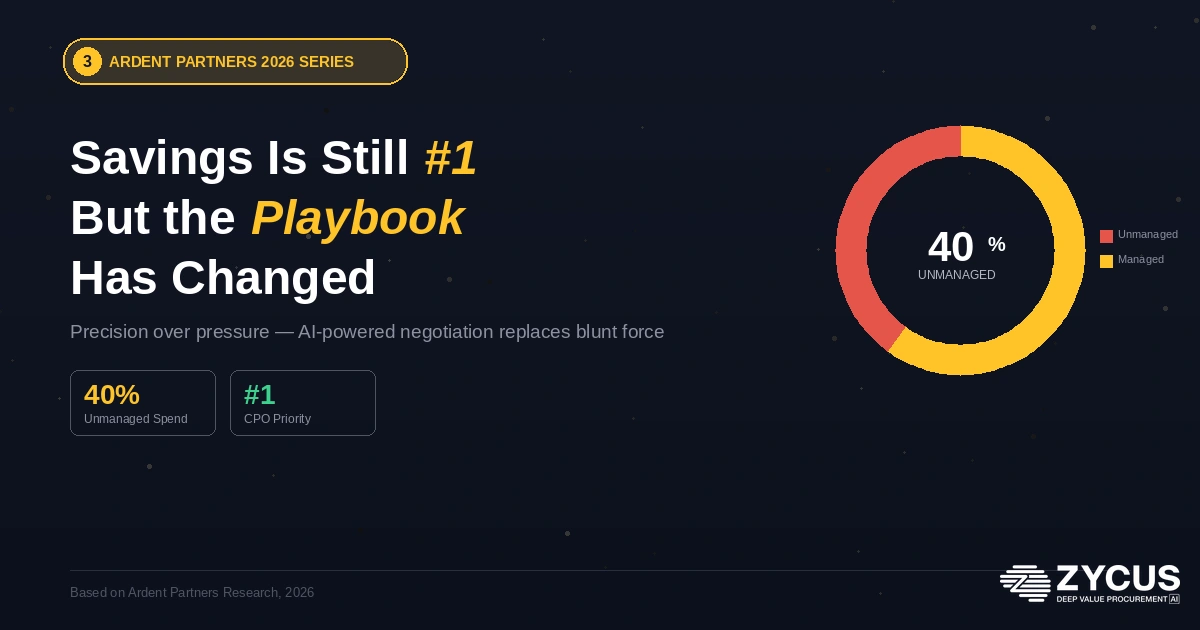
- Roughly 40% of enterprise spend remains unmanaged — representing the single largest untapped savings lever. Autonomous negotiation agents can bring these categories under active procurement influence without adding headcount.
- Persistent inflation is acting as a “low-grade fever” in 2026 — with suppliers embedding mini-escalators into every contract. Periodic RFP cycles cannot keep pace; continuous market monitoring and real-time price indexing are now essential.
- The report’s Five-Wave CPO Playbook dedicates Wave III to aggressive AI-driven savings — deploying autonomous agents and should-cost modeling to capture margin-impacting value across tail-spend and mid-tier categories.
- Savings in 2026 is not about squeezing suppliers harder. It is about using AI to operate with precision, speed, and coverage that human-only teams cannot match — turning procurement into a margin-protection engine.
Every year, the same debate resurfaces. Is savings still the primary CPO mandate? Has procurement evolved beyond cost reduction? Should the function focus on value creation, innovation, supplier collaboration?
And every year, the CFO settles the argument. Show me the savings.
Ardent Partners’ Procurement 2026: BIG Trends and Predictions puts numbers behind what most CPOs already feel. Savings tops the priority list. Again. The blend of CFO demands, capital market expectations, and a higher cost of capital have turned every dollar saved into what the report calls “jet fuel for sky-high enterprise valuations.”
In the previous two parts of this series, we explored the Genesis of Autonomy reshaping procurement and why the intake layer is where compliance and intelligence begin. Both of those shifts matter precisely because they feed into this one: the ability to deliver savings at a scale, speed, and precision that was previously impossible.
But the how has fundamentally changed. As the report states plainly: savings in 2026 are not the classic price beatings of the past. They are driven by more sophisticated sourcing, including some that is AI-powered. The blunt-force negotiation tactics that once defined procurement’s contribution are giving way to precision, data-driven cost reduction.
The 40% Problem
Here is the number that should define every CPO’s 2026 strategy: roughly 40% of enterprise spend remains unmanaged by the average procurement department.
This is not a new statistic. But in the context of autonomous procurement, it represents something new: an enormous, AI-addressable opportunity. The reason that spend has remained unmanaged is not negligence. It is economics. Tail-spend categories — facilities maintenance, office supplies, one-off IT purchases, professional services below threshold — have never justified the cost of assigning a human buyer. The value per transaction is too low. The volume is too high. The categories are too fragmented.
Autonomous negotiation changes this math entirely. An AI agent does not weigh the economics of whether a contract is “worth” its time. It monitors, benchmarks, and negotiates across hundreds of low-value categories simultaneously — capturing savings that individually seem marginal but collectively represent millions in recovered margin.
Ardent’s Five-Wave CPO Strategic Playbook devotes its third wave — Aggressive Savings: The AI Scale-Up — to this exact challenge. The recommendation: deploy autonomous negotiation agents and real-time should-cost modeling to capture deep savings in tail-spend and mid-tier categories without increasing headcount. This is procurement’s primary defense against persistent inflation and high capital costs.
The Low-Grade Fever
And that inflation pressure is not easing. Ardent identifies persistent inflation as BIG Trend #6 — a “low-grade fever” where headline numbers may have stabilized but underlying costs for labor, energy, and logistics remain stubbornly sticky.
The operational consequence is subtle and corrosive. Suppliers are not announcing dramatic price increases. They are baking mini-escalators into every contract renewal — a 2% adjustment here, an index-linked clause there, a fuel surcharge that never quite goes away. Individually, these adjustments seem reasonable. Collectively, across thousands of supplier relationships, they erode margin relentlessly.
The report’s advice is vivid: “Bring a gun (data, market intel, etc.) to the supplier negotiation knife fight.” In practical terms, this means shifting from periodic RFP cycles to continuous market monitoring. It means using real-time price indexing to capture market dips immediately rather than waiting for the next quarterly review. And it means having the analytical firepower to challenge supplier escalation clauses with actual market data, not last year’s benchmarks.
Autonomous Negotiation: From Concept to Operating Reality
The concept of autonomous negotiation has crossed the line from theoretical to deployable. AI agents can now manage supplier negotiations within defined guardrails — analyzing historical pricing, market benchmarks, contract terms, and supplier risk profiles to execute negotiations that deliver measurable, auditable savings.
For categories where human negotiators cannot justify the time investment, AI agents become the first line of savings capture. They do not replace strategic negotiation for complex, high-value sourcing events. They extend procurement’s reach into the long tail where savings have historically leaked uncaptured.
The report frames this within the broader Genesis of Autonomy — where procurement moves into a state of self-governance. Autonomous negotiation is one of the most tangible, ROI-measurable expressions of this shift. And it directly addresses the CPO’s perennial challenge: how to deliver more savings without more people.
Precision, Not Pressure
Ardent’s CPO takeaway on savings is both a validation and a challenge: “Savings remains the CPO’s #1 KPI; in 2026, it must be delivered through precision rather than blunt-force negotiation.”
Precision means knowing the true cost structure of a category before the negotiation begins. It means understanding where a supplier has margin to give and where they do not. It means running scenario models that account for tariff exposure, currency risk, and logistics cost before committing to a sourcing strategy. And it means doing all of this at a speed that matches the volatility of the market — not at the pace of a quarterly business review.
The CPOs who build this capability in 2026 will deliver savings that are sustainable, margin-impacting, and defensible to the board. The ones who rely on annual RFP cycles and relationship-based negotiation will watch their margins erode, one mini-escalator at a time.
But precision requires intelligence — and not the kind that sits in a static annual category plan. As we explore next, the shift from category management to category intelligence is redefining how procurement teams make decisions in real time.
The full Ardent Partners report covers savings strategies, autonomous negotiation, and the Five-Wave CPO Playbook in detail. Download Procurement 2026: BIG Trends and Predictions to see how leading CPOs are architecting their savings engines.
Continue Reading
Previous in this series: Why Intake-to-Procure Is 2026’s Most Important Battleground
Next in this series: From Category Plans to Category Intelligence: Procurement’s Data Revolution
FAQs
Q1. Is savings still the top CPO priority in 2026?
Yes. Ardent Partners confirms that savings remains the #1 CPO mandate in 2026. The combination of CFO pressure, capital market expectations, and a higher cost of capital has made every dollar saved by procurement directly impactful to enterprise valuations. However, the methods for delivering savings have fundamentally shifted from blunt-force negotiation to AI-powered precision.
Q2. How much enterprise spend is unmanaged and what does that mean for savings?
According to Ardent Partners, roughly 40% of enterprise spend remains unmanaged by the average procurement department. This persistent gap represents the largest untapped savings opportunity — categories like tail spend, facilities maintenance, and below-threshold professional services that never justified assigning human buyers. Autonomous AI agents can bring these categories under active procurement oversight, capturing savings at scale without adding headcount.
Q3. What is autonomous negotiation in procurement?
Autonomous negotiation refers to AI agents that manage supplier negotiations within pre-defined guardrails. These systems analyze historical pricing, real-time market benchmarks, contract terms, and supplier risk profiles to execute negotiations that deliver measurable savings. They do not replace strategic human negotiation for complex sourcing events — they extend procurement’s reach into the long tail of categories where savings have historically gone uncaptured.
Q4. How is inflation affecting procurement savings strategies in 2026?
Ardent Partners describes 2026 inflation as a “low-grade fever” — headline numbers have stabilized but underlying costs for labor, energy, and logistics remain sticky. Suppliers are embedding mini-escalators into contracts rather than announcing dramatic increases. This demands a shift from periodic RFP cycles to continuous market monitoring, real-time price indexing, and AI-powered analytics that can challenge supplier escalation clauses with current market data.
Q5. What does Ardent’s Five-Wave Playbook recommend for savings?
Wave III of the CPO Strategic Playbook — Aggressive Savings: The AI Scale-Up — recommends deploying autonomous negotiation agents and real-time should-cost modeling to capture deep savings in tail-spend and mid-tier categories. The goal is to scale procurement’s influence over the 40% of unmanaged spend without increasing headcount, creating margin-impacting liquidity that helps the enterprise navigate persistent inflation and high capital costs.
Q6. What is the difference between blunt-force and precision savings?
Blunt-force savings relies on leveraging volume and pressure to extract lower prices from suppliers — the classic “price beating” approach. Precision savings uses AI-powered intelligence to understand true cost structures, run scenario models accounting for tariffs and currency risk, benchmark against real-time market data, and identify savings opportunities at a speed and scale that human-only teams cannot match. Ardent Partners states that in 2026, savings must be delivered through precision rather than pressure.
Related Reads: