








TL;DR
- Risk management vs compliance are related but serve fundamentally different roles in procurement — one is proactive, the other is reactive.
- Supplier risk extends far beyond tier-one visibility: only 42% of organizations have risk visibility into tier-two suppliers and beyond (McKinsey, 2025).
- Regulatory compliance failures cost organizations an average of $14.82 million annually, making it a board-level priority, not just a legal checkbox.
- AI-powered procurement platforms like Zycus Merlin AI unify risk monitoring and compliance tracking across the entire source-to-pay lifecycle.
- 68% of organizations now use specialized technology, AI, or advanced analytics to manage risks (KPMG, 2025).
- Procurement leaders who integrate both disciplines into a single governance framework outperform peers in cost savings, resilience, and audit readiness.
Why are Procurement Leaders Rethinking Risk and Compliance?
If you lead a procurement function at a billion-dollar enterprise, you already know the ground has shifted. Tariffs are being rewritten overnight. ESG disclosure mandates are tightening across the EU, US, and Asia-Pacific. Suppliers that looked rock-solid twelve months ago are flagging financial distress signals. And somewhere in the middle of all this, your team is expected to keep costs down, maintain supply continuity, and pass every audit thrown your way.
Here is the uncomfortable truth: most procurement organizations still treat risk management and compliance as the same thing. They are not. Conflating the two creates blind spots that regulators, auditors, and supply chain disruptions are more than happy to exploit.
This blog unpacks the real difference between risk management vs compliance in procurement, explains where they overlap, where they diverge, and lays out a practical framework for getting both right — without doubling your team’s workload.
Read more: Procurement Orchestration for Compliance & Risk Management
What is the Core Difference Between Risk Management and Compliance?
At the simplest level, compliance asks: “Are we following the rules?” Risk management asks: “What could go wrong, and how do we prevent it?”
Regulatory compliance is about adhering to external laws, regulations, industry standards, and internal policies. Think GDPR for data handling, the EU Corporate Sustainability Due Diligence Directive (CSDDD) for supply chain accountability, SOX for financial controls, or ISO 37301 for compliance management systems. Compliance is largely binary: you either meet the requirement, or you don’t.
Risk management is broader, more strategic, and inherently forward-looking. It encompasses identifying, assessing, prioritizing, and mitigating threats to the business — whether those threats come from supplier financial instability, geopolitical disruption, cyber vulnerabilities, or commodity price swings. Frameworks like ISO 31000 and COSO ERM guide this process, but unlike compliance, risk management rarely has a definitive finish line.
For procurement leaders, the practical distinction matters enormously. A compliance-only approach tells you that your suppliers have signed the required code of conduct. A risk management approach tells you that three of your critical sole-source suppliers operate in regions facing escalating political instability — and your contingency plan has not been updated since 2023.
Download eBook: Empowering Your Business with Effective Supplier Risk Management Tool Strategies
How do Risk Management and Compliance Compare Side by Side?
The following table provides a clear breakdown of how these two disciplines differ across key procurement dimensions:
| Dimension | Risk Management | Regulatory Compliance |
| Primary Focus | Identifying and mitigating threats before they materialize | Adhering to laws, regulations, and internal policies |
| Approach | Proactive, continuous, and scenario-driven | Reactive, checklist-driven, and audit-focused |
| Scope | Enterprise-wide: financial, operational, strategic, geopolitical | Rule-specific: GDPR, SOX, CSDDD, FCPA, ISO standards |
| Time Horizon | Short, medium, and long-term planning | Primarily near to medium-term cycles |
| Key Frameworks | ISO 31000, COSO ERM, NIST RMF | ISO 37301, USSG, OECD, SOC 2 |
| Measurement | KRIs, risk heat maps, scenario analysis, stress testing | Audit outcomes, pass/fail assessments, penalty avoidance |
| Ownership | CPO, CRO, cross-functional leadership | Legal, compliance officers, internal audit |
| Technology Role | AI-driven monitoring, predictive analytics, real-time alerts | Document management, audit trails, policy tracking |
Why Does Supplier Risk Demand a Different Playbook Than Compliance?
Supplier risk is where the gap between risk management and compliance becomes most visible — and most dangerous. A compliant supplier is not necessarily a safe supplier.
Consider this scenario: a tier-one electronics component supplier passes every compliance check — they have valid ISO certifications, clean audit reports, and signed ethics agreements. But a risk management lens reveals that 70% of their raw materials come from a single sub-tier supplier in a region experiencing escalating trade restrictions. Their financial health has deteriorated over two consecutive quarters. And their cybersecurity posture scores well below industry benchmarks.
Compliance did not catch any of this. Risk management should have.
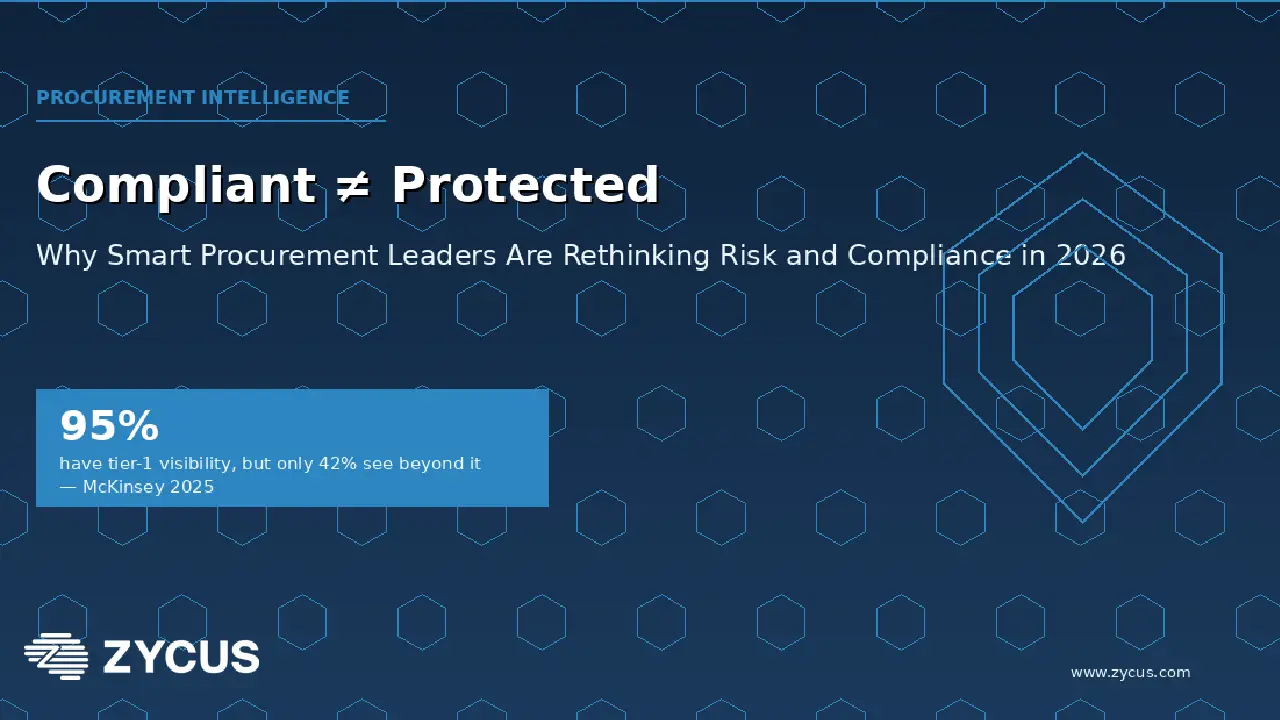
McKinsey’s 2025 Global Supply Chain Risk Survey found that while 95% of organizations now have visibility into tier-one supplier risks, only 42% extend that visibility to tier-two and beyond. That gap is where disruptions breed.
Effective supplier risk management requires continuous monitoring across multiple dimensions: financial stability, geopolitical exposure, ESG performance, operational capacity, cybersecurity maturity, and sub-tier dependencies. This is not something a quarterly compliance audit can deliver.
What Are the Key Categories of Supplier Risk in Procurement?
| Supplier Risk Category | What It Covers | Why Compliance Alone Misses It |
| Financial Risk | Supplier bankruptcy, credit downgrades, cash flow instability | Compliance checks verify certifications, not real-time financial health |
| Geopolitical Risk | Trade wars, sanctions, regional conflict, tariff volatility | Regulatory frameworks lag behind fast-changing geopolitical developments |
| Cybersecurity Risk | Data breaches, ransomware, IT infrastructure vulnerabilities | SOC 2 or ISO 27001 certification is a snapshot, not ongoing assurance |
| ESG & Sustainability Risk | Carbon footprint, labor practices, Scope 3 emissions, modern slavery | Self-reported ESG questionnaires lack third-party verification depth |
| Operational & Capacity Risk | Production delays, quality failures, workforce shortages | Compliance audits assess policies, not real-time operational capacity |
| Sub-Tier Concentration Risk | Hidden dependencies on single sub-suppliers or regions | Most compliance programs stop at tier-one supplier evaluation |
Where Do Risk Management and Compliance Overlap in Procurement?
Despite their differences, risk management and compliance are not adversaries — they are complementary forces. The most effective procurement organizations treat them as two sides of the same governance coin.
Here is where they converge:
- Shared data infrastructure: Both disciplines require robust supplier data, contract repositories, audit trails, and spend analytics. An AI-powered platform that unifies this data eliminates the silos that weaken both functions.
- Supplier due diligence: Compliance-driven onboarding checks (sanctions screening, anti-bribery verification) naturally feed into risk assessment processes. When these workflows are integrated, they create a single, comprehensive supplier profile.
- Regulatory risk as a risk category: Non-compliance is itself a risk — one that carries financial penalties, operational shutdowns, and reputational damage. Managing compliance risk requires the same probabilistic thinking used in broader risk management.
- Third-party monitoring: Both functions benefit from continuous monitoring of supplier behavior, financial health, and regulatory status rather than point-in-time assessments.
The key insight is that compliance provides the floor — the minimum standard. Risk management raises the ceiling. Procurement leaders need both.
Download Whitepaper: Supplier Risk Management Framework: A Comprehensive Approach to Mitigating Supplier Risks
What Does a Mature Risk and Compliance Framework Look Like?
Building a unified framework does not mean merging risk and compliance into a single department. It means ensuring both functions share the same data, technology, and strategic priorities. Here is a maturity model that procurement leaders can benchmark against:
| Maturity Level | Risk Management | Compliance | Integration Level |
| Level 1: Ad Hoc | Reactive fire-fighting; no formal risk register | Manual policy tracking; audit-driven corrections | Siloed functions with no shared data |
| Level 2: Defined | Risk categories identified; basic scoring in place | Documented policies; scheduled compliance reviews | Some shared reporting; separate tools and teams |
| Level 3: Managed | Continuous monitoring with KRIs; scenario planning active | Automated compliance workflows; real-time policy tracking | Unified supplier data; cross-functional governance |
| Level 4: Optimized | AI-powered predictive risk analytics; real-time multi-tier visibility | Embedded compliance checks across source-to-pay lifecycle | Single platform for risk, compliance, and performance; AI-driven insights |
Most enterprise procurement teams today operate between Level 2 and Level 3. Reaching Level 4 requires an AI-native platform capable of unifying supplier risk scoring, compliance tracking, contract lifecycle management, and spend analytics into a single intelligent workflow.
How is AI Transforming Procurement Risk Management and Compliance?
The most significant shift in how organizations handle risk management vs compliance in procurement is the emergence of AI-powered platforms that make both disciplines faster, smarter, and more connected.
Consider what AI enables:
- Predictive supplier risk scoring: Machine learning models analyze financial filings, news sentiment, geopolitical indicators, and operational data to flag supplier risks before they escalate. Zycus Merlin AI’s risk analytics continuously monitor your supplier base against hundreds of risk signals.
- Automated compliance monitoring: AI agents track regulatory changes across jurisdictions, automatically map them to your supplier contracts, and flag gaps in real time. Zycus’s Contract Agent ensures compliance clauses are embedded, tracked, and enforced throughout the contract lifecycle.
- Intelligent intake and sourcing: Zycus’s Intake Agent streamlines procurement requests with built-in risk and compliance checkpoints, while the Sourcing Agent evaluates supplier bids against both cost and risk parameters simultaneously.
- Analytics-driven governance: The ANA Agent (Analytics and Autonomous) provides CPOs with real-time dashboards spanning risk exposure, compliance status, and spend concentration — enabling proactive decisions instead of post-audit corrections.
KPMG’s 2025 Risk and Resilience Survey found that 68% of organizations are already using specialized technology, AI, or advanced analytics to manage risks. The question is no longer whether to adopt AI for risk and compliance — it is how quickly you can operationalize it.
What Are the Real-World Consequences of Getting This Wrong?
The cost of treating risk management and compliance as interchangeable — or worse, neglecting one entirely — is steep and well-documented:
- Financial exposure: Non-compliance penalties under GDPR alone can reach up to 4% of global annual turnover or €20 million. Supply chain disruptions cost companies the equivalent of 42% of one year’s EBITDA over a decade, according to McKinsey.
- Operational disruption: In 2025, 82% of supply chain leaders reported tariff-driven disruptions affecting 20–40% of their supply chain activity. Organizations without proactive risk frameworks bore the heaviest impact.
- Reputational damage: ESG violations, modern slavery discoveries in sub-tier supply chains, and data breaches generate headlines that erode stakeholder trust far beyond the immediate financial penalty.
- Strategic stagnation: Teams mired in reactive compliance firefighting cannot focus on strategic sourcing, innovation, or supplier collaboration — the activities that actually drive competitive advantage.
The pattern is clear. Organizations that build integrated risk-and-compliance programs — supported by AI-powered platforms like Zycus — recover faster, spend less on crisis response, and consistently outperform peers in audit readiness and supply chain resilience.
What Should Procurement Leaders Do Next?
If your organization is still running risk and compliance as separate, disconnected workstreams, here is a practical starting point:
- Conduct a gap analysis: Map your current risk management capabilities against your compliance obligations. Where are the overlaps? Where are the blind spots?
- Unify your supplier data: Consolidate supplier profiles, risk scores, compliance documentation, and performance metrics into a single platform. Fragmented data is the root cause of governance failure.
- Invest in continuous monitoring: Move beyond point-in-time audits. Deploy AI-powered tools that monitor supplier risk signals and regulatory changes in real time.
- Embed risk checks into procurement workflows: Risk and compliance checkpoints should be built into intake, sourcing, contracting, and payment processes — not bolted on after the fact.
- Benchmark against a maturity model: Use the framework above to assess where your team stands and define a 12-month roadmap to the next level.
- Leverage a purpose-built platform: Solutions like Zycus Merlin AI integrate risk analytics, compliance tracking, contract management, and spend intelligence into a single source-to-pay ecosystem — giving procurement leaders the visibility and control they need.
Quick-Reference Action Checklist for CPOs
| Priority | Action Item | Expected Outcome |
| 1 | Audit current risk vs compliance gaps | Clear visibility into governance blind spots |
| 2 | Consolidate supplier data into a unified platform | Single source of truth for risk and compliance |
| 3 | Deploy AI-powered continuous supplier monitoring | Early warning on financial, geopolitical, and ESG risks |
| 4 | Embed compliance checkpoints in source-to-pay workflows | Reduced audit findings and policy violations |
| 5 | Establish cross-functional risk governance council | Aligned strategy between procurement, legal, and finance |
| 6 | Benchmark maturity quarterly and track improvements | Measurable progress toward Level 4 integration |
FAQs
Q1. What is the main difference between risk management and compliance in procurement?
Compliance focuses on meeting external regulatory requirements and internal policies — it is rule-bound and often assessed through audits. Risk management is broader and more strategic: it involves identifying, assessing, and mitigating potential threats to the organization, whether those threats are regulatory, financial, operational, or geopolitical. In procurement, compliance ensures you follow the rules; risk management ensures your supply chain survives when the rules change or when threats emerge that no regulation anticipated.
Q2. Can an organization be compliant but still face significant procurement risks?
Absolutely. This is one of the most common and dangerous misconceptions. A supplier can hold every required certification, pass every audit, and still be at high risk of financial collapse, cyberattack, or geopolitical disruption. Compliance is a necessary floor, but it does not provide the forward-looking, multi-dimensional view that risk management delivers. The 2025 McKinsey data showing only 42% of organizations have visibility beyond tier-one suppliers illustrates this gap perfectly.
Q3. How does supplier risk management differ from general enterprise risk management?
Supplier risk management is a specialized discipline within the broader enterprise risk management (ERM) framework. While ERM covers financial risk, strategic risk, operational risk, and reputational risk across the entire organization, supplier risk management focuses specifically on the threats originating from or impacting your supply base: financial instability, concentration risk, ESG non-compliance, capacity constraints, and sub-tier dependencies. For procurement-heavy enterprises, supplier risk often represents the single largest category of operational risk.
Q4. What role does AI play in unifying risk management and compliance?
AI is the enabling technology that makes integrated risk-and-compliance governance practical at scale. AI-powered platforms can simultaneously monitor supplier risk signals across financial, operational, and geopolitical dimensions while tracking regulatory changes and mapping them to your contracts and policies. Platforms like Zycus Merlin AI go further by embedding risk and compliance checkpoints directly into procurement workflows — from intake through payment — so governance is continuous rather than periodic.
Q5. What are the biggest regulatory compliance challenges facing procurement in 2026?
Procurement teams face an expanding regulatory landscape that includes the EU CSDDD (Corporate Sustainability Due Diligence Directive), tightening ESG disclosure mandates, evolving data privacy regulations including GDPR enforcement and emerging US state-level privacy laws, anti-bribery and sanctions compliance under rapidly shifting geopolitical conditions, and the new wave of AI governance requirements. The challenge is not just knowing the rules — it is operationalizing compliance across a global supply base with thousands of suppliers in dozens of jurisdictions.
Q6. How can procurement leaders measure the ROI of integrated risk and compliance programs?
ROI should be measured across four dimensions: avoided costs (penalties, disruption losses, emergency sourcing premiums), efficiency gains (reduced audit preparation time, automated compliance workflows), resilience metrics (supplier diversification scores, mean time to respond to disruptions), and strategic value (improved supplier relationships, faster time-to-contract, reduced cycle times). Organizations that deploy AI-powered platforms like Zycus typically see measurable improvements across all four within the first 12 months.
Q7. Why should procurement leaders invest in a unified platform rather than point solutions?
Point solutions for risk management, compliance tracking, contract management, and spend analytics create data silos, duplicate effort, and blind spots at the seams. A unified source-to-pay platform like Zycus connects supplier data, risk scores, compliance documentation, contract terms, and spend patterns into a single intelligent ecosystem. This integration is what enables predictive insights, automated governance, and the kind of cross-functional visibility that modern procurement demands. It also dramatically reduces the total cost of ownership compared to managing multiple disconnected tools.
Related Reads
- Research Report: Integrated Risk Management: A Playbook for Procurement
- eBook: Procurement AI Adoption Index 2025–26
- Whitepaper: Astute Contract Risk Management: Best Practices to Mitigate Risks
- Podcast: Preemptive Procurement: Beyond Forecasting with Agentic AI
- Whitepaper: Ensuring Efficiency with Supplier Risk Management Software, ensuring Efficiency for Supply Chain Transparency