



A supplier collaboration network is a shared digital environment where a buying organization and its suppliers exchange data, plan together, and resolve problems in one place, rather than through disconnected email threads, spreadsheets, and single-purpose portals.
The idea is not new. What has changed is the evidence behind it and the technology available to support it. Research conducted by McKinsey & Company with Michigan State University found that companies scoring highest on supplier development and innovation tended to beat industry growth trends by roughly two times, based on a survey of 105 companies about their supplier-collaboration practices. The same body of research found something less comfortable: most organizations are considerably better at agreeing on collaboration in principle than at executing it.
This article covers what a supplier collaboration network is, how it differs from the adjacent terms it is routinely confused with, what analysts mean when they treat this as a software market, and how to build a program that produces results you can measure and defend.
Key Takeaways:
- A supply chain collaboration network connects buyers and suppliers on a shared platform covering planning, execution, risk, and performance. It goes further than a one-way supplier portal.
- The hardest part is not agreeing to collaborate. McKinsey benchmarking found that scores fall sharply between strategic alignment and execution, with value sharing and governance scoring lowest.
- Supplier collaboration describes a practice. Research firms describe the software market under at least four different names, which is why searches on this topic return inconsistent results.
- Programs that work start with a small set of strategic suppliers, agree how value will be measured and shared before the first project, and govern the work cross-functionally.
- Technology removes friction. It does not create trust, and it does not substitute for governance.
What is Supplier Collaboration Networks?
A supplier collaboration network is a digital environment that supports two-way communication, real-time data sharing, and joint decision-making between procurement teams and their suppliers. Instead of each party working from its own copy of the data, both work from a shared record of forecasts, orders, documents, performance, and risk signals.
An integrated supplier collaboration network enables organizations to:
- Access real-time supplier data for improved decision-making
- Collaborate on product development and process improvements
- Enhance supply chain agility by anticipating and mitigating risks early
- Increase procurement collaboration efficiency by eliminating redundancies and streamlining workflows
The distinction worth holding on to is scope. A supplier portal gives suppliers a window into your systems. A collaboration network gives both sides a working surface, where each party contributes information the other does not already hold. A portal reduces your administrative load. A network changes what both organizations are able to see and decide.
Supplier collaboration, SRM, supplier networks, and procurement collaboration
These four terms appear in the same conversations and are frequently treated as interchangeable. They are not, and the confusion has practical consequences: programs get the wrong sponsor, the wrong metrics, and the wrong technology.
| Term | What it describes | The question it answers |
| Supplier relationship management (SRM) | The discipline of segmenting suppliers, measuring performance, and managing the relationship across its lifecycle | How is this supplier performing, and how should we manage them? |
| Supplier collaboration | The practice of working jointly with suppliers toward shared objectives across innovation, planning, cost, quality, and risk | What can we achieve together that neither side can achieve alone? |
| Supplier network | The connected community of suppliers an organization transacts with, and the platform that connects them | Who are we connected to, and how do transactions and documents flow between us? |
| Collaborative procurement | Multiple organizations, or multiple internal departments, combining requirements and buying power | How do we buy together to secure better terms? |
The last row is the one that causes the most trouble. Procurement collaboration, also called cooperative or group purchasing, is about aggregating demand across buyers. Supplier collaboration is about deepening the relationship between one buyer and its suppliers. They share a vocabulary and almost nothing else. A team that sets out to build supplier collaboration solution and ends up measured on volume-discount savings has been given the wrong goal.
For the structural view of how a supplier network is composed, see the Zycus guide to what a supplier network is and how it is structured. For performance management and segmentation methodology, see the Zycus guide to supplier relationship management.
How research firms define this market?
| Research firm | Category name | Definition in brief |
| ARC Advisory Group | Supply Chain Collaboration Network (SCCN) | A collaborative solution for supply chain processes built on a public cloud, many-to-many architecture that supports a community of trading partners. Applications span plan, source, make, deliver, returns, supply chain risk, and supply chain finance. |
| Gartner | Multienterprise Collaboration Networks (MCN) | Solutions supporting a community of trading partners of any tier and type that need to coordinate and execute business processes extending across multiple enterprises. Gartner previously covered a closely related market as Multienterprise Supply Chain Business Networks, with the final Magic Quadrant for that market published in May 2022. |
| Forrester | Collaborative Supply Networks | Assessed in The Forrester Wave: Collaborative Supply Networks, Q4 2022, a 25-criterion evaluation of 15 providers. |
| IDC | Multi-Enterprise Supply Chain Commerce Network | Assessed through the IDC MarketScape effective vendor collaboration assessment series. |
There is a practical consequence for anyone building a shortlist. The category label determines which vendors appear. Networks assessed under supply-chain-centric categories tend to emphasize planning, logistics, manufacturing, and multi-tier visibility. Networks positioned inside source-to-pay suites tend to emphasize onboarding, sourcing events, ordering, invoicing, and supplier risk. Deciding which processes you actually need to collaborate on should therefore come before you decide which analyst list to read.

Why supplier collaboration solution programs stall
McKinsey identifies several recurring barriers, and they match what most procurement teams encounter in practice.
- Time to value. Collaboration projects often require significant time and management effort before they generate value, which pushes organizations toward simpler, faster initiatives even when those are worth less.
- Mindset. Both sides may be accustomed to transactional or adversarial dealing. Moving from a cost-based to a value-based way of working is a real change in how people are expected to behave, not a process adjustment.
- Cross-functional effort. Most collaborative work needs engineering, quality, planning, and finance participation on both sides. That is a marked change from normal working methods at many companies, and it is the dimension executives consistently report as hardest.
- Measurement. Value created through collaboration is difficult to isolate when conventional cost-reduction programs are running with the same supplier at the same time.
- Capability. Leaders often admit they lack the structures needed to design collaboration programs and the staff needed to run them.
Trust sits underneath all of these. McKinsey’s interviews found that buyers and suppliers describe high trust in relationships they consider strategic, but are less confident that a partner will put the interests of the collaboration ahead of its own organization. Greater transparency in sensitive areas such as cost was repeatedly named as the gate to the highest levels of collaboration, and just as repeatedly named as difficult to reach.
A roadmap for building a supplier collaboration program
Developing a successful supplier collaboration program requires careful planning, dedicated resources, and a commitment to fostering strong relationships. The following roadmap outlines the key steps in building an effective supplier collaboration program.
1. Select the right suppliers first
Start with suppliers where joint work can create and retain significant value, not simply with the largest suppliers by spend. Segmentation matters more than size. A mid-spend supplier holding critical technology or scarce capacity is usually a better first partner than a high-spend commodity supplier where the only available lever is price. Three to five relationships is a realistic starting scope.
2. Gather supplier information
Uncovering the “essence” of your suppliers is necessary if you want to build strong relationships. Knowledge beyond price and product offerings can include their ownership, ethics, mission statements, credibility in media, and more, which is why it is important to have an up-to-date central repository so this information remains current. Automated trackers, alerts, and audit trails will keep everything updated for better supplier relations. For instance, in tools such as Zycus’ supplier management software, an audit trail is accessible for all the changes a supplier makes to their profile and submitted documents.
3. Align on joint objectives before you select supplier collaboration tooling
Define what each side wants from the relationship and write it down. McKinsey describes joint business planning as a formal process in which buyer and supplier align on short- and long-term objectives, agree mutual targets, and develop plans together to reach them. At its simplest it means agreeing on metrics and value-sharing arrangements. At its most advanced it can extend to joint investment in new sources of value. Areas of opportunity typically include growth, innovation, productivity, quality, and margin.
4. Establish open communication
Building a successful partnership with your suppliers relies heavily on the strength of your communication. Both parties need to be informed and involved in the relationship, so keep them looped in, stay connected through regular messaging, provide feedback, show gratitude, and let them know if anything needs improvement. By helping them understand their role in achieving your goals, you create a cohesive team working together for success.
5. Define how value is created and shared
This is the step most programs skip, and the one the benchmarking data suggests matters most. Agree in advance what counts as value, which may include cost, revenue, quality, lead time, emissions, or working capital. Agree how it will be measured and what each party receives.
McKinsey found that additional volume remains the most common way buyers share the value created, and that where performance-based supplier incentives were used, both buyers and suppliers were satisfied with the results. That combination suggests the mechanism is available and under-used.
Cost transparency is the enabler. Cleansheet cost modeling, which calculates the cost of each step in creating a product, component, or service from a database covering materials, labor, factory space, equipment, time, and energy, gives both sides a shared fact base. It changes the conversation from negotiating a relative price movement to identifying where cost actually sits, and it provides the agreed baseline that any value-sharing arrangement will later be measured against.
6. Manage risk jointly
Collaborate with suppliers to identify potential risks within the supply chain and develop mitigation strategies. Several organizations rely on supplier advisory boards to manage risks and reduce disruptions to the supplier ecosystem.
A supplier advisory board is usually chaired by an executive business sponsor together with a sourcing lead. Buyer-side membership spans functions such as legal, marketing, and research and development. On the supplier side, organizations typically nominate a lead strategic supplier alongside around a dozen members drawn from the strategic supplier base, selected against criteria set by the board’s objectives. Boards are used to advise on industry trends and disruptive threats, to improve operational processes between the parties, and to support joint innovation or sustainability projects.
Risk visibility should also extend past your immediate suppliers where the exposure justifies it. For that discussion, see the Zycus article on collaboration beyond your Tier 1 suppliers.
Zycus iRisk supports this work with AI-assisted supplier risk monitoring, and integrates with the Zycus Supplier Network so that risk and performance signals sit alongside the transactional record rather than in a separate system.
7. Govern the program deliberately
Governance is where collaboration either becomes routine or quietly stops. Two-way scorecards allow buyers and suppliers to tell each other whether they are effectively supporting the program’s goals, which surfaces asymmetry before it turns into disengagement. Governance should be cross-functional, and incentives inside your own organization should reward long-term joint outcomes rather than short-term savings. Where internal incentives still pay out only on price reduction, the collaboration program will lose every time the two conflict.
8. Build trust deliberately
Trust is built rather than declared. The practical approach is to start small, with collaborations that deliver results quickly, and use that momentum to demonstrate both a serious commitment and a willingness to share gains fairly. Transparency and information sharing come first; the deeper trust follows from them rather than preceding them.
Long-term collaboration fosters mutual growth for both parties. Developing strong, trust-based partnerships encourages open communication, understanding of goals, and shared successes.
What supplier collaboration looks like in practice?
The following examples are drawn from McKinsey’s published research on supplier collaboration. They are included because they are named and verifiable, which most published collaboration examples are not.
- Unilever and Novozymes. Pursuing more sustainable detergents, Unilever partnered with its enzyme supplier to jointly develop new enzyme solutions, combining Unilever’s understanding of relevant stains and materials with Novozymes’ reagent-optimization capability. The partnership produced two enzyme innovations that improved product performance and increased market penetration. The resulting formulation also performed well at lower temperatures, helping customers save energy.
- L’Oréal. The company’s annual “Cherry Pack” exhibition gives suppliers an early view of the consumer trends it will be working on and asks them to develop packaging solutions in line with those trends. The event functions as a trust-based forum in which suppliers present ideas and products still in development, including some not yet patented.
- Procter & Gamble. P&G created cross-functional teams dedicated specifically to joint innovation with suppliers under an open innovation practice, coordinating internal skills to assess the competitive landscape and identify appropriate external partners. Its value-sharing models range from shared funding pools for co-development through to licensing agreements for commercialization.
- ASML. The lithography-equipment manufacturer operates an explicit value-sharing mechanism: it allows suppliers to maintain healthy margins as a volatility buffer, finances the infrastructure needed to make its products, and offers staggered purchase guarantees. In return it gains supplier prioritization and access to leading-edge technology in an industry with short lifecycles and volatile demand.
- Toyota. Toyota builds clearly defined quality, cost, and delivery improvement targets into supplier contracts, and governs the relationships through a steering committee staffed with senior stakeholders from both organizations to define scope, review progress, and clear obstacles.
The common thread is structural rather than cultural. In each case the collaboration has a defined scope, a defined mechanism for sharing value, and a defined forum where it is reviewed.
Benefits of Supplier Collaboration
Despite all the challenges, supplier collaboration has a plethora of benefits for the procurement teams and the organization.
- Improved Supply Chain Visibility: Through a deeper understanding of each other, buyers and suppliers can mutually benefit from improved performance across the supply chain. The collaborative networks provide insights into suppliers’ overall performance, stock ranges, and demand fluctuations. This helps to increase accuracy in demand forecasting, and optimize stock management.
- Cost Savings: Establishing and preserving relationships with key suppliers can eliminate many setup costs associated with setting up new deals. Relationships with suppliers go further than simply saving money- in addition they assist in creating smoother processes, decreasing availability/quality problems or delays which could have an effect on customer support.
- Innovation drawn from supplier expertise: Suppliers see materials, processes, and adjacent markets that a buying organization does not. Bringing them into product and process development early converts that visibility into products better matched to market demand. This is also the benefit most often lost, because few organizations record supplier-originated ideas or track how long they take to reach implementation.
- Faster problem resolution: When both parties work from the same record of orders, confirmations, documents, and performance, the first hour of any exception is not spent establishing whose version of the facts is correct. Over a year of exceptions, this is often the most visible operational return from a collaboration network, even though it rarely appears in a business case.
- Stronger long-term relationships: Sustained collaboration reduces the repeated cost of rebuilding relationships, encourages open communication about goals, and creates the conditions in which a supplier chooses to bring its best capacity, people, and ideas to your business rather than a competitor’s.
What to measure in a collaboration program
Most published guidance on supplier collaboration stops at the benefits and does not say what to track. The following seven dimensions cover what a collaboration program can reasonably be held to.
| Dimension | Example measures | Why it matters |
| Responsiveness | Purchase order acknowledgement time, query resolution time, forecast-to-commit turnaround | Shows whether the network is genuinely replacing email or simply sitting alongside it |
| Reliability | On-time in-full delivery, schedule adherence, forecast accuracy | The most direct operational evidence that joint planning is working |
| Quality | Defect rate and first-pass yield on jointly developed items | Separates real collaboration from improved communication |
| Cost | Improvements attributed to joint projects, measured against an agreed cleansheet baseline | Prevents the credit disputes that end most programs in year two |
| Risk | Time to detect a supplier issue, share of strategic spend under active monitoring | Connects collaboration to resilience rather than to savings alone |
| Innovation | Supplier-originated ideas adopted, time from supplier proposal to implementation | Captures the value that programs create most often and record least often |
| Relationship health | Two-way scorecard results, supplier participation and response rates | Surfaces one-sided effort before the supplier disengages |
Set the baseline before the program starts. Reconstructing a baseline afterwards is the most common reason collaboration value is disputed internally, and it is entirely avoidable.
Capabilities to look for in a collaborative supply network provider
Feature checklists for this category run long. In practice a small number of capabilities determine whether a network is adopted:
- Two-way data exchange rather than one-way publishing
- Supplier onboarding with automated data extraction and validation
- Exchange of purchase orders, invoices, contracts, catalogs, and confirmations in standard digital formats
- Sourcing event participation, with notifications for RFPs, RFQs, and auctions
- Risk and performance visibility sitting alongside the transactional record
- Multi-language support and a low barrier to entry for smaller suppliers
- Integration with your ERP and source-to-pay systems
- Audit trails and role-based access controls
The last three decide adoption more often than feature depth does. A network only works if every supplier can participate, including the ones without an integration team, and if the data it produces reaches the systems your organization already runs on. For the capability detail, see the Zycus supplier network platform.
Where AI agents are changing supplier collaboration?
The current shift in this category is from platforms that display information toward platforms that act on it. Agentic capabilities are being applied first to the repetitive coordination work that has always consumed procurement time: extracting and validating supplier data during onboarding, matching suppliers to relevant opportunities, chasing confirmations, handling routine supplier queries, and surfacing risk signals for review.
Two cautions are worth holding on to. First, autonomy without governance is a liability in a two-party relationship. Any decision that affects a supplier’s revenue, obligations, or standing needs an audited human decision point, and the audit trail matters as much as the outcome. Second, agents are only as reliable as the shared data they read. An organization that has not resolved supplier data quality will not get dependable agent behavior, whatever the platform claims.
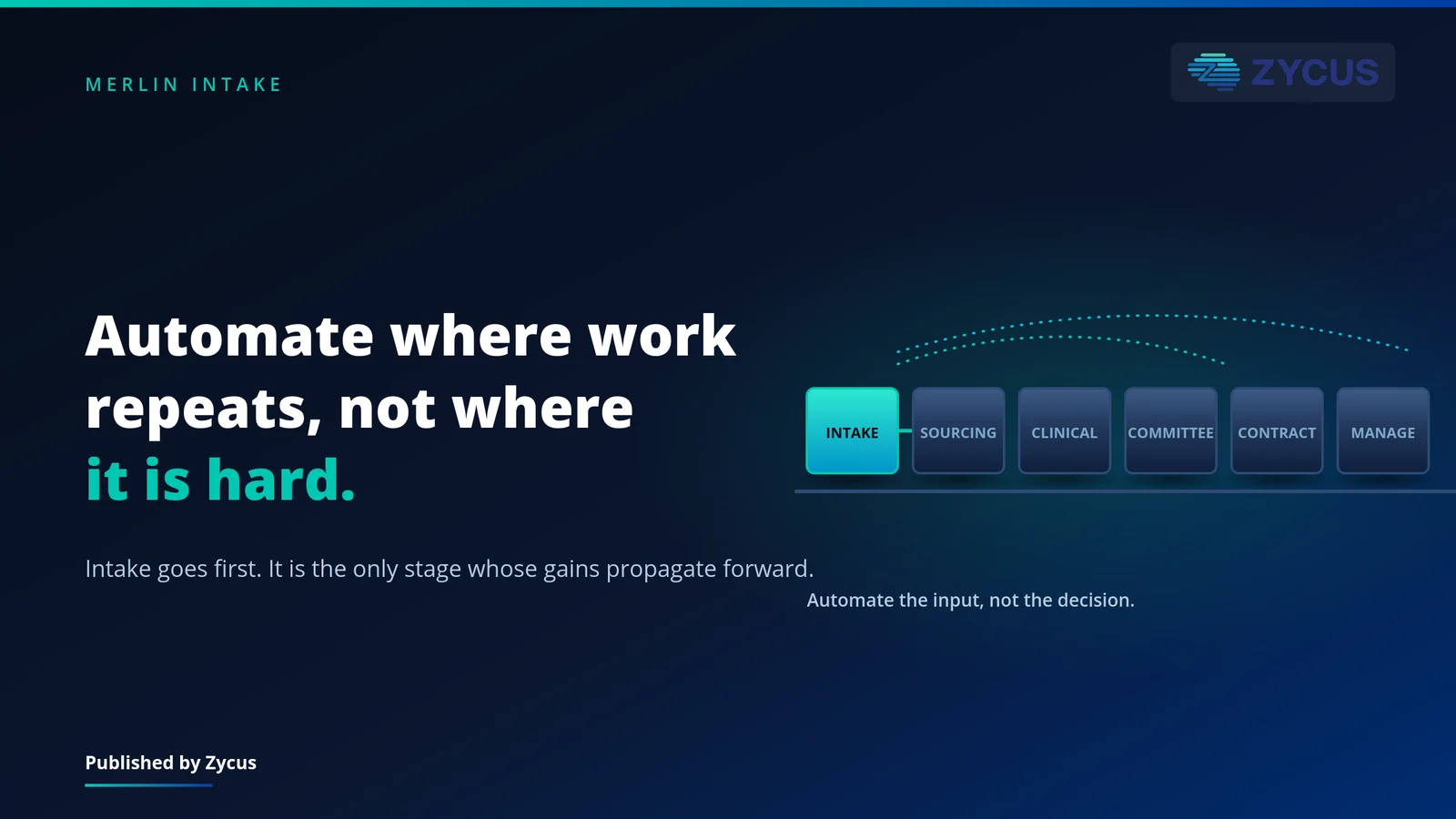
Zycus applies this through Merlin Intake within the Zycus Supplier Network, using AI-driven extraction and validation of supplier data, intelligent matching of suppliers to opportunities, and a centralized hub where procurement teams and suppliers exchange updates on purchase orders, requisitions, and approvals.
Common mistakes that stall collaboration programs
- Launching with too many suppliers. Breadth early guarantees shallowness everywhere. Depth with a few suppliers produces the evidence needed to expand.
- Treating the platform as the program. Deploying a network without agreeing objectives, metrics, and governance produces a well-instrumented version of the previous relationship.
- Measuring only cost. If cost is the only tracked outcome, cost becomes the only outcome pursued, and the innovation and resilience value never appears in any report.
- Designing without the supplier. A process designed entirely around buyer convenience will be complied with rather than used.
- Requesting transparency without offering it. Cost transparency asked for in one direction reads as a negotiating tactic, and suppliers respond accordingly.
- No executive sponsor. Cross-functional participation is the dimension that benchmarking shows companies find hardest, and it cannot be secured from within procurement alone.
How Zycus supports supplier collaboration?
The Zycus Supplier Network connects buying organizations and their suppliers on a shared platform, giving both sides a current view of purchase orders, contracts, invoices, and related documents, along with real-time updates on sourcing events such as RFPs, RFQs, and auctions. Multi-language support and AI-driven data enrichment reduce the onboarding friction that keeps smaller suppliers out of collaboration programs.
Alongside it, Zycus iRisk provides AI-assisted supplier risk monitoring, and Zycus supplier management maintains the auditable supplier record that any collaboration program depends on. Together they support the parts of the roadmap above that technology can support: shared data, faster exchange, visible performance, and an auditable history of what each party did.
The parts technology cannot supply remain the same as ever: choosing the right suppliers, agreeing how value will be shared, and governing the work.

Frequently Asked Questions
Q1. What is a supplier collaboration network?
A supplier collaboration network is a shared digital environment where a buying organization and its suppliers exchange data, plan jointly, and resolve issues from a common record. It differs from a supplier portal in that information flows in both directions and both parties contribute data the other does not already hold.
Q2. What is the difference between supplier collaboration and supplier relationship management?
Supplier relationship management is the discipline of segmenting suppliers, measuring their performance, and managing the relationship over its lifecycle. Supplier collaboration is what two organizations do together once that relationship is established: joint planning, joint innovation, joint risk management, and shared improvement. SRM tells you which suppliers merit collaboration. Collaboration is the work itself.
Q3. Is collaborative procurement the same as supplier collaboration?
No. Collaborative procurement, also called cooperative or group purchasing, involves multiple organizations or departments combining requirements to secure better terms. Supplier collaboration involves one buying organization deepening its working relationship with its suppliers. The two have different sponsors, different mechanics, and different success measures.
Q4. How can supplier collaboration networks reduce procurement risks?
By promoting better communication and real-time data exchange, these networks help identify potential risks sooner and enable more effective mitigation strategies.
Q5. What role does technology play in supplier collaboration networks?
Technology provides the shared record, moves documents and transactions between organizations, makes performance and risk visible to both sides, and increasingly automates routine coordination work through AI. It removes friction and shortens cycle times. It does not create trust, agree value-sharing terms, or govern the program, which is why technology-first collaboration programs tend to stall.
Q6. Which suppliers should we start with?
Start with suppliers where joint work can create value that neither party can produce alone, which usually means those holding critical technology, scarce capacity, or specialist capability. Spend is a poor sole criterion. Three to five relationships is a realistic first scope.
Q7. How long does a supplier collaboration program take to show results?
It varies by the type of value pursued. Coordination improvements such as faster confirmations and shorter query resolution appear within weeks of a network going live. Joint innovation and co-development typically run to product development cycles, which means quarters rather than weeks. McKinsey identifies this delay as one of the main reasons organizations abandon collaboration in favor of faster initiatives that are worth less, which is an argument for setting expectations up front rather than for lowering ambition.
Related reads:
- Blog – Collaboration in supply chain
- Blog – The Supplier Information & Performance Dossier (part 6): Case Studies
- Blog – Seven Keys to Better Sourcing & Supplier Management
- White Paper – The Ins and Outs of Supplier Networks
- White Paper – Supplier Performance Evaluation for Better Results
- Press release- Australian State Government Department Streamlines Procurement with Zycus’ Solution Suite
- Press Release- Zycus Expands its Procurement Ecosystem with Zycus Supplier Network