





Connecting modern rfp automation tools to legacy enterprise systems and specialized health networks is the key to unlocking true clinical efficiency. When sourcing teams attempt to manage complex bids using isolated software, data silos form, manual rekeying slows down contract cycles, and critical compliance checks get missed. Achieving seamless healthcare RFP software integration ensures that EHRs, ERPs, and vendor management platforms share live data effortlessly.
By building an automated sourcing workflow grounded in healthcare data interoperability in procurement, health systems can align clinical requirements with purchasing data, streamline vendor evaluations, and strengthen overall clinical procurement integration.
TL;DR
- RFP automation only pays off if it exchanges data with the systems already in place, otherwise it becomes another silo.
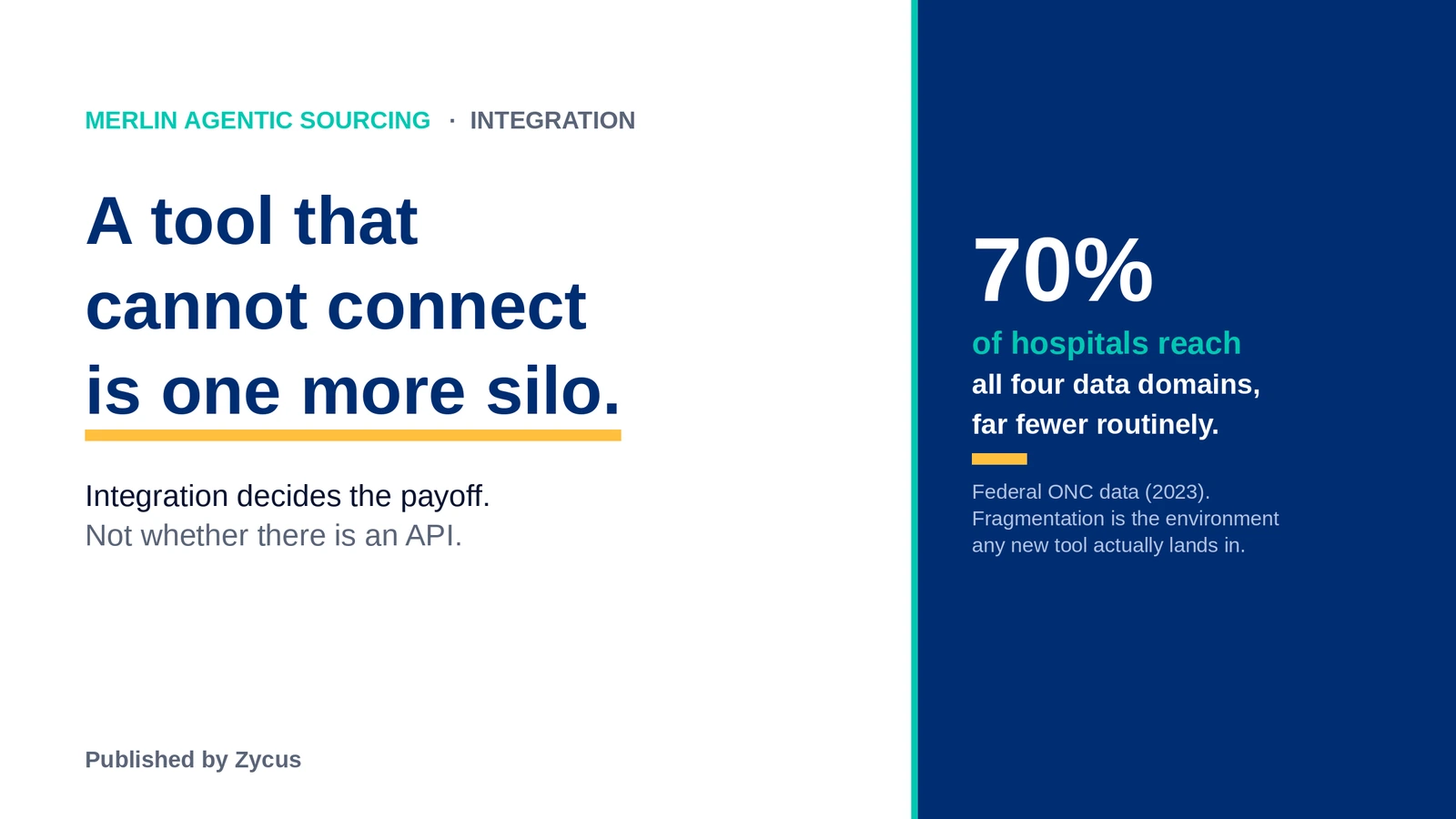
- Fragmentation is the norm in healthcare: federal ONC data shows only 70% of hospitals engaged in all four interoperability domains even sometimes as of 2023.
- Even in procurement, systems are fragmented: McKinsey found only 60% of large organizations and 30% of small ones have a procure-to-pay system in place at all.
- The right question is not whether a tool has an API, but whether it fits into your data ecosystem without creating reconciliation work.
- Merlin Autonomous Sourcing is designed to draw on the systems and data a sourcing decision depends on, rather than standing apart from them.
Automating the RFP process is only half the job. The other half is integration: whether the tool can draw on the spend, contract, and supplier data that lives in the systems your organization already runs, and whether its outputs flow back into those systems cleanly. An RFP tool that cannot do this does not remove work, it relocates it, turning saved drafting time into new reconciliation time.
Why does integration decide whether RFP automation pays off?
Because a sourcing decision depends on data the RFP tool does not itself own. The spend history lives in one system, the contracts in another, the supplier records in a third, and often several of each after years of mergers and additions. An RFP tool that cannot reach those has to be fed by hand, which reintroduces the manual work the automation was supposed to remove, and its outputs, the award, the new contract terms, then have to be keyed back into the systems that will actually use them. The time saved on drafting is spent on reconciliation instead.
Integration is what determines whether automation adds net capacity or just moves the effort from one place to another. The principle shows up in procurement’s own systems. The spend, contract, and supplier data a sourcing tool needs is typically scattered across systems and spreadsheets rather than sitting in one clean source, which is exactly why an RFP tool that cannot integrate ends up being fed by hand. Put plainly, an RFP tool is only as useful as the data it can reach and the systems it can hand its results back to, and everything else about it is secondary to that.
Read More About How to Choose the Right RFP Tool for Health Tech and Clinical Providers?
How fragmented is the healthcare data ecosystem, really?
Fragmented enough that it is measured at the national level, and the numbers are sobering. Federal ONC data shows that as of 2023 only 70% of U.S. hospitals engaged in all four domains of interoperable data exchange, finding, sending, receiving, and integrating, even sometimes, up from 23% a decade earlier, and the share doing so routinely is far lower. A health system rarely runs one clean stack. It runs many systems accumulated over time, often several versions of the same category across affiliated sites, and any new tool lands in that reality. A tool that ignores it and expects a clean single source of truth is a tool that will not fit.
Read More About How To Calculate ROI on AI-Powered Sourcing in Healthcare Procurement in 2026?
What is the difference between having an API and actually fitting a data ecosystem?
A large one. An API is necessary but nowhere near sufficient. Fitting a data ecosystem means the tool can map to the specific data the organization holds, in the formats it holds it, and can exchange it without a person translating between systems in the middle. Two tools can both advertise an API and behave completely differently in practice, one that slots into the existing data with modest configuration, and one that requires a custom integration project for every system it touches. The question a buyer should ask is not whether integration is possible but what it actually takes: which systems it connects to out of the box, how it handles the formats the organization uses, and how much of the connective work falls back on the team.
The distinction is not academic. ONC tracks integration, pulling outside records in without manual re-entry, as its own domain precisely because it is the hardest to achieve: an ONC analysis of hospitals in the late 2010s found only about 55% could electronically send, receive, find, and integrate records from outside their system. Exchanging data and integrating it without manual work are different things, which is exactly the difference between having an API and fitting a data ecosystem. The right posture is skepticism toward the word integration and specificity about what it means for your systems, because the gap between possible and practical is where budgets and timelines disappear.
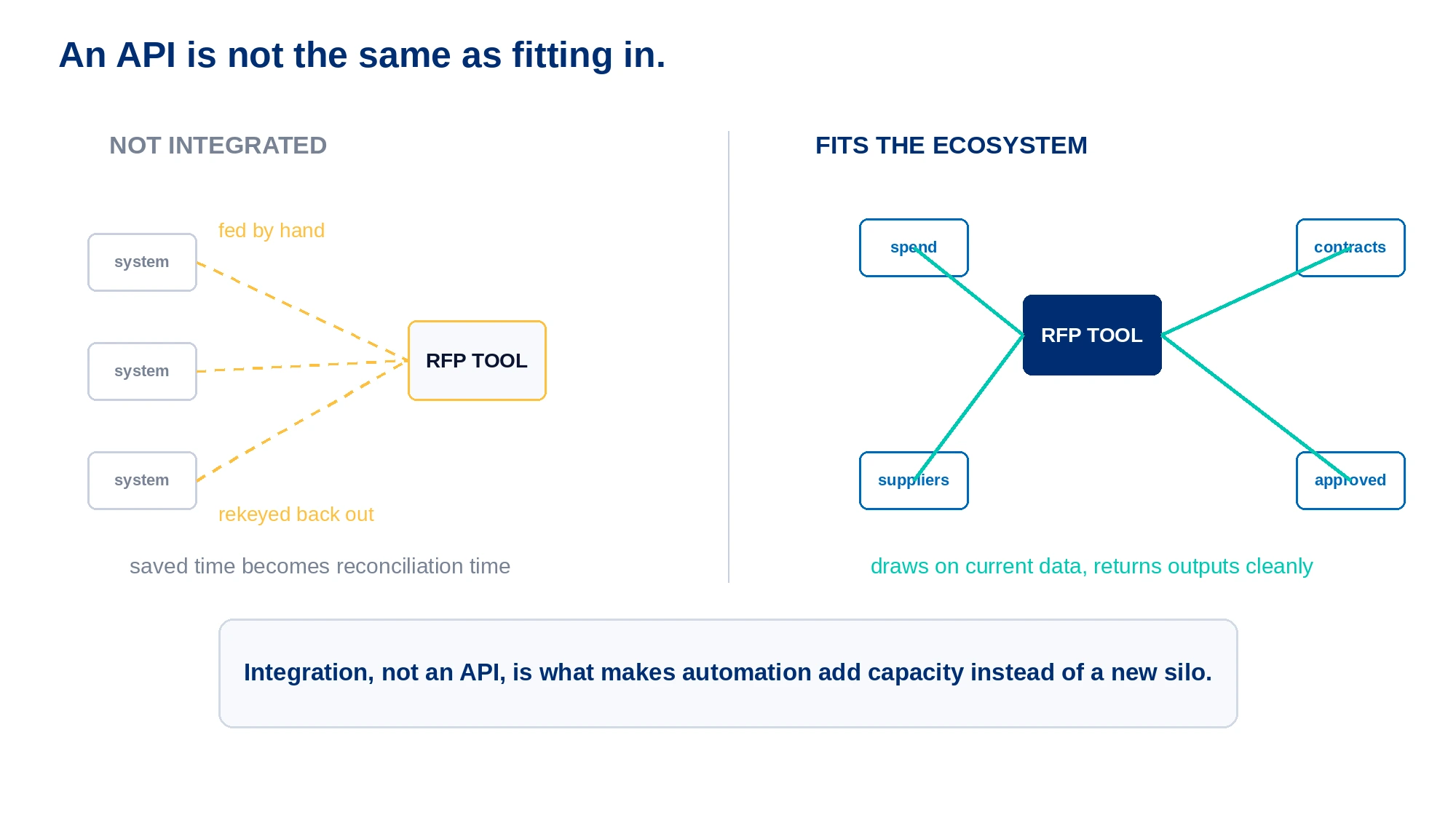
Figure 1. An API is not the same as fitting in. Left: a tool that cannot connect is fed by hand and its outputs rekeyed back out, so saved time becomes reconciliation time. Right: a tool wired into the spend, contract, and supplier systems adds capacity instead of another silo.
Where does clinical data belong in a sourcing decision, and where does it not?
This distinction matters, and overreaching on it is a real risk. Sourcing decisions legitimately draw on operational and financial data: spend, contracts, supplier performance, demand and volume information. Some of that is adjacent to clinical operations, for example the demand signals that tell a team how much of a supply a service line will need. But a sourcing tool has no business reaching into patient records, and claiming a deep clinical-data integration that does not exist is both an overpromise and a compliance hazard.
The honest position is that RFP automation should integrate with the operational and financial systems that a sourcing decision actually depends on, and with clinical data only at the specific, governed points where demand or utilization genuinely informs the sourcing, not as a blanket claim of clinical integration. Holding that line is not a limitation; it is what keeps the tool trustworthy in an environment where the boundary between operational and clinical data is one regulators watch closely.
How is autonomous sourcing designed to draw on existing systems?
By treating the sourcing decision as something that runs on the organization’s own data rather than in isolation from it. Merlin Autnomous Sourcing builds its analysis from spend and contract history, constructs should-cost models from external cost references, and qualifies suppliers against the organization’s approved-vendor and risk data. That design assumes the data lives in systems the tool must draw on, not that the tool is the system of record for all of it.
Because it is a pre-launch product, specific integration capabilities should be confirmed against your environment rather than assumed, and its performance figures are design-intent. The relevant design principle is that a sourcing agent is only as good as the data it can reach, so it is built to operate on the organization’s existing information rather than to stand apart from it as one more disconnected tool.
How do you evaluate integration before you buy?
Test it against your actual systems, not a reference architecture. Name the specific systems the tool would need to exchange data with, the spend system, the contract repository, the supplier master, and ask the vendor to show the exchange working against those, or against realistic equivalents, rather than against a clean demo environment. Ask what falls on your team versus what the tool handles. Ask how it behaves when the same supplier or category appears under different records in different systems, because that duplication is where integrations quietly break.
The goal is to surface the real integration cost before you commit, since that cost, not the license, is usually what determines whether the automation delivers. A sourcing agent cut off from the organization’s data is a fast way to produce confident, poorly-grounded recommendations, which is exactly the failure a well-integrated design is built to avoid.
Explore our Integration Ecosystem to see how effortlessly Zycus connects rfp automation with your existing ERP, EHR, and clinical data platforms.
What does good integration actually buy you?
A tool that adds capacity instead of overhead. When RFP automation draws cleanly on the systems already in place and returns its outputs to them, the drafting and analysis time it saves is net savings, not effort displaced into reconciliation. The sourcing team works from current data rather than stale exports, the award flows into the contract system without rekeying, and the organization avoids adding one more silo to the fragmentation its CIOs are already trying to reduce. Integration is not a technical footnote to an automation decision. In a healthcare data ecosystem, it is often the difference between a tool that pays for itself and one that becomes another system someone has to keep in sync by hand.
Conclusion
Bridging the gap between standalone sourcing tools and core healthcare infrastructure is essential for modern supply chain resilience. Embedding rfp automation directly into your technology ecosystem enables continuous compliance tracking, faster decision-making, and frictionless vendor onboarding. Prioritizing healthcare data interoperability in procurement alongside deep clinical procurement integration ensures your team works from a single source of truth—simplifying every automated sourcing workflow from start to finish.
Ready to break down data silos and sync your clinical sourcing across all legacy systems? Request a demo today to see how Zycus Merlin seamlessly integrates AI-powered RFP capabilities into your existing healthcare environment.
Frequently Asked Questions
Q1. Why does integration decide whether RFP automation is worth it?
Because a sourcing decision depends on spend, contract, and supplier data the RFP tool does not own. If the tool cannot reach that data, it must be fed and unloaded by hand, turning saved drafting time into new reconciliation time. Integration determines whether automation adds net capacity or just relocates the effort.
Q2. How fragmented are healthcare data systems?
Very. Federal ONC data shows only 70% of U.S. hospitals engaged in all four interoperability domains (find, send, receive, integrate) even sometimes as of 2023, up from 23% in 2014, with routine integration lagging furthest. Health systems typically run many systems accumulated over time, often several versions of the same category across sites.
Q3. Is having an API enough for a tool to fit a data ecosystem?
No. An API is necessary but not sufficient. Fitting means the tool maps to the specific data an organization holds, in its formats, and exchanges it without manual translation. Two tools can both have APIs yet differ completely, one slotting in with modest configuration, the other needing a custom project per system.
Q4. Should RFP automation integrate with clinical data?
Only at specific, governed points where demand or utilization genuinely informs sourcing. Sourcing legitimately uses operational and financial data such as spend, contracts, and demand signals, but a sourcing tool has no business reaching into patient records, and claiming a broad clinical-data integration that does not exist is both an overpromise and a compliance hazard.
Q5. How does Merlin Autonomous Sourcing use existing systems and data?
It builds analysis from spend and contract history, constructs should-cost models from external references, and qualifies suppliers against approved-vendor and risk data, assuming that data lives in systems it must draw on. As a pre-launch product, specific integration capabilities should be confirmed against your environment and its performance figures are design-intent.
Q6. How do you evaluate a tool’s integration before buying?
Test it against your actual systems, the spend system, contract repository, and supplier master, not a clean demo environment. Ask what falls on your team versus the tool, and how it behaves when the same supplier appears under different records in different systems, since that duplication is where integrations quietly break.
Q7. What does good integration buy a procurement team?
A tool that adds capacity instead of overhead. Saved drafting and analysis time becomes net savings rather than displaced reconciliation work, the team works from current data, awards flow into the contract system without rekeying, and the organization avoids adding another silo to the fragmentation it is already trying to reduce.
Q8. What is the risk of poor integration in healthcare sourcing?
It reintroduces the manual work automation was meant to remove, creates stale-data decisions, and adds one more disconnected system to an already fragmented environment. In a healthcare data ecosystem, weak integration is often the difference between a tool that pays for itself and one that has to be kept in sync by hand.