








TL;DR
- Ardent Partners declares static, annual category plans a relic. BIG Trend #8 describes the evolution into category intelligence — continuous, data-driven insight loops powered by market data, AI, and supplier signals.
- Category management is no longer a document created once a year. It is a live intelligence feed that informs daily sourcing decisions, adapts to tariff shifts and supply bottlenecks in real time, and drives long-term value creation.
- BIG Prediction #3 reinforces the shift: decision augmentation becomes the primary output from spend visibility. AI-powered systems actively recommend savings opportunities and sourcing strategies — moving procurement from “what happened” to “what should we do next.”
- The intelligence layer only works when it is embedded in a unified S2P platform — not siloed in spreadsheets or disconnected analytics tools. Native AI with access to intake, contract, supplier, and spend data produces fundamentally richer insights.
- Category managers in 2026 are not document creators. They are intelligence analysts who use external data feeds and internal demand signals to provide the business with proactive advice rather than retrospective reports.
There is a document that exists in nearly every procurement organization. It is called the category plan. It was created six months ago, possibly nine. It includes a market overview drawn from data that was current when it was compiled. It contains a supplier landscape that has probably shifted. It proposes a strategy that may or may not reflect what has happened since the plan was approved.
It sits in a shared drive. It gets reviewed quarterly, usually as a formality. It informs annual sourcing events. And between those events, it gathers dust.
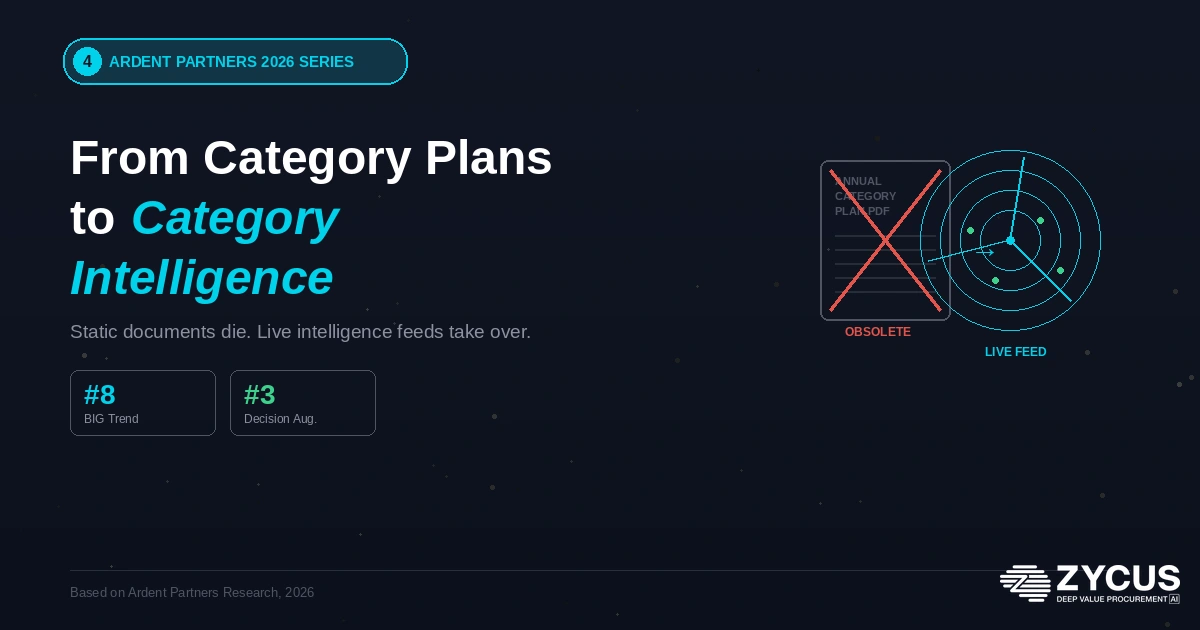
Ardent Partners’ Procurement 2026: BIG Trends and Predictions calls this model what it is: a relic. BIG Trend #8 declares that category management has evolved into category intelligence — continuous, data-driven insight loops powered by market data, AI, and supplier signals.
This shift is the natural next step from the savings transformation we explored in our previous analysis. If procurement is going to deliver precision savings against persistent inflation and across 40% of unmanaged spend, it cannot rely on strategies that were set in a document months ago. It needs intelligence that moves at the speed of the market.
From Documents to Data Feeds
The distinction between category management and category intelligence is not cosmetic. It is structural.
Category management, as most procurement teams practice it, is a planning exercise. A category manager researches a market, analyzes spend patterns, identifies opportunities, and produces a strategy document. That document is presented, approved, and then serves as the reference point for sourcing decisions over the next year. The problem is obvious: the market does not wait for the next planning cycle.
Category intelligence, as Ardent describes it, is a live feed. It adapts to price fluctuations, tariff changes, and supply bottlenecks in real time. It does not replace the category manager’s judgment — it arms that judgment with current data rather than stale analysis. The difference is between a weather report from last month and a live radar feed. Both tell you something about the climate. Only one tells you what to do right now.
Ardent’s CPO takeaway is actionable: “Replace static category documents with dynamic intelligence loops that allow for real-time strategic shifts.” This is not about working harder. It is about working with better information, delivered faster, with AI handling the data aggregation and pattern recognition that no human team can perform at the speed the 2026 market demands.
Decision Augmentation: The Death of the Passive Dashboard
Ardent reinforces this evolution with BIG Prediction #3: decision augmentation becomes the primary output from spend visibility. The era of AI simply classifying spend is over. Standard spend reports without recommendations will become obsolete.
Think about what this means in practice. Today, most spend analytics platforms tell you what happened — how much was spent, with which suppliers, in which categories. Useful, but retrospective. The category manager still needs to interpret the data, identify the opportunity, and formulate the response.
In the decision augmentation model, AI-powered spend visibility actively recommends savings opportunities, sourcing strategies, supplier actions, and the complex trade-offs involved. Procurement teams can use AI to simulate the impact of a tariff hike or a supplier disruption, receiving a list of optimized mitigation strategies. The shift moves procurement from “what happened” to “what should we do next” — and it does so continuously, not once a quarter.
For category managers, this is transformative. Instead of spending weeks compiling data for a category review, they spend their time evaluating AI-generated recommendations, applying business judgment, and engaging stakeholders with proactive advice. The intelligence does the heavy lifting. The human provides the context and the decision authority.
The Platform Foundation
Category intelligence does not exist in a vacuum. It depends on the data flowing through the procurement platform — and this is where Ardent’s BIG Trend #9 connects directly. The report predicts that procurement platforms are becoming Systems of Business Insight — where the CEO and CFO go to understand margin risk, market exposure, and ESG compliance.
When category intelligence is embedded in a unified S2P platform, it draws from every data source that matters: intake demand signals, historical spend patterns, contract terms and expiry dates, supplier performance scores, market price indices, and risk alerts. This creates a 360-degree view of a category that no standalone analytics tool can replicate.
When category intelligence is siloed in a separate tool — pulling data extracts from the S2P system, processing them externally, and pushing recommendations back — it operates on stale data with incomplete context. The recommendations lack the transactional awareness that makes them actionable. The category manager ends up cross-referencing multiple systems rather than acting on a unified intelligence feed.
Proactive Advice, Not Retrospective Reports
The report frames the role of the category manager in 2026 clearly: they are no longer document creators. They are intelligence analysts. By leveraging external data feeds and internal demand signals, category managers provide the business with proactive advice rather than retrospective reports.
This is the role that procurement has always aspired to — the trusted advisor who tells the business what is coming before it arrives, who recommends action before the opportunity closes, who understands the supply market better than anyone else in the enterprise. Category intelligence, embedded in the right platform, finally makes that aspiration operational.
But for category intelligence to serve the enterprise — not just the procurement team — it needs to live in a platform that the C-suite actually trusts and uses. And that requires a fundamental rethinking of what a procurement platform is for. As we explore next, the S2P platform in 2026 is no longer a transaction engine. It is the enterprise’s intelligence layer.
The Ardent Partners report covers the full evolution from category management to category intelligence, alongside the complete set of trends and predictions. Download Procurement 2026: BIG Trends and Predictions for the full analysis.
Continue Reading
Previous in this series: Savings Is Still the #1 CPO KPI — But the Playbook Has Changed
Next in this series: The S2P Platform Is Now the C-Suite’s Intelligence Layer
FAQs
Q1. What is category intelligence in procurement?
Category intelligence is the evolution of traditional category management from static, annual planning documents into continuous, data-driven insight loops. Powered by market data, AI, and real-time supplier signals, it creates a live intelligence feed that informs daily sourcing decisions and adapts to price fluctuations, tariff changes, and supply disruptions as they happen — rather than waiting for the next quarterly review.
Q2. Why are static category plans no longer effective?
Static category plans are typically created once a year using data that is current at the time of compilation. By the time the plan is approved and implemented, market conditions, supplier dynamics, and cost structures may have shifted significantly. In a 2026 environment characterized by persistent inflation, tariff volatility, and supply chain disruption, strategies set months in advance cannot keep pace with the speed of change.
Q3. What does decision augmentation mean for spend analytics?
Ardent Partners predicts that decision augmentation will become the primary output from spend visibility in 2026. This means AI-powered spend analytics will move beyond classifying and reporting historical spend to actively recommending savings opportunities, sourcing strategies, and mitigation actions. Procurement teams can simulate tariff impacts or supplier disruptions and receive optimized response strategies — shifting from “what happened” to “what should we do next.”
Q4. How does a unified S2P platform improve category intelligence?
When category intelligence is embedded in a unified S2P platform, it draws from all relevant data sources in real time: intake demand signals, spend history, contract terms, supplier performance, market indices, and risk alerts. This creates a comprehensive view that no standalone analytics tool can replicate. Siloed tools operating on data extracts lack the transactional context needed to make recommendations genuinely actionable.
Q5. How does the category manager’s role change with category intelligence?
Category managers in 2026 shift from document creators to intelligence analysts. Instead of spending weeks compiling data for category reviews, they evaluate AI-generated recommendations, apply business judgment, and provide proactive advice to stakeholders. The intelligence layer handles data aggregation and pattern recognition at speed, while the human provides strategic context and decision authority.
Q5. How does category intelligence connect to savings in 2026?
Category intelligence directly enables the precision savings approach that Ardent Partners describes. By providing real-time visibility into market prices, supplier cost structures, and demand patterns, it allows procurement to identify and act on savings opportunities as they emerge — not months later during an annual review. This continuous intelligence loop is essential for fighting the persistent inflation and supplier mini-escalators that characterize the 2026 cost environment.
Related Reads: