





TL;DR
- Creating a single agent is an engineering task. Getting multiple agents to share context, route exceptions, and produce a single auditable output is a systems design problem of a fundamentally different order.
- The reason coordination gets harder with every agent added is concrete: every new agent creates connections to every existing agent, and each connection can break, drift, or conflict independently.
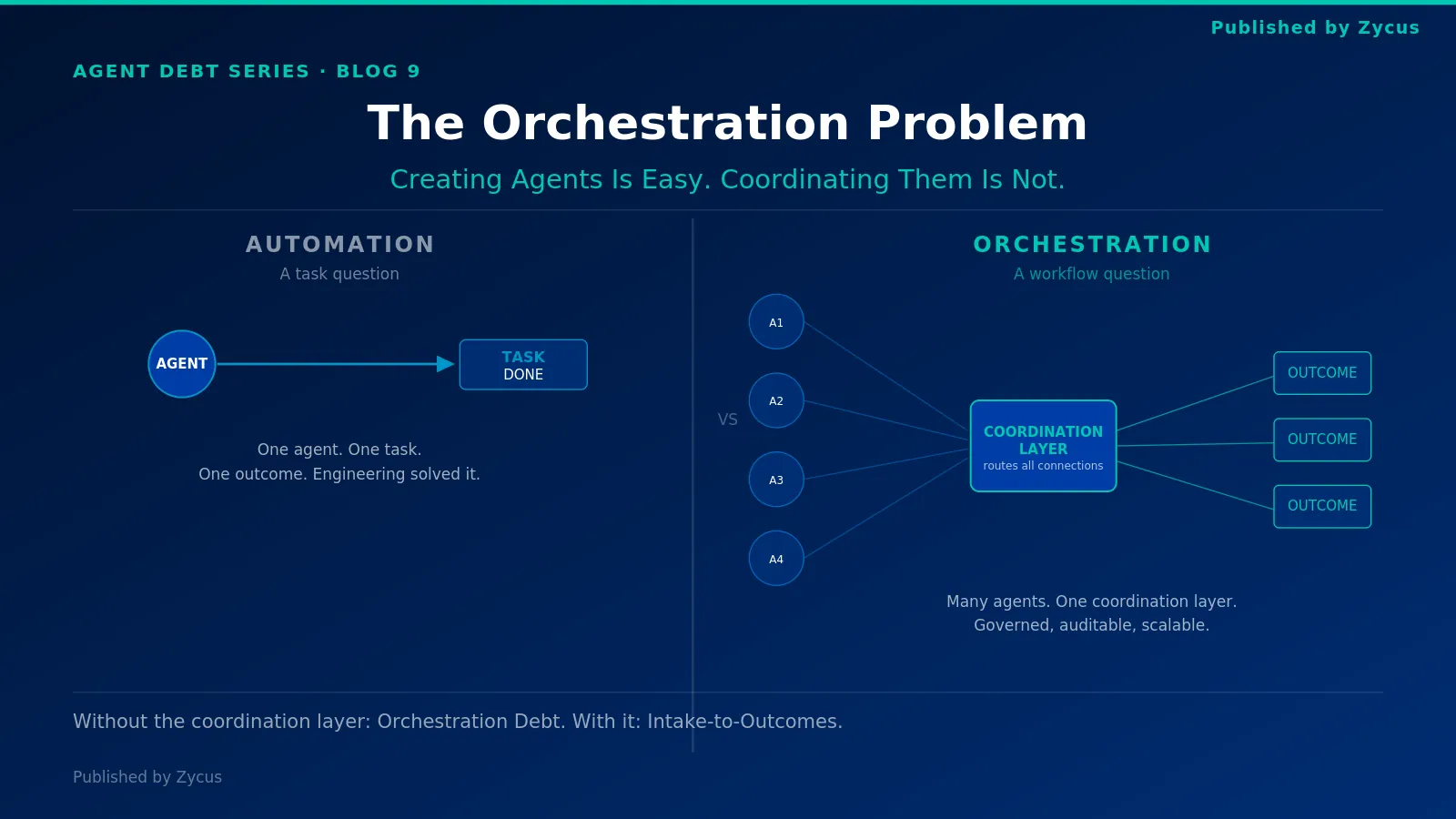
- The difference between automation and orchestration is the difference between a task question and a workflow question. Most studio vendors sell automation and call it orchestration.
- Uncoordinated orchestration generates Orchestration Debt: a maintenance burden that grows faster than the estate and becomes the primary job of the team managing it.
- The architectural answer is a coordination layer above the agents that routes all connections through one place rather than managing them point-to-point across the estate.
- See how the Merlin Agentic AI Platform resolves the coordination problem by design through the Intake-to-Outcomes architecture.
The foundational Agent Debt piece established the mechanism. The CPO self-assessment provided the diagnostic. The studio teardown identified where debt originates. The four debt types named the dimensions, including Orchestration Debt specifically. The technical debt comparison explained why Agent Debt compounds faster. The agent count metric showed what drives accumulation. The prevention blog described the coordination protocol decision. The paydown blog addressed how to retrofit it. The agent washing blog showed how to identify whether a vendor’s coordination claims are real. This blog addresses what the coordination problem actually is, why it grows the way it does, and what resolves it architecturally.
Agent Debt is the compounding operational liability an enterprise takes on when it deploys task-doing AI agents faster than it can govern, orchestrate, and tie them to business outcomes. Orchestration Debt is the specific type that accumulates when agents are deployed without a coordination layer. It is the most common type, the one that surprises organizations most, and the one that becomes the maintenance team’s primary job if left unaddressed.
Why does adding the fifth agent feel harder than adding the first?
The first agent is a contained deployment: one task, one set of inputs, one set of outputs. The second requires some coordination with the first, but the relationship is bilateral and manageable. The third is where the pattern shifts: three bilateral relationships, and an exception in any one can affect the other two. By the fifth agent, the coordination work is no longer a side task. By the tenth, it has become the job. This is not a failure of execution. It is what happens when an estate grows without a coordination layer. The question is not why the fifth agent is harder, but what exactly is growing each time a new agent is added.
What is actually growing with every agent added?
Every new agent creates a connection to every existing agent. At two agents, there is one connection. At five, there are ten. At ten, forty-five. At fifty, more than one thousand. Each of those connections can break, drift, or produce conflicting outputs independently of the others. Adding the fiftieth agent does not add one new thing to maintain. It adds forty-nine new connections, each requiring its own coordination, exception handling, and context sharing. If those connections are managed point-to-point, the maintenance burden grows with each addition.
“By 2029, IDC forecasts that enterprises will collectively run more than one billion AI agents, reshaping how organizations design infrastructure and operations.” (IDC, Agent Adoption: The IT Industry’s Next Great Inflection Point)
The organizations now building coordination infrastructure will have a structural edge over those managing point-to-point connections at that scale.
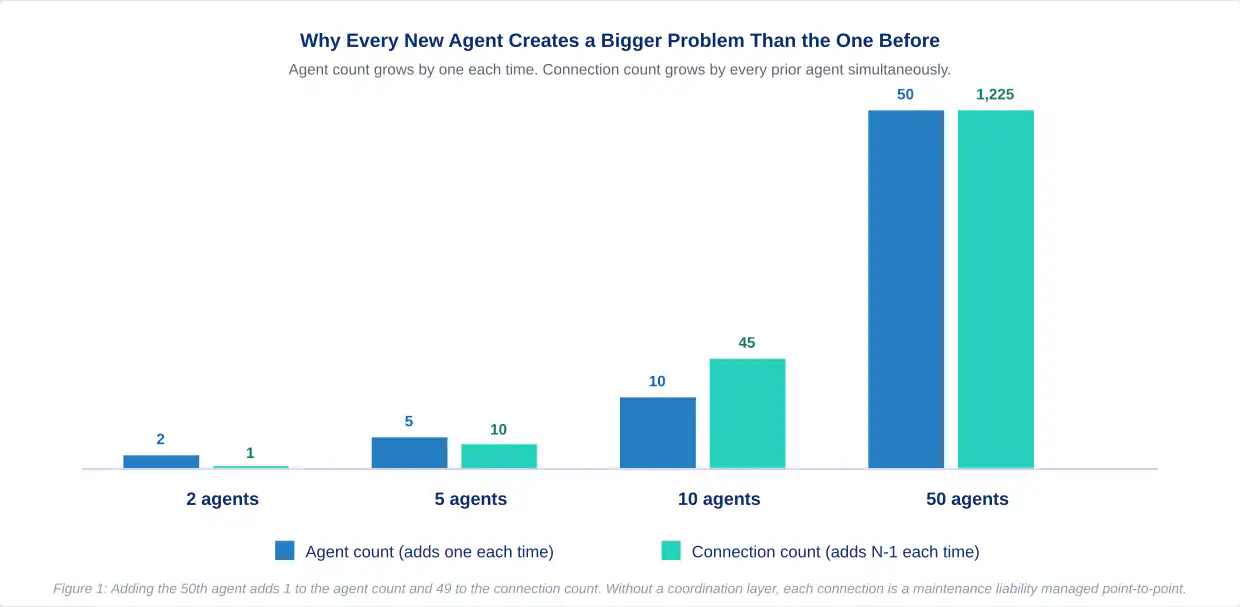
Figure 1. Connection count versus agent count: connections grow faster than the estate, becoming the primary maintenance burden.
Where does the connection problem show up in a live procurement estate?
Three scenarios, each recognizable without a technical explanation. A sourcing agent and a contract agent process the same supplier in the same hour and reach different conclusions about supplier risk. Which output does the category manager act on? A request intake agent routes a complex purchase to three downstream agents, one of which is in exception because its data source has changed. Does the intake agent know? Does the request stall, route to a fallback, or complete with incorrect inputs? A senior leader asks why a decision about a strategic supplier was made six months ago. Five agents were involved. Which one is responsible? Which one holds the record? If these questions require engineering involvement, manual reconstruction, or have no answer, Orchestration Debt is already compounding.
What is the difference between automation and orchestration?
Automation asks a task question: can this specific action be performed without a human? One agent, one task, clear output. This has an engineering solution. Orchestration asks a workflow question: can this sequence of tasks share context across agents, handle exceptions at the right level without human configuration per exception, and produce a single accountable output that any stakeholder can trace? This question does not have an engineering solution. It requires an architectural one.
“Eighty-five percent of companies expect to customize agents to fit the unique needs of their business.” (Deloitte State of AI in the Enterprise 2026, N=3,235)
Customization at that scale without a coordination layer produces estates where each agent reflects a unique configuration that no other agent was designed to integrate with. The result is an automated estate with the appearance of orchestration.
What does uncoordinated orchestration cost a procurement estate?
Three costs, each scaling with the connection count. Exception handling volume rises because every uncoordinated connection is a potential exception source, and the volume grows faster than the team can absorb. Integration maintenance grows because each point-to-point connection requires updating whenever either connected agent changes. Governance gaps widen because each connection is a decision boundary with no platform-level log. At fifty agents with custom connections, these three costs represent the dominant maintenance burden of the estate.
“Organizations can achieve a 75 percent performance advantage over Hackett industry peer groups through process-led AI transformation.” (Hackett Group, AI World Class Benchmarks, May 2026)
Process-led transformation assumes the process has a coordination layer. Without one, the performance gap compounds with every agent added rather than closing with it.
What does a properly orchestrated estate look like, and what does it make possible?
Every agent connection is mediated by the coordination layer. When a sourcing agent and a contract agent process the same supplier, the coordination layer sees both, surfaces the conflict, and routes it to the right owner by policy. When an intake agent routes to agents that include one in exception, the coordination layer routes accordingly. When a stakeholder asks why a decision was made, the coordination layer holds the record. What this makes possible: adding the fiftieth agent adds one new connection to the coordination layer, not forty-nine new point-to-point integrations. The estate can grow without the maintenance burden growing at the same rate.
How does the Merlin Agentic AI Platform resolve the coordination problem by design?
The Merlin Agentic AI Platform is built around the Intake-to-Outcomes architecture, where the coordination layer is the structural foundation rather than a configuration choice. Every agent operates within the coordination layer. Context is shared at the platform level. Exceptions route by policy. The connection problem is not eliminated as the estate grows; it is managed centrally rather than point-to-point. Isolated agents do tasks. Zycus delivers Intake to Outcomes.
Published by Zycus
The orchestration problem is not a scaling challenge. It is an architectural choice made before the first agent deploys. The Merlin Agentic AI Platform makes the coordination layer structural so that the estate can grow without the connection problem compounding with it.
Read the series: What is Agent Debt? · The CPO Self-Assessment · What 50+ Agents Actually Means · The Four Types · Agent Debt vs Technical Debt · Why Agent Count Is Wrong · How to Prevent Agent Debt · How to Pay Down Agent Debt · What Is Agent Washing · Beyond the Hype (Whitepaper)
FAQs
Q1. Why does the orchestration problem not appear with the first or second agent?
With one agent there are no connections to manage. With two, there is one bilateral relationship, which is manageable. The problem surfaces structurally at three or four agents, when the number of relationships and the complexity of shared context starts to require decisions that were not made at deployment. Most organizations do not plan for orchestration at the point of the first or second deployment because the problem has not appeared yet. By the time it does, the estate is larger and harder to retrofit.
Q2. Is there a number of agents at which orchestration becomes critical?
There is no universal threshold, but the structural shift typically becomes visible between three and five agents in a shared workflow. The more relevant indicator is not the count of agents but the count of point-to-point connections between them that are currently custom rather than platform-mediated. One custom connection is manageable. Ten is a maintenance backlog. Fifty is Orchestration Debt at a level that constrains estate growth.
Q3. Can orchestration be added after the estate is already large?
Yes, through the paydown sequence in B7: audit existing agent-to-agent connections, classify by risk, and migrate the highest-risk connections to platform-mediated coordination first. The cost and residual debt of this approach are higher than building the coordination layer before deployment, but the paydown is achievable. The key constraint is that the coordination audit requires a decision log to be accurate, which means Governance Debt must be addressed first.
Q4. What is the difference between a coordination layer and an orchestration framework?
An orchestration framework is a developer tool for building multi-agent systems. It provides the communication plumbing. A coordination layer is a business-level architectural component that governs how agents interact: routing exceptions, maintaining shared context, enforcing governance policy across agent interactions, and logging decisions at the platform level. Orchestration frameworks solve the communication problem. They do not solve the governance, auditability, or accountability problems that arise when agents make consequential business decisions.
Q5. How does the connection growth problem relate to the four Agent Debt types?
The connection growth problem is the mechanism through which Orchestration Debt accumulates. Each point-to-point connection without a coordination protocol is a unit of Orchestration Debt. Growing exception volume creates Maintenance Debt as monitoring tries to keep pace with an expanding failure surface. The governance gap at each connection boundary creates Governance Debt as the decision surface grows faster than audit infrastructure. The knowledge of how each custom connection works concentrates in the individuals who built it, creating Talent Debt. The connection problem generates all four types simultaneously.
Q6. What procurement workflows are most affected by uncoordinated orchestration?
Workflows where multiple agents touch the same data object in the same time window carry the highest exposure: sourcing and contract agents processing the same supplier, intake agents routing to downstream agents including one in exception, and approval agents whose decisions depend on outputs from multiple upstream agents. Strategic sourcing workflows are particularly affected because the decisions are consequential and the data dependencies are complex. Tail spend workflows are often less affected because each transaction is more independent.
Q7. How does the Intake-to-Outcomes architecture resolve the orchestration problem?
The Intake-to-Outcomes architecture defines the workflow outcome first and then determines which agents are needed to achieve it. Coordination relationships between agents are determined by the workflow definition rather than built custom per deployment. The coordination layer manages those relationships at the platform level: shared context persists across agent handoffs, exceptions route to defined owners by policy, and the full decision trace is available for any decision in the workflow. The connection problem is still present in terms of interaction count. What changes is that all interactions are managed centrally rather than point-to-point.
Q8. Why is the orchestration problem harder than the creation problem?
Creating an agent requires solving a task problem with a defined scope: what is the input, what logic applies, what is the output. Orchestrating agents requires solving a systems problem with no defined scope: how do multiple agents share context without conflicting outputs, how do exceptions route across agent boundaries, how does accountability work when a decision spans multiple agents, and how does the governance record reflect the full workflow. Systems problems expand with the complexity of the estate. That is why the orchestration problem appears gradually and is rarely recognized until it has become the dominant maintenance challenge.
Related Reads:
- Agent Debt: The Tech Debt of the Agentic Era
- Do You Have Agent Debt? A CPO’s Self-Assessment
- What Does “50+ Agents Out of the Box” Actually Mean for Procurement AI?
- What Are the Four Types of Agent Debt, and When Does Each One Surface?
- Whitepaper: Beyond the Hype: Agent Studio vs. Enterprise Agentic AI
- From Co-Pilots to Commanders: How Agentic AI is Redefining Procurement Transformation
- AI Agents in Procurement: A Comprehensive Guide
- Why Is Agent Count the Wrong Metric for Procurement AI, and What Should Replace It?
- How Do You Pay Down Agent Debt? The Sequence That Makes It Possible