





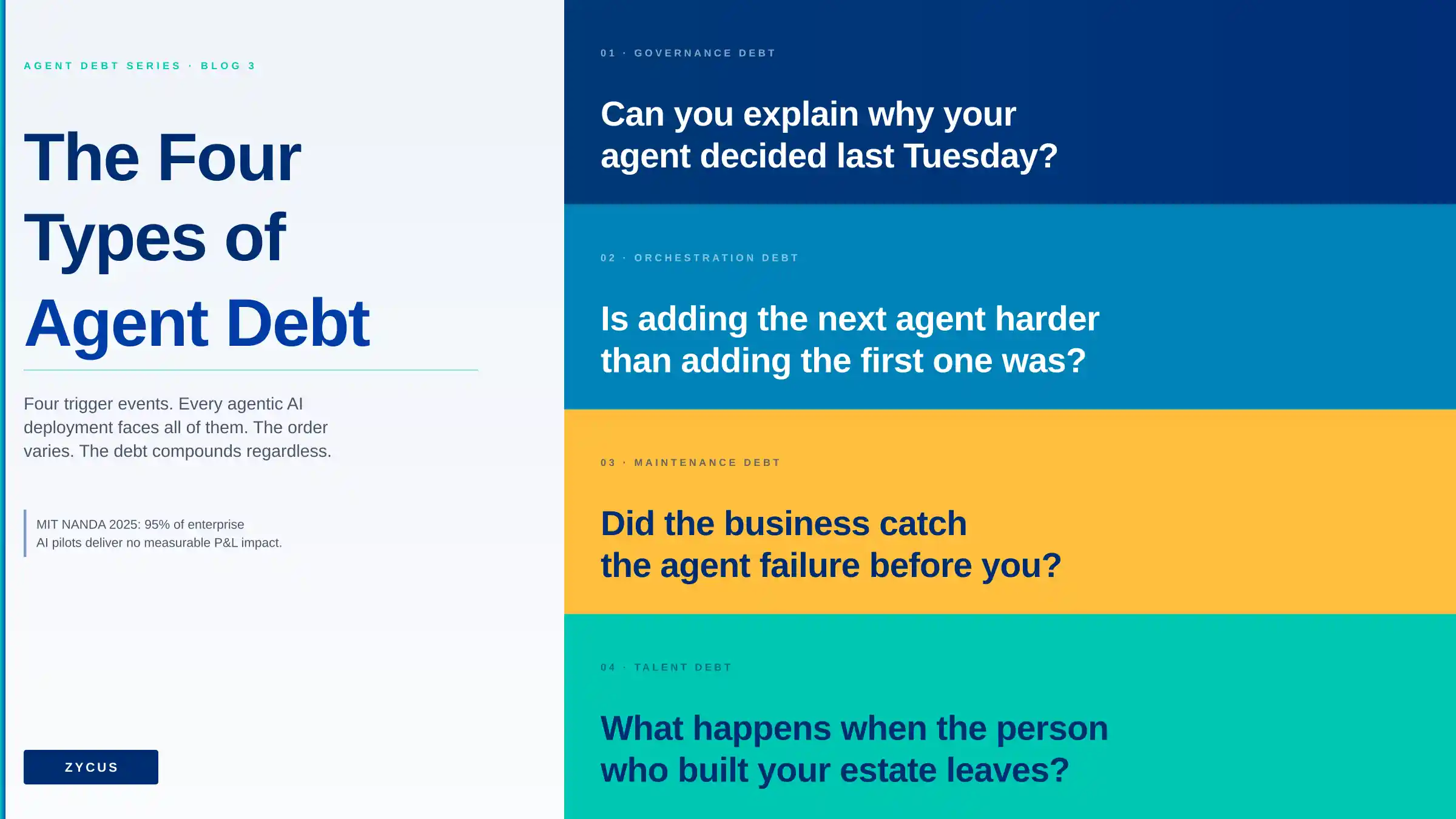

Four trigger events. Every agentic AI deployment faces all of them. The order varies, but none can be skipped. At each one, a single question either has an answer or it does not.
TL;DR
- Agent Debt accumulates across four dimensions. Each has a trigger event that forces the question. By the time it does, the debt has usually been active for months.
- Governance Debt surfaces at the first audit request. If you cannot reconstruct a specific agent decision in under ten minutes, the debt is already present.
- Orchestration Debt surfaces when adding the next agent costs more than the last one did. Integration complexity grows non-linearly without a coordination layer.
- Maintenance Debt surfaces when the business reports a problem before your monitoring system does. Silent regression is the signature failure mode.
- Talent Debt surfaces when the person who built your most complex agent becomes unavailable. Knowledge was in the person, not the platform.
- Download Beyond the Hype: Agent Studios vs. Enterprise Agentic AI for the full architectural analysis of all four debt dimensions.
The foundational Agent Debt piece established the concept. The CPO self-assessment established the diagnostic. The studio teardown identified their source. This blog names all four dimensions and the trigger event that exposes each one.
Agent Debt is the compounding operational liability an enterprise takes on when it deploys task-doing AI agents faster than it can govern, orchestrate, and tie them to business outcomes. The four types below are its structural components.
Why does Agent Debt surface differently in every deployment, and why does it always surface?
The trigger events arrive in different orders. A deployment that begins with aggressive agent proliferation will encounter Orchestration Debt first. A deployment in a heavily audited sector will encounter Governance Debt first. A deployment that relies on a single experienced architect will encounter Talent Debt earliest. The sequence is not fixed.
But all four arrive. Agents built without shared governance, a centralized orchestration layer, persistent shared context, or platform-embedded knowledge will accumulate all four types over time.
MIT’s NANDA initiative found that 95% of enterprise AI pilots deliver no measurable P&L impact, despite $30-40 billion invested. The four types of Agent Debt are the mechanism behind that number. Not capability failure. Architectural failure.
When your auditor asks why an agent made a specific decision last Tuesday, can you answer?
Governance Debt accumulates when agents produce activity records but not decision records: which policy applied, what logic was invoked, what data the agent read at the moment of the decision.
The trigger event is the first serious audit request. In a governed estate, answering takes minutes. In an ungoverned one, it takes an engineering sprint to reconstruct, and the answer is still a guess.
Three indicators that Governance Debt is already present:
Decision logs: Your agents produce completion records but not reasoning records. You can see what they did; you cannot reconstruct why.
Policy propagation: A policy change requires manual updates to each agent individually. There is no centralized policy layer.
Audit reconstruction: Tracing a specific agent decision requires engineering effort, not a query.
KPMG’s Q4 2025 AI Pulse Survey found that 75% of large enterprise leaders cite security, compliance, and auditability as the most critical requirements for agent deployment. The majority of enterprises name the problem. Fewer have the architecture to solve it.
Is adding the next agent to your estate harder than adding the first one was?
Orchestration Debt is the structural consequence of building an agent estate without a coordination layer. In a governed platform, a new agent extends the existing framework. In a studio, it must be wired individually to every agent it may interact with.
The trigger event is when the integration backlog starts growing faster than the deployment queue. At some point, the coordination cost of the next agent exceeds the value it delivers.
Three indicators that Orchestration Debt is accumulating:
- Integration cost escalation: Each new agent requires more integration work than the last. The estate is described internally as brittle or delicate.
- Exception ownership: Cross-agent failures have no platform owner. Human intervention is required each time.
- Context fragmentation: Agents that should share supplier, contract, or policy data are working from different cached states. The same supplier can appear differently to two agents simultaneously.
Did you learn about your last agent performance regression from your monitoring system or from the business?
Maintenance Debt accumulates silently. Agents continue to run. Their output quality degrades incrementally through prompt drift, model update side effects, data inconsistencies introduced by upstream system changes. None of these events produces a visible failure. The agent passes its operational checks and keeps executing.
The trigger event is the first time the business reports a problem your monitoring system did not catch. A category manager notices sourcing recommendations have been off for three weeks. An invoice agent has been misrouting exceptions since the last model update. No alert fired.
Three indicators that Maintenance Debt is present:
- Reactive detection: Agent performance issues surface through business complaints or downstream errors, not monitoring alerts.
- Re-tuning cycles: Manual prompt re-tuning and agent re-testing appear as recurring engineering work after every vendor model update.
- Re-validation burden: When any significant upstream data or system changes, the engineering team must manually verify each affected agent still behaves correctly.
The Hackett Group’s 2025 Key Issues Study found that procurement workloads are projected to increase 10% while budgets grow just 1%, a 9% efficiency gap that Maintenance Debt widens from inside: degrading agent quality in a team already constrained.
If the person who built your most complex agent left tomorrow, what would you lose?
Talent Debt is the most invisible of the four types because it has no operational signature before the departure event. The agent runs correctly. The output is fine. The dashboard is green. The knowledge required to maintain, extend, or modify the agent is held entirely by one person, and that person is still in the seat.
The trigger event is departure, transfer, or extended absence. When it arrives, the organization discovers that the documented understanding of the estate is thinner than anyone assumed. Runbooks are incomplete. Configuration decisions were verbal. The vendor’s engineers become the de facto operations team.
Three indicators that Talent Debt is present:
- Knowledge concentration: One person or a small team holds the operational understanding of the agent estate. There is no documented runbook for the most critical agents.
- Vendor dependency: The vendor’s forward-deployed engineers are the effective operations team for anything beyond basic configuration.
- Onboarding cost: Bringing someone new up to operating capability takes months, not days.
Talent Debt is not a talent problem. It is architectural. Knowledge concentrates in people when the platform cannot embed it. A governed platform embeds operating logic structurally. A studio externalizes it to operators.
Why do the four types of Agent Debt compound rather than simply add?
Each type makes the others harder to address. Governance Debt forces emergency Orchestration work, which expands the surface Maintenance must cover. Maintenance burden concentrates knowledge in specialists, creating Talent Debt. Talent Debt prevents systematic Governance resolution because the people who understand the estate’s decision logic are the only ones who can reconstruct it. The cycle is closed and self-reinforcing.
Agents are cheap. The space between them is expensive. The four types of Agent Debt are what lives in that space.
What does a governed platform produce at each trigger event that a studio cannot?
- At the Governance trigger: centralized audit-ready decision lineage, produced structurally, accessible without engineering effort.
- At the Orchestration trigger: a shared coordination layer each new agent extends rather than a new point-to-point integration it must establish.
- At the Maintenance trigger: monitoring infrastructure that surfaces regressions proactively, before the business reports them.
- At the Talent trigger: operating logic embedded in the platform, not held by the people who built it.
The Merlin Agentic AI Platform is built on this architectural starting point. Agents are embedded in governed Intake-to-Outcomes workflows from day one. This is the architectural starting point from which the four trigger events arrive with answers rather than debt. The trigger events do not disappear. What changes is whether the organization can respond to them without an engineering crisis.
Beyond the Hype: Agent Studios vs. Enterprise Agentic AI. The full architectural analysis of all four Agent Debt dimensions and the governed alternative. Published by Zycus. → Download the whitepaper
FAQs
Q1. What is Governance Debt in an agentic AI deployment?
Governance Debt accumulates when agents make decisions without producing auditable records of why those decisions were made. In practice, it means the organization can describe what agents did but not why they did it, which policy applied, or whether that policy was current at the time. Governance Debt surfaces visibly at audit time. By then, it has typically been accumulating since the first agent was deployed.
Q2. What is Orchestration Debt and how is it different from ordinary integration complexity?
Ordinary integration complexity is linear: each new system adds a defined integration effort. Orchestration Debt is different because it is non-linear: in an ungoverned agent estate, the integration surface grows with the square of the agent count, not linearly with it. Each new agent creates potential coordination requirements with every existing agent. The reason is architectural: without a centralized orchestration layer, every agent must be individually wired to every other agent it may need to interact with.
Q3. What is Maintenance Debt in the context of AI agents?
Maintenance Debt is the engineering tax imposed when agents degrade silently. Prompt drift, model updates, and data inconsistencies cause agents to produce increasingly divergent outputs over time without any visible failure event. Organizations accumulate Maintenance Debt when they rely on the business to report problems rather than monitoring systems to detect them. In a governed platform, maintenance is systematic. In a studio, it is reactive.
Q4. What is Talent Debt and why is it the hardest type to detect?
Talent Debt is hard to detect because it has no failure event until someone leaves, transfers, or becomes unavailable. The knowledge that makes a complex agent estate function concentrates in the people who built and maintain it, not in the platform. A platform with strong Talent Debt looks fine on every dashboard until the departure event. Then the organization discovers that the documented understanding of the estate is far thinner than anyone assumed.
Q5. Which type of Agent Debt typically surfaces first?
It varies by deployment pattern. Governance Debt typically surfaces first in organizations with strong audit functions, because the first serious audit request exposes the absence of auditable decision records immediately. Orchestration Debt typically surfaces first in organizations that deploy agents aggressively, because integration complexity becomes visible when the queue starts growing faster than the deployment rate. Maintenance Debt and Talent Debt surface later, but the order of their appearance does not reflect the order in which they began accumulating.
Q6. Can Agent Debt be paid down without replacing the underlying platform?
Some types can be partially addressed. Governance Debt can be reduced by retrofitting logging and audit layers onto existing agents, though this creates technical debt of its own and rarely produces genuinely audit-ready records. Orchestration Debt is harder to pay down incrementally because it is a structural property of how the estate was designed, not a configuration issue. Maintenance and Talent Debt can be partially addressed through documentation and monitoring investment, but the underlying architecture continues to generate them unless the architectural starting point changes.
Q7. Can Agent Debt compounding be stopped once it has started, or does it require a full platform reset?
Some compounding can be interrupted without a full platform reset, but it depends on which type is dominant. Governance Debt can be partially addressed by retrofitting audit layers, though this creates its own technical debt. Orchestration Debt is the hardest to reverse incrementally because it is structural: a property of how the estate was designed, not a configuration choice. Maintenance and Talent Debt can be reduced through documentation and monitoring investment, but as long as the underlying platform continues generating them, the paydown is permanent overhead. The architectural reset is not required in every case, but it is the only path that stops generating new debt rather than managing the accumulation of existing debt.
Q8. What procurement workflows accumulate Agent Debt fastest?
Tail spend automation accumulates Orchestration Debt quickly, because tail spend typically involves high agent count and complex exception routing across suppliers, categories, and thresholds. Contract review agents accumulate Governance Debt fast, because contract decisions carry legal accountability that audit teams will scrutinize. Supplier onboarding agents accumulate Maintenance Debt rapidly, because supplier data is high-velocity and agents that do not share persistent context diverge quickly. Any workflow where one person built and maintains the agent in production is a Talent Debt concentration risk.
Related Reads:
- Agent Debt: The Tech Debt of the Agentic Era
- Do You Have Agent Debt? A CPO’s Self-Assessment
- What Does “50+ Agents Out of the Box” Actually Mean for Procurement AI?
- Whitepaper: Beyond the Hype: Agent Studio vs. Enterprise Agentic AI
- From Co-Pilots to Commanders: How Agentic AI is Redefining Procurement Transformation
- AI Agents in Procurement: A Comprehensive Guide